Demonstrators during a ‘Kill The Bill’ protest against The Police, Crime, Sentencing and Courts Bill in London, January 15, 2022
LABOUR was urged today to scrap Tory anti-protest laws and reject harmful rhetoric used to stigmatise peaceful demonstrations.
Peace, pro-Palestine, environmental and civil liberties groups called on ministers to champion the rights to free speech by repealing the draconian legislation aimed at silencing dissent.
Amnesty International led the calls as it published a new report warning of an increasingly wide range of means to quash peaceful demonstrations and silence free speech across Europe.
It called on Home Secretary Yvette Cooper to urgently scrap the public order elements of the Police, Crime, Sentencing and Courts Act as well as the entirety of the Public Order Act and the Serious Disruption Regulations.
Kerry Moscogiuri, of Amnesty International UK, said: “The new government must seize this moment to halt the alarming march towards repression in the UK by repealing the anti-protest laws pushed through by the previous government and ending the harmful rhetoric being used to stigmatise those who peacefully protest.
From nationalising public services, taxes on the rich, dropping tuition fees to green investment, the new PM’s abandoned promises raise doubts about Labour’s real commitment to its promises for ‘change,’ writes PETER KENWORTHY
…
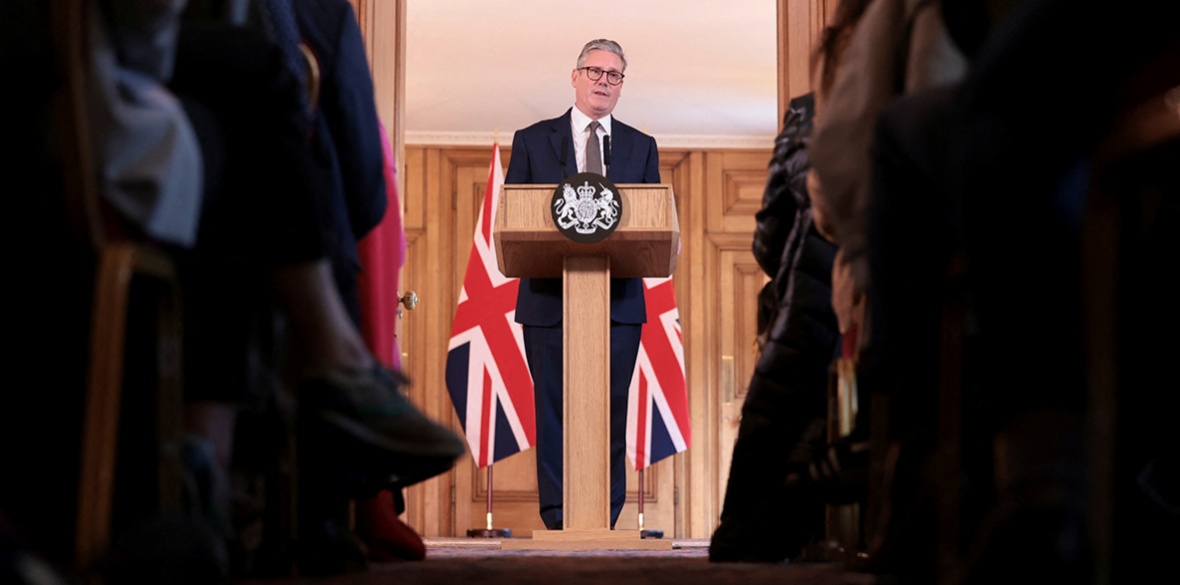
And the new PM, Labour’s Keir Starmer, has also done his fair share of U-turning. Starmer, among other things, pledged and promised to “increase income tax for the top 5 per cent earners” in 2020, during the Labour leadership election — “I will maintain our radical values [ … ] no stepping back from our core principles” as he added in the pledges. Only for him to back away from tax rises.
“We are in a different situation now, because obviously I think we’ve got the highest tax burden since World War II,” he told the BBC in May, when asked about this policy pledge.
Starmer has also essentially abandoned several other pledges, such as to nationalise public services like mail and water companies and the abolition of university tuition fees, among other of his 10 pledges from 2020.
“We are likely to move on from that commitment, because we do find ourselves in a different financial situation,” he told the BBC when asked about tuition fees.
More cake
Labour’s so-called “missions” for Britain (a “long-term plan to get Britain’s future back” that “will drive forward a Labour government”) instead include sticking “tough fiscal rules with economic stability at their heart.”
…
If the new PM really wants to turn Britain around and keep his political momentum, he will need more than economic stability, growing cakes and political dilly dallying, however. He will need to improve the lives of ordinary people, as well as keep his promises, principles and integrity.
But Labour’s election manifesto does not even contain the sort of spending plans needed to protect public services from future cuts, the Institute for Fiscal Studies says in a response to the manifesto.
“Delivering genuine change will almost certainly also require putting actual resources on the table. And Labour’s manifesto offers no indication that there is a plan for where the money would come from to finance this,” the IFS adds.
From left to right, outgoing net zero sceptic MPs Steve Baker, Miriam Cates, Liz Truss, Jacob Rees-Mogg, Andrea Jenkyns and Philip Davies. Credit: Official House of Commons portraits. Design: Adam Barnett
The result has “buried Sunak’s anti-green agenda once and for all”, said Will McCallum of Greenpeace UK.
Labour’s landslide victory over the Conservatives has left the party’s anti-net zero wing in tatters.
DeSmog’s analysis of Westminster’s influential Net Zero Scrutiny Group (NZSG) found that two thirds of its supporters are no longer represented in parliament following the July 4 general election.
Twenty-four of the 37 MPs supportive of the backbench grouping were voted out – a loss of 65 percent of its backers. Outgoing supporters include former energy secretary Jacob Rees-Mogg, former NZSG co-chair Steve Baker, and Net Zero Watch board member Andrea Jenkyns.
A further five stood down or resigned before the election, among them veteran climate crisis John Redwood.
The group’s former chair Craig Mackinlay, who contracted sepsis in September, has been appointed to the House of Lords by outgoing prime minister Rishi Sunak. Mackinlay has said he would use this platform to campaign for “sensible net zero”.
The NZSG has actively campaigned against climate action since it was formed in 2021. The group’s joint letters to the Telegraph made front page news, as supporters urged the government to scrap “environmental levies on domestic energy”, “expand North Sea exploration” for oil and gas, and support “shale gas extraction” by lifting the ban on fracking.
In addition to the NZSG grouping, former Prime Minister Liz Truss, who has become an outspoken critic of net zero since leaving Downing Street in 2022, was voted out on Thursday.
Campaigners have welcomed the departure of MPs opposed to climate action. “This landslide election victory has buried Sunak’s anti-green agenda once and for all along with many of its principle architects”, Will McCallum, co-executive director at Greenpeace UK, told DeSmog.
“Most of the former MPs who sought to sow division and disinformation about net zero have lost at the ballot box.”
Four new Reform MPs were also elected, including party leader Nigel Farage and chairman Richard Tice, both of whom have a record of climate science denial.
Despite this, campaigners are still positive. McCallum added that “the biggest winners [in the election] – Labour, the Liberal Democrats and the Green Party – contested this election on strong green policies that will slash emissions, lower bills and deliver hundreds of thousands of new jobs”.
“There is and has long been a public consensus on climate action in this country”, he said, and “the new government should feel empowered to be bold”.
Here are some of the most prominent critics of net zero who have lost their seats:
Jacob Rees-Mogg
Jacob Rees-Mogg, who lost his North East Somerset seat by more than 6,000 votes to Labour’s Dan Norris, was secretary of state for business, energy and industrial strategy under Liz Truss between September and October 2022.
While in office he reportedly argued for lifting the ban on fracking for shale gas, and told the head of the UAE’s state investment company, in a private meeting revealed by DeSmog, that people need to “stop demonising oil and gas”.
Since January 2023, Rees-Mogg has presented his own show on GB News, which regularly broadcasts climate science denial. Rees-Mogg has been a harsh critic of the government’s net zero policies, stating that “the current headlong rush to net zero risks impoverishing the nation to no global benefit on emissions”.
Steve Baker has led the charge against climate policies in parliament. Baker was a trustee of the UK’s main climate denial group, the Global Warming Policy Foundation (GWPF), from May 2021 to September 2022, when he stepped down to serve as Northern Ireland minister. He was co-chair of the NZSG, which operated as the GWPF’s caucus in parliament.
At a 2021 Conservative Party conference event, Baker said that much climate science is “contestable” and “sometimes propagandised”, while claiming that some UN climate scenarios were “implausible”.
In February 2022, Baker received £5,000, and a further £10,000 in February 2023, from Neil Record, chair of Net Zero Watch, the campaign arm of the GWPF.
On Thursday Baker lost his Wycombe seat to Labour’s Emma Reynolds by more than 4,000 votes.
Dame Andrea Jenkyns
Andrea Jenkyns, who lost her seat of Leeds and South West Morley by more than 7,000 votes to Labour’s Mark Sewards, sits on the board of Net Zero Watch, the campaign arm of the GWPF, the UK’s main climate science denial group.
In March 2023 Jenkyns told parliament: “Personally, net zero, I think we need to ditch these targets, especially at the moment, and use whatever resources we’ve got under our feet.” She has described herself on Twitter as holding “no-to-net-zero views”.
Miriam Cates
Miriam Cates lost her Penistone and Stocksbridge seat by more than 9,000 votes to Labour’s Marie Tidball in Thursday’s general election.
Cates was tipped as a rising star of the Conservative party, a “darling” of the Tory right. She is the co-chair of the New Conservatives, a socially conservative faction of the Tory party which received £50,000 in January from GB News investors the Legatum Group.
Speaking at the National Conservatism Conference in London last year, Cates suggested that “epidemic levels of anxiety and confusion” are being caused by teaching children that “humanity is killing the Earth”.
Philip Davies
Philip Davies, who lost his Shipley seat by more than 8,000 votes to Labour’s Anna Dixon, has a long record of opposing climate policies. Davies was one of only five MPs to vote against the UK’s Climate Change Act in 2008.
He currently works as a presenter for GB News, as does his wife and fellow Conservative politician Esther McVey, who was re-elected on Thursday.
Liz Truss
A number of net zero sceptic MPs existed outside the NZSG grouping, among them former prime minister Liz Truss, who resigned in October 2022 after just 49 days in the job. As well as appointing Rees-Mogg energy secretary, Truss overturned the UK’s moratorium on fracking for shale gas – a key demand from the Net Zero Scrutiny Group.
Since leaving Downing Street – and in between giving paid speeches to U.S. anti-climate groups like CPAC and the Heritage Foundation – Truss has become an open opponent of net zero policies.
In her 2024 book “Ten Years to Save the West”, Truss called for the independent Climate Change Committee to be abolished, and attacked the UN COP process, which coordinates international action on climate change. Truss also claimed that while in cabinet she argued against the UK hosting the COP26 climate summit.
On Thursday, Truss lost her South West Norfolk seat by 630 votes to Labour’s Terry Jermy.
‘Watching Closely’
“It’s obviously fantastic news that 30 Tory MPs who’ve lobbied against climate policies are no longer in parliament”, said Jessica Townsend, founder of the MP Watch campaign group, which used DeSmog research in a recent event on “top ten climate denial MPs”.
Townsend noted that seven of the campaign’s list have won seats, including Reform’s Farage and GWPF director Graham Stringer.
“MP Watch will be watching these MPs closely in coming months as well as the influence fossil fuel companies and their think tanks may have on Labour in Westminster now that the power base has shifted,” she added.
Fatma Hijazi, the mother of 10-year-old Palestinian boy Mustafa Hijazi, who died due to malnutrition and lack of medication, holds the lifeless body of her child in Deir al-Balah, Gaza on June 14, 2024. (Photo: Ashraf Amra/Anadolu via Getty Images)
The starvation of Palestinians in Gaza “is a form of genocidal violence,” said 10 rights experts.
While the United Nations still has not formally declared a famine in Gaza after nine months of Israel’s near-total blockade on humanitarian aid, 10 top U.N. experts on Tuesday said they have seen enough.
“We declare that Israel’s intentional and targeted starvation campaign against the Palestinian people is a form of genocidal violence and has resulted in famine across all of Gaza,” said the experts.
Michael Fakhri, special rapporteur on the right to food, was joined in the statement by other experts including Francesca Albanese, special rapporteur on the situation of human rights in the Palestinian territory occupied since 1967, and Paula Gaviria Betancur, special rapporteur on the human rights of internally displaced persons.
They said the recent deaths of three children in various parts of the enclave led the experts, who do not speak on behalf of the United Nations as a whole, to declare a famine has taken hold.
“Fayez Ataya, who was barely six months old, died on May 30, 2024 and 13-year-old Abdulqader Al-Serhi died on June 1, 2024 at the Al-Aqsa Hospital in Deir Al-Balah,” said the experts. “Nine-year-old Ahmad Abu Reida died on June 3, 2024 in the tent sheltering his displaced family in Al-Mawasi, Khan Younis. All three children died from malnutrition and lack of access to adequate healthcare.”
“With the death of these children from starvation despite medical treatment in central Gaza, there is no doubt that famine has spread from northern Gaza into central and southern Gaza,” they continued.
We are now seeing famine across the whole of Gaza. All houses destroyed, food systems destroyed and healthcare destroyed. And kids are dying. Is there any humanity left? https://t.co/jjI5ZHAvbA
— UN Special Rapporteur on the right to housing (@adequatehousing) July 9, 2024
At least 34 Palestinians in Gaza—the majority being children—have now died from malnutrition since October, when Israel began its bombardment of the enclave in retaliation for a Hamas-led attack and Defense Minister Yoav Gallant announced there would “be no electricity, no food, no fuel” allowed in to Gaza.
Israeli officials said in response to Tuesday’s statement that it has increased the aid allowed into Gaza recently, but hundreds of delivery trucks remain stranded in Egypt and a floating pier built by the U.S. has not significantly improved the humanitarian crisis.
The U.N. experts said that with the first death of a child from malnutrition and dehydration, it should have been considered “irrefutable that famine has taken hold.”
“When a two-month-old baby and 10-year-old Yazan Al Kafarneh died of hunger on February 24 and March 4, respectively, this confirmed that famine had struck northern Gaza,” they said. “The whole world should have intervened earlier to stop Israel’s genocidal starvation campaign and prevented these deaths… Inaction is complicity.”
The Integrated Food Security Phase Classification, which is backed by the U.N., said last month that Gaza is at high risk for famine and that nearly half a million people were facing “catastrophic” food insecurity, with an extreme lack of food.
In May, Human Rights Watch co-founder Aryeh Neier, who had previously hesitated to say Israel was committing genocide in Gaza, said Israel’s “sustained policy of obstructing the movement of humanitarian assistance into the territory” ultimately convinced him that Israeli officials are “engaged in genocide.”
In March, the International Court of Justice ordered Israel to ensure its military refrain from violating the Genocide Convention by preventing humanitarian aid from reaching people in Gaza, saying that “the catastrophic living conditions of the Palestinians in the Gaza Strip have deteriorated further” and that “famine is setting in.”
A woman named Ghaneyma Joma told Reuters on Monday at a hospital in Khan Younis that she feared her son would soon die of starvation.
“It’s distressing to see my child… lying there dying from malnutrition because I cannot provide him with anything due to the war, the closing of crossings, and the contaminated water,” she told the outlet.
The Council on American-Islamic Relations called on the U.S. government, the biggest international funder of Israel’s military and a persistent defender of its actions in Gaza, to ensure that a cease-fire agreement is reached and that Palestinians receive necessary humanitarian aid.
“The intentional starvation of the Palestinian people in Gaza can only occur with the active complicity of the Biden administration in Israel’s campaign of genocide,” said Ibrahim Hooper, national communications director for the group. “This complicity must end, and the Palestinian people must be offered a future in which they are free of occupation and can live in dignity.”
Zionist Keir Starmer is quoted “I support Zionism without qualification.” He’s asked whether that means that he supports Zionism under all circumstances, whatever Zionists do.
The Doctors Without Borders vessel Geo Barents intercepted two small boats full of migrants navigating toward Europe in the Central Mediterranean on March 16, 2024. (Photo by Simone Boccaccio/SOPA Images/LightRocket via Getty Images)
“As this legislative cycle starts, the E.U. can and must do better than abandon its commitment to the global refugee protection regime,” said an Amnesty campaigner.
Nearly 100 human rights organizations came together Tuesday to emphasize that members of the European Union “must guarantee the right to seek and enjoy asylum and uphold their commitments to the international refugee protection system.”
The joint statement from groups including Amnesty International, Human Rights Watch, and Oxfam came as members of the European Parliament prepare for the July 16 plenary sitting, the first meeting scheduled since the bloc’s June elections, which resulted in the far-right “Patriots for Europe” becoming the third-largest alliance in the legislative body.
The human rights coalition underscored obligations under Article 18 of the E.U. Charter of Fundamental Rights and expressed concern about “the recent and increasing attempts by the E.U. and its member states to evade their asylum responsibilities by outsourcing asylum processing and refugee protection risk undermining the international protection system.”
As the groups detailed:
Italy, for instance, is currently seeking to process asylum applications of certain groups of asylum-seekers outside of its territory, from detention in Albania—which risks leading to prolonged, automatic detention, a denial of access to fair asylum procedures with necessary procedural guarantees, and delayed disembarkation for people rescued or intercepted at sea. Others, such as Denmark and Germany, are assessing the feasibility of this type of arrangement. Fifteen E.U. member states and some political groups have endorsed similar shortsighted measures to shift asylum processing outside E.U. territory and encouraged the European Commission to explore ways to facilitate this through further legislative reform, including through a watered-down ‘safe third country’ concept.
These attempts must be seen in the context of parallel containment efforts that seek to stem departures and prevent the arrival of asylum-seekers to E.U. territory through partnership agreements with third countries, with little to no attention to the human rights records of those authorities.
The coalition stressed that “as the extensive track record of human rights violations in partner countries such as Libya demonstrates, the E.U. and Member States have no adequate tools and competencies to effectively monitor or enforce human rights standards outside of E.U. territory.”
A report published in November by Doctors Without Borders features stories of violence that migrants endured in nations including Libya and Tunisia while trying to get to the E.U. That publication also points out that 2023 was the deadliest year for migration in the Central Mediterranean since 2017, due in part to E.U. countries failing to assist those at risk of drowning.
On Friday, our aircrew witnessed 1 of 3 rescues by @soshumanity_de that day. While 111 people were evacuated to Lampedusa, the other ~180 survivors had to stay on board the Humanity 1, assigned the port of Bari, over 1100km & a 4-day crossing away—pure political harassment by 🇮🇹. pic.twitter.com/DXwVFzNq0X
— Sea-Watch International (@seawatch_intl) July 8, 2024
In addition to sounding the alarm about current E.U. policies and practices, the coalition on Tuesday cited examples including Australia’s offshore detention scheme, which “demonstrates how these models have created prolonged confinement and restricted freedom of movement, deeply harming both the mental and physical health of people seeking protection.”
The organizations also pointed to an asylum scheme attempted by the United Kingdom—which left the E.U. in 2020 following the 2016 Brexit vote—and Rwanda, which the statement notes “is not yet in effect following the U.K. Supreme Court declaring it unlawful and in any event is unlikely to be operationalized at any significant scale.”
The U.K.’s failed attempt to forcibly remove people to the African country was “projected to cost a staggering £1.8 million per asylum-seeker returned,” which is equal to €2.13 million or $2.3 million. The coalition called such schemes “not only an unjustifiable waste of public money, but also a lost opportunity to spend it in ways that would truly aid people seeking asylum by investing in fair and humane asylum systems and the communities that welcome them.”
Olivia Sundberg Diez, Amnesty’s E.U. advocate on migration and asylum, said in a statement Tuesday that “attempts by states to outsource their asylum responsibilities to other countries are not new—but have long been criticized, condemned, and rejected for good reason.”
“Just as the U.K.-Rwanda scheme is, rightly, collapsing, the E.U. and its member states should pay attention, stop making false promises, and wasting time and money on expensive, inhumane, and unworkable proposals,” she continued. “As this legislative cycle starts, the E.U. can and must do better than abandon its commitment to the global refugee protection regime.”
The EU and its member states have had some truly terrible policies toward asylum seekers in recent years.
The meeting scheduled for next week will follow the Pact on Migration and Asylum that the European Parliament passed in April and the Council of the E.U. adopted in May. The coalition highlighted that “civil society organizations have been clear about their serious concerns” regarding the reforms while also explaining that “the transfer of asylum-seekers outside of E.U. territory for asylum processing and refugee protection is not provided for in the pact, nor within current E.U. law.”
“After the E.U. and member states have spent close to a decade attempting to reform the E.U.’s asylum system, they should now focus on implementing it with a human rights-centered approach that prioritizes the right to asylum per E.U. law and fundamental principles of international refugee law to which they remain bound,” the coalition concluded. “They should not, mere weeks after the reform has passed, waste further time and resources on proposals that are incompatible with European and international law.”