South Africa has launched a case against Israel at the UN’s international court of justice (ICJ) accusing the state of committing genocide in its military campaign in Gaza.
Israel responded to the allegations “with disgust”, calling South Africa’s case a “blood libel” and urging the ICJ to reject it.
Any case at the ICJ is likely to take years to resolve, but South Africa has called for the court to convene in the next few days to issue “provisional measures” calling for a ceasefire. In March 2022, the ICJ ordered Russia to halt its offensive in Ukraine, an order which was supposed to be legally binding, but Moscow ignored it anyway. Any such ruling however is likely to significantly sway international public opinion.
“The acts and omissions by Israel complained of by South Africa are genocidal in character because they are intended to bring about the destruction of a substantial part of the Palestinian national, racial and ethnical group,” the South African application to open proceedings said.
“Provisional measures are necessary in this case to protect against further, severe and irreparable harm to the rights of the Palestinian people under the Genocide Convention, which continue to be violated with impunity.”
Article IX of the Genocide Convention allows any state party to the convention to bring a case against another to the ICJ, even if it doesn’t have any direct link to the conflict in question. Last year, the court ruled that the Gambia could bring a genocide claim against Myanmar. The court also ruled in a case between Croatia and Serbia that depriving a people of food, shelter, medical care and other means of subsistence constitutes genocidal acts.
The hottest year in recorded history casts doubts on humanity’s ability to deal with a climate crisis of its own making, senior scientists have said.
As historically high temperatures continued to be registered in many parts of the world in late December, the former Nasa scientist James Hansen told the Guardian that 2023 would be remembered as the moment when failures became apparent.
“When our children and grandchildren look back at the history of human-made climate change, this year and next will be seen as the turning point at which the futility of governments in dealing with climate change was finally exposed,” he said.
“Not only did governments fail to stem global warming, the rate of global warming actually accelerated.”
After what was probably the hottest July in 120,000 years, Hansen, whose testimony to the US Senate in 1988 is widely seen as the first high-profile revelation of global heating, warned that the world was moving towards a “new climate frontier” with temperatures higher than at any point over the past million years.
Now director of the climate programme at Columbia University’s Earth Institute in New York, Hansen said the best hope was for a generational shift of leadership.
“The bright side of this clear dichotomy is that young people may realise that they must take charge of their future. The turbulent status of today’s politics may provide opportunity,” he said.
Severe conditions brought turmoil across the world, impacting small towns and major cities, as storms, heatwaves, floods, and droughts claimed many lives and destroyed communities.
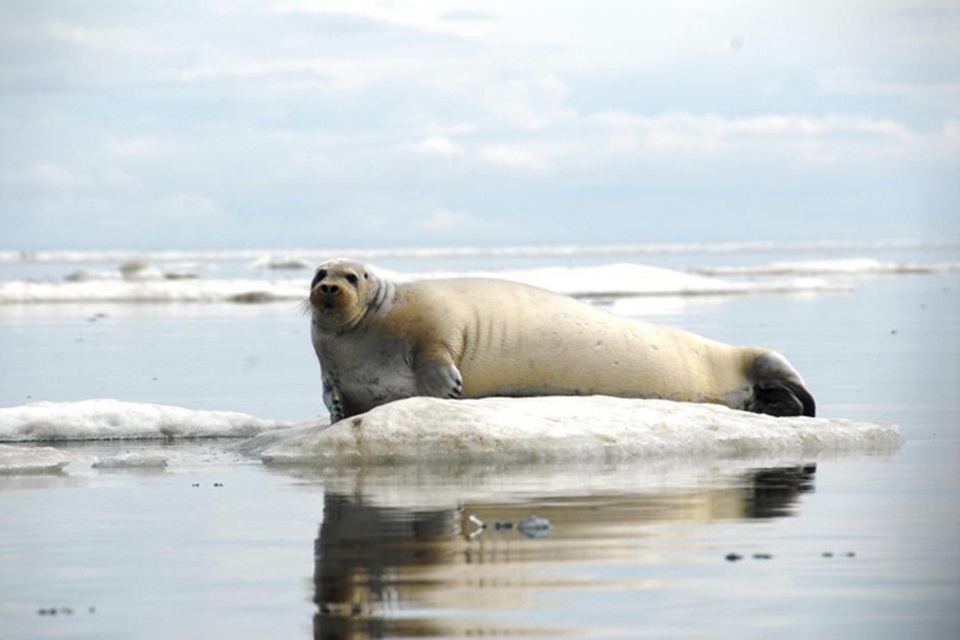
A bearded seal on ice off the coast of Alaska. | John Jansen / National Oceanic and Atmospheric Administration’s Alaska Fisheries Science Center
The Arctic is rapidly heating up, and that’s already spelled trouble for other parts of the world. 2023 has become the warmest year since 1900, and now, at the Earth’s southernmost point, an iceberg three times the size of Manhattan has broken away—and it’s on the move. When it comes to the ravaging effects of global warming, the world’s poles have proven themselves to be Exhibit A.
On Dec. 12, the annual Arctic Report Card was released by the National Oceanic and Atmospheric Administration. It found that the Arctic is warming four times more quickly than the world’s average, chiefly as a result of climate change caused by the burning of fossil fuels. The effect of that has already been felt south of the region, with Juneau, Alaska, stricken by a glacial outburst flood and Canada enduring a record year of devastating wildfires. Experts say the changes in the Arctic are early signs of what to expect globally as the planet’s temperature continues to increase.
And then there’s A23a. That’s what scientists have called the icy behemoth that was dislodged from an Antarctic ice shelf and—since 2020—has been wending its way through the sea; as of November, it was observed moving past the Antarctic Peninsula’s northern tip and approaching the Southern Ocean. The iceberg is about 1,500 square miles in size. It and other ice shelves are breaking off at rapidly increasing rates due to the climate crisis, and experts are concerned about the implications of its movement.
“It’s just astonishingly big, and it’s a reminder of how much risk we’re at from sea level rise,” said sea scientist Robbie Mallett, an honorary research fellow at the University of College London. “Antarctica has historically been quite a small contributor to sea level rise, but it is growing, and it is taking up a bigger and bigger share of the sea level rise that we see every year. So, it’s a symbol of the growing dominance of Antarctica in the sea rise equation.”
This is such a critical matter because it’s a symptom of a much larger and more worrying issue. The World Meteorological Organization (WMO) described it as a “deafening cacophony” of record-breaking that is fueled by global warming, and said that it was putting mankind in jeopardy of losing the fight to control sea level rise.
WMO Secretary-General Professor Petteri Taalas remarked, “We risk losing the race to save our glaciers and to rein in sea level rise. We cannot return to the climate of the 20th century, but we must act now to limit the risks of an increasingly inhospitable climate in this and the coming centuries. Extreme weather is destroying lives and livelihoods on a daily basis, underlining the imperative need to ensure that everyone is protected by early warning services.”
Gail Whiteman, professor of sustainability at the University of Exeter, described it this way: “The Antarctic used to be seen as this sleeping giant, nothing was happening. It was just big and really cold – that’s my non-scientific way of saying it. And now it’s clear based on the sea ice that it is actually destabilizing. The discussion here should be about the polar regions because they are flipping first, and once they do, the issue of adaptation becomes that much more critical.”
Back up north, ice sheets are causing just as much concern; in Greenland, they’re melting. That nation lost an amount of ice in 2022 that could have covered West Virginia in a foot of water, according to reports. The vanishing ice is also creating an unfortunate self-perpetuating cycle: sea ice reflects solar energy back into space, but as it melts, the dark water of the ocean absorbs that heat – meaning that the more it melts, the more quickly the entire process accelerates.
These simultaneous events are, at the end of the day, proof of one thing: “Climate change is not something that’s coming down the pipe somewhere in the future,” said Daniel Schindler, an ecologist at the University of Washington. “Whether you’re talking about fish, or people, or birds, there are going to be real impacts that we need to deal with right now.”
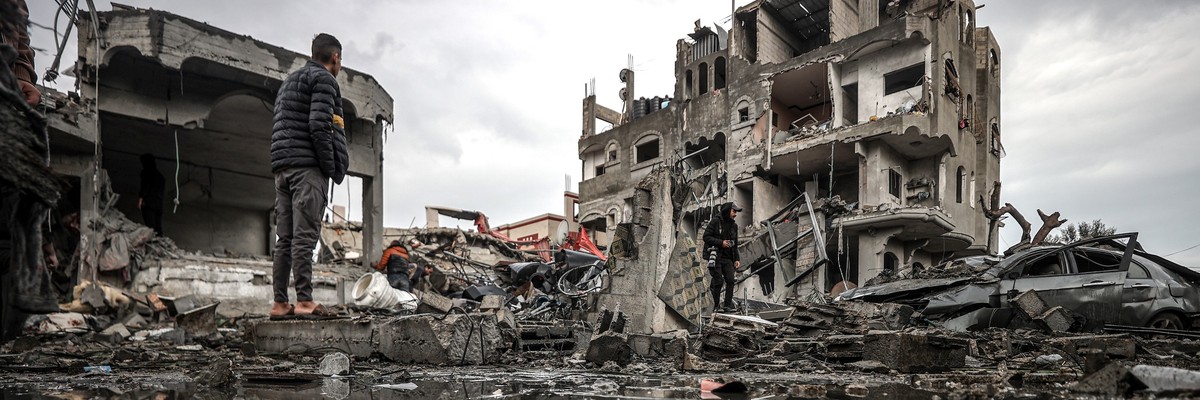
Search and rescue efforts for those trapped under rubble continue after Israel bombed the Maghazi refugee camp in central Gaza on December 25, 2023. (Photo: Ali Jadallah/Anadolu via Getty Images)
“So long as Netanyahu faces no consequences, even more innocent civilians will face death and starvation,” said one U.S. lawmaker.
The Israeli military on Tuesday expanded its ground assault to refugee camps in central Gaza, forcing displaced people to flee in terror from an area that was once considered a relative safe zone as the rest of the strip came under near-constant bombardment.
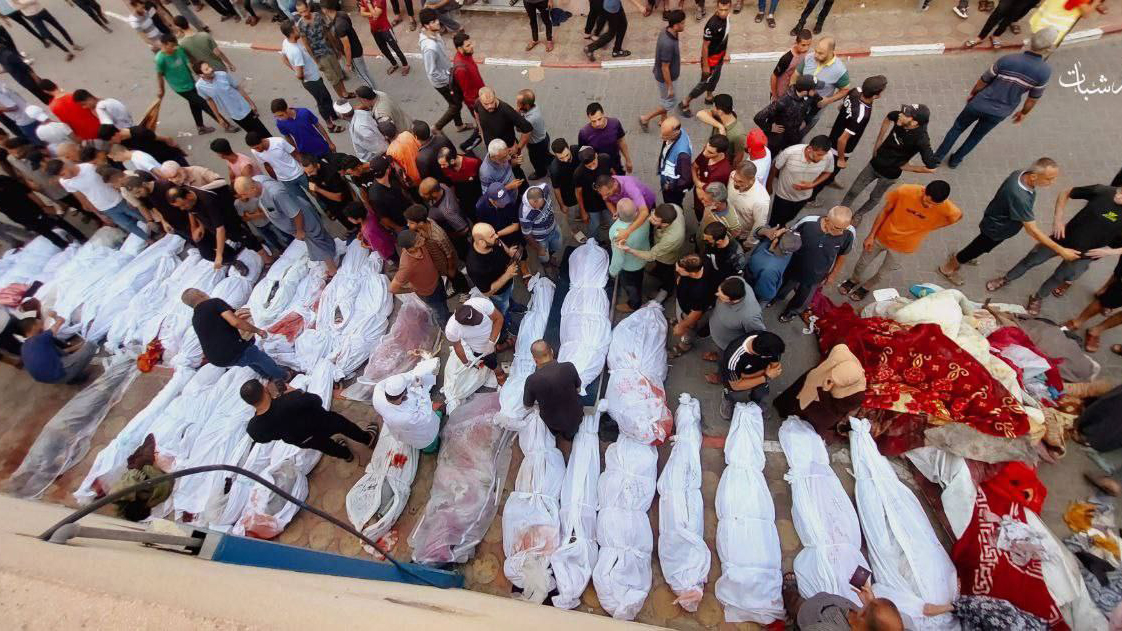
Over the weekend, U.S.-armed Israeli forces pummeled central Gaza with airstrikes, reducing the Maghazi refugee camp to ruins and killing more than 100 people in one of the deadliest bombings since the devastating military campaign began in early October. Many more people are believed to be trapped under the rubble in Maghazi.
The Associated Press reported Tuesday that the Israeli military has “ordered residents to evacuate a belt of territory the width of central Gaza, urging them to move to nearby Deir al-Balah.” According to the United Nations, more than 61,000 people were sheltering in the area Israel is now targeting.
“Residents of central Gaza described shelling and airstrikes shaking the Nuseirat, Maghazi, and Bureij camps,” AP reported. “The built-up towns hold Palestinians driven from their homes in what is now Israel during the 1948 war, along with their descendants.”
One mother of four told Middle East Eye that she “started crying hysterically” when she heard the news that Israel had deemed areas of central Gaza battle zones and issued evacuation orders.
“Where would I go with these children?” she asked. “We do not have any relatives in Deir al-Balah.”
Seif Magango, a spokesperson for the U.N. Human Rights Office, said in a statement Tuesday that he is “gravely concerned about the continued bombardment of Middle Gaza by Israeli forces.”
“It is particularly concerning that this latest intense bombardment comes after Israeli forces ordered residents from the south of Wadi Gaza to move to Middle Gaza and Tal al-Sultan in Rafah,” Magango continued. “Israeli forces must take all measures available to protect civilians. Warnings and evacuation orders do not absolve them of the full range of their international humanitarian law obligations.”
Israel’s expansion of its ground assault came days after the United Nations Security Council (UNSC) approved a binding resolution calling for an increase in humanitarian aid to Gaza and urgent steps to “create the conditions for a sustainable cessation of hostilities.”
An initial draft of the resolution called for an “urgent and sustainable cessation of hostilities,” but the U.S.—which has veto power at the UNSC—watered the measure down. The U.S. ultimately abstained from the final vote, allowing it to pass.
This is what the US chose. More civilian suffering & death. The impunity must end @IntlCrimCourt@USUN
“Israeli forces on Tuesday expanded their ground offensive into urban refugee camps in central Gaza after bombarding the crowded Palestinian communities”https://t.co/xZWnk6bkT4
Passage of the U.N. resolution has done nothing to deter the Israel Defense Forces (IDF) from intensifying their attacks on areas packed with civilians, many of whom have been displaced multiple times in less than three months.
More than 90% of Gaza’s population of 2.3 million has been forced to flee their homes due to Israel’s airstrikes and ground invasion, which began following a deadly Hamas-led attack on southern Israel. Around 60% of Gaza’s housing infrastructure has been destroyed or damaged by Israeli forces, leaving displaced people with nothing to return to—if they’re able to return at all.
Israeli Prime Minister Benjamin Netanyahu reportedly suggested Monday that he’s looking for countries to “absorb” displaced Gazans, intensifying fears that a goal of the ongoing assault on Gaza is the permanent removal of the Palestinian population.
The U.S., meanwhile, has not wavered in its unconditional military support for Israel, even as the country’s government has defied its meager calls for the protection of Gaza civilians. The Biden administration has reportedly delivered more than 10,000 tons of military equipment to Israel since October, including 2,000-pound bombs that Israel has dropped on densely populated areas.
In a social media post on Tuesday, U.S. Rep. Lloyd Doggett (D-Texas) argued that the Biden administration’s “begging Netanyahu to safeguard civilians while sending him weapons and abstaining on even the most modest U.N. resolution has failed.”
“So long as Netanyahu faces no consequences,” Doggett added, “even more innocent civilians will face death and starvation.”
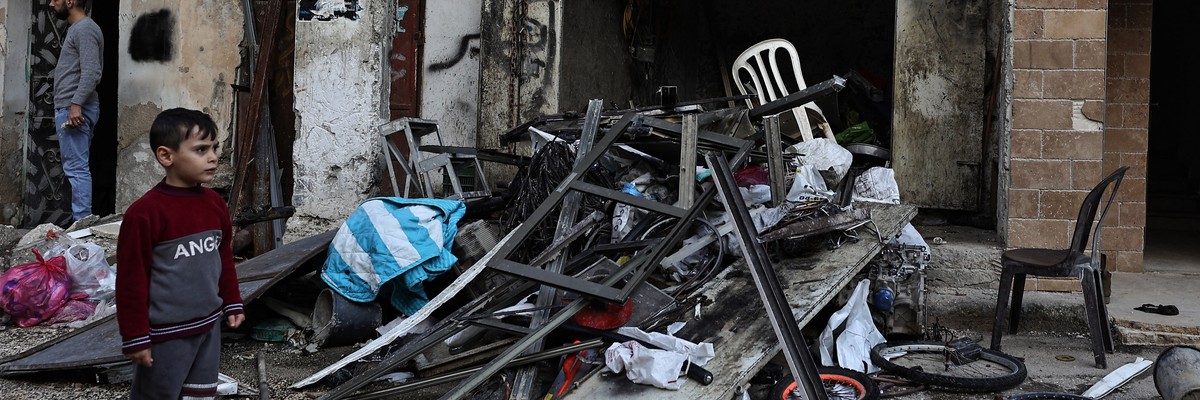
A Palestinian child stands next to a damaged building following a three-day Israeli army raid on the Jenin refugee camp in the occupied West Bank on December 14, 2023. (Photo: Zain Jaafar/AFP via Getty Images)
The U.N. high commissioner for human rights called surging settler attacks on Palestinians “very disturbing.”
A United Nations report released Thursday warned that conditions in the occupied West Bank have worsened rapidly since October, with Israeli settlers and soldiers ramping up violent attacks on the Palestinian population and subjecting people across the territory to frequent abuse, movement restrictions, arbitrary detention, and “unlawful killings.”
The report by the Office of the U.N. High Commissioner for Human Rights found that since October 7, settler attacks—including shootings and the burning of homes—have surged to an average of six per day, up from three per day previously. The report notes that in many cases, the settlers were “accompanied” by Israeli forces, wearing Israeli military uniforms, and carrying weapons supplied by the army.
Between October 7 and December 27, Israeli forces and settlers killed at least 300 Palestinians in the West Bank, according to the U.N. Israeli soldiers arrested more than 4,700 Palestinians during that period, holding many of them in so-called administrative detention without charge or trial.
Palestinian detainees have faced grotesque abuse and torture at the hands of Israeli soldiers, who have raided West Bank homes and refugee camps with increased frequency in recent weeks. Six Palestinian men died in Israeli detention between October 7 and November 20, the U.N. found. One of the men was reportedly insulin-dependent; he, along with others detained at the same time, was physically assaulted by Israeli soldiers.
The new report notes that members of the Israel Defense Forces (IDF) have filmed and photographed themselves “abusing, degrading, and humiliating Palestinians apprehended in the West Bank, including pictures of detainees stripped naked or half-naked, blindfolded and handcuffed, and screaming in pain while physically abused and humiliated including by being forced to pose with the Israeli flag, sing songs in Hebrew or forced to dance with soldiers.”
“In one of the videos, a Palestinian man, subsequently identified through monitoring as having been arrested on 31 October, is seen kneeling, blindfolded, and with hands tied behind his back, being kicked several times in the stomach by a soldier who spits on him and insults him,” the report continues. “On 1 November, IDF reportedly stated they would investigate the abuses and that one reserve soldier had been dismissed from reserve service.”
“The intensity of the violence and repression is something that has not been seen in years.”
Volker Türk, the U.N. high commissioner for human rights, said in a statement Thursday that “the violations documented in this report repeat the pattern and nature of violations reported in the past in the context of the longstanding Israeli occupation of the West Bank.”
“However,” Türk added, “the intensity of the violence and repression is something that has not been seen in years.”
Since October 7—when Hamas launched a deadly attack on southern Israel and the IDF responded with a catastrophic bombing campaign—violence by Israeli settlers in the West Bank has surged. Israeli officials have tallied at least 120 hate crimes committed in the occupied West Bank, but no charges have been brought in any of the cases, the U.N. said.
The report observed that Israeli settlers—with the support of the far-right government of Prime Minister Benjamin Netanyahu—are “taking advantage of a generally permissive environment to accelerate displacement of Palestinians from their land, raising concerns of forcible transfer seeking to create facts on the ground making the existence of a viable Palestinian state almost impossible.”
“According to Israeli organizations monitoring settlement expansion, settlers have built at least four new outposts since 7 October and at least nine new roads leading to settlements, marking a growth in illegal construction by settlers unprecedented since the second Intifada,” the U.N. report says.
Türk called settlers’ “dehumanization” of Palestinians “very disturbing” and said the attacks and illegal settlement expansions “must cease immediately.”
“Israeli authorities should strongly censure and prevent settler violence and prosecute both its instigators and perpetrators,” said Türk.
The U.N.’s findings were published as Al Jazeera reported that Israeli forces have “launched their most intense raids yet on cities in the occupied West Bank as they pressed on with one of the largest incursions in the territory since Israel’s war on Gaza began in October.”
“At least one person was killed after Israeli troops launched a coordinated overnight assault on 10 cities including Hebron, Halhul, Nablus, Jenin, Tulkarem, el-Bireh, Jericho, and notably the center of Ramallah, which is the administrative headquarters of the Palestinian Authority,” the outlet reported. “Israeli forces used tear gas and stun grenades to clear a street and then blocked off the area, before using a ‘controlled explosion’ to enter a money exchange shop. The soldiers seized documents and arrested business owners.”
An Al Jazeera correspondent said that Israeli soldiers seized around $2.5 million in the raids.