NHS news review

BMA says that government NHS ‘reforms’ are chaotic and that the ConDem coalition government should have had “a clear plan from the outset.”

A private company is providing maternity care.

Looks like the government has been lying about the failed NHS computer project having been abandoned. The project continues although we were told that it had ended. The ConDems also confirmed that black is white and up is down and that Lansley and Cameron love the NHS.
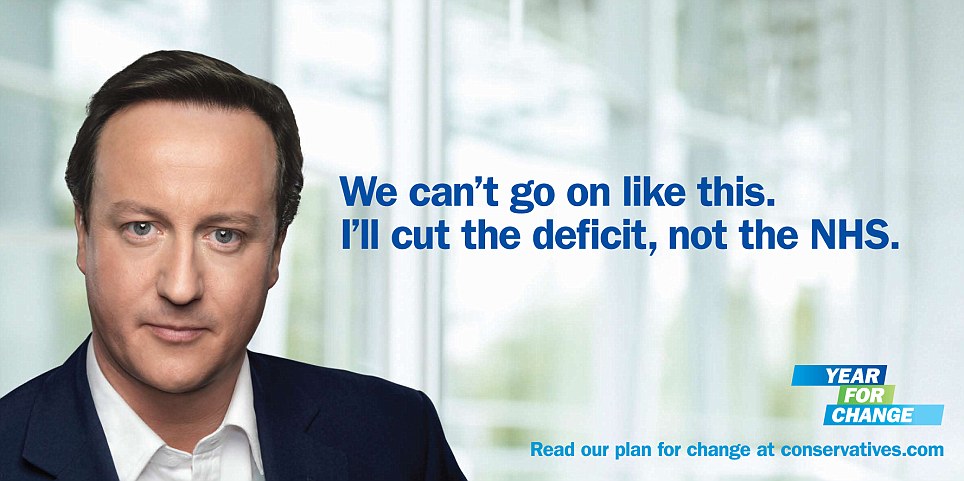
Conservative election poster 2010

A few recent news articles about the UK’s Conservative and Liberal-Democrat (Conservative) coalition government – the ConDem’s – brutal attack on the National Health Service.

NHS reforms causing chaos, says BMA – Health News – Health & Families – The Independent

The Government’s reforms of the NHS “continue to cause chaos” on the ground, doctors leaders said today.

The British Medical Association (BMA), which opposes the Health and Social Care Bill in its entirety, said changes taking place now before legislation has even been passed are “chaotic and poorly co-ordinated”.

Groups of GPs have been told they must form groups to determine how the NHS budget is spent but, according to the BMA, they are being told they are too small.

Dr Hamish Meldrum, chairman of the BMA, said: “There has been a growing level of unease about how the reforms are panning out – we hear repeated concerns from doctors about mounting chaos on the ground.

“For example, clinical commissioning groups (CCGs), that had initially been told they’d have freedom to form to suit their local communities, are now being told they’re too small and have to re-form.

“People are still unclear how primary care will be managed as we don’t yet know where staff currently working in primary care trust ‘clusters’ will eventually be based or if they’ll have jobs at all.

“Even at this stage, there are still unanswered questions about what statutory functions some bodies will have, making planning very difficult.

“Guidance is being issued that is overly restrictive and more and more bureaucracy is being created to try to deal with issues which should have been dealt with at the beginning.

“A huge amount of time, energy, money and commitment has been wasted because of a lack of a clear plan from the outset.”

NHS Wirral announces first ever private maternity deal | News | Nursing Times

A primary care trust has become the first in the country to sign a contract with a private company to provide maternity care.

NHS Wirral has signed a three year deal with the company One to One, following a pilot scheme to provide services to women in the local area.

Those women opting to go with One to One will be provided with a midwife who sees them through all their antenatal care, birth of the baby and postnatal care.

This will be an alternative to the usual NHS services on offer, although One to One midwives will be able to go into NHS hospitals to deliver the baby if the woman has a hospital birth.

The company is now in talks with other PCTs around England and Wales about providing some of their maternity services.

Jacque Gerrard, the Royal College of Midwives’ director for England, said: “The RCM is aware of the progress made by One to One as a maternity service provider, and we welcome it as an add-on service for choice for women.

“However, we have reservations regarding the impact upon jobs for midwives in the NHS. We have formed a professional relationship with One to One to gain recognition for our members, as they will be an alternative employer for midwives.”

Labour’s shadow public health minister Diane Abbott said: “This long-term privatisation project may well end up marginalising our NHS maternity services, and draining them of resources.

“It is incredible that having directly promised an extra 3,000 midwives before the election, what we now see from this government is NHS maternity services being sidelined and privatised, thousands of clinical posts such as nurses and midwives being axed, and the NHS budget being cut in real terms.”

UNISON Press | Press Releases Front Page

Private maternity contract

UNISON, the UK’s largest union, is warning that the maternity deal between private company, One to One and NHS Wirral is the “thin end of the wedge”. “The Government is moving steadily towards the privatisation of NHS services” said Christina McAnea, UNISON Head of Health, adding that the Government is wedded to promoting more private deals across the NHS. She went on to say:

“Maternity services are for too important to be entrusted to unaccountable private companies.

“Of course pregnant women want choice, but they want a genuine choice over whether to have their baby in hospital or at home, or whether to do so by conventional means or to use alternative methods such as water births.

“They don’t want an artificial choice between different types of providers, being brought about not in the best interests of mothers and mothers to be, but in the interests of a free market ideology that wants to undermine the NHS.

“This is exactly the sort of initiative we can expect more of if the government succeed in getting their massively dangerous Health and Social Care Bill passed, with its commitment to a wholesale competitive free-for-all.”

NHS computer farce to cost another £2bn – Telegraph

A US company contracted to provide IT technology for the National Health Service is set to receive a £2 billion extension despite the failed project being abandoned, it was claimed last night.

Computer Sciences Corporation [CSC] has reportedly informed Wall Street that it expects its contract to provide electronic patient records across the NHS to be extended.

Taxpayers are now facing an estimated £2billion bill, despite the company already failing to deliver a fully functional version of its software, The Times reported.

The £11.4billion National Programme for IT, set up in 2002, was at the time billed as the world’s biggest civilian computerisation project.

It aimed to give doctors instant access to patient records wherever they were being treated and CSC had signed a deal to computerise records in most of England.

Digitising the medical records of the country’s 62 million people was the core objective of the National Programme for IT in the NHS, accounting for £7bn of the total estimated cost.

Andrew Lansley, the Health Secretary, announced in September that he was abandoning the scheme to create a national patient database because it had “let down” the health service.

Yet the company stated in official US papers that it was in talks with the British Government for its contract to be extended until 2017, at a cost of up to £2billion.

On Wednesday night, the Department of Health [DoH] admitted that “negotiations” were ongoing with the company over its NHS contracts, but would not comment further.

The Times reported that health trusts had been threatened with funding cuts unless they agreed to implement the system, and civil servants had privately estimated the software had a one-in-three chance of being late.

Computer applications installed as part of the scheme have also failed or been scrapped.

However, £250,000 in bonuses has been paid by the DoH to 80 people involved in the scheme as a reward for “an exceptional contribution to delivery”, the newspaper said.

27/11/13 Having received a takedown notice from the Independent newspaper for a different posting, I have reviewed this article which links to an article at the Independent’s website in order to attempt to ensure conformance with copyright laws.

I consider this posting to comply with copyright laws since
a. Only a small portion of the original article has been quoted satisfying the fair use criteria, and / or
b. This posting satisfies the requirements of a derivative work.

Please be assured that this blog is a non-commercial blog (weblog) which does not feature advertising and has not ever produced any income.

dizzy

Continue ReadingNHS news review

NHS news review

The main NHS news story today is that Health Secretary Andrew Lansley is due to announce a 60-point review of NHS performance. Lansley is expected to announce that surveys will concentrate on patients’ experience. The reviews are getting spun as imposing tough new targets on the NHS demanding improvements. It raises two issues.

Firstly, it appears very much like a top-down organisation of the NHS and is inconsistent with Lansley’s acknowledged aim to distance himself and the government from responsibility for providing and overseeing the NHS.

Secondly, following yesterday’s big news item concerning allowing private companies access to patient databases and access to drugs before they are licensed it suggests that the Con-Dem Coalition are attempting to dominate the NHS news agenda.

Pulse reports that even supportive GPs are leaving CCGs (Clinical Commissioning Groups) because of the roles’ excessive demands.

How cuts will make Britain more unfair | The wrong cure | False Economy

How cuts will make Britain more unfair

The government says that its cuts programme is not just unavoidable, but also fair and progressive. Is this true?

You can argue about the meaning of fair, but progressive has a definition. If what the government is doing is progressive it would take from the rich and give to the poor (or at least hit them much less than the rich).

Independent experts say the cuts are not progressive.

Let’s first look at the changes in tax and benefits, and then at the impact of cuts in services.

Tax and benefits

Whether changes in tax and benefits are progressive is relatively easy to measure as these are flows of cash.

The Institute of Fiscal Studies is well respected as an independent analyst. It says that the government’s claim that the tax and benefit changes in the budget and spending review are progressive is wrong.

This graph is from their analysis of George Osborne’s first budget:

June 2010 Budget: Effect of tax and benefit reforms by income decile

It shows the biggest losers are the poorest 10 per cent of families with children.

The IFS also had this to say about October’s spending review:

Our analysis (of the budget) shows that … the impact of all tax and benefit measures yet to come reduces the incomes of lower income households by more than that of higher income households, with the notable exception of the richest 2% of the population who are the hardest hit. Therefore the tax and benefit changes are regressive rather than progressive across most of the income distribution. And when we add in the new measures announced yesterday this finding is, unsurprisingly, reinforced. So our analysis continues to show that, with the notable exception of the richest 2%, the tax and benefit components of the fiscal consolidation are, overall, being implemented in a regressive way.

This is the IFS analysis of all government policies on tax and benefit by 2015. The poorest lose the most. It is only the impact of the previous government’s tax increases for the wealthy that make the top ten per cent bigger losers than some of those who are poorer.

Impact by 2015-15 of government policies

Spending cuts

Working out the impact of the cuts in spending on services is harder. Some parts of public spending benefit all of us – such as many environmental protection measures.

But other parts of public spending do benefit some people more than others. To give a simple example the richer you are, the less likely that you use the bus.

Researchers for the TUC trawled official statistics to gather information about how different income groups benefit from public spending. With these figures, and by assuming that everyone benefits equally from spending like environmental protection and defence, they were able to work out whether the cuts were progressive.

This chart shows the value of the services lost as a proportion of household income.

Value of services lost by percentage of household income

Again the impact of the cuts is much harder on the poor and those in the middle than it is on the rich. The poorest ten per cent suffer 15 times more than the richest.

The impact on women

The Womens’ Budget Group is a group of independent experts who have been working with the Treasury to analyse the effect of economic policies on women.

This is what they said about the impact of the Spending Review:

  • Lone parents and single pensioners – most of whom are women – will suffer the greatest reduction in their living standards to public service cuts. Lone parents will lose services worth 18.5% and female singles pensioners services worth 12% of their incomes.
  • Overall single women will lose services worth 60% more than single men as proportions of their incomes, and nearly three times the amount lost by couples.
  • The cuts will lead to hundreds of thousands of women losing their job. 53% of the jobs in the public sector services that have not been protected from the cuts are held by women. The pay and conditions of all public sectors workers, 65% of whom are women, are likely to deteriorate.
  • Cuts in welfare spending fall disproportionately on women’s finances. Child benefit is paid almost 100% to women; while 53% of housing benefit claimants are single women. Both benefits have been cut significantly in real terms and eligibility has been tightened.

Conservative election poster 2010

A few recent news articles about the UK’s Conservative and Liberal-Democrat (Conservative) coalition government – the ConDem’s – brutal attack on the National Health Service.

BBC News – New NHS goals are to centre on patients’ experiences

Patient surveys are to be at the centre of new goals to measure the quality of care received in the NHS in England.

Speaking at a London hospital, Health Secretary Andrew Lansley will call for focus on what matters most to patients.

The latest NHS “Outcomes Framework” stresses surveys of patients, including children, and bereaved relations.

In an interview with The Daily Telegraph, Mr Lansley said patients would be asked: “Was the service and experience you had good or not?”

Of bereaved relatives he said: “We’ll be… asking them, after a suitable passage of time, what was their loved one’s experience of care and how well were they looked after towards the end of life.”

He added: “[We will] ask children about their experience. So five to 16-year-olds would be part of this survey, with their parents, so for the first time we’ll be measuring as part of the outcomes, the children’s experience of their care.”

NHS Hospitals To Get New Goals To Improve Care And Save Over 20,000 Lives A Year | Politics | Sky News

NHS hospitals are to be measured against 60 new benchmark targets with the aim of saving more than 20,000 lives a year.

Health Secretary Andrew Lansley has said doctors and hospitals will be judged on the quality of care patients receive, rather than the speed they are treated at, in an attempt to restore faith in the system.

The NHS outcomes framework includes a focus on improving cancer survival and a zero-tolerance approach to hospital-acquired infections such as MRSA and Clostridium difficile.
…[yawn]

Tough new goals for NHS – UK – ITN.co.uk

Health Secretary Andrew Lansley will impose tough new targets on the health service on Wednesday, telling hospitals they must improve patient outcomes.

The Government is producing a 60-step plan called the NHS Outcomes Framework which will focus on improving cancer survival rates and ridding the health service of hospital-acquired infections such as MRSA and Clostridium difficile.

The plan is also designed to improve services for women and families, ensuring better maternity facilities and increasing the number of people who can access an NHS dentist.
… [yawn]

Announced by Lansley to the Torygraph: Health reforms: sixty-step plan to restore faith in the NHS – Telegraph

GPs quit CCG roles as commissioning enthusiasts lose heart – Pulse

Exclusive GP commissioning leaders are quitting the boards of clinical commissioning groups amid concerns that even enthusiasts for the NHS reforms are being ground down by excessive workload and frustration at bureaucracy.

A Pulse investigation covering 50 PCTs found 15 CCG board members have stepped down since April. Among those who resigned from board roles were CCG chairs and commissioning enthusiasts who found it impossible to juggle commissioning with their clinical work.

Board members have stepped down in Fareham and Gosport, Southampton, Wiltshire, Coventry and Warwickshire and Dorset.

Dr Patrick Craig-McFeely, a GP in Salisbury, resigned as chair of Sarum NHS Alliance commissioning group and stepped down from the CCG board last month. Dr Craig-McFeely, who was previously heavily involved in practice-based commissioning, said the experience had had a major impact on his professional and personal life.

‘It was taking over my family life and hitting the care I felt I could provide to my patients. It seemed to be getting ever worse,’ Dr Craig-McFeely said.

‘When commissioning was announced it sounded like GPs would be able to do what they thought was right. But it has shifted to us being accountable here and accountable there and a whole lot of management speak. You never seem to be making any progress.’

The time pressures on CCG chairs have also led to one of the country’s most prominent advocates of GP commissioning standing down. Dr Johnny Marshall, chair of the National Association of Primary Care, quit as chair of the United Commissioning LLP, soon to become a CCG in Buckinghamshire, after he found it impossible to devote enough time to the role alongside his other commitments.

Continue ReadingNHS news review

NHS news review

Conservative election poster 2010

A few recent news articles about the UK’s Conservative and Liberal-Democrat (Conservative) coalition government – the ConDem’s – brutal attack on the National Health Service.

Campaigners win delay to controversial NHS changes | This is Devon

A controversial “part privatisation” of some back office NHS functions has been put on hold after it provoked an uproar from staff.

The proposal to hand over administrative duties for the Westcountry’s family health services to a 50-50 Government and private sector partnership had enraged unions and family doctors.

After a series of meetings, the primary care trusts (PCT) , which had hoped to sign off the transfer this month, have postponed until January after conceding some issues “would benefit from greater discussion”.

Karen Williams, an organiser for the trade union Unison in Devon, welcomed the news.

“Our members are very pleased that they have been given some breathing room on this,” she said.

“While it is not a long period of time and I don’t think people will exactly be breathing a sigh of relief, members will feel that they have been paid attention to in terms of their concerns.”

Ms Williams said the union had concerns over individuals’ employment terms, as well as some larger questions about the manner of the transfer.

Under the agreement, certain administrative tasks will be transferred to the NHS Shared Business Services (SBS), a partnership between the Government and private firm Steria.

GPs in Devon and Cornwall have already voiced misgivings about SBS since the group took over invoice processing which many practices complain has resulted in late payment and bills being rejected for spurious reasons.

Former Health Minister and Exeter MP Ben Bradshaw has spoken out against the latest transfer to SBS, calling it “part-privatisation.”

Whistleblowers being ignored, RCN survey finds | News | Nursing Times

No action is taken in almost half of cases where nurses are whistleblowers about poor NHS care, according to a survey.

The poll of more than 3,000 nurses for the Royal College of Nursing (RCN) found nothing was done when fears were raised about issues including patient safety and too few staff on duty.

More than a third of nurses (34%) said they have been discouraged or told directly not to report their concerns about quality of care. Some 73% said managers had told them not to speak up, while 24% said work colleagues had said it was a bad idea.

The RCN said the results suggest pressure on staff is intensifying – in 2009, just 21% of nurses said they had been discouraged or told not to speak out.

The survey follows heavy criticism of nursing care in a series of reports from the Care Quality Commission (CQC) and the Patients Association.

It found that more than 80% of nurses had raised concerns with employers about issues relating to NHS wards. Yet 84% admitted they worried about being victimised or expected a negative effect on their career from whistleblowing. Of those who reported concerns, 38% had filled in incident forms (an official record regarding threat to patient safety), while 72% had told their line manager. Overall, just 20% of nurses said their employer took immediate action (down from 29% in the 2009 survey), while 48% said no action was ever taken (compared with 35% previously).

UK Uncut

Philip Green

Philip Green is a multi-billionaire businessman, who runs some of the biggest names on British high streets. His retail empire includes brands such as Topshop, Topman, Dorothy Perkins, Burton, Miss Selfridge and British Home Stores.

Philip Green is not a non-dom. He lives in the UK. He works in the UK. He pays tax on his salary in the UK. All seems to be in order. Until you realise that Philip Green does not actually own any of the Arcadia group that he spends every day running. Instead, it is in the name of his wife who has not done a single day’s work for the company. Mrs Green lives in Monaco, where she pays not a penny of income tax.

In 2005 Philip Green awarded himself £1.2bn, the biggest paycheck in British corporate history. But this dividend payout was channeled through a network of offshore accounts, via tax havens in Jersey and eventually to Green’s wife’s Monaco bank account. The dodge saved Green, and cost the tax payer, close to £300m. This tax arrangement remains in place. Any time it takes his fancy, Green can pay himself huge sums of money without having to pay any tax.

Before the election, the Lib Dems liked to talk tough on tax avoiders. But as soon as they entered the coalition, this pre-election bluster became just another inconvenient promise they quietly forgot. In August David Cameron appointed the country’s most notorious serial-tax avoider to advise the government on how best to slash public spending. Not a single Lib Dem minister uttered a word of complaint. A Guardian editorial denounced this as “shameful”.

Philip Green’s £285m tax dodge could pay for:

  • The full, hiked up £9,000 fees for almost 32,000 students
  • Pay the salaries of 20,000 NHS nurses

And if that’s not reason enough to take action against Sir Philip, it is worth noting that he has built his £5bn fortune on the back of sweatshop labour, using Mauritius sweatshops where Sri Lankans, Indians and Bangladeshis toil 12 hours a day, six days a week, for minimal pay.

Continue ReadingNHS news review

NHS news review

Conservative election poster 2010

A few recent news articles about the UK’s Conservative and Liberal-Democrat (Conservative) coalition government – the ConDem’s – brutal attack on the National Health Service.

NHS should work hand-in-glove with private firms, says Cameron – Health News – Health & Families – The Independent

A government plan to share patient records and other NHS data with private health companies ran into an immediate storm of opposition yesterday.

David Cameron will try to get the proposal back on track today when he will argue that “opening up” the health service would make it a “huge magnet” for innovation and would boost economic growth.

In a speech in London, the Prime Minister will outline plans for seriously ill patients to get quicker access to potentially life-saving new drugs before they are licensed. He will call for the NHS to work “hand-in-glove” with life science companies in a move that could give them more freedom to run clinical trials inside hospitals and access anonymised patient records. It could mean records being handed to pharmaceutical firms which carry out experiments on animals.

Privacy campaigners pointed out that the Government did not have a good record in holding personal data. In 2008, child benefit records including the details of 25 million people were lost by HM Revenue & Customs.

Guy Herbert, general secretary of the NO2ID campaign, said: “Anonymised data is like sterilised milk – it stops being that way the moment you open it up.”

David Cameron ready to put chunks of NHS up for sale, says Labour | Politics | The Guardian

Prime minister will outline plans to encourage NHS ties with industry and fuel innovation, including £180m catalyst fund


Burnham said that in principle he was not opposed to the idea of private firms getting access to some NHS data. But he said the government had to “tread carefully” in this area, and that he was concerned about Cameron’s willingness to open up the NHS to the private sector. “[Cameron] sees no limit on the involvement of the private sector and says he wants it to be a ‘fantastic business’. In his desperation to develop a credible industrial strategy, he seems willing to put large chunks of our NHS up for sale.”

Roger Gross, from the pressure group Patient Concern, said that allowing private firms access to NHS data would mean “the death of patient confidentiality”. Patient Concern resigned from a Department of Health consultation on the plan.

“”We understand GP surgeries will have the right to refuse to release their patients’ records, but whether patients will ever be told what is happening, let alone have the choice to protect their privacy, is still unclear,” Gross said.

NHS reforms costing nurses’ jobs, says MP (From The Bolton News)

THE Government has been slammed by MP David Crausby for its “wasteful” NHS reforms.

Mr Crausby, Labour MP for Bolton North East, has said guidelines requiring NHS Bolton to put a side £18,906,908 in two years are not acceptable.

“These shocking new figures show the Government’s reorganisation is costing the NHS even more than we first feared,” he said.

“It is scandalous that they are telling our local NHS to hold back millions of pounds for their own reckless plans whilst thousands of nursing jobs are being axed.

“Bolton Primary Care Trust has seen a 129 per cent rise in the number of patients waiting longer than 18 weeks for treatment since David Cameron became Prime Minister

UK Uncut

We start with some simple points of agreement. The brutal cuts to services about to be inflicted by the current Government are unnecessary, unfair and ideologically motivated. The coalition are particularly fond of two obscene catchphrases: ‘There is no alternative’ and ‘We’re all in this together.’ Both slogans are empty and untrue. The cuts will dismantle the welfare state, send inequality sky-rocketing and hit the poorest and most vulnerable hardest. A cabinet of millionaires have decided that libraries, healthcare, education funding, voluntary services, sports, the environment, the disabled, the poor and the elderly must pay the price for the recklessness of the rich.

Austerity-economics is the policy of the powerful. It cannot be stopped by asking nicely. We cannot wait until the next election. If we want to win the fight against these cuts (and we can win) then we must make it impossible to ignore our arguments and impossible to resist our demands. This means building a powerful grassroots mass movement, able to resist the Government cuts at every turn.

UK Uncut

The Government’s Line lies


“There is no alternative.”

We are told that the only way to reduce the deficit is to cut public services. This is certainly not the case. There are alternatives, but the government chooses to ignore them, highlighting the fact that the cuts are based on ideology, not necessity.

  • One alternative is to clamp down on tax avoidance by corporations and the rich and tax evasion, estimated to cost the state £95bn a year
  • Another is to make the banks pay for free insurance provided to them by the taxpayer: a chief executive at the Bank of England put the cost of this subsidy at £100bn in a single year

Either the tax avoided and evaded in a single year or the taxpayer subsidy to the banking industry could pay for all of the £81bn, four-year cuts programme.

“We are all in this together.”

Since the banking crisis:

David Cameron himself has said that the cuts will change Britain’s “whole way of life”. Every aspect of what was fought for by generations seems under threat – from selling off the forests, privatising health provision, closing the libraries and swimming pools, to scrapping rural bus routes. What Cameron doesn’t say is that the cuts will also disproportionately hit the poor and vulnerable, with cuts to housing benefit, disability living allowance, the childcare element of working tax credits, EMA, the Every Child a Reader programme, Sure Start and the Future Jobs Fund to name a few.

The facts speak for themselves; we are not all in this together, we are paying for the folly of reckless bankers whilst the rich profit


27/11/13 Having received a takedown notice from the Independent newspaper for a different posting, I have reviewed this article which links to an article at the Independent’s website in order to attempt to ensure conformance with copyright laws.

I consider this posting to comply with copyright laws since
a. Only a small portion of the original article has been quoted satisfying the fair use criteria, and / or
b. This posting satisfies the requirements of a derivative work.

Please be assured that this blog is a non-commercial blog (weblog) which does not feature advertising and has not ever produced any income.

dizzy

Continue ReadingNHS news review

NHS news review

John Wight: Public Sector Strike Heralds the Return of the Nasty Party

According to the Institute of Fiscal Studies, the effect of the chancellor’s latest spending proposals will be the further penalisation of the poor and more help for the better-off.

The decision not to increase tax credits will hurt the poorest in society, with the IFS predicting that the overall effect of the chancellor’s new proposals will be a reduction in the incomes of the bottom 30 percent income bracket and more children pushed into poverty.

Severe NHS cuts to nursing staff are threatening patient care.

A resignation email by Barts and the London orthopaedic consultant sparks inquiry. Consultant David Goodier wrote a shocking resignation email that recounts numerous cases of patient harm as a result of NHS cuts.

Care Quality Commission is criticised for failing to ensure quality at Stafford hospital and elsewhere.

http://www.ukuncut.org.uk/targets

The banks have run the global economy into the ground. Bankers, encouraged by the government, gambled recklessly with our money, and they lost. Spectacularly. Remember 2008? In the UK, the government decided it had to step in with a bail-out because these banks were ‘too big to fail’. According to the Bank of England, the cost of this bail-out now exceeds £1trillion. The result is that all high street banks- from Barclays to RBS- owe their existence to public financing.

What did we get for our billions? A banking system that serves ordinary people rather than the super-rich? No. Regretful bankers who refuse to reward themselves with massive bonuses? No. How about increased financial regulation to ensure this crisis couldn’t happen again? No. The government has done nothing to stop it being business as usual for banks.

What’s worse, the money that was given to the bankers is the money now being taken from the poorest in society, guaranteeing a rise in poverty, debt and inequality. Nearly £7 billion will be paid out in bank bonuses this year. This sum is more than the first wave of public spending cuts. We are not all in this together because it’s us who will pay if education, health, housing, libraries, woodland and much, much more, disappears from our lives.

Who’s telling us we must make these cuts? A government led by a cabinet of millionaires, in bed with the bankers, which is now pulling off an audacious con-trick in front of our eyes.

This is how their story goes. The crisis was caused by a bloated public sector. We binged away all our money on luxuries like healthcare and free education and council services, care for the elderly, for people with disabilities, school sports and free school meals for children living in poverty. Now the country is bankrupt and we must repent, detox, cut back. We have to relinquish our welfare state to appease the circling money men. Welcome to the Age of Austerity but don’t worry because we are all in this together.

We say – don’t believe their lies. This is their crisis, but there is no austerity for the bankers.

Conservative election poster 2010

A few recent news articles about the UK’s Conservative and Liberal-Democrat (Conservative) coalition government – the ConDem’s – brutal attack on the National Health Service.

John Wight: Public Sector Strike Heralds the Return of the Nasty Party

David Cameron’s dismissal of the huge and unprecedented national public sector strike on 30 November with his statement that it proved “a damp squib” may well come back to haunt him before the next election. It reflects a massive chasm of understanding within the coalition when it comes to the breadth and depth of anger that exists in the country over the brutal injustice that they are intent on inflicting on the vast majority in response to the greed and venality of a small minority.

Combined with the chancellor George Osborne’s Autumn Statement, Cameron’s flippant disregard for the quality of life of millions of people has ripped the mask off to reveal the nasty party in its full glory. In other words, this week has seen the Tory-led coalition unleash a full blown class war as it moves to protect the interests, privileges and wealth of their friends and backers in the boardrooms of the City as the economic crisis deepens across the eurozone and beyond.

According to the Institute of Fiscal Studies, the effect of the chancellor’s latest spending proposals will be the further penalisation of the poor and more help for the better-off.

The decision not to increase tax credits will hurt the poorest in society, with the IFS predicting that the overall effect of the chancellor’s new proposals will be a reduction in the incomes of the bottom 30 percent income bracket and more children pushed into poverty.

This continues a pattern of punishing the poor for an economic crisis not of their making, especially in light of last year’s spending review when a cap on housing benefit and swingeing cuts in disability allowances were introduced.

Midwife cuts: NHS £20 billion savings target is threatening frontline nursing care | Mail Online

  • Nurses and health care assistants make up 34 per cent of posts earmarked to be cut, finds RCN study

  • Baroness Masham says lack of leadership causing a ‘culture of indifference’ among nursing staff

The drive to find £20 billion of efficiency savings in the NHS is threatening patient care as medical staff struggle to cope with frontline cuts, it was claimed today.

Retired obstetrician Lord Patel told ministers there is now a shortfall of 4,500 to 5,000 midwives in the United Kingdom with half of the workforce aged between 45 and 55.

In a Lords debate on nursing, he said: ‘Recruitment of a younger workforce is extremely important.

‘There is a need to address the issue of a midwife shortage if we are going to deliver quality care to mothers and their children.’

Labour’s Baroness Warwick of Undercliffe added that cuts in nursing staff could have ‘disastrous consequences’ for patient care.

She said: ‘Frontline nursing care is being severely threatened by the £20 billion efficiency savings target set for the NHS.’

Analysis by the Royal College of Nursing suggested that across 41 NHS trusts in England, registered nurses and health care assistants accounted for 34 per cent of posts ‘earmarked to be cut’.

Lady Warwick said: ‘Despite Government promises that there would be no cuts to frontline NHS care, clinical services and staffing levels are being severely affected.’

Patients physically harmed by NHS cuts and bad management, says surgeon | Society | The Guardian

Resignation email by Barts and the London orthopaedic consultant sparks inquiry

An inquiry has been launched into a leading London hospital trust after a consultant claimed in a devastating resignation email that poor management and government cuts had resulted in infections, pain and starvation for dozens of patients.

David Goodier, a consultant orthopaedic surgeon at Barts and the London NHS Trust, wrote that patients with broken bones were being physically harmed as managers strove to hit waiting list targets and cut budgets.

Prof Norman Williams, the president of the Royal College of Surgeons who works part time at the hospital, has also written to the hospital’s medical council expressing his own concerns at an apparent “appalling deterioration” of surgical services. He warned that a failure to investigate could result in allegations of a cover-up similar to “Mid Staffs” – a reference to Mid Staffordshire hospital, where hundreds of patients died because of substandard care.

Now, the Royal College has been asked by the hospital to conduct an independent inquiry into Goodier’s claims and similar complaints from other members of staff.

The inquiry, uncovered by the Guardian and BBC London, will result in calls for the Department of Health and the Care Quality Commission to intervene. Goodier, 49, trained at the Royal London Hospital in Whitechapel and has worked at the trust for most of his 31 years as a junior doctor, registrar and consultant.

In his email, sent to colleagues in September, he claims that he went “ballistic” at the hospital authorities a year ago because of the lack of commitment to trauma services.

In response, he claimed, a manager “made clear that the only priorities of the trust were 18-week waiting times and the financial state”.

“We are regularly out of kit, out of nurses, out of ODPs [operating department practitioners, who plan care] and always out of beds. We have become so used to the situation, it is no longer seen as a crisis, it is the norm.”

Those who suffer are not emergency cases, he wrote, but those with less urgent needs who are left while their injuries fester.

… [continues by detailing shocking cases of neglect and consequent harm to patients.]

NHS watchdog under fire for ‘putting patient care at risk’ | Society | The Guardian

Care Quality Commission attacked after inquiry into Stafford hospital, where poor care led to hundreds of patient deaths

The watchdog responsible for overseeing the NHS came under fire on multiple fronts, with counsel for the public inquiry into the Mid Staffs hospital scandal calling into question its leadership and “unhealthy organisational culture” while the National Audit Office said its failures had risked “unsafe or poor quality (patient) care”.

In a series of withering assessments of the Care Quality Commission, at the end of the 13-month public inquiry into Stafford hospital, where poor care led to hundreds of needless patient deaths between 2005 and 2008, Tom Kark QC said the final report should consider the question of “the leadership of the CQC”.

He added: “The evidence could suggest that the CQC had an unhealthy organisational culture, and that culture goes to the top.”

The inquiry also needed to see if the CQC’s board was open to “internal criticism” and whether that allowed it to improve as an organisation, Kark said.

The chief executive of the CQC, Cynthia Bower, paid more than £195,000 a year, was formerly chief executive of the NHS West Midlands’ strategic health authority, where she was responsible for supervising the performance of Stafford hospital during the time of the scandal.

Bower was criticised by her own staff this week. On Monday the inquiry heard extraordinary testimony from employees at the CQC who publicly condemned their own bosses, including Bower, for having “no clear strategy” and presiding over a “culture of bullying” at a regulator meant to discipline poorly-run hospitals such as Stafford, which she had also been responsible for in her previous job. Kark said it was “truly surprising” to hear from these whistleblowers.

Hours after he completed his summary, parliament’s spending body, the NAO, produced a report noting that a collapse in inspections and reviews last year – from more than 13,500 to a little over 7,300 – had “increased the risk that unsafe or poor quality care went undetected”.

It also highlighted the regulator’s “shortcomings” in failing to investigate abuse of residents at Winterbourne View care home – revealed by the BBC’s Panorama programme – where “timely action was not taken to deal with poor quality care”.

Related: Neglect and indignity: Stafford hospital inquiry damns NHS failings | Society | The Guardian

Continue ReadingNHS news review