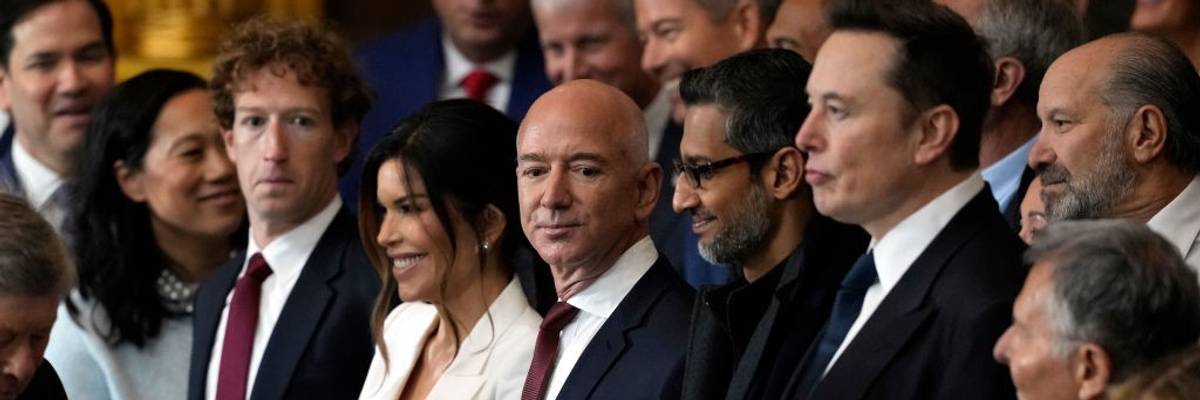
Guests including Mark Zuckerberg, Lauren Sanchez, Jeff Bezos, Sundar Pichai, and Elon Musk attend the Inauguration of Donald J. Trump in the US Capitol Rotunda on January 20, 2025 in Washington, DC. (Photo by Julia Demaree Nikhinson – Pool/Getty Images)
“These platforms are attacking the mental health, dignity, and rights of our sons and daughters,” said the Spanish president. “The state cannot allow it. The impunity of the giants must end.”
Big Tech firms are coming under greater scrutiny for the proliferation of child sexual abuse material generated by artificial intelligence-powered chatbots on their social media platforms.
Ireland’s Data Protection Commission (DPC) announced on Tuesday that it was invoking the European Union’s data privacy regulations to open an investigation into Grok, the AI chatbot featured on Elon Musk’s X platform, after it was used to generate nonconsensual deepfake images, including sexualized images of children.
In announcing the investigation, DPC Deputy Commissioner Graham Doyle said that the commission has been in contact with X for weeks after reports first emerged of Grok being used to generate child sexual abuse material (CSAM).
Doyle said DPC has since decided to launch “a large-scale inquiry which will examine [X’s] compliance with some of their fundamental obligations” under European privacy laws.
Spanish President Pedro Sánchez said on Tuesday that his government would ask Spain’s Public Prosecution Service to “investigate the crimes that X, Meta, and TikTok may be committing through the creation and dissemination of child pornography by means of their AI.”
“These platforms are attacking the mental health, dignity, and rights of our sons and daughters,” Sánchez emphasized. “The state cannot allow it. The impunity of the giants must end.”
The probes announced by Ireland and Spain mark just the latest actions by European governments against US-based tech giants. Earlier in February, law enforcement authorities in France raided the office of X in Paris, which the Paris prosecutor’s office said was part of an investigation aimed at “ensuring that the X platform complies with French laws, insofar as it operates on national territory.”
The UK government’s Information Commissioner’s Office has also announced an investigation into X that the agency said encompasses “their processing of personal data in relation to the Grok artificial intelligence system and its potential to produce harmful sexualized image and video content.”
Last autumn, a UK government report warned that climate-driven ecosystem collapse could lead to food shortages, mass migration, political extremism and even nuclear conflict. The report was never officially launched.
Commissioned by Defra – the Department for Environment Food and Rural Affairs – and informed by intelligence agencies including MI5 and MI6, the briefing assessed how environmental degradation could affect UK national security.
At the last minute the launch was cancelled, reportedly blocked by Number 10. Thanks to pressure from campaigners and a freedom of information request, a 14-page version of the report was snuck out (no launch, not even a press release) on January 22.
That report says: “Critical ecosystems that support major food production areas and impact global climate, water and weather cycles” are already under stress and represent a national security risk. If they failed, the consequences would be severe: water insecurity, severely reduced crop yields, loss of arable land, fisheries collapse, changes to global weather patterns, release of trapped carbon exacerbating climate change, novel zoonotic disease and loss of pharmaceutical resources.
In plainer terms: the UK would face hunger, thirst, disease and increasingly violent weather.
An unredacted version of the report, seen by the Times, goes further. It warns that the degradation of the Congo rainforest and the drying up of rivers fed by the Himalayas could drive people to flee to Europe (Britain’s large south Asian diaspora would make it “an attractive destination”), leading to “more polarised and populist politics” and putting more pressure on national infrastructure.
The Times describes a “reasonable worst case scenario” in the report, where many ecosystems were “so stressed that they could soon pass the point where they could be protected”. Declining Himalayan water supplies would “almost certainly escalate tensions” between China, India and Pakistan, potentially leading to nuclear conflict. Britain, which imports 40% of its food, would struggle to feed itself, the unredacted report says.
The report isn’t an outlier, and these concerns are not confined to classified briefings. A 2024 report by the University of Exeter and think-tank IPPR warned that cascading climate impacts and tipping points threaten national security – exactly the risk outlined in the Defra report.
Melting glaciers in remote mountains ultimately pose a security threat for the UK, say intelligence services. Hussain Warraich / shutterstock
The government has not publicly explained why the launch was cancelled. In response to the Times article, a Department for Environment, Food and Rural Affairs spokesperson said: “Nature underpins our security, prosperity and resilience, and understanding the threats we face from biodiversity loss is crucial to meeting them head on. The findings of this report will inform the action we take to prepare for the future.”
Perhaps there are mundane reasons to be cautious about a report linked to the intelligence services that warns of global instability. But the absence of any formal briefing or ministerial comment is itself revealing – climate risks appear to be treated differently from other risks to national security. It’s hard to imagine a report warning of national security risks from AI, China or ocean piracy getting the same treatment.
This episode is not even especially unusual, historically. Governments have been receiving warnings about climate change – and downplaying or delaying responses – for decades.
Decades of warnings
In January 1957, the Otago Daily Times reported a speech by New Zealand scientist Athol Rafter under the headline “Polar Ice Caps May Melt With Industrialisation”. And Rafter was merely repeating concerns already circulating internationally, including by a Canadian physicist whose similar warning went around the world in May 1953. Climate change first went viral more than seven decades ago.
By the early 1960s, scientists were holding meetings explicitly focused on the implications of carbon dioxide build-up. In 1965, a report to the US president’s Science Advisory Council warned that “marked changes in climate, not controllable though local or even national efforts, could occur”.
But the story we see today was the same. Reports are commissioned, urgent warnings are issued – and action is deferred. When climate change gained renewed momentum in the mid-1980s, following the discovery of the ozone hole and the effects of greenhouse gases besides carbon dioxide, the message sharpened: global warming will come quicker and hit harder than expected.
Margaret Thatcher finally acknowledged the threat in a landmark 1988 speech to the Royal Society. But when green groups tried to get her to make specific commitments, they had little success.
Since about 1990, the briefings have barely changed. Act now, or suffer severe consequences later. Those consequences, however, are no longer theoretical.
Why does nothing happen?
Partly, it’s down to inertia. We have built societies in which carbon-intensive systems are locked in. Once you’ve built infrastructure around, say, the private petrol-powered automobile, it’s hard for competitors to offer an alternative. There’s also a mental intertia: it’s hard to let go of assumptions you grew up with in a more stable era.
Secrecy plays a role too. As the Defra report illustrates, uncomfortable assessments are often softened, delayed or buried. Then, if you do accept the need for action, you are then up against the problem of responsibility being fragmented across sectors and institutions, making it hard to know where to aim your efforts. Meanwhile, social movements fighting for climate action find it hard to sustain momentum for more than three years.
Here’s the final irony. Conspiracy theorists and climate deniers insist governments are exaggerating the threat. In reality, the evidence increasingly suggests the opposite. Official assessments tend to lag behind scientific warnings, and the most pessimistic scenarios are often confined to technical or classified documents.
The situation is not better than we are told. It’s actually far worse.
Nigel Farage urges you to ignore facts and reality and be a climate science denier like him and his Deputy Richard Tice. He says that Reform UK has received £Millions and £Millions from the fossil fuel industry to promote climate denial and destroy the planet.Donald Trump urges you to be a Climate Science denier like him. He says that he makes millions and millions for destroying the planet, Burn, Baby, Burn and Flood, Baby, Flood.Orcas discuss Donald Trump and the killer apes’ concept of democracy. Front Orca warns that Trump is crashing his country’s economy and that everything he does he does for the fantastically wealthy.
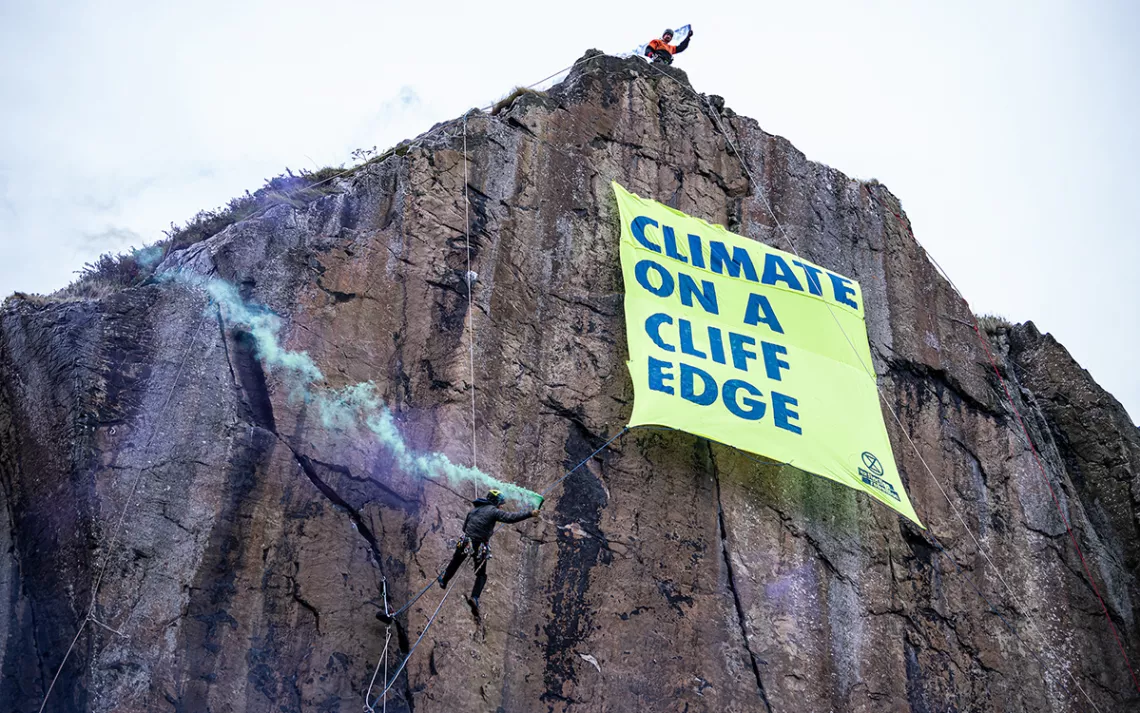
Experienced climbers scale a rock face near the historic Dumbarton castle in Glasgow, releasing a banner that reads “Climate on a Cliff Edge.” One activist, dressed as a globe, symbolically looms near the edge, while another plays the bagpipes on the shores below. | Photo courtesy of Extinction Rebellion and Mark Richards
I doubt that the Earth will be habitable or that humans can survive that increase – these 2 issues are essentially the same phrased in different ways. I suggest that 2300 should instead be regarded as the best estimate we have of our end date. It’s unfortunately a very rough and unreliable estimate and it might be better to rely on 30 or 40 years earlier.
12.45p.m. Researching this further, probably for a later article. There are projections for 2.6 to 3C rise by 2100.
10.50 p.m.GMT Apologies, did this post shock or startle some of you? Doesn’t it stand to reason? Global temperatures continue to rise due to the rich and powerful unopposed by any governments continuing use of fossil fuels, the climate is damaged and it will continue unless meaningful action is taken. I don’t intend to mislead you, my job is to inform my audience.
Neo-Fascist Climate Science Denier Donald Trump says Burn, Baby, Burn.Nigel Farage urges you to ignore facts and reality and be a climate science denier like him and his Deputy Richard Tice. He says that Reform UK has received £Millions and £Millions from the fossil fuel industry to promote climate denial and destroy the planet.
The Trump administration took a major step in its efforts to unravel America’s climate policies on Feb. 12, 2026, when it moved to rescind the 2009 endangerment finding – a formal determination that six greenhouse gases that drive climate change, including carbon dioxide and methane from burning fossil fuels, endanger public health and welfare.
But the administration’s arguments in dismissing the health risks of climate change are not only factually wrong, they’re deeply dangerous to Americans’ health and safety.
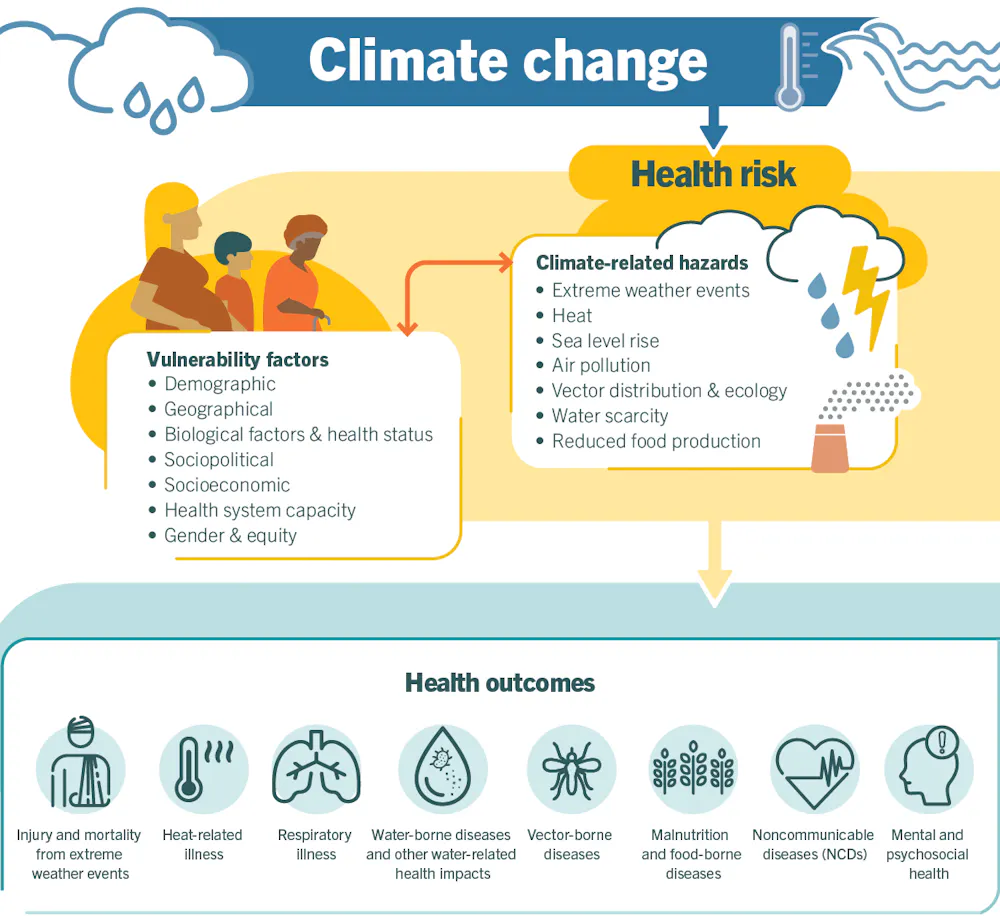
As physicians, epidemiologists and environmental healthscientists, we’ve seen growing evidence of the connections between climate change and harm to people’s health. Here’s a look at the health risks everyone face from climate change.
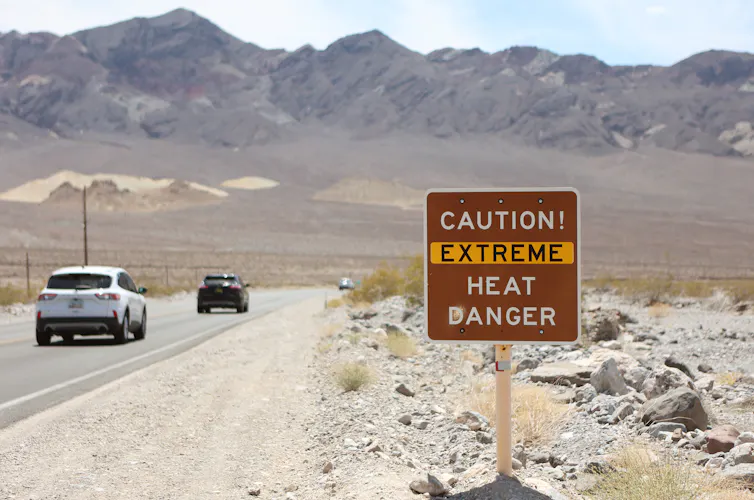
Greenhouse gases from vehicles, power plants and other sources accumulate in the atmosphere, trapping heat and holding it close to Earth’s surface like a blanket. Too much of it causes global temperatures to rise, leaving more people exposed to dangerous heat more often.
Most people who get minor heat illnesses will recover, but more extreme exposure, especially without enough hydration and a way to cool off, can be fatal. People who work outside, are elderly or have underlying illnesses such as heart, lung or kidney diseases are often at the greatest risk.
Heat deaths have been rising globally, up 23% from the 1990s to the 2010s, when the average year saw more than half a million heat-related deaths. Here in the U.S., the 2021 Pacific Northwest heat dome killed hundreds of people.
Climate scientists predict that with advancing climate change, many areas of the world, including U.S. cities such as Miami, Houston, Phoenix and Las Vegas, will confront many more days each year hot enough to threaten human survival.
Increased flooding carries health risks, including drownings, injuries and water contamination from human pathogens and toxic chemicals. People cleaning out flooded homes also face risks from mold exposure, injuries and mental distress.
Flooding from hurricanes and other extreme storms can put people at risk of injuries during the cleanup while also triggering dangerous mold growth on wet wallboard, carpets and fabric. This home flooded up to its second flood during Hurricane Irma in 2017. Sean Rayford/Getty Images
Climate change also worsens droughts, disrupting food supplies and causing respiratory illness from dust. Rising temperatures and aridity dry out forests and grasslands, making them a setup for wildfires.
Air pollution
Wildfires, along with other climate effects, are worsening air quality around the country.
Because they are cold-blooded organisms, insects are directly influenced by temperature. So with rising temperatures, mosquito biting rates rise as well. Warming also accelerates the development of disease agents that mosquitoes transmit.
As global temperatures rise, regions are becoming more suitable for mosquitoes to transmit dengue virus. The map shows a suitability scale, with red areas already suitable for dengue transmissions and yellow areas becoming more suitable. Taishi Nakase, et al., 2022, CC BY
New York and many other cities now open cooling centers during heat waves to help residents, particularly older adults who might not have air conditioning at home, stay safe during the hottest parts of the day. Angela Weiss/AFP via Getty Images
Young children, older adults, pregnant women and people with preexisting medical conditions are among the highest-risk groups. Lower-income people also face greater risk because of higher rates of chronic disease, higher exposures to climate hazards and fewer resources for protection, medical care and recovery from disasters.
The evidence is clear: Climate change endangers human health. But there’s a flip side to the story.
When governments work to reduce the causes of climate change, they help tackle some of the world’s biggest health challenges. Cleaner vehicles and cleaner electricity mean cleaner air – and less heart and lung disease. More walking and cycling on safe sidewalks and bike paths mean more physical activity and lower chronic disease risks. The list goes on. By confronting climate change, we promote good health.
To really make America healthy, in our view, the nation should acknowledge the facts behind the endangerment finding and double down on our transition from fossil fuels to a healthy, clean energy future.
Experienced climbers scale a rock face near the historic Dumbarton castle in Glasgow, releasing a banner that reads “Climate on a Cliff Edge.” One activist, dressed as a globe, symbolically looms near the edge, while another plays the bagpipes on the shores below. | Photo courtesy of Extinction Rebellion and Mark RichardsNeo-Fascist Climate Science Denier Donald Trump says Burn, Baby, Burn.Nigel Farage urges you to ignore facts and reality and be a climate science denier like him and his Deputy Richard Tice. He says that Reform UK has received £Millions and £Millions from the fossil fuel industry to promote climate denial and destroy the planet.
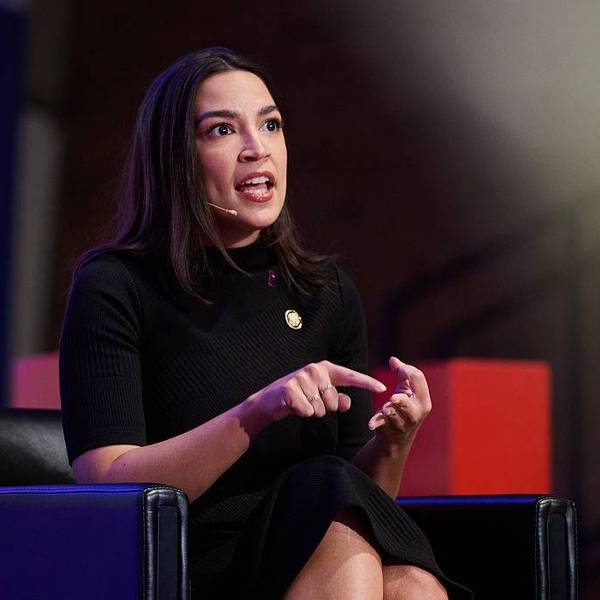
Alexandria Ocasio-Cortez, U.S. representative for New York’s 14th congressional district, speaks at a Townhall panel on populism at the 62nd Munich Security Conference on February 13, 2,026 in Munich, Germany. (Photo by Sean Gallup/Getty Images)
“An unmistakable majority wants a party that will fight harder against the corporations and rich people they see as responsible for keeping them down,” wrote the New Republic’s editorial director.
Democratic voters overwhelmingly want a leader who will fight the superrich and corporate America, and they believe Rep. Alexandria Ocasio-Cortez is the person to do it, according to a poll released this week.
While Democrats are often portrayed as squabbling and directionless, the poll conducted last month by the New Republic with Embold Research demonstrated a remarkable unity among the more than 2,400 Democratic voters it surveyed.
This was true with respect to policy: More than 9 in 10 want to raise taxes on corporations and on the wealthiest Americans, while more than three-quarters want to break up tech monopolies and believe the government should conduct stronger oversight of business.
But it was also reflected in sentiments that a more confrontational governing philosophy should prevail and general agreement that the party in its current form is not doing enough to take on its enemies.
Three-quarters said they wanted Democrats to “be more aggressive in calling out Republicans,” while nearly 7 in 10 said it was appropriate to describe their party as “weak.”
This appears to have translated to support for a more muscular view of government. Where the label once helped to sink Sen. Bernie Sanders’ (I-Vt.) two runs for president, nearly three-quarters of Democrats now say they are either unconcerned with the label of “socialist” or view it as an asset.
Meanwhile, 46% said they want to see a “progressive” at the top of the Democratic ticket in 2028, higher than the number who said they wanted a “liberal” or a “moderate.”
It’s an environment that appears to be fertile ground for Ocasio-Cortez, who pitched her vision for a “working-class-centered politics” at this week’s Munich summit in what many suspected was a soft-launch of her presidential candidacy in 2028.
Congresswoman @AOC is currently one of the most popular figures among Democrats—maybe even the most popular.
With 85% favorability, Bronx congresswoman had the highest approval rating of any Democratic figure in the country among the voters surveyed.
It’s a higher mark than either of the figures who head-to-head polls have shown to be presumptive favorites for the nomination: Former Vice President Kamala Harris and California Gov. Gavin Newsom.
Early polls show AOC lagging considerably behind these top two. However, there are signs in the New Republic’s poll that may give her supporters cause for hope.
Embold Research poll | 1/7-1/16 (released 2/12)
(Democratic voters surveyed nationwide)
Do you think Kamala Harris should run for president again in 2028, or do you think she had her shot?
While Harris is also well-liked, 66% of Democrats surveyed said they believe she’s “had her shot” at the presidency and should not run again after losing to President Donald Trump in 2024.
Newsom does not have a similar electoral history holding him back and is riding high from the passage of Proposition 50, which will allow Democrats to add potentially five more US House seats this November.
But his policy approach may prove an ill fit at a time when Democrats overwhelmingly say their party is “too timid” about taxing the rich and corporations and taking on tech oligarchs.
As labor unions in California have pushed for a popular proposal to introduce a billionaire’s tax, Newsom has made himself the chiseled face of the resistance to this idea, joining with right-wing Silicon Valley barons in an aggressive campaign to kill it.
While polls can tell us little two years out about what voters will do in 2028, New Republic editorial director Emily Cooke said her magazine’s survey shows an unmistakable pattern.
“It’s impossible to come away from these results without concluding that economic populism is a winning message for loyal Democrats,” she wrote. “This was true across those who identify as liberals, moderates, or progressives: An unmistakable majority wants a party that will fight harder against the corporations and rich people they see as responsible for keeping them down.”
Orcas discuss Donald Trump and the killer apes’ concept of democracy. Front Orca warns that Trump is crashing his country’s economy and that everything he does he does for the fantastically wealthy.Donald Fuhrump says that Amerikkka doesn’t bother with crimes or charges anymore, not being 100% Amerikkkan and opposing his real estate intentions is enough.Front Orca supports AOC, urges her to kick some ass.