A view of International Court of Justice (ICJ) on August 07, 2024 [Dursun Aydemir/Anadolu Agency]
Ireland has submitted a declaration to join South Africa’s genocide case against Israel, the International Court of Justice (ICJ) said Tuesday, Anadolu Agency reports.
“Ireland, invoking Article 63 of the Statute of the Court, filed in the Registry of the Court a declaration of intervention in the case concerning Application of the Convention on the Prevention and Punishment of the Crime of Genocide in the Gaza Strip,” or South Africa versus Israel, the Court said in a statement.
Irish Foreign Minister, Micheal Martin, announced last month that they would join the case after they secured government approval for the move under the Genocide Convention.
Under Article 63, any state party to a convention that is under judicial consideration has the right to intervene, making the ICJ’s interpretation of that convention binding on them as well.
In December 2023, South Africa filed an application instituting proceedings against Israel, claiming violations of the Genocide Convention in relation to Palestinians in the Gaza Strip. Several countries have since joined the case, including Nicaragua, Colombia, Libya, Mexico, Palestine, Spain and Turkiye.
Israel has continued its brutal offensive on Gaza since a Hamas attack in October 2023 despite a UN Security Council resolution demanding an immediate ceasefire.
Nearly 46,000 people, mostly women and children, have since been killed and over 105,000 injured, according to local health authorities.
The Israeli onslaught has displaced almost the entire population of the Territory amid an ongoing blockade that has led to severe shortages of food, clean water and medicine.
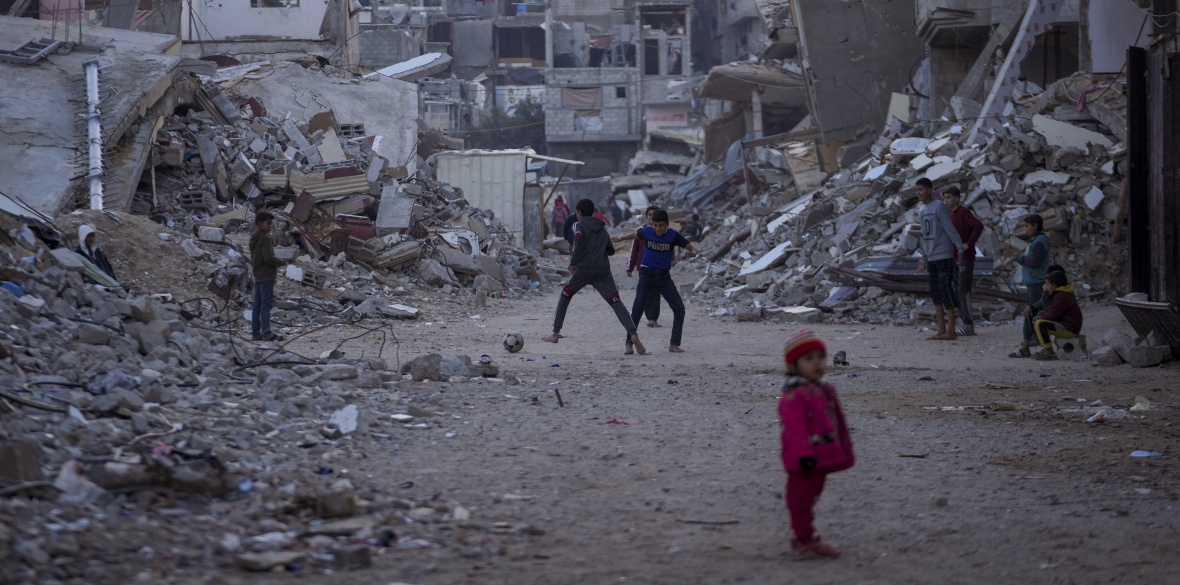
Palestinian children play next to buildings destroyed by Israeli army strikes in Khan Younis, Gaza Strip, January 7, 2025
PRESSURE continues to mount on the government over its backing for Israel and its failure to take any serious measures to impede its genocide of the Palestinian people.
MPs from all parts of the Commons united at the first opportunity in the new year to demand that ministers act.
Even many Tory backbenchers — although not Kemi Badenoch’s front bench — seem disgusted at Britain’s continuing complicity with Israeli war crimes.
Vocal support for Israel seems to be draining away on the Labour back benches, while Liberal Democrat, SNP, Green and independent MPs are more-or-less united in urging a change of course.
There are several concrete actions they are demanding that the government should take.
First is an end to all arms sales to the Israeli regime. So far the government has only suspended a minority of the licences which permit the export of British military equipment to Israel.
Yet there is now little room for doubt that the Israeli military is engaging in war crimes daily and is in continual breach of international law.
Continuing to supply the Israeli war machine with equipment makes ministers themselves culpable for the consequences.
Genocide denier and Current UK Prime Minister Keir Starmer is quoted that he supports Zionism without qualification. He also confirms that UK air force support has been essential in Israel’s mass-murdering genocide. Includes URLs https://www.declassifieduk.org/keir-starmers-100-spy-flights-over-gaza-in-support-of-israel/ and https://youtu.be/O74hZCKKdpAUK Foreign Minister David Lammy confirms that UK government and military are active participants in Israel’s genocides and that the F-35 parts that they suspended from supplying to Israel are instead simply diverted via the United States. He says see https://youtu.be/QILgUHrdWRE
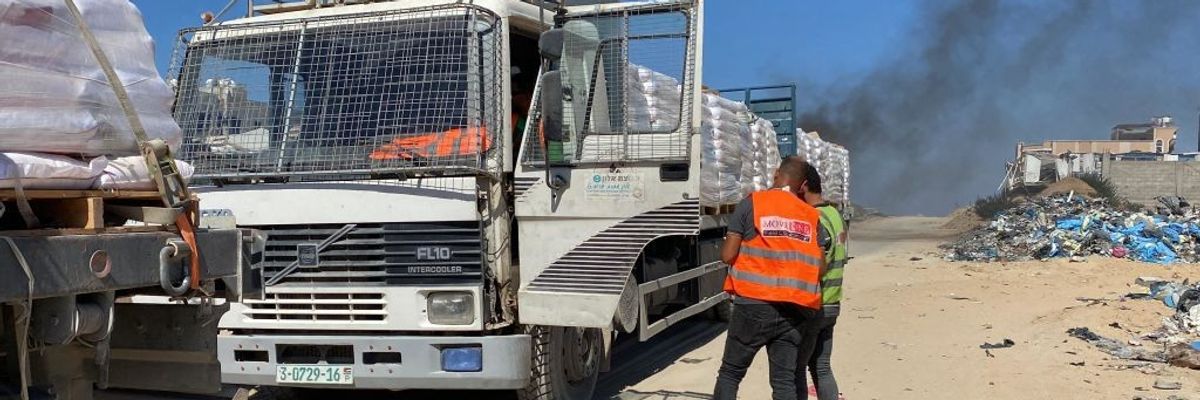
Humanitarian aid trucks belonging to the World Food Program arrive in Gaza on September 26, 2024. (Photo: Hasan Zaain/Anadolu via Getty Images)
“This unacceptable event is just the latest example of the complex and dangerous working environment that WFP and other agencies are operating in today,” said the United Nations agency.
The United Nations World Food Program said Monday that Israeli forces opened fire on one of the organization’s aid convoys at a checkpoint in central Gaza over the weekend, an attack that the organization condemned as “horrifying.”
“This unacceptable event is just the latest example of the complex and dangerous working environment that WFP and other agencies are operating in today,” the organization said in a statement, noting that the convoy was “clearly marked” and that it had “received all of the necessary clearances from Israeli authorities” prior to Sunday’s attack.
“Security conditions in Gaza must urgently improve for lifesaving humanitarian assistance to continue,” WFP said, urging “all parties to respect international humanitarian law, protect civilian lives, and allow safe passage for humanitarian aid.”
At least 16 bullets struck the WFP convoy on Sunday, but none of the eight staffers traveling in the three vehicles that came under Israeli attack on Sunday were killed or wounded, WFP said.
It was nonetheless a “terrifying encounter” that underscored the dangers facing aid workers attempting to deliver food and other necessities to starving and desperate people across the Gaza Strip.
ABSOLUTELY UNACCEPTABLE: A @WFP convoy, clearly marked & carrying 8 team members, was shot at by Israeli forces near Wadi Gaza despite prior clearances. Humanitarians are #NotATarget!
Last year was the deadliest on record for aid workers around the world, according to the U.N. Office for the Coordination of Humanitarian Affairs, with Israeli attacks in Gaza fueling a surge in killings.
Philippe Lazzarini, commissioner-general of the U.N. Relief and Works Agency for Palestine Refugees in the Near East (UNRWA), said in an October speech to the U.N. Security Council that Gaza is “the most dangerous place in the world for aid workers.”
Sunday wasn’t the first time Israeli forces have fired on a WFP convoy in Gaza during their 15-month assault on the Palestinian enclave. Last August, the WFP was forced to temporarily halt employee movements in Gaza after Israeli soldiers fired on one of the U.N. agency’s vehicles.
Stéphane Dujarric, spokesman for U.N. Secretary-General António Guterres, said Monday that WFP is “trying to get the answers” from Israeli forces on why they once again fired on an aid convoy, an attack that came as a new round of cease-fire talks began in Doha, brokered by Qatar and Egypt.
“I don’t think there’s an explanation for shooting at a clearly marked convoy from the World Food Program, whose movements had been completely coordinated with the Israeli security forces,” said Dujarric.
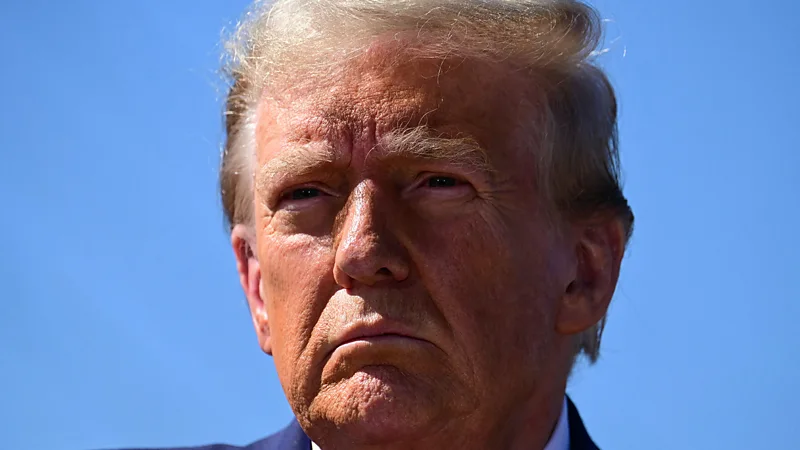
Donald Trump has voiced plans to withdraw the US from the Paris Agreement, and possibly from the entire UNFCCC, after assuming the US presidency this year (Credit: Getty Images)
…
Yearlong: Extreme weather continues
As these global opportunities to make a difference on climate roll around, there is another certainty running through the calendar year: climate-driven extreme weather.
As long as we continue to burn fossil fuels, headlines in 2025 and beyond will continue to be dominated by large death tolls, suffering and destruction due to ever more extreme weather events – Friederike Otto
What’s harder to know is exactly when disasters will hit. But 2025 is also expected to be a scorcher: it will be one of the three hottest years on record globally, according to an outlook from the UK’s Met Office, falling just behind 2024 and 2023. Warm temperatures are forecast in 2025 despite the Pacific Ocean moving into a La Niña phase, in which sea surface temperatures are lower than usual and conditions overall are cooler.
“Years such as 2025, which aren’t dominated by the warming influence of El Niño, should be cooler,” Adam Scaife, head of long-range prediction at the Met Office, stated in the outlook.
Still, the Met Office expects average global temperature in 2025 to be 1.29C to 1.53C above pre-industrial temperatures.
Friederike Otto, who leads World Weather Attribution group, says the La Niña predictions mean 2025 “might be cooler than 2024” but argues “this is really irrelevant” if natural climate variability is masking the overall warming trend.
Climate and environmental protest is being criminalised and repressed around the world. The criminalisation of such protest has received a lot of attention in certain countries, including the UK and Australia. But there have not been any attempts to capture the global trend – until now.
We recently published a report, with three University of Bristol colleagues, which shows this repression is indeed a global trend – and that it is becoming more difficult around the world to stand up for climate justice.
This criminalisation and repression spans the global north and south, and includes more and less democratic countries. It does, however, take different forms.
Our report distinguishes between climate and environmental protest. The latter are campaigns against specific environmentally destructive projects – most commonly oil and gas extraction and pipelines, deforestation, dam building and mining. They take place all around the world.
Climate protests are aimed at mitigating climate change by decreasing carbon emissions, and tend to make bigger policy or political demands (“cut global emissions now” rather than “don’t build this power plant”). They often take place in urban areas and are more common in the global north.
The intensifying criminalisation and repression is taking four main forms.
1. Anti-protest laws are introduced
Anti-protest laws may give the police more powers to stop protest, introduce new criminal offences, increase sentence lengths for existing offences, or give policy impunity when harming protesters. In the 14 countries we looked at, we found 22 such pieces of legislation introduced since 2019.
2. Protest is criminalised through prosecution and courts
This can mean using laws against climate and environmental activists that were designed to be used against terrorism or organised crime. In Germany, members of Letzte Generation (Last Generation), a direct action group in the mould of Just Stop Oil, were charged in May 2024 with “forming a criminal organisation”. This section of the law is typically used against mafia organisations and had never been applied to a non-violent group.
Criminalising protest can also mean lowering the threshold for prosecution, preventing climate activists from mentioning climate change in court, and changing other court processes to make guilty verdicts more likely. Another example is injunctions that can be taken out by corporations against activists who protest against them.
3. Harsher policing
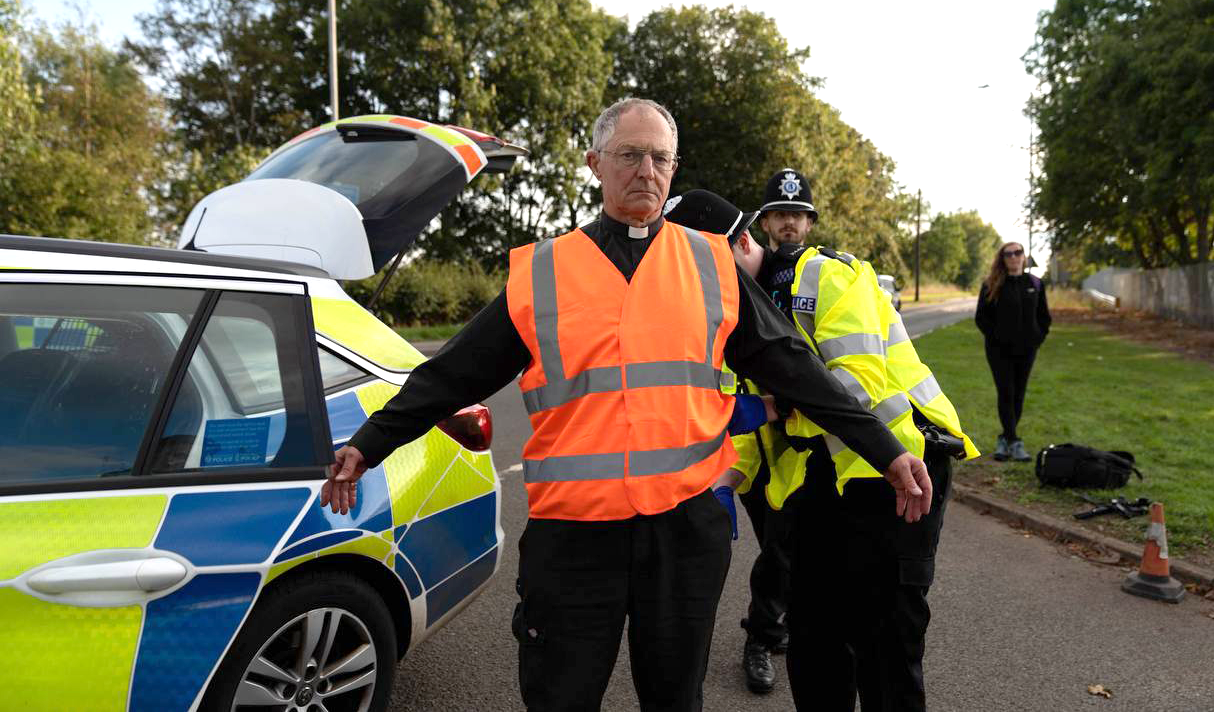
This stretches from stopping and searching to surveillance, arrests, violence, infiltration and threatening activists. The policing of activists is carried out not just by state actors like police and armed forces, but also private actors including private security, organised crime and corporations.
In Germany, regional police have been accused of collaborating with an energy giant (and its private fire brigade) to evict coal mine protesters, while private security was used extensively in policing anti-mining activists in Peru.
4. Killings and disappearances
Lastly, in the most extreme cases, environmental activists are murdered. This is an extension of the trend for harsher policing, as it typically follows threats by the same range of actors. We used data from the NGO Global Witness to show this is increasingly common in countries including Brazil, Philippines, Peru and India. In Brazil, most murders are carried out by organised crime groups while in Peru, it is the police force.
Protests are increasing
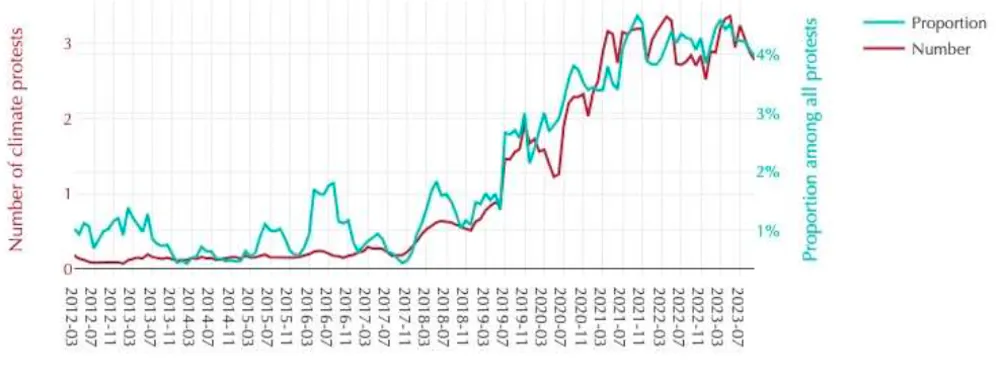
To look more closely at the global picture of climate and environmental protest – and the repression of it – we used the Armed Conflicts Location Event database. This showed us that climate protests increased dramatically in 2018-2019 and have not declined since. They make up on average about 4% of all protest in the 81 countries that had more than 1,000 protests recorded in the 2012-2023 period:
Climate protests increased sharply in the late 2010s in the 14 countries studied. (Data is smoothed over five months; number of protests is per country per month.) Berglund et al; Data: ACLED, CC BY-SA
This second graph shows that environmental protest has increased more gradually:
Environmental protests in the same 14 countries. Data: ACLED, CC BY-SA
We used this data to see what kind of repression activists face. By looking for keywords in the reporting of protest events, we found that on average 3% of climate and environmental protests face police violence, and 6.3% involve arrests. But behind these averages are large differences in the nature of protest and its policing.
A combination of the presence of protest groups like Extinction Rebellion, who often actively seek arrests, and police forces that are more likely to make arrests, mean countries such as Australia and the UK have very high levels of arrest. Some 20% of Australian climate and environmental protests involve arrests, against 17% in the UK – with the highest in the world being Canada on 27%.
Meanwhile, police violence is high in countries such as Peru (6.5%) and Uganda (4.4%). France stands out as a European country with relatively high levels of police violence (3.2%) and low levels of arrests (also 3.2%).
In summary, while criminalisation and repression does not look the same across the world, there are remarkable similarities. It is increasing in a lot of countries, it involves both state and corporate actors, and it takes many forms.
This repression is taking place in a context where states are not taking adequate action on climate change. By criminalising activists, states depoliticise them. This conceals the fact these activists are ultimately right about the state of the climate and environment – and the lack of positive government action in these areas.