Teams and civilians conduct a search and rescue under debris of destroyed building, belonged to Palestinians Al Naami family, following the Israeli attack on Maghazi refugee camp in Gaza City, Gaza on December 28, 2024 [Ashraf Amra – Anadolu Agency]
Israel has spent more than a decade developing its “AI factory,” a system used to support its military attacks on Gaza since 7 October, 2023, The Washington Post reported.
Citing multiple sources familiar with Israel’s use of artificial intelligence in Gaza, the daily reported that Israel has been advancing AI technology for over 10 years to target locations in Gaza more efficiently.
Some sources, including former Israeli military personnel, expressed concern that the Israeli military’s use of AI has significantly increased civilian casualties.
The report reveals that AI systems, including “Gospel” and “Lavender,” processed intelligence at an unprecedented pace, enabling the Israeli military to bomb 12,000 targets in Gaza in weeks.
Soldiers worked in what was described as a “target factory,” prioritizing speed over intelligence assessment and reducing the time needed for evaluation to as little as three minutes.
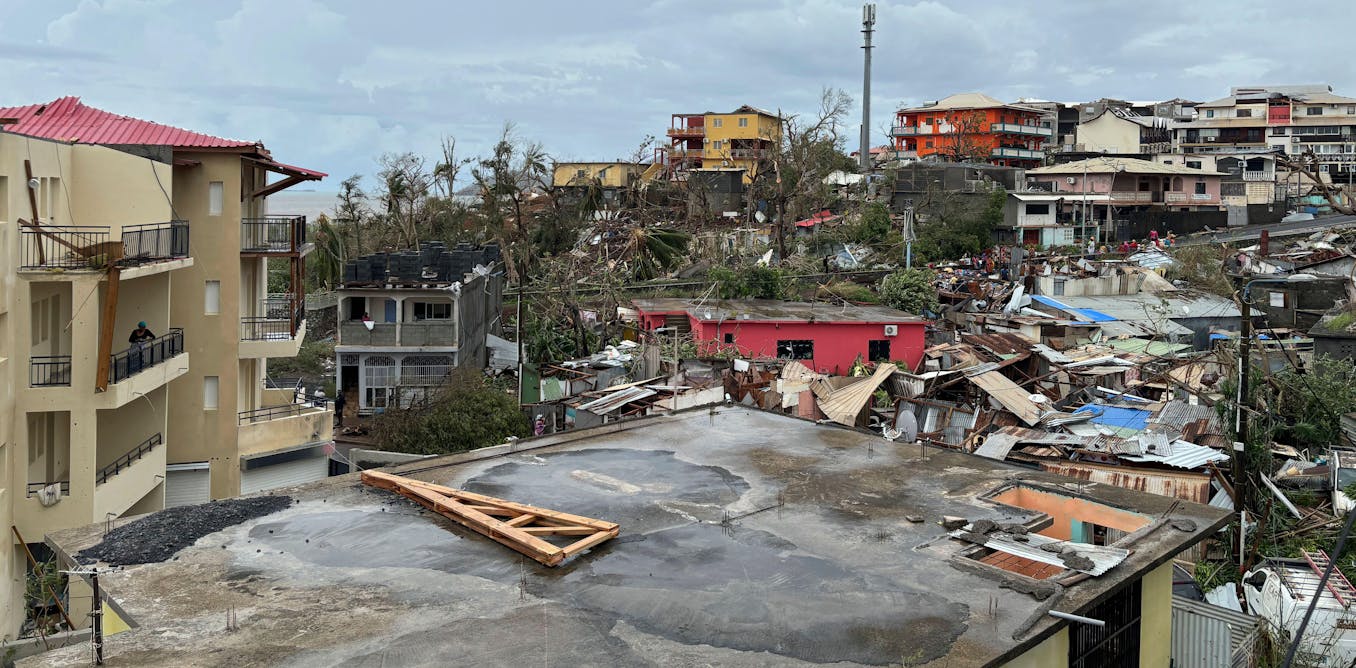
Damaged houses in Mamoudzou, in the French Indian Ocean territory of Mayotte on December 16 2024 after being battered by the islands’ worst cyclone in nearly a century. Associated Press / Alamy Stock Photo
Cyclone Chido was an “intense tropical cyclone”, equivalent to a category 4 hurricane in the Atlantic. It made landfall in Mayotte, a small island lying to the north-west of Madagascar on December 14, generating wind gusts approaching 155mph (250km/hr). Later on, it hit Mozambique, East Africa with the same ferocity.
This storm skirted north of Madagascar and affected the Comoros archipelago before making landfall in Mozambique. It is well within the range of what is expected for this part of the Indian Ocean. But this region has experienced an increase in the most intense tropical cyclones in recent years. This, alongside its occurrence so early in the season, can be linked to increases in ocean temperatures as a result of climate change.
News of the effects of tropical cyclone Chido in Mayotte, Mozambique and Malawi continues to emerge. Current estimates suggest 70% of Mayotte’s population have been affected, with over 50,000 homes in Mozambique partially or completely destroyed.
Ongoing conflict in Mozambique and undocumented migration to Mayotte will have played a key role in the number of deaths and the infrastructure damage.
Assessing how these cyclones characteristics are changing across southern Africa is part of the research we are involved in. Our team also studies how to build resilience to cyclones where conflict, displacement and migration magnify their effects.
A human-made disaster?
The risk that tropical cyclones pose to human life is exacerbated by socioeconomic issues. Migrants on Mayotte, many of whom made perilous journeys to escape conflict in countries such as the Democratic Republic of Congo, now make up more than half of the island’s population.
Precarious housing and the undocumented status of many residents reportedly made the disaster more deadly, as people feared evacuation would lead them to the police. On islands with poor infrastructure such as Mayotte, there is often simply nowhere safe to go. It takes many days for the power network and drinking water supply to be restored.
The situation is particularly complex in Mozambique. The ongoing conflict and terrorist violence, coupled with cyclones, including Kenneth in 2019, has caused repeated evacuations and worsening living conditions. Cabo Delgado and Nampula in the far north of Mozambique, the provinces most affected by both Chido and the conflict, rank among the poorest and most densely populated in the country due to limited education, scarce livelihood options and an influx of people displaced by violence.
As of June 2024, more than half a million people remained without permanent homes in the region, many living in displacement camps. That number is likely to rise significantly after Chido.
Compounding the crisis, Chido’s landfall so early in the cyclone season meant that the usual technical and financial preparations were not yet fully ramped up, with low stock levels delaying the timely delivery of aid. Unrest following elections in November hampered preparations further, cutting the flow of resources and personnel needed for anticipatory action and early response.
Tropical cyclones in a warmer world
Warmer sea surface temperatures not only provide more fuel for stronger storms, but may also expand the regions at risk of tropical cyclones.
Climate simulations predict that storms will continue getting stronger as we further warm our world, and could even lead to an unprecedented landfall as far south as the Mozambican capital, Maputo.
Scientists carry out attribution studies to determine how climate change contributed to specific events. Scientists undertaking rapid attribution studies of Chido have found that the ocean surface temperatures along the path of the storm were 1.1°C warmer than they would have been without climate change. So, temperatures this warm were made more than 50 times more likely by climate change. Another study focusing on Chido itself concluded that the cyclone’s winds were 5% faster due to global heating caused by burning fossil fuels, enough to bump it from a category 3 to a category 4 storm.
Intense winds are not the only hazard. Scientists are confident that tropical cyclones will dump more rain as a result of climate change. A trend towards slower-moving storms has been observed, causing more of that rain to accumulate in a single location, resulting in floods.
Cyclone Freddy delivered a year’s worth of rain to southern Malawi in just four days in March 2023. Storm surges, exacerbated by sea level rise, also raise the scale of flooding, as in the devastating Cyclone Idai in March 2019. An increase in the number of storms that rapidly intensify, as Chido did before landfall in Mayotte has also been linked to climate change, which makes it harder to provide early warnings.
To improve resilience to future cyclones, conflict, migration and social dynamics must be considered alongside climate change, without this, displaced and migrant communities will continue to be the most affected by the risks that climate change poses.
United Nations Secretary-General António Guterres speaks at the U.N. headquarters on February 22, 2023. (Photo: Lev Radin/Pacific Press/LightRocket via Getty Images)
“This is climate breakdown—in real time,” said United Nations Secretary-General António Guterres.
United Nations Secretary-General António Guterres said in a year-end message on Monday that “we have no time to lose” in the face of the worsening global climate crisis, which pushed temperatures to a record high this year and supercharged deadly extreme weather around the world.
“Today, I can officially report that we have just endured a decade of deadly heat,” Guterres said in a video message posted to social media. “The top 10 hottest years on record have happened in the last 10 years, including 2024.”
“This is climate breakdown in real time. We must exit this road to ruin,” he continued. “In 2025, countries must put the world on a safer path by dramatically slashing emissions and supporting the transition to a renewable future. It is essential—and it is possible.”
Guterres’ call to action came in the waning days of what scientists say is almost certain to be the hottest year on record and the first full year to breach the critical 1.5°C temperature threshold.
Celeste Saulo, secretary-general of the World Meteorological Organization (WMO), echoed Guterres’ warning about the dire consequences of the status quo, saying in a statement Monday that “if we want a safer planet, we must act now.”
“It’s our responsibility. It’s a common responsibility, a global responsibility,” Saulo said. “Every fraction of a degree of warming matters, and increases climate extremes, impacts, and risks. Temperatures are only part of the picture. Climate change plays out before our eyes on an almost daily basis in the form of increased occurrence and impact of extreme weather events.”
Last month, with emissions continuing to surge as the rich nations most responsible for the climate emergency refuse to ditch fossil fuels, world leaders convened for a U.N. climate summit in Azerbaijan that was swarmed by oil and gas lobbyists. The key gathering ended with a deal that climate advocates described as a step backward in the necessary push to rein in fossil fuel emissions.
Climate-denier and fossil fuel booster Donald Trump’s looming return to office in the U.S.—the world’s largest historical emitter—has campaigners and scientists increasingly concerned about the future of existing global climate agreements such as the Paris accord, from which the president-elect has pledged to withdraw once again.
One recent analysis projected that a second Trump administration could unleash an additional 4 billion tonnes of carbon dioxide equivalent by 2030, which would inflict $900 billion in global climate damages and deal a devastating blow to efforts to forestall runaway warming.
Throughout 2024, Guterres used his role as head of the U.N. to sound the alarm about the world’s dangerous trajectory, saying in an October address that “there is a direct link between increasing emissions and increasingly frequent and intense climate disasters.”
“We’re playing with fire,” he said, “but there can be no more playing for time.”
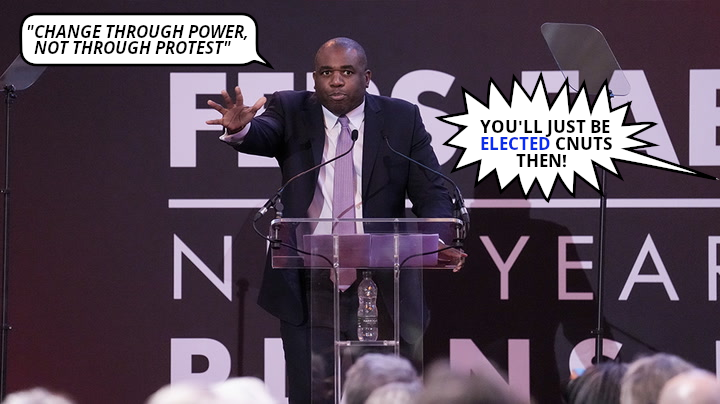
UK Foreign Minister David Lammy confirms that UK government and military are active participants in Israel’s genocides and that the F-35 parts that they suspended from supplying to Israel are instead simply diverted via the United States. He says see https://youtu.be/QILgUHrdWRE
Peace campaigners blast government for ‘aiding and abetting’ Israel’s genocide in Gaza while announcing extra millions to prosecute Russian war criminals
THE British government was accused of “hypocrisy and double standards” today after announcing extra millions in funding to prosecute Russian war criminals in Ukraine while arming Israel’s criminal genocide in Gaza.
The Ministry of Defence said that it is to give £4.5 million to support Ukrainian documentation, investigation and prosecution of Russian war crimes.
The money comes on top of £6.2m previously committed.
…
Stop the War Coalition convener Lindsey German told the Morning Star: “The reek of hypocrisy and double standards coming from Whitehall has rarely been stronger.
“This latest announcement is about the most brazen yet. It is giving millions to investigate Russian war crimes while at the same time is aiding and abetting the war criminal [Israeli PM Benjamin] Netanyahu by providing weapons, military support and political succour to a government committing genocide against the Palestinians.
“If David Lammy wants to do the right thing he should stop arming Israel and demand a complete cessation to Israel’s attacks on Yemen, Lebanon and Syria as well as his ethnic cleansing of Gaza and the West Bank.”
Genocide denier and Current UK Prime Minister Keir Starmer is quoted that he supports Zionism without qualification. He also confirms that UK air force support has been essential in Israel’s mass-murdering genocide. Includes URLs https://www.declassifieduk.org/keir-starmers-100-spy-flights-over-gaza-in-support-of-israel/ and https://youtu.be/O74hZCKKdpAUK Labour Party Shadow Foreign Secretary repeatedly heckled at a speech to the Fabian Society over his and the Labour Party’s support for and complicity in Israel’s genocide of Gaza.