A view of the Qubbat al-Sakhra (Dome of the Rock) at Al-Aqsa mosque compound, where the first qibla of Muslims, in Jerusalem on April 19, 2024 [Mostafa Alkharouf – Anadolu Agency]
Qatar has strongly condemned the storming of Al-Aqsa Mosque by the Israeli National Security Minister Itamar Ben-Gvir under the protection of occupation forces.
In a statement issued yesterday, the Qatari Foreign Ministry stated that repeated attempts to undermine the religious and historical status of Al-Aqsa Mosque are not only an attack on Palestinians but also on over two billion Muslims worldwide.
It also warned about the continuation of the aggressive policies adopted by the Israeli government in the occupied Palestinian territories, highlighting their impact on increasing violence in the region and undermining efforts for a two-state solution and achieving a comprehensive, just and sustainable peace.
Qatar reaffirmed its steadfast position on justice for the Palestinian cause and the legitimate rights of the Palestinian people, including their full right to practice their religious rituals without restrictions and to establish their independent state based on the 1967 borders, with East Jerusalem as its capital.
Earlier yesterday, extremist minister, Itamar Ben-Gvir, stormed Al-Aqsa Mosque with a group of settlers. They were heavily guarded by occupation police. This is thought to be part of his efforts to mark the Jewish holiday of Hanukkah.
Thousands of Israelis gather in front of the Israel’s Ministry of Defense building, holding banners and Israeli flags to protest against Israeli Prime Minister Benjamin Netanyahu and his government for not signing the ceasefire agreement with Gaza and to demand hostage swap deal with Palestinians in Tel Aviv, Israel on November 16, 2024 [Mostafa Alkharouf – Anadolu Agency]
Families of Israeli hostages in Gaza threatened legal action on Thursday against Prime Minister Benjamin Netanyahu, accusing him of blocking a prisoner swap deal with Palestinians, Anadolu Agency reports.
“We will petition the High Court if you persist in abandoning our loved ones in Hamas captivity,” the families said in a letter to Netanyahu cited by Israeli daily Yedioth Ahronoth.
The letter accused the Israeli premier of hindering efforts to reach a prisoner exchange agreement with Hamas.
“Refusing to end the war sacrifices the hostages and diminishes their chances of returning alive,” it reads.
On Wednesday, Hamas said that a Gaza cease-fire and prisoner swap has been delayed due to new Israeli conditions.
“The (Israeli) occupation set new issues and conditions related to withdrawal, ceasefire, prisoners, and the return of the displaced, which delayed reaching an agreement that was available,” it added in a statement.
On Tuesday, Netanyahu said that an Israeli negotiating team would return from Qatar for consultations on a potential prisoner exchange deal with Hamas.
Observers, however, view Netanyahu’s announcement as part of a pattern of delays in negotiations.
Since the lone ceasefire in late November 2023, the Israeli premier has hinted at progress in talks for a prisoner swap and a potential cease-fire, only to later insist on continuing military operations in the Gaza Strip.
Netanyahu told The Wall Street Journal last week that the Gaza war will continue “until Hamas is entirely eradicated,” emphasizing Israel’s rejection of Hamas’ presence near its borders.
His Defense Minister Israel Katz also said that Israel will maintain security control in Gaza and establish buffer zones along the border.
Their remarks drew fire from officials in Israel’s negotiating team for jeopardizing talks to reach a Gaza cease-fire and prisoner swap deal with Hamas.
Israel is believed to hold more than 10,300 Palestinian prisoners, while approximately 100 Israeli captives are in Gaza. Hamas has said that dozens of the captives were killed in indiscriminate Israeli airstrikes.
Israel has continued a genocidal war on Gaza that has killed nearly 45,400 people, most of them women and children, since a Hamas attack on 7 October, 2023.
Last month, the International Criminal Court issued arrest warrants for Netanyahu and his former Defense Minister Yoav Gallant for war crimes and crimes against humanity in Gaza.
Israel is also facing a genocide case at the International Court of Justice for its actions in Gaza.
Nearly half of countries endured at least two months of high-risk temperatures, data shows. Photograph: Fernando Bustamante/AP
Analysis shows fossil fuels are supercharging heatwaves, leaving millions prone to deadly temperatures
The climate crisis caused an additional six weeks of dangerously hot days in 2024 for the average person, supercharging the fatal impact of heatwaves around the world.
The effects of human-caused global heating were far worse for some people, an analysis by World Weather Attribution (WWA) and Climate Central has shown. Those in Caribbean and Pacific island states were the hardest hit. Many endured about 150 more days of dangerous heat than they would have done without global heating, almost half the year.
Nearly half the world’s countries endured at least two months of high-risk temperatures. Even in the least affected places, such as the UK, US and Australia, the carbon pollution from fossil fuel burning has led to an extra three weeks of elevated temperatures.
Worsened heatwaves are the deadliest consequence of the climate emergency. An end to coal, oil and gas burning was vital to stopping the effects getting even worse, the scientists said, with 2024 forecast to be the hottest year on record with record-high carbon emissions.
The researchers called for deaths from heatwaves to be reported in real time, with current data being a “very gross underestimate” because of the lack of monitoring. It is possible that uncounted millions of people have died as a result of human-caused global heating in recent decades.
Meta, led by Mark Zuckerberg (left), and Amazon, led by Jeff Bezos, gave $1m each. Photograph: Getty Images
Donations, not restricted by campaign finance laws, come as industries seek favor with incoming administration
US business leaders are spending big on Donald Trump’s second inaugural fund, which is predicted to exceed even the record-setting $107m raised in 2017.
The donations, which are not restricted by campaign finance laws, come as industries and business leaders seek to curry favor with the incoming administration after the president-elect decisively won a second, non-consecutive term in November.
Some of the planned donationsreportedly include $1m each from Jeff Bezos’s Amazon, OpenAI CEO Sam Altman and Facebook parent company Meta, led by Mark Zuckerberg.
Hedge-fund manager Ken Griffin has said he plans to donate $1m, Bloomberg reported; Uber and its CEO Dara Khosrowshahi are reported to be chipping in $1m each; and Toyota, Ford and General Motors are each peeling off $1m. Ford is also reportedly coupling its donation with a fleet of vehicles.
“EVERYBODY WANTS TO BE MY FRIEND!!!” Trump wrote in a post on Truth Social on Thursday.
Many senior executives in US industries and finance have already made the trip to Mar-a-Lago, Trump’s transition team headquarters, or are planning to, according to reports, as they seek to gain influence and access to the incoming administration that’s threatening to shake up international trading norms.
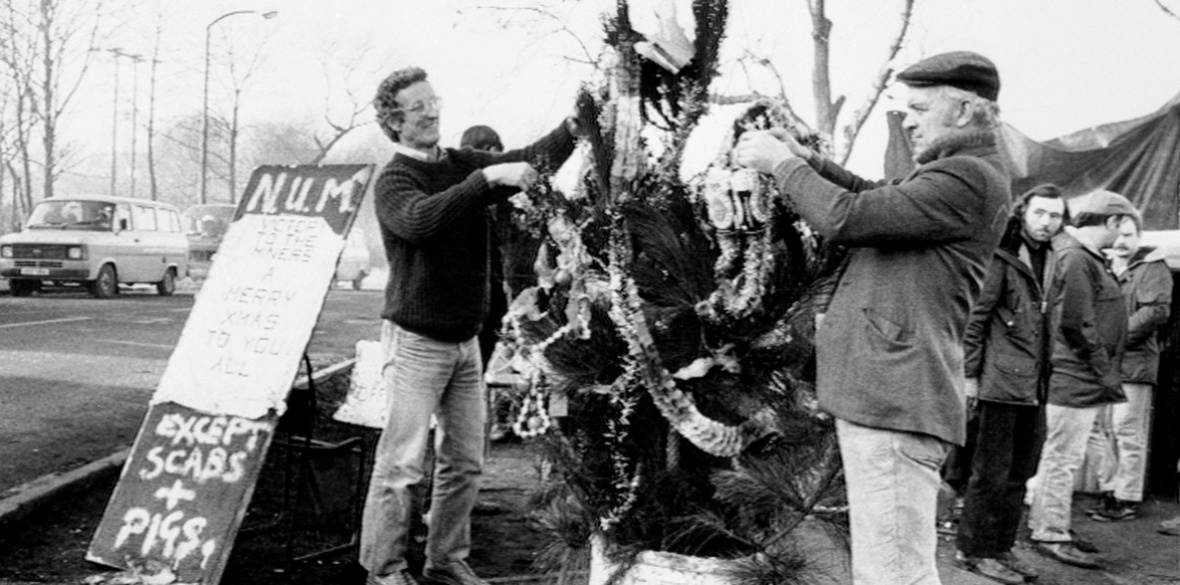
Picketers decorate a Christmas tree outside Rossington Colliery, while police transit vans line the roadway, December 11, 1984
CHRISTMAS 1984 was potentially a desperate time for the families of miners who had been on strike against pit closures for nine months. It turned out to be the opposite for many striking mining communities.
France’s communist-led union group CGT sent a convoy of 30 lorries, driven by volunteers and packed with food and toys, across the Channel. The union had mounted a “toy drive” among its members, and thousands had flooded in.
The convoy arrived at Dover, and the lorries journeyed to struggling mining communities in Wales and northern England.
Hundreds of miners’ support groups across the country redoubled their solidarity efforts — and the public responded generously.
The result for many striking miners and their families was the best Christmas they had ever had. And the solidarity is remembered today across the former coalfields.
In the north-east, Ian Lavery, now Labour MP for Blyth and Ashington, was a 20-year-old miner at Ellington Colliery in Northumberland. He lived with his parents and siblings. His father was a striking miner, as were two of his three brothers.
He told the Morning Star: “It was one of the best times of my life.
“At Christmas time 1984, none of us had a ha’penny — no money at all. But one thing about miners and working-class people is that they will do anything to make sure the kids have a good Christmas. Whatever the situation — on strike for seven or eight months — we would not let the kids down.
“It was fabulous to see the juggernauts arriving from France. They provided every striking miner’s kid with a toy at Christmas. Honestly, there was juggernaut after juggernaut come all the way from France. Absolutely amazing. Then there were the chickens and the turkeys. They were on the Christmas table of every striking miner. It was just fabulous.
“There were Christmas parties in every village and community.