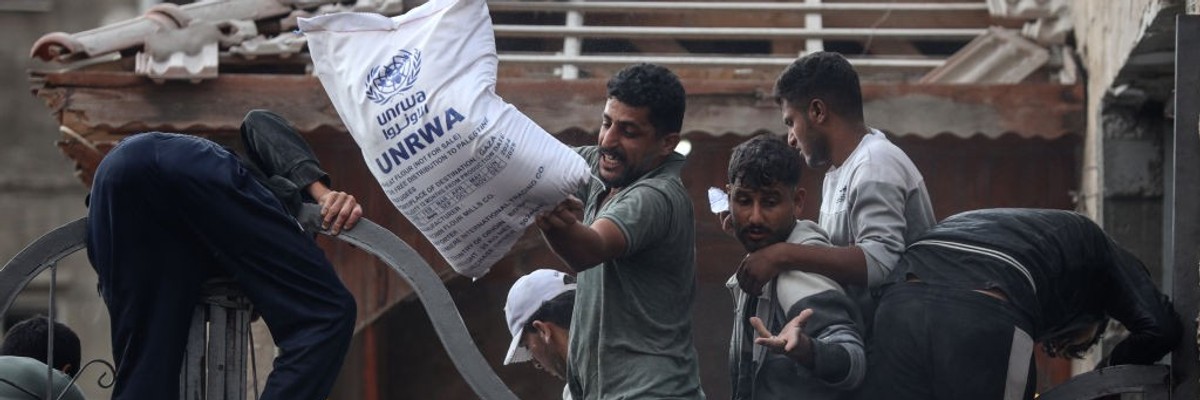
Palestinians scramble to receive sacks of flour at a United Nations Relief and Works Agency aid distribution center in Deir al-Balah, Gaza on November 3, 2024. (Photo: Majdi Fathi/NurPhoto via Getty Images)
“Restricting humanitarian access and at the same time dismantling UNRWA will add an additional layer of suffering to already unspeakable suffering,” said the U.N. agency’s commissioner-general.
Israel’s Foreign Affairs Ministry on Sunday formally notified the United Nations that it has terminated a decades-old legal agreement governing the country’s relations with the U.N. agency for Palestinian refugees, a move that aid workers and advocacy groups say will spell further disaster for Gaza’s besieged and famine-stricken population as winter approaches.
The director-general of the Israeli Foreign Affairs Ministry announced the decision to scrap the 1967 agreement in a letter to the president of the U.N. General Assembly, a message sent roughly a week after Israeli lawmakers approved legislation banning the U.N. Relief and Works Agency for Palestine Refugees in the Near East (UNRWA) from operating or providing services “in the sovereign territory of the state of Israel.”
The new letter states that the legislation “will enter into effect following a three-month period.”
The Washington Post reported Monday that Juliette Touma, UNRWA’s communications director, said that “the agency expected to continue its work coordinating the distribution of aid in Gaza and the West Bank at the operational level.”
But aid groups have warned that Israel’s UNRWA ban could inflict fatal damage to humanitarian operations in Gaza and the West Bank, given Israeli control over access to the illegally occupied territories. The legislation Israeli lawmakers passed last week bars the government from issuing work permits to foreign UNRWA staff and prevents the military from coordinating with the aid agency.
“The human cost of this ban is immeasurable,” Mara Kronenfeld, executive director of UNRWA USA, said in a statement last week. “This Israeli Knesset vote banning UNRWA is not merely an attack on the U.N. agency; it’s an attack on the fundamental rights and dignity due to all human beings. The consequences of this ban could result in the loss of tens of thousands, if not more, precious Palestinian lives. Where is the humanity?”
“You can hear children crying, people screaming, people running for their lives, and it has been nonstop for 24 hours. There’s nowhere to go. People are trapped.”
The U.S., Israel’s main ally and arms supplier, urged the Israeli government last week not to implement the newly passed legislation, even though the U.S. has yet to restore its own funding to UNRWA. The Biden administration suspended U.S. funding for UNRWA in January after Israel accused a small number of agency employees of taking part in the October 7, 2023 Hamas-led attack on Israel.
The U.N. fired nine UNRWA workers after an investigation determined that they “may have been involved” in the attack. UNRWA has roughly 13,000 staffers in the Gaza Strip, and the agency is the most important aid group operating in the enclave.
Dylan Williams, vice president for government affairs at the Center for International Policy, argued that by terminating its agreement with UNRWA, “Israel is also further breaking U.S. law prohibiting the restriction of aid delivery.”
“It’s a definitive rejection of an explicit demand in the Biden administration’s October 13 letter and by law must result in halting U.S. arms and military aid to Israel,” Williams added.
The Israeli Foreign Affairs Ministry’s announcement came as Israel’s military continued its bombing campaign and ground attacks across Gaza. Reuters reported that at least a dozen Palestinians were killed by Israeli airstrikes on Monday, including seven people in an attack on houses in northern Gaza.
“It is absolutely terrifying,” Louise Wateridge, an UNRWA spokesperson, told Al Jazeera on Saturday, referring to conditions on the ground in Gaza. “You can hear children crying, people screaming, people running for their lives, and it has been nonstop for 24 hours. There’s nowhere to go. People are trapped.”
Philippe Lazzarini, UNRWA’s commissioner-general, said Monday that Israeli authorities allowed an average of just 30 aid trucks to enter Gaza per day last month.
Prior to October 7, 2023, around 500 aid trucks were entering the enclave daily.
“This cannot meet the needs of over 2 million people, many of whom are starving, sick, and in desperate conditions,” Lazzarini said Monday. “Restricting humanitarian access and at the same time dismantling UNRWA will add an additional layer of suffering to already unspeakable suffering.”
“Only political will,” he added, “can put an end to a politically made situation.”
We have witnessed limited, restrained violence directed at political authority at Paiporta near Valencia, Spain. It was a spontaneous expression of anger from people having experienced an extreme ordeal believing that they have been ignored and neglected.
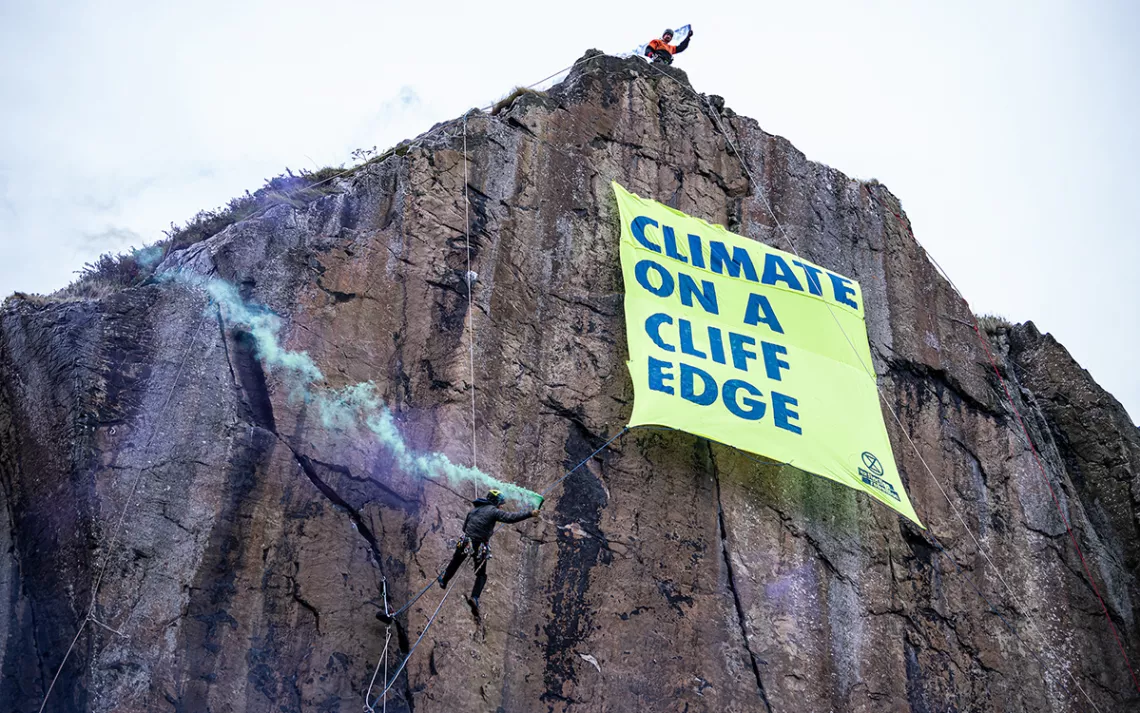
Experienced climbers scale a rock face near the historic Dumbarton castle in Glasgow, releasing a banner that reads “Climate on a Cliff Edge.” One activist, dressed as a globe, symbolically looms near the edge, while another plays the bagpipes on the shores below. | Photo courtesy of Extinction Rebellion and Mark Richards
People will soon come to realise that the extreme weather experienced in Spain amoung similar extreme weather events is a result of the fossil fuel industry and politicians having jointly destroyed the planet’s climate rather than an isolated event.
We are in transition to a new global reality – sound familiar? – because climate changes are so extreme that the old reality which we are leaving is no longer viable. It’s not a matter of choice: the climate has been destroyed, we are going to experience more and more severe weather events. We’re basically at 1.5C – the limit of the Paris agreement – now. WTF is coming even in 5 years time?
According to a report released by Brown University’s Costs of War project, from October 7, 2023 to September 30, 2024, the US sent 17.9 billion dollars in military aid to Israel, which accounts for the largest amount of military funding ever granted to Israel in a single year. Israel’s ongoing genocide against the Palestinian people, as well as its 76-year project of colonization of Palestine would not be possible without the vital military, financial, diplomatic, and political support of the United States.
The US presidential elections, which will see Democrat Kamala Harris face off against far-right Republican Donald Trump, are set to be held on Tuesday, November 5. The elections are being held over a year into Israel’s genocidal war on Gaza, and the result of the elections may cast a shadow on the current situation in particular, and the Palestinian cause in general.
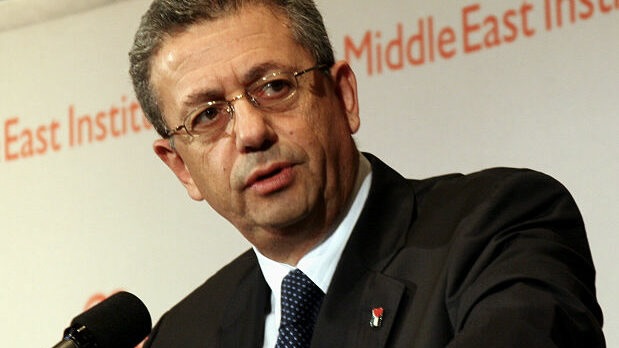
To discuss more about the impact of US policy, and the possible repercussions of the US presidential elections on the Palestinian cause, Peoples Dispatch interviewed prominent Palestinian politician, physician, and activist Dr. Mustafa Barghouthi.
Dr. Mustafa Barghouthi is the Secretary General and co-founder of the Palestinian National Initiative, and member of the Palestinian Legislative Council (PLC).
Peoples Dispatch: What has the last year of Israeli genocide revealed about US policy towards the region?
Dr. Mustafa Barghouthi: It has revealed that the United States can restrain Israel if it wants, but it did not, which makes the United States complicit in the genocide being carried out by Israel against the Palestinian people. A clear example that proves that the US has an influence on Israel, is its ability to restrain the Israeli aggression on Iran.
Peoples Dispatch: Were people expecting more from Democrat Joe Biden?
Dr. Mustafa Barghouthi: The Palestinian people were completely disappointed by Biden and his administration, including his State Secretary, Defense Secretary and National Security Advisor, who all came to take part in Israel’s war cabinet meetings, and gave their blessing to Israel during its genocidal aggression on Gaza. They further sent American fleet, ships, aircrafts to support Israel. Biden has provided Israel with no less than 17.9 billion dollars of military equipment, and more than 50,000 tons of explosives and weapons. All of that was used in committing the genocide against the Palestinian people.
Peoples Dispatch: Are any major changes expected if either Kamala or Trump gets elected? Does the outcome of these elections impact the Palestinian struggle?
Dr. Mustafa Barghouthi: Trump’s election may make the situation even worse, while it is still unclear about Kamala Harris, who maybe will be more sensitive regarding the changes that are happening inside the Democratic Party, where the majority of the younger generation are against the policy of Biden in relation to what has been happening in Gaza and to Palestinians in general.
However, so far she could not make any definite decision or take any definite position to stop the genocide against the Palestinian people. Like Biden, Harris continued with the biased approach towards Israel. This needs to be completely changed, because when it comes to the reputation of the United States it has been negatively affected by the policy of this administration, not only in Palestine but also worldwide. We shouldn’t forget that Kamala Harris was the US vice president during the genocide, she was not outside the administration. Perhaps, she will adopt a different approach in comparison to Biden, but that needs to be proved in reality and in action.
Peoples Dispatch: With regards to the broader region, one of Trump’s pet projects while president was advancing normalization with Israel. What is your view of how Israel’s genocide has impacted the process of normalization? Have there really been major setbacks? Will these setbacks be recovered or is it irreversible?
Dr. Mustafa Barghouthi: The war crimes in Gaza did not affect the existing normalization agreements between three Arab countries and Israel. Unfortunately, it has not changed at all, but the war crimes in Gaza and the genocide have restrained other countries from proceeding in normalization with Israel. Even the countries that maintained normalization agreements with Israel, are very embarrassed about the current situation, because their peoples are against normalization. It is not apparent yet whether the genocide will have further impact on normalization. The largest popular protest against normalization is happening in Morocco, and it is the most important country among the three countries that normalized with Israel”, the prominent Palestinian politician said, referring to Morocco, United Arab Emirates (UAE) and Bahrain, which signed the US-backed normalization agreements with Israel known as “the Abraham Accords” in 2020.
Keep reading Peoples Dispatch for analysis and news on the US elections from a perspective you won’t see on mainstream media.
The New York Times (10/12/24) says it “verified” supposed Hamas documents provided to the paper by Israel—which turns out to mostly mean that that the Israeli military “concluded the documents were real.”
Earlier this month, the New York Times (10/12/24), Washington Post (10/12/24) and Wall Street Journal (10/12/24) each published front-page articles based on different sets of documents handed to them by the Israeli military.
Israel claims it seized all the documents—in the form of meeting minutes, letters and planning documents—in its ground invasion of Gaza, and that they reveal insights into Hamas’s operations prior to the October 7 attacks. The documents include alleged evidence of Hamas’s pre-10/7 coordination with Iran, plans to blow up Israeli skyscrapers, and even a scheme to use horse-drawn chariots in an attack from Gaza.
Documents received directly from intelligence agencies should always be treated with skepticism, and that’s especially true when their government has a well-documented history of blatant lying. Yet leading newspapers took these Israeli document dumps largely at face value, advancing the agenda of a genocidal rogue state.
A history of lying
Fake “Hamas” documents were being cited in the press as recently as September 2024 (Middle East Eye, 9/9/24).
Israel’s use of fabrications to shape public perception is well known, and was put on display early in the assault on Gaza that began last October. After an explosion at Al Ahli hospital killed and injured hundreds (misreporting of which caused a great deal of confusion), the media naturally pointed the finger at Israel. The Israeli government, concerned about the public backlash, denied responsibility, claiming that the explosion was caused by a misfired rocket from Palestinian Islamic Jihad. (See FAIR.org, 11/3/23.)
To back up their claims, Israel released a recording allegedly capturing two Palestinian militants discussing Palestinian Islamic Jihad’s responsibility for the strike. However, an analysis by the firm Earshot found that the audio was the result of two separate channels being edited together (Channel 4, 10/19/23). In other words, Israel engineered a phony audio clip in an attempt to clear itself of war crimes in the public mind.
Investigations based on open sources have since come to various conclusions about the attack (Guardian, 10/18/23; Bellingcat, 10/18/23; Human Rights Watch, 11/26/23; AP, 11/22/23; Michael Kobs, 2023; New Arab, 2/19/24), but Israel’s fraudulent attempt to manipulate evidence certainly suggests that they had something to hide, and demonstrates their lack of reliability as a media source. Recently, the UN released a report accusing Israel of systematically targeting healthcare infrastructure in Gaza, making their denials of this earlier attack far less credible.
In another instance, Israel presented 3D renderings of a supposed Hamas “command center” beneath Al Shifa hospital, claiming it was based on intelligence. However, no such command center was ever found (FAIR.org, 12/1/23). Upon storming the hospital, Israel staged scenes in order to bolster claims that the facility was used by militant groups. The deception was so blatant that mainstream outlets were openly calling it out.
Recently Israel was caught actually providing fabricated documents to the press with the aim of manipulating public opinion. Earlier this year, the Israeli government provided documents to both the Jewish Chronicle (9/5/24) and the German paper Bild (9/6/24) that purportedly showed that Hamas had no interest in a ceasefire, and had a plan to sneak the late Hamas chief Yahya Sinwar out of Gaza to Iran, along with some of the remaining hostages. The reports were then uncritically repeated in outlets like the Times of Israel (9/6/24).
Shortly after these documents were published, the Israeli paper Yedioth Ahronoth (9/8/24) reported on an internal IDF investigation that found that they had been leaked to foreign media as part of a campaign to “shape public opinion on Israel.” The documents were determined to be forgeries, after a comprehensive search of all databases containing documents found in the wake of Israel’s operations. The IDF told the paper that an investigation was underway to determine the origin of the leak.
This non-exhaustive list of examples demonstrates a pattern of Israel engineering misleading narratives to shape public opinion, and fabricating the evidence needed to do so.
Questionable authenticity
The Washington Post (10/12/24) reported that “the documents’ authenticity could not be definitively established”—but there’s no trace of that doubt in the story’s headline or subhead.
Whether they are authentic or not, it is clear that the documents leaked to the Wall StreetJournal, New York Times and Washington Post serve the same purpose of propagandizing on behalf of Israel. In an attempt to preserve some journalistic integrity, the Post and Times both gave separate justifications for why they believed the respective documents leaked to them were authentic.
The Post was quick to note that “the documents’ authenticity could not be definitively established,” but gave readers the impression there was reason to believe they were real. First, it claimed that the contents of the documents it received were
“broadly consistent” with US and allies’ post–October 7 intelligence assessments about Hamas’s long-range planning and complex relationship with Iran.
Then it wrote that unnamed US and Israeli officials they shared the documents with did not express concerns about their authenticity. (Iranian and Hamas officials they consulted didn’t comment on the documents but accused Israel of having a history of “fabricating documents.”)
The New York Times consulted former Hamas member Salah al-Din al-Awawdeh, whom the paper frequently quotes on matters related to Hamas, and an unnamed Palestinian analyst with “knowledge of Hamas’s inner workings.” It also said an internal Israeli military report concluded the documents were authentic, and the paper “researched details mentioned in the meeting records to check that they corresponded with actual events.” It said “Hamas and Hezbollah did not respond to requests to comment” and that Iran “denied the claims made in the minutes.”
The Wall Street Journal story did not describe any attempt to verify the authenticity, and only reported that the paper “hasn’t independently verified the documents.”
But given Israel’s track record, there is no epistemologically sound way of verifying the validity of documents provided by the Israeli government without confirmation from Hamas itself. Citing sources who say that the documents resemble Hamas documents, without noting Israel’s history of creating credible forgeries, creates a patina of credibility without actually substantiating anything.
Advancing Israel’s agenda
Haaretz (10/14/24): The documents bolster Netanyahu’s claim that Israel is “fighting a terrifying ‘axis of evil’ led by Iran that threatens to destroy Western culture as a whole.”
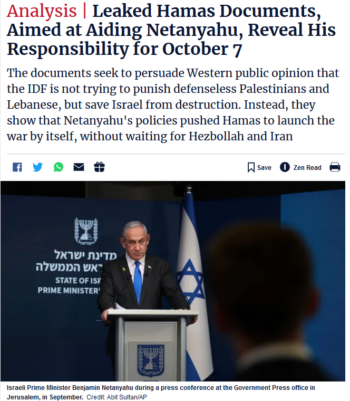
The Israeli paper Haaretz (10/14/24), which took the documents as authentic, argued that their release by Israel was “Aimed at Aiding Netanyahu.” While both the Times and the Post have largely advanced Israel’s agenda over the past year of bombing (FAIR.org, 10/13/23, 2/1/24, 10/7/24), both papers are considered to be on the critical end of the press spectrum in the US, particularly towards Netanyahu. As Haaretz explained, this perception enhances the propaganda value of the document leak: “The Times and the Post enjoy greater credibility when they fall in line with Israel’s narrative.”
While Haaretz made no note of the leaked documents provided to the Wall Street Journal, the article ironically acknowledged that
having them published by Fox News or even the Wall Street Journal would have looked like an Israeli public diplomacy operation rather than a legitimate journalistic investigative report.
Haaretz noted that the documents promote narratives that “Israel would be happy to burn into the world’s consciousness,” namely the well-known propaganda effort to equate Hamas with organizations that are universally reviled by Americans. The Post documents purportedly outlined a Hamas plan to blow up a skyscraper in Tel Aviv, evoking the September 11 attacks against the World Trade Center:
The Hamas documents are supposed to bolster Netanyahu’s claim that Israel isn’t fighting against a liberation movement seeking to free the occupied Palestinian people, or even against a paramilitary organization that is poorly funded and trained and lacks planes, the Iron Dome anti-missile system, tanks and artillery….
Rather, it is fighting a terrifying “axis of evil” led by Iran that threatens to destroy Western culture as a whole.
Haaretz also argued that this kind of propaganda campaign was designed to ensure that the violence continues to escalate:
In this spirit, the documents are supposed to justify Israel’s counterattack, which has so far caused enormous death and destruction in Gaza and, to an increasing degree, also in Lebanon.
Obvious PR value
Unlike the New York Times or Washington Post, the Wall Street Journal (10/12/24) acknowledged in its headline that the revelations in the documents are what “Israel says” they show.
While Haaretz overlooked the story from the Wall Street Journal, the same logic can be applied to the documents given to that paper as well. The Journal was apparently curious about the political purpose of the documents, noting that “the officials who provided the documents declined to say why they were releasing them now.”
The Journal wrote that the documents “suggest that Hamas leader Yahya Sinwar was negotiating with Iran over funding for a planned large-scale assault on Israel as far back as 2021,” and gave specific dollar amounts that Iran provided to Hamas’s armed wing. The obvious public relations value of these documents was that they boosted the negative image of Iran prior to Israel’s recent attack on that country.
Israel’s campaign of genocide in Gaza and greater war in the Middle East has been successful in part because the Israeli government can count on Western press to present and contextualize facts in a way that advances their narrative. Despite Israel’s long history of fabrications, the corporate media will dutifully republish documents, statements and explanations with complete credulity.