Biden’s UNGA address espousing democracy and cooperation contrasts with reality

Original article by Natalia Marques republished from peoples dispatch under a Creative Commons Attribution-ShareAlike 4.0 (CC BY-SA) license.
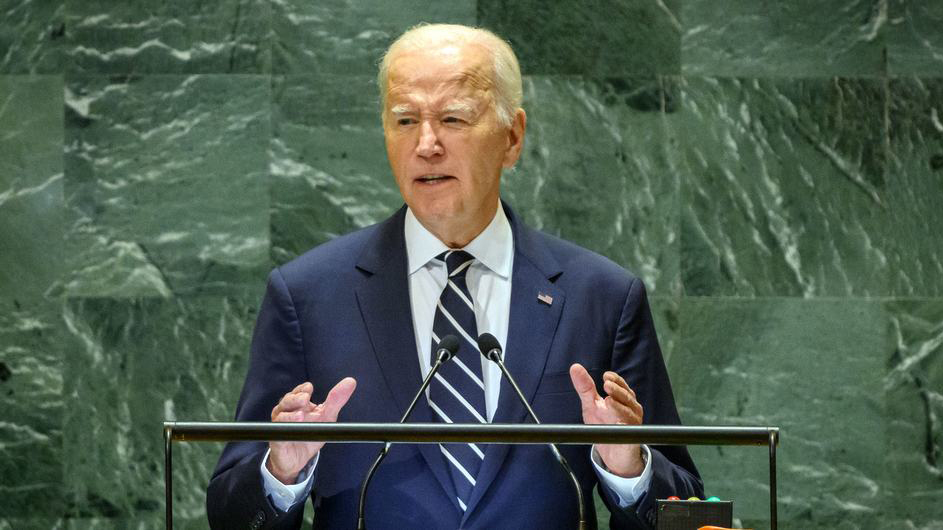
Biden addresses the general debate of the General Assembly’s 79th session (Photo: UN Photo/Loey Felipe)

Biden’s final address to the United Nations as president was riddled with falsehoods and hypocrisies typical of US foreign policy

When US President Biden ended his final address to the UN General Assembly with “my fellow leaders, there is nothing that’s beyond our capacity if we work together,” it can be easy to forget that the United States is the number one obstacle to mutual cooperation around the world.

Biden’s mention of the various conflicts and aggressions around the world—from Ukraine to Sudan to Gaza—of course made no mention of the US’s complicity in each of these conflicts.

Biden calls for “a ceasefire and hostage deal” for Gaza in order to “bring the hostages home, secure security for Israel, and Gaza free of Hamas’ grip, ease the suffering in Gaza, and end this war.”

But while Biden calls for an end to the war, the US continues to send weapons and other forms of aid to Israel as it carries out genocide in Gaza, aggression in the West Bank, and extends the war to Lebanon. Biden’s administration has ignored the popular demand for an arms embargo against Israel, supported by major labor unions which represent almost half of all unionized workers in the US as well as 61% of the US population. Instead, the US has only expanded its military support for Israel, approving a USD 20 billion dollar arms package to the Zionist state in August. 

The US has maintained its unconditional support of Israel, even as Israel floats a possible ground invasion of Lebanon. Yet ironically Biden said of the war in Sudan, “the world needs to stop arming the generals.” According to the Palestinian Youth Movement, an international Palestinian diaspora organization, “the Biden-Harris administration is responsible for the current massacres in Lebanon.”

The US’s support for Israeli genocide has received additional scrutiny after it was revealed that USAID and the State Department knew that Israel had deliberately blocked humanitarian aid to Gaza. US law requires the government to cut off weapons shipments to countries which block deliveries of US-backed aid, and so US Secretary of State Antony Blinken seems to have deliberately told Congress that Israel did not block aid so that weapons shipments to Israel would remain unaffected. 

Yet in his speech to the UNGA, Biden entreated Sudanese generals to “stop blocking aid to the Sudanese people.”

“We do not currently assess that the Israeli government is prohibiting or otherwise restricting the transport or delivery of US humanitarian assistance,” Blinken told Congress on May 10, despite being told the opposite by USAID and the State Department in April.

In Ukraine, not only were the US and NATO’s violations of Russian security red lines the chief cause of that war, but the West continues to be an obstacle to a peaceful settlement of the conflict. There has been no negotiation between Ukraine and Russia ever since the West allegedly forced Ukraine to withdraw from talks in April 2022, and the US in its usual fashion continues to supply billions of dollars in weapons to Ukraine to continue the war. 

And while Biden urged other UNGA member nations to “stand up” for the Ukrainian people, US military officials openly thirst for Ukrainian blood—complaining in a New York Times article from last year that the Ukrainian military has become too “casualty averse,” causing it to “race through precious [US-provided] ammunition supplies” as opposed to human lives.

Biden spent time lamenting the humanitarian situation in Sudan, and claiming that “the United States has led the world in providing humanitarian aid” to the war-torn country. But like many global conflicts, the war in Sudan has its roots in the savagery of US imperialism. According to Stephanie Weatherbee Brito of the International Peoples Assembly, “Through both military interventions and economic sanctions, the United States has shown its willingness to coerce any nation deviating from its interests. This has fostered a global environment where nations vie for power and influence. The US’s propensity to invade and punish perceived adversaries has spurred countries to bolster their military and geopolitical capabilities to safeguard their sovereignty in a world marked by violence and conflict, saturated with weaponry and lacking effective mechanisms to ensure peace.”

“This is essentially what is happening in Sudan today, where the conflict has resulted in more than ten million displaced persons. The conflict between the Sudanese Armed Forces and the Rapid Support Forces serves to thwart the democratic process the people have been struggling for since 2018, as rival military groups struggle to control the country and its resources,” Brito articulated. 

US hybrid wars remains chief obstacle to global cooperation

“Our task, our test, is to make sure that the forces holding us together are stronger than those that are pulling us apart,” Biden claimed in his address to the UN, despite his administration’s wielding of sanctions that cause economic devastation throughout the world.

For decades, the international community has been calling on the United States to lift deadly sanctions on Cuba that are part of an over 60-year-long blockade against the socialist nation. Most recently, a group of nearly 600 parliamentarians from 73 different countries penned a joint letter condemning the continued inclusion of Cuba on the list. And 35 former heads of state from across the globe penned a separate letter to Biden, urging him to remove Cuba from the US’s “State Sponsors of Terrorism” list. 

But when it comes to US sanctions and other violations of the sovereignty of other countries, Cuba is but one facet. Comprehensive US sanctions target and put a stranglehold on the economies of countries such as Iran, North Korea, Russia, Venezuela, and Syria. Other nations, such as China, are under constant attack on many fronts, whether through media fear mongering or military exercises near their territories. 

And yet in his speech to the UNGA, Biden seems to deny that his administration has deliberately stoked conflict with China. “We also need to uphold our principles as we seek to responsibly manage the competition with China so it does not veer into conflict,” Biden pontificated. “We stand ready to cooperate on urgent challenges for the good of our people and the people everywhere.”

According to Amanda Yee, journalist, anti-imperialist activist, and host of The China Report on BreakThrough News, Biden’s China strategy has nothing to do with managed competition. “In reality, it’s a belligerent policy which will only escalate toward war,” Yee told Peoples Dispatch

“What he calls ‘strengthening our network of alliances and partnerships across the Indo-Pacific’ really means the continuation of arming Taiwan, building more military bases on allies’ soil and in the South China Sea, sending cruise missiles to Japan, conducting war games exercises in South Korea—all to further build up the military encirclement of China.”

The future of US democracy

“I’ve made the preservation of democracy the central cause of my presidency,” Biden claimed during his address. And yet those in the US who have protested against their governments’ domestic and foreign policies have faced police violencemass arrests, and even deportation

As US presidential elections fast approach, whether the winner is Biden’s successor Kamala Harris or the ultra-conservative former president Donald Trump, anti-imperialist activists can expect more of the same repression.

Original article by Natalia Marques republished from peoples dispatch under a Creative Commons Attribution-ShareAlike 4.0 (CC BY-SA) license

Continue ReadingBiden’s UNGA address espousing democracy and cooperation contrasts with reality

Climate scientists call on Labour to pause £1bn plans for carbon capture

https://www.theguardian.com/environment/2024/sep/25/climate-scientists-call-on-labour-to-pause-1bn-investment-plans-carbon-capture-blue-hydrogen

Ed Miliband, Rachel Reeves and Keir Starmer visit Teesside, the location of a proposed multibillion-pound carbon capture and storage project. Photograph: Ian Forsyth/Getty Image

Letter says technologies to produce blue hydrogen and capture COare unproven and could hinder net zero efforts

Leading climate scientists are urging the government to pause plans for a billion pound investment in “green technologies” they say are unproven and would make it harder for the UK to reach its net zero targets.

Labour has promised to invest £1bn in carbon capture, usage and storage (CCUS) to produce blue hydrogen and to capture carbon dioxide from new gas-fired power stations – with a decision on the first tranche of the funding expected imminently.

However, in the letter to the energy security and net zero secretary, Ed Miliband, the scientists argue that the process relies on unproven technology and would result in huge emissions of planet-heating CO2 and methane – gases that are driving the climate crisis.

“We strongly urge you to pause your government’s policy for CCUS-based blue hydrogen and gas power, and delay any investment decision … until all the relevant evidence concerning the whole-life emissions and safety of these technologies has been properly evaluated,” they write.

The letter, which is signed by leading climate scientists from the UK and US as well as campaigners, argues the plans would:

  • Lock the UK into fossil fuel production for generations to come.
  • Result in huge upstream emissions from methane leaks, transport and processing of liquefied natural gas (LNG) from the US.
  • Rely on carbon capture and storage (CCS) during the production of hydrogen – technology they say has been abandoned in the vast majority of similar projects around the world.
  • Pose a danger to the public if there are any leaks from pipes carrying the captured carbon. At least 45 people had to be taken to hospital after a leak in the US.

https://www.theguardian.com/environment/2024/sep/25/climate-scientists-call-on-labour-to-pause-1bn-investment-plans-carbon-capture-blue-hydrogen

Continue ReadingClimate scientists call on Labour to pause £1bn plans for carbon capture

Labour Conference 2024: ‘Britain needs investment, not austerity mark two’

https://morningstaronline.co.uk/article/britain-needs-investment-not-austerity-mark-two

Delegates defy Starmer by voting to reject the callous cut to pensioners’ winter fuel allowance after Unite chief’s barn-storming speech

LABOUR conference defied Sir Keir Starmer today and voted to reject the callous cut to pensioners’ winter fuel allowance.

Delegates backed a motion from Unite the union demanding that the government “reverse the introduction of means-testing for the winter fuel allowance.”

It also urged Labour to scrap the “fiscal rules which prevent borrowing to invest” and introduce a wealth tax on the top 1 per cent and an excess profits tax.

In a barn-storming speech, Unite general secretary Sharon Graham recalled how the 1945 Labour government had rebuilt the country despite debt ratios three times the level of today.

She said: “People simply do not understand, I do not understand, how our new Labour government can cut the winter fuel allowance for pensioners and leave the super-rich untouched.

“This is not what people voted for. It is the wrong decision and needs to be reversed.

“We are the sixth-richest economy in the world. We have the money. Britain needs investment, not austerity mark two. We won’t get any gold badge for shaving peanuts off our debt.

“These fiscal rules are self-imposed and the decision to keep them is like hanging a noose around our necks.

https://morningstaronline.co.uk/article/britain-needs-investment-not-austerity-mark-two

Continue ReadingLabour Conference 2024: ‘Britain needs investment, not austerity mark two’

‘Red Alert’ as 7th of 9 Planetary Boundaries On Verge of Being Breached: Report

Original article by Edward Carver republished from Common Dreams under Creative Commons (CC BY-NC-ND 3.0). 

A diver checks the coral reefs of the Society Islands in French Polynesia in 2019. (Photo: Alexis Rosenfeld/Getty Images).

“Our updated diagnosis shows that vital organs of the Earth system are weakening, leading to… rising risks of crossing tipping points.”

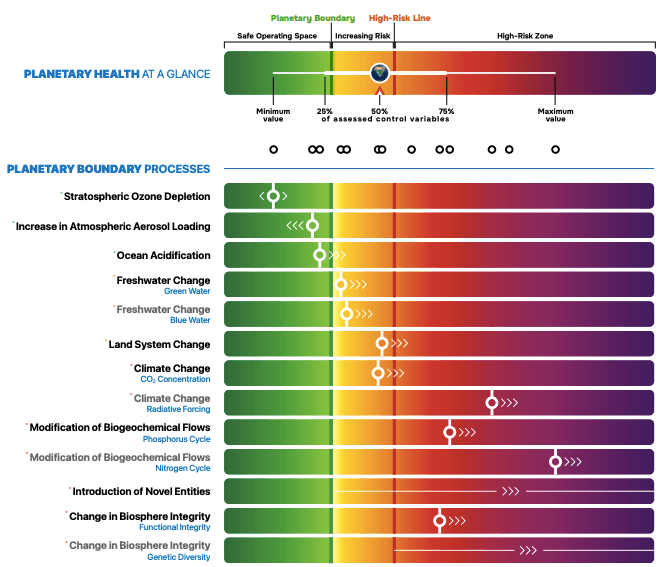
Six of nine planetary boundaries have already been transgressed, and a seventh, for ocean acidification, is on the verge of being breached, according to a major report released Monday.

The 96-page report, produced by the Potsdam Institute for Climate Impact Research (PIK), is the first in a planned series of annual “planetary health checks.”

The authors found that safe planetary boundaries had already been crossed for the climate, freshwater, land use, biogeochemical flows, novel entities, and biosphere integrity—in keeping with a study in Science Advances last year. They found a “clear trend towards further transgression”—moving deeper into the danger zone, where irreversible tipping points are more likely to be triggered—in each of the six categories.

“Our updated diagnosis shows that vital organs of the Earth system are weakening, leading to a loss of resilience and rising risks of crossing tipping points,” Levke Caesar, a PIK climate physicist lead author of the report, said in a statement that announced a “red alert.”

The health check also showed that ocean acidification, a seventh category, has reached a dangerous precipice, putting the foundations of the marine food web at risk. Ocean acidification, which can threaten coral reefs and phytoplankton populations, is caused by the buildup of carbon dioxide from burning fossil fuels and other human activities.

Caesar said a “safe operating space” threshold for acidification could be crossed in the next few years.

“Looking at the current evolution, I’d say it’s really, really difficult to prevent that [boundary] crossing,” she toldMongabay.

A graphic shows the status of nine environmental categories, four of which have been broken down into two control variables. Image from Planetary Health Check 2024. Design by Globaïa.

PIK director Johan Rockström, a co-author of the new report, helped develop planetary boundary research in the late 2000s. In a seminal 2009 paper in Nature, he and his co-authors found that three of the nine boundaries had already been crossed. That number has gradually gone up based on a series of studies over the last decade.

The planet boundary framework, which is often connected to the degrowth movement, emphasizes that the categories are interconnected.

“The interconnectedness of [planetary boundary] processes means that addressing one issue, such as limiting global warming to 1.5°C, requires tackling all of them collectively,” the new report says.

Boris Sakschewski, a climate scientist who, along with Caesar, is a lead author of the report said that, “We know that all planetary boundary processes act together and each one needs protection to protect the whole system.”

The consequences of continued ocean acidification, which is primarily measured by aragonite saturation, would be severe, the report warns.

Ocean acidification is approaching a critical threshold, with significant declines in surface aragonite saturation, particularly in high-latitude regions like the Arctic and Southern Ocean. These areas are vital for the marine carbon pump and global nutrient cycles, which support marine productivity, biodiversity, and global fisheries. The growing acidification poses an increasing threat to marine ecosystems, especially those reliant on calcium carbonate for shell formation.

Some researchers believe that the ocean acidification threshold has already been crossed, especially given regional variability, with cooler polar waters absorbing more carbon dioxide, causing a faster drop in pH levels.

The report was written with a general audience in mind and is not peer-reviewed, though it’s based on peer-reviewed studies, the authors said.

The final pages of the report present solutions, especially agricultural. A radical overhaul of the global food system, heavily dependent on fertilizer and other harmful inputs, will be necessary to reverse the disturbing trends documented in the report, the authors wrote.

“Sometimes overlooked compared to the impacts of energy production and consumption—particularly the use of fossil fuels—the food systems we depend on are among the largest drivers of environmental degradation. The global food system is the single largest driver behind the transgression of multiple planetary boundaries,” the report says.

Original article by Edward Carver republished from Common Dreams under Creative Commons (CC BY-NC-ND 3.0). 

Continue Reading‘Red Alert’ as 7th of 9 Planetary Boundaries On Verge of Being Breached: Report

Ending Oil Subsidies, Taxing the Rich Could Help Free Up $5 Trillion a Year for Climate: Report

Original article by Jake Johnson republished form Common Dreams under Creative Commons (CC BY-NC-ND 3.0).

Wildfires are seen in San Marcos Sierra, Cordoba province, Argentina, on September 23, 2024. (Photo: Stringer/AFP via Getty Images)

“The real question isn’t whether we can afford to act, but whether we can afford not to.”

Research published Tuesday estimates that rich countries could mobilize over $5 trillion a year for climate action worldwide by cutting off subsidies to the oil and gas industry, imposing a levy on big polluters, and cracking down on tax evasion by large corporations and the rich.

The new report from Oil Change International (OCI) was released as world leaders gathered in New York City for high-level United Nations General Assembly talks, a meeting that comes less than two months before the COP29 climate summit in Azerbaijan.

OCI’s research, which includes a fact sheet outlining various proposals to raise funds for climate action, stresses that “there is no shortage of public money available for rich countries to pay their fair share on fair terms for climate action at home and abroad.”

“The urgency and extent of growing economic inequality, unfair sovereign debt crises, climate disasters, and fossil fuel profits have created significant momentum towards many of these measures in international and domestic policy spheres,” OCI’s research brief notes. “Finance has been in the spotlight in most major international political fora in the past few years in recognition that our current financial architecture is a major driver of these overlapping crises.”

Among the proposals laid out in OCI’s brief are an equitable end to “public finance, direct subsidies, and state-owned company investments in fossil fuels,” which could raise $846 billion a year globally; a “climate damages tax” on fossil fuel extraction, which could raise $618 billion a year; a 25% minimum corporate tax rate, which could raise $479 billion annually; and a wealth tax on billionaires, which could raise roughly $2.60 trillion a year in the Global North and over $5.6 trillion worldwide.

Laurie van der Burg, OCI’s public finance lead, said that the rich nations most responsible for the climate emergency “owe this money to Global South countries that have not caused this crisis and need fair finance to deliver strong climate plans next year that phase out fossil fuels.”

“This is essential to avoid climate breakdown and save lives,” she added.

The COP29 climate summit will take place a year after nations agreed at COP28 to transition “away from fossil fuels in energy systems” in a “just, orderly, and equitable manner.”

The success of that pledge, OCI said, depends on rich nations contributing massively to global climate finance after years of falling short of their pledges and continuing to expand fossil fuel extraction and handouts. Worldwide, environmentally harmful subsidies—including fossil fuel subsidies—have surged to $2.6 trillion a year, according to a report released last week.

“Global North countries have a responsibility to redirect their share of these subsidies in support of climate action,” OCI said Tuesday.

The new report comes on the heels of a record-hot summer and amid devastating extreme weather, from massive flooding across Europe and Africa to wildfires in South America.

Andreas Sieber, associate director of policy and campaigns at 350.org, said Tuesday that “the real question isn’t whether we can afford to act, but whether we can afford not to.”

“It is a bitter irony that rich nations hide behind claims of fiscal restraint, yet trillions are still spent on fossil fuel subsidies and militarization,” said Sieber. “The truth is simple: the money exists, but the political will does not. By treating climate finance as a zero-sum game, wealthy countries not only deepen global inequality but also undermine their own futures.”

“The energy transition isn’t charity—it’s an investment in global stability and security,” Sieber added. “Ignoring the need for support only worsens the climate crisis, which knows no borders.”

Original article by Jake Johnson republished form Common Dreams under Creative Commons (CC BY-NC-ND 3.0).

Continue ReadingEnding Oil Subsidies, Taxing the Rich Could Help Free Up $5 Trillion a Year for Climate: Report