Bernard Capp, University of Warwick
Around 8pm on a cold February evening in 1733, a gentleman named Francis Peters was returning to his home near Knightsbridge, London, in a hackney cab, when someone knocked on the wooden shutters of the door. An armed horseman thrust a pistol inside, demanded Peters’s money and valuables and snatched a ring from his finger. Peters handed them over without fuss. But when the thief also snatched his hat and wig, he protested vigorously, though in vain – the robber rode away with his booty.
The puzzle, to the modern reader, is that the hat was worth only five shillings – far less than the watch (worth £4), the ring and the cash he had already handed over. So why make such a fuss?

The robber was later arrested and Peters made a point of going to see him in Newgate Prison as he awaited trial. He told him it had been bad manners to take his hat. The Old Bailey trial records tell us that the highwayman apologised.
Historically, hats had a significance that went far beyond fashion and keeping the head warm. For any respectable man in Tudor, Stuart and Hanoverian England, to go hatless was almost unthinkable, while for people lower down the social scale, it suggested total destitution. Suspects awaiting trial were often desperate to obtain a hat before appearing in court, to present at least a shred of respectability. But what made it so unthinkable for respectable men to appear hat-less?
As my new research explains, the power of social convention is certainly one part of the answer. Another is contemporary concerns over health and the belief that it was important to keep the head warm at all times. Wearing a nightcap, after all, was common practice. Peters raised his own health concerns when he pleaded with the highwayman. A man who wore a wig as well as a hat would generally have had his head shaved, so the theft left him bare-headed and vulnerable on a cold winter night.
Madness and status
There was another factor, too – the association of a bare head with madness, which was familiar through images of the shaven inmates of Bedlam. The strength of that association can be seen through another strange story – that of Thomas Ellwood, the teenage son of an Oxfordshire gentleman.
In 1659, by chance, Ellwood and his father had come across the Quakers, a new movement at the time. Thomas was intrigued but his father was appalled, and forbade him to attend any Quaker meetings. Thomas sneaked away regardless, even after his father had beaten him and banished him from the dinner table.
Eventually his father found a bizarre tactic that did work: he confiscated all his son’s hats. Many years later, Ellwood explained in his autobiography that the move had rendered him effectively a prisoner for many months, “unless I would have run about the country bare-headed, like a mad-man: which I did not see it my place to do”. He would have appeared deranged, and he recognised the shame that such behaviour would bring to a gentleman’s family.
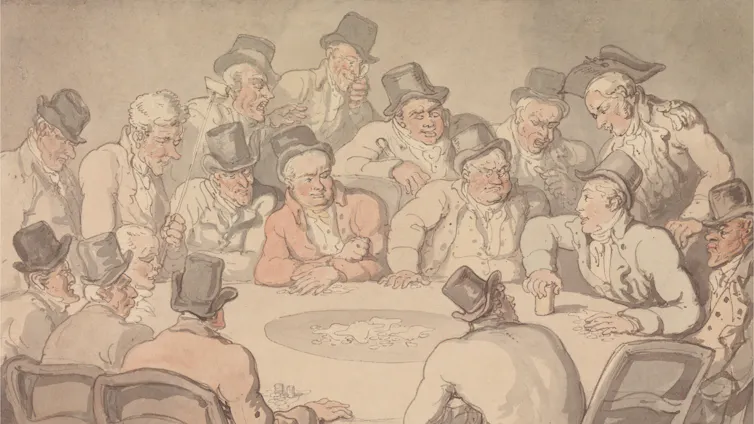
As that concern suggests, the hat also had a far wider significance in this period as a marker of status and in associated gestures of deference. Unlike today, almost everyone wore a hat or, in the case of labourers and poor artisans, a flat cap. And convention required men and boys to doff the hat or cap in the presence of someone of higher status – a parent, master, employer, gentleman, magistrate, peer, or monarch.
Though there was no law to underpin “hat-honour”, the convention was firmly enforced. Many people who had grown up with this convention may have accepted it as part of the natural order of things, but having to “bow and scrape” to a harsh landlord, for example, was deeply resented by others. And in times of political upheaval, such as the civil wars of the 1640s, hat-honour could take on an ideological significance.
John Lilburne was a leader of the radical Leveller movement that was pressing for social reforms and a more accountable form of government. He refused to doff his hat when he was summoned to appear before the House of Lords for publishing illicit tracts, and announced his defiance in a pamphlet.
Many other radical leaders made similar gestures of defiance. Most notorious were the early Quakers, who refused on principle to doff their hats to anyone, explaining it as a gesture against the sin of pride and vanity.
Changing fashions
Refusing hat honour was an overt gesture of defiance associated with radicals, whether political, religious. But after the civil war of the 1640s ended with parliament’s victory over Charles I, the political order was turned upside down, and such gestures might now appeal to the defeated royalists.
At the trial of the king in January 1649, Charles himself refused to remove his hat when brought into court. As sovereign, he refused to recognise any superior on earth, or to accept that any court had the right to try him.
The importance of hat-honour gradually faded in later centuries, as manners became more informal and crowded cities made it ever less practicable. And finally, in the 1960s, the practice of men wearing hats abruptly ceased, for reasons that remain largely unexplained. The “swinging sixties” celebrated youth, informality and the rejection of old, hidebound conventions – and that cultural shift may provide at least a part of the answer.
Bernard Capp, Emeritus Professor of History, University of Warwick
This article is republished from The Conversation under a Creative Commons license. Read the original article.