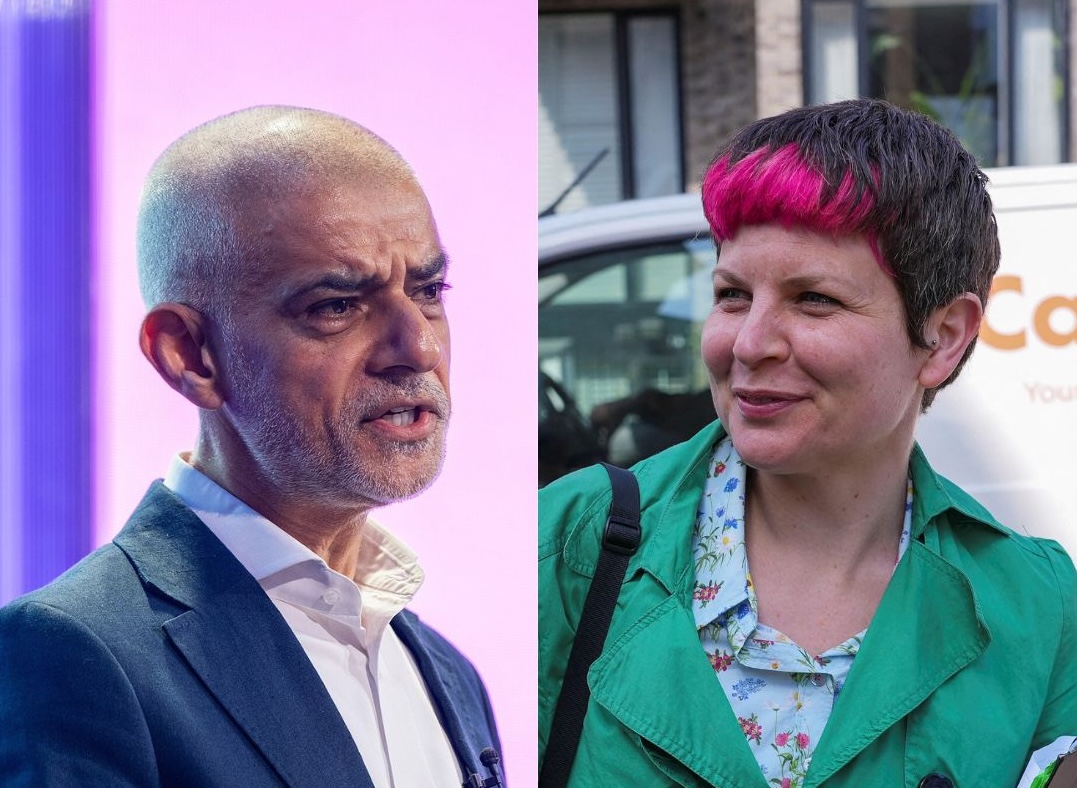
Green party-controlled councils have joined a high court legal challenge led by the Aspire party to stop London mayor Sadiq Khan slashing affordable housing in the city.
Hackney and Lewisham councils, which Zack Polanski’s party took control of following the 7 May elections, have joined the Aspire-run Tower Hamlets council in its bid to stop Khan from cutting the city’s affordable housing quota from 35% to 20%.
…
Khan said in 2016 that more than 50% of new homes in London should be affordable, but later the same year allowed private developers to limit affordable housing in new developments to 35%.
His plan to further reduce the quota comes amid an escalating housing crisis in the city, where the cost of rent is a major driver of poverty and child homelessness.
Brazilian President Lula da Silva wearing hat “Brazil is for the Brazilians”. Photo: Lula / X
The diplomatic row devolved into a potential trade crisis when Trump threatened Brazil with higher tariffs on Brazilian products if it did not cease the alleged persecution of the ultra-right former president Jair Bolsonaro.
Tensions between Washington and Brasília persist. On July 7, Trump sent a letter to the Brazilian government urging an end to the alleged persecution of former Brazilian president Jair Bolsonaro and threatening a 50% tariff on Brazilian goods.
Lula responds
Brazilian President Lula da Silva swiftly responded to Bolsonaro’s close friend and ally, asserting that Brazil’s decisions and its judiciary are sovereign and that they reject any interference whatsoever. He announced reciprocity in the measures taken by Trump: “If he charges us 50%, we will charge him 50% … Brazil is respected!”
In a post on X, Lula wrote: “Brazil is a sovereign country with independent institutions that will not accept being tutored by anyone. The judicial process against those who planned the coup d’état is the sole responsibility of the Brazilian justice system and is therefore not subject to any interference or threat that would harm the independence of national institutions.”
Lula stated that the information about the “alleged US deficit is false”, pointing out the fact that the US is not currently the main country to which Brazilian products are sold. In other words, the United States sells more to Brazil than it buys from it, meaning the US may stand to lose more from a trade war.
The Brazilian president noted: “The US government’s statistics show a surplus in trade in goods and services with Brazil of around 410 billion dollars over the last 15 years. In this sense, any measure to raise tariffs unilaterally will be responded to in light of the Brazilian Law of Economic Reciprocity. Sovereignty, respect, and the uncompromising defense of the interests of the Brazilian people are the values that guide our relationship with the world.”
However, it is important to emphasize that Lula is not closed to talks with the Trump administration: “We have several options. We can go to the WTO [World Trade Organization], initiate international investigations, and demand explanations [from the White House]. But the main thing is to show that Brazil is respected.”
The crisis has also involved other institutions of both countries. On July 9, the US Embassy released a public statement defending Bolsonaro: “Jair Bolsonaro and his family have been strong partners of the United States … The political persecution against him, his family, and his supporters is shameful and disrespectful of Brazil’s democratic traditions.”
In response, the Brazilian Secretariat of State, which called the statement “undue meddling” in Brazil’s internal affairs, summoned the US chargé d’affaires, Gabriel Escobar, in an expression of diplomatic displeasure.
Lula’s progressive government has now taken further concrete measures to respond to Trump’s threats. On Monday, July 14, Lula signed a decree regulating the country’s Reciprocity Law. According to the announcement by the President’s office, the decree, “establishes criteria for suspending trade concessions, investments, and obligations related to intellectual property rights in response to unilateral measures adopted by countries or economic blocs that negatively impact Brazil’s international competitiveness.”
The decree also calls for the creation of a committee which will be responsible for “deciding on the application of provisional countermeasures and monitoring negotiations to overcome the unilaterally imposed measures.”
Bolsonaro, together with several generals and civilians aligned with his ultra-right program, is accused of participating in a plot to overturn the election that he lost to Lula at the end of 2022. According to the prosecutor’s office, part of this plot was the coup attempt on January 8 in Brasília, when thousands of Bolsonaro supporters stormed the Three Powers Square and other Brazilian government buildings, and vandalized and destroyed them.
The episode on January 8, 2023 somewhat resembled January 6, 2021, when hundreds of Trump supporters stormed the US Capitol building to protest the allegedly “stolen elections” in November 2020. Though hundreds were prosecuted for their participation in the January 6 riots, Trump pardoned 1,500 of those convicted, in one of his first actions in office.
People’s movements in Brazil and left groups have demanded that the Lula government hold those responsible for the January 8 coup attempt responsible to ensure it does not happen again .
The protest soon incorporated the tension between Washington and Brasília, with demonstrators rejecting Trump’s threats: “The demonstration had been born as a response to the Congress veto against Lula’s government projects that sought to charge more taxes on large companies and banking transactions, but given the situation it became a march to repudiate the tariffs imposed by Trump against Brazil,” said journalist Nacho Lemus on X.
In this way, it is entirely possible that Washington’s measures could backfire: not only could they deepen the unity around a sovereigntist sentiment and behind Lula as a defender of the nation’s interests, but many businessmen may even distance themselves from a crisis that carries risks for them as well.
Geopolitical implications
Brazil is South America’s leading economy and is currently part of the BRICS. Its main trading partner is China, far ahead of the United States. Some analysts have seen in Trump’s statements more than a simple gesture of generosity to Jair Bolsonaro, but rather a tactic to enter negotiations from a stronger position with one of the largest economies in the Global South and one of the fundamental nations involved in building a multipolar world not subordinated to US financial hegemony.
It is a surprise to no one that Lula, for the moment, has not approached the second Trump administration for negotiations, so there has been a kind of tense calm for the last six months between the countries. The calm, however, was abruptly ended with the back and forth messages from the top officials in the public and on social media.
For now, it seems that Brasilia has extended its hand to negotiate a “ceasefire” on social media. Fernando Hadad, secretary of finance, has reiterated his government’s willingness to engage in dialogue with the US government. For now, it is unclear if Washington has responded to this gesture, although it is likely that the economic advisors of the White House would caution the president against ignoring the clear geo-economic reality.
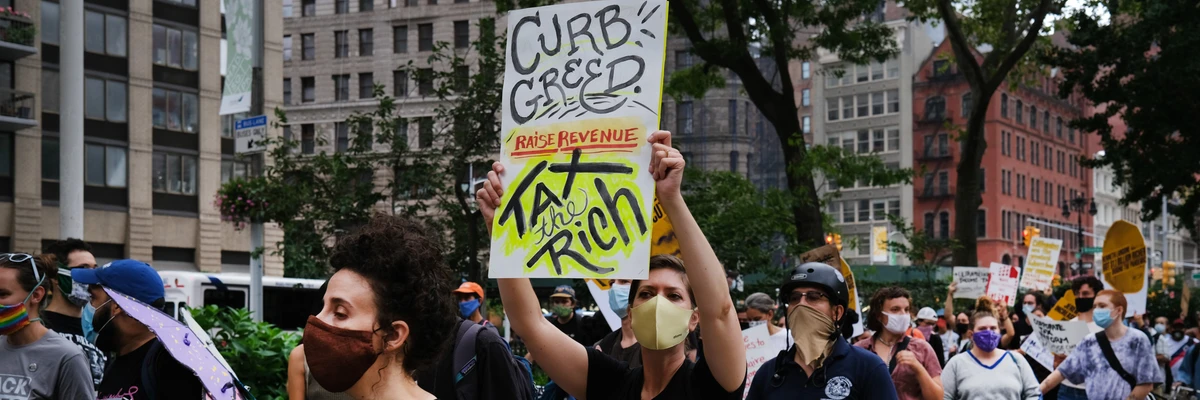
People participate in a “march on billionaires” event on July 17, 2020 in New York City. (Photo: Spencer Platt/Getty Images)
“Americans overwhelmingly prefer raising taxes on the ultra-wealthy and huge corporations to making cuts to critical programs like healthcare, medical research, and infrastructure,” said Sen. Elizabeth Warren.
The United States’ astronomical levels of economic inequality are poised to become further entrenched in the coming years as what The New York Timesdescribed Sunday as “the greatest wealth transfer in history” gets underway, with the richest members of the Baby Boomer generation set to pass trillions of dollars in assets on to their descendants—often paying little or nothing in taxes.
“Most will leave behind thousands of dollars, a home, or not much at all. Others are leaving their heirs hundreds of thousands, or millions, or billions of dollars in various assets,” the Times reported. “Of the $84 trillion projected to be passed down from older Americans to millennial and Gen X heirs through 2045, $16 trillion will be transferred within the next decade.”
The newspaper added that thanks to the loophole-ridden U.S. tax system, “heirs increasingly don’t need to wait for the passing of elders to directly benefit from family money, a result of the bursting popularity of ‘giving while living‘—including property purchases, repeated tax-free cash transfers of estate money, and more—providing millions a head start.”
“The trillions of dollars going to heirs will largely reinforce inequality,” the Times observed. “The wealthiest 10% of households will be giving and receiving a majority of the riches. Within that range, the top 1%—which holds about as much wealth as the bottom 90%, and is predominantly white—will dictate the broadest share of the money flow. The more diverse bottom 50% of households will account for only 8% of the transfers.”
1/Months in the making, here's the final cut of my story on the long-awaited wealth transfer, no longer in the future tense: We're closer to 2053 than 1992. Elites are already disbursing to heirs while alive. The masses likely need luck or a paradigm shifthttps://t.co/FDKNafpCyV
Don Moynihan, a professor at Georgetown University’s McCourt School of Public Policy, argued that the Times analysis further demonstrates that “we are not taxing the very wealthy enough.”
The Times noted that individuals in the U.S. can pass nearly $13 million in assets to heirs without paying the federal estate tax, which only applies to around two of every 1,000 American estates.
“As a result, although high-net-worth and ultrahigh-net-worth individuals could inherit more than $30 trillion by 2045, their prospective taxes on estates and transfers is $4.2 trillion,” the Times observed.
The explosion of wealth inequality in the U.S. over the past several decades has prompted growing calls for systemic reform but little substantive action from lawmakers. In 2017, congressional Republicans and then-President Donald Trump contributed to the inequality boom by ramming through tax legislation that disproportionately benefited the wealthiest Americans.
Now in control of the U.S. House, Republicans are trying to make the Trump tax cuts for individuals permanent and eliminate the estate tax altogether—a move that would give the nation’s wealthiest households another $2 trillion in tax breaks.
In April, Sen. Bernie Sanders (I-Vt.) led several of his colleagues in offering an alternative proposal: Legislation that would impose progressively higher taxes on estates worth between $3.5 million and $1 billion, as well as a 65% levy on estates worth more than $1 billion.
“At a time of massive wealth and income inequality, we need to make sure that people who inherit over $3.5 million pay their fair share of taxes,” Sanders said last month. “We do not need to provide a huge handout to multi-millionaires and billionaires. It is unacceptable that working families across the country today are struggling to file their taxes on time and put food on the table, while the wealthiest among us profit off of enormous tax loopholes and giant tax breaks.”
Sen. Elizabeth Warren (D-Mass.), a co-sponsor of Sanders’ legislation, tweeted Monday that “Americans overwhelmingly prefer raising taxes on the ultra-wealthy and huge corporations to making cuts to critical programs like healthcare, medical research, and infrastructure.”
“Congressional Republicans need to get on board,” the senator added.
Americans overwhelmingly prefer raising taxes on the ultra-wealthy and huge corporations to making cuts to critical programs like health care, medical research, and infrastructure. Congressional Republicans need to get on board.
Morris Pearl, a former managing director at the asset management behemoth BlackRock and the chair of the Patriotic Millionaires, stressed in an interview with the Times that structural changes to the U.S. tax code—not just a crackdown on wealthy tax cheats—are necessary to slow the rise of inequality.
“People are following the law just fine. I generally don’t pay much taxes,” said Pearl, whose group has warned that democracy “will not survive” unless the rich are taxed much more aggressively.
Stressing the ease with which rich families in U.S. are able to pass assets on to their heirs tax-free, Pearl told the Times that he currently holds stock that his wife’s father, “who died a long time ago, bought in the 1970s,” an investment that “has gone from a few thousand dollars to many hundreds of thousands of dollars”—unrealized capital gains that are not subject to taxation.
University of California, Berkeley economists Emmanuel Saez and Gabriel Zucman have estimated that $2.7 trillion of the $4.25 trillion in wealth held by U.S. billionaires is unrealized.
“I’ve never paid a penny of taxes on all that,” Pearl said of his inherited equities, “and I may not ever, because I might not sell and then my kids are going to have millions of dollars in income that’s never taxed in any way, shape, or form.”