‘Grotesque’: Israeli Knesset Bans UN Agency in Charge of Humanitarian Aid in Gaza

Spread the love

Original article by Jessica Corbett republished from Common Dreams under Creative Commons (CC BY-NC-ND 3.0). 
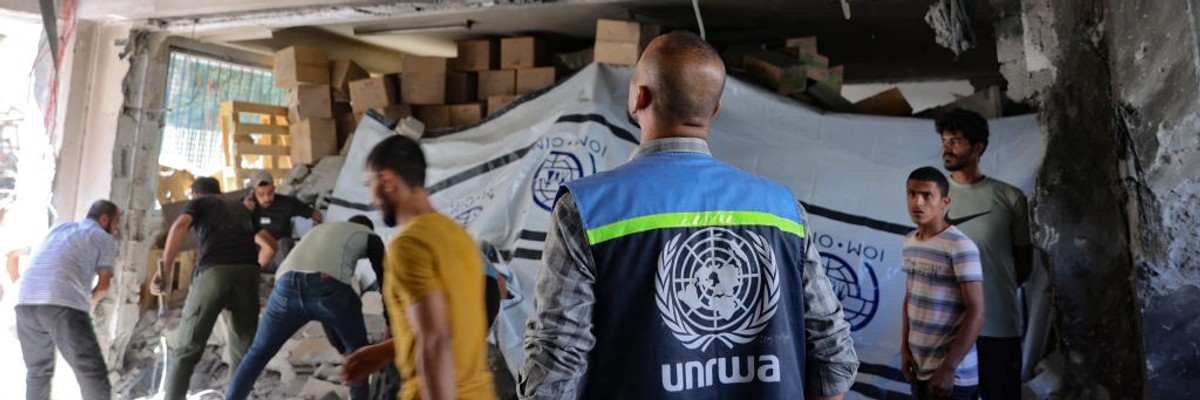
A worker with the United Nations Relief and Works Agency for Palestine Refugees in the Near East and displaced Palestinians check the damage inside a U.N. school-turned-shelter near Gaza City after a reported Israeli strike on October 19, 2024. (Photo: Omar al-Qattaa/AFP via Getty Images)

“This legislation not only contravenes the basic principles of human rights that led to the U.N. General Assembly’s founding of UNRWA, but also violates a range of Israel’s international legal obligations.”

Over a year into Israel’s obliteration of the Gaza Strip, Israeli lawmakers faced sharp criticism on Monday after voting for a pair of bills targeting the United Nations agency responsible for humanitarian aid in the illegally occupied Palestinian territories.

The first bill, which says that the United Nations Relief and Works Agency for Palestine Refugees in the Near East (UNRWA) “will not operate any missions, won’t provide any service, and won’t hold any activity—directly or indirectly—in the sovereign territory of the state of Israel,” passed the Israeli parliament 92-10.

The second legislative proposal—under which the Israeli agency that handles humanitarian issues, the Coordinator of Government Activities in the Territories (COGAT), will have to cut off contact with UNRWA—passed the 120-member Knesset 87-9. Critics called the votes “grotesque” and “outrageous.”

The Israel-based organization Adalah said in a statement that “despite widespread international pressure and condemnation, the Knesset has nearly unanimously passed two bills aimed at dismantling UNRWA, all while Israel continues its genocidal assault on Gaza and intensifies violence across the West Bank, including East Jerusalem.”

“This legislation threatens a vital lifeline for over 2.5 million Palestinian refugees throughout the occupied Palestinian territory,” the group warned. “It represents a deliberate attempt to fundamentally undermine UNRWA and its essential mission of supporting the relief, education, and human development of Palestinian refugees. Specifically, the laws aim to strip Palestinians—who were forcibly displaced from their homes during the 1948 Nakba and the 1967 war—of their status as refugees and their right of return.”

The United Nations General Assembly created UNRWA in 1949, in the wake of the Nakba, or “catastrophe,” when more than 750,000 Palestinians fled or were forced from their homeland to establish the modern state of Israel—whose officials have claimed without providing evidence that a dozen of the agency’s 13,000 staffers in Gaza were involved with the Hamas-led October 7, 2023 attack on Israel.

“This legislation not only contravenes the basic principles of human rights that led to the U.N. General Assembly’s founding of UNRWA, but also violates a range of Israel’s international legal obligations, including those under the Genocide Convention and the Rome Statute of the International Criminal Court,” said Adalah. “The international community must hold Israel accountable.”

Although Israel faces a South Africa-led genocide case at the International Court of Justice over its war on Hamas-controlled Gaza—which has killed at least 43,020 people and injured another 101,110 since last October—governments around the world have not acted to stop the bloodshed. The U.S. Congress and President Joe Biden’s administration have even provided Israel with billions of dollars in military aid and blocked cease-fire resolutions at the United Nations.

Earlier this month, the Biden administration finally threatened to cut off weapons if the Israeli government does not take “urgent and sustained actions” to improve humanitarian conditions in Gaza within 30 days. U.S. Secretary of State Antony Blinken and Secretary of Defense Lloyd Austin’s letter specifically raised concerns about the legislation that passed the Knesset Monday.

Asked about the Israeli bills on Monday, Matthew Miller, a U.S. State Department spokesperson frequently slammed for his statements about Israel, pointed to the secretaries’ criticism of the legislation in the recent letter and acknowledged that UNRWA serves the West Bank and plays “an irreplaceable role” in Gaza, where Palestinians are starving to death.

Sally Abi Khalil, Oxfam’s regional director in the Middle East and North Africa, said Monday that “Israel has bombed Palestinians to death, maimed them, starved them, and is now ridding them of their biggest lifeline of aid. Piece by piece, Israel is systemically dismantling Gaza as a land that is autonomous and liveable for Palestinians.”

“Its banning of UNRWA today is condemnable and another step in this crime,” she argued. “The decision will further undermine the ability of the international community to provide sufficient humanitarian aid and to save lives in any safe, independent, and impartial way. UNRWA was not only the biggest and most established agency that has been delivering aid and sustenance to the people of Gaza for years, it was also a thread that connected them in some hope of solidarity and security to the United Nations.”

“We are in no doubt that Israel and its allies are fully aware of the terrible consequences that this decision will have on Palestinians living in Gaza, many of whom are already starving,” she added. “We join others in warning again that this will result in more death, more suffering, and more forced displacement of people from their besieged homeland. It is impossible not to believe that this is their aim.”

Leading up to the votes, human rights advocates have been sounding the alarm. On Saturday, over 50 groups including Oxfam, Human Rights Watch, and ActionAid released a joint statement demanding action and warning that “dismantling UNRWA would be catastrophic for Palestinians especially in Gaza and the West Bank as they are deprived of essentials such as food, water, medical aid, education, and protection. It will also have catastrophic consequences for millions of Palestinian refugees in Lebanon, Jordan, and Syria, where essential humanitarian aid is crucial for both the refugees and the host communities.”


Philippe Lazzarini, the UNRWA commissioner-general, delivered a similar warning on social media Monday, declaring that the Knesset action not only “is unprecedented and sets a dangerous precedent” but “it opposes the U.N. Charter and violates the state of Israel’s obligations under international law.”

“This is the latest in the ongoing campaign to discredit UNRWA and delegitimize its role towards providing human-development assistance and services to Palestine Refugees,” he continued. “These bills will only deepen the suffering of Palestinians, especially in Gaza where people have been going through more than a year of sheer hell.”

“It ⁠will deprive over 650,000 girls and boys there from education, putting at risk an entire generation of children,” Lazzarini added. “These bills increase the suffering of the Palestinians and are nothing less than collective punishment.”

Original article by Jessica Corbett republished from Common Dreams under Creative Commons (CC BY-NC-ND 3.0). 

Continue Reading‘Grotesque’: Israeli Knesset Bans UN Agency in Charge of Humanitarian Aid in Gaza

Analysis Details How Israel’s Gaza Siege ‘Is Driving a Humanitarian Disaster’

Spread the love

Original article by Brett Wilkins republished from Common Dreams under Creative Commons (CC BY-NC-ND 3.0). 

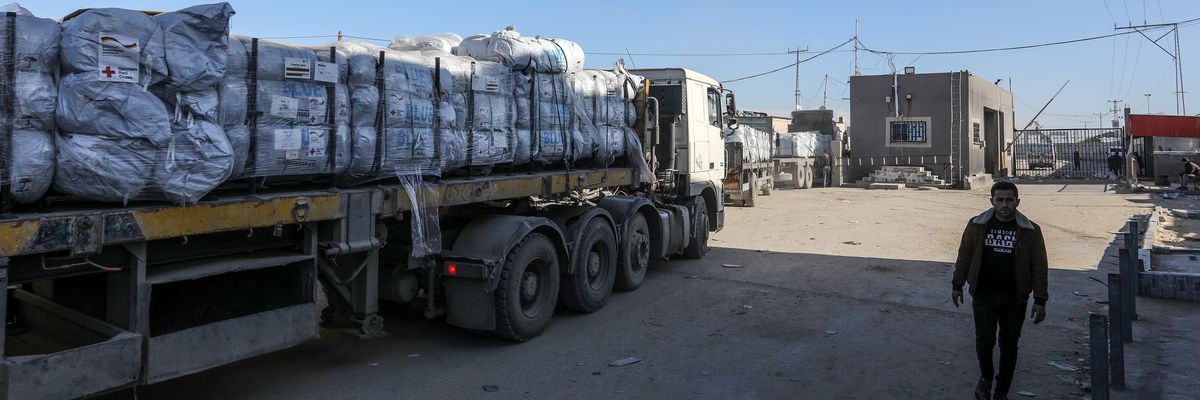
Trucks carrying aid supplies to Gaza are seen at the Karem Abu Salem border crossing on February 17, 2024. (Photo: Abed Rahim Khatib/Anadolu via Getty Images)

“Over 11 months, we have reached shocking levels of conflict, displacement, disease, and hunger,” said one campaigner.

Israel’s “complete siege” of the Gaza Strip “is driving a humanitarian disaster,” with 83% of required food aid failing to enter the embattled enclave, where the entire population is facing hunger and disease and almost half a million Palestinians are at risk of starvation, an analysis published Monday revealed.starvation,

The analysis by 15 international aid organizations noted that a record-low average of just 69 aid trucks are entering the Gaza Strip each day, compared with an already insufficient 500 daily truckloads a year ago. Additionally, the groups said that “only 17 out of Gaza’s 36 hospitals remain partially functional, and “critical infrastructure such as water networks, sanitation facilities, and bread mills” have been destroyed.

“While Israeli military attacks on Gaza intensify, lifesaving food, medicine, medical supplies, fuel, and tents have been systematically blocked from entering for almost a year,” the aid groups—which include ActionAid, American Friends Service Committee, CARE International, Christian Aid, Islamic Aid, Oxfam International, and Save the Children—said in a statement.

The publication highlights numerous ways that “lifesaving aid is systematically obstructed on a daily basis” in Gaza.

“These include the denial of safety, with more than 40,000 Palestinians and nearly 300 aid workers killed since last October; the sharp tightening of a 17-year blockade to a full siege, which prevents aid from entering Gaza; delays and denials which restrict the movement of aid around Gaza; tightly restrictive and unpredictable control of imports; the destruction of public infrastructure such as schools and hospitals; and the displacement of civilians and humanitarian workers,” the analysis’ authors wrote.

Zenab, a 33-year-old Palestinian woman pregnant with her second child, said that her pregnancy “has been the hardest time of my life.”

“It was also hard to get the medication I needed,” she continued. Sometimes I had to walk for hours to different pharmacies, hospitals, and health centers to see if anyone had my medication available. For me as a pregnant woman, there has been hardly any healthcare support, no proper hygiene and sanitation, and no suitable mattress to sleep on.”

“I was suffering from complications during my pregnancy,” Zenab added. “We didn’t have enough water to drink, and had hardly any food. The doctors again told me that my pregnancy was in danger.”

Among the report’s key findings:

  • 83% of required food aid doesn’t make it into Gaza, up from 34% in 2023;
  • An estimated 50,000 children aged between 6-59 months urgently require treatment for malnutrition by the end of the year;
  • 65% of the insulin required and half of the required blood supply are not available in Gaza;
  • Availability of hygiene items has dropped to 15% of the amount available in September 2023, with 1 million women now going without the hygiene supplies they need;
  • Only around 1,500 hospital beds in Gaza remain operational, compared to around 3,500 beds in 2023 which was already well below sufficient to meet the needs of a population of more than 2 million people; and
  • 1.87 million people are in need of shelter with at least 60% of homes destroyed or damaged as of January, yet tents for around just 25,000 people have entered Gaza since May 2024.

“There is a shortage of all humanitarian items. We are overwhelmed [with] these needs and [these] urgent requirements,” said Amjad Al Shawa, director of the Palestinian NGOs Network. “People [are] starving due to the shortage of aid. One hundred percent of the population depends on humanitarian aid.”

The authors of the analysis—which was released ahead of this week’s United Nations General Assembly in New York—are demanding that Israel secure an immediate and lasting cease-fire. They are also calling for an arms embargo on Israel and Israeli compliance with the recent International Court of Justice (ICJ) advisory opinion, which found that the occupation of Palestine is an illegal form of apartheid that must end immediately. Israel is on trial for genocide in a separate ICJ case.

“The situation was intolerable long before last October’s escalation and is beyond catastrophic now.”

“The situation was intolerable long before last October’s escalation and is beyond catastrophic now,” CARE International West Bank and Gaza country director Jolien Veldwijik said in a statement. “Over 11 months, we have reached shocking levels of conflict, displacement, disease, and hunger.”

That includes dozens of children who have died due to malnutrition, dehydration, and lack of adequate medical care.

“Aid is still not getting in, and humanitarian workers are risking their lives to do their jobs while attacks and violations of international law intensify,” Veldwijik added. “Aid, which is urgently required for 2.2 million people at risk of dying in the coming weeks and months, should never be politicized. We demand an immediate and sustained cease-fire, and the free flow of humanitarian aid into and throughout Gaza.”

Original article by Brett Wilkins republished from Common Dreams under Creative Commons (CC BY-NC-ND 3.0). 

Continue ReadingAnalysis Details How Israel’s Gaza Siege ‘Is Driving a Humanitarian Disaster’

As Gaza Death Toll Tops 40,000, Congress Urged to Block New Weapons to Israel

Spread the love

Original article by BRETT WILKINS republished form Common Dreams under Creative Commons (CC BY-NC-ND 3.0). 

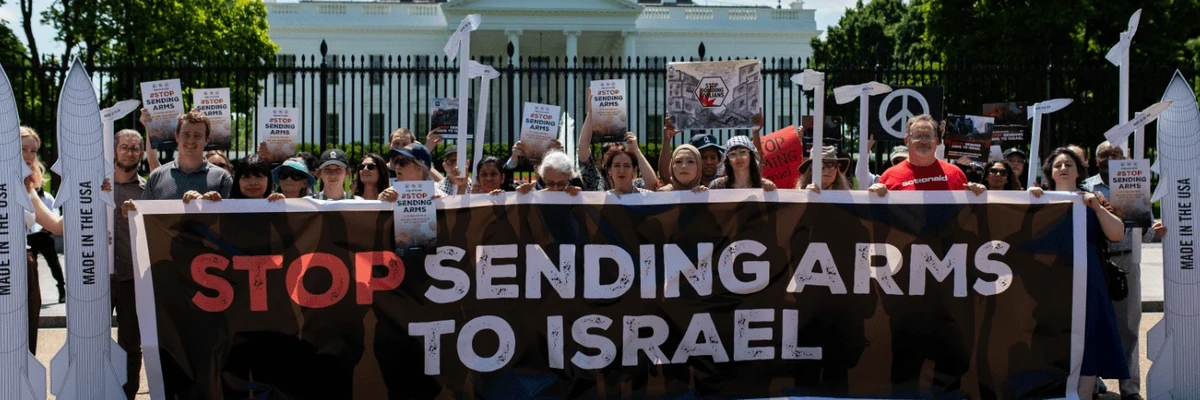
Activists demand an end to U.S. arms transfers to Israel during a May 2, 2024 protest outside the White House in Washington, D.C. (Photo: Amnesty International USA)

“U.S. arms transfers to Israel have fueled unimaginable suffering in Gaza, including staggering levels of civilian harm,” said one embargo advocate.

As the Palestinian death toll from Israel’s 314-day assault on Gaza passed 40,000—a figure experts say is likely a vast undercount—human rights groups this week decried the Biden administration’s approval of $20 billion worth of new weapons for Israel and renewed pleas for Congress to block further arms transfers to the nation on trial for genocide at the World Court.

On Tuesday—just days after Israeli forces used at least one U.S.-supplied bomb in an airstrike on a Gaza City school that killed scores of forcibly displaced Palestinian civilians sheltering there—the Biden administration notified Congress of the pending sale of a new weapons package that includes dozens of F-15 fighter jets, tens of thousands of 120mm mortar shells, over 32,700 tank shells, and 30 Advanced Medium Range Air-to-Air Missiles.

Since October, Congress and the Biden administration have approved more than $14 billion in unconditional military aid to Israel. President Joe Biden has signed off on more than 100 arms transfers to Israel during that period. This, atop the $3.8 billion in annual armed aid the U.S. already gives to the key Middle Eastern ally.

“Israel used U.S.-made weapons in May when it slaughtered Palestinian families sheltering in tent camps in Rafah,” Jewish Voice for Peace (JVP) said Wednesday. “Israel used U.S.-made weapons when it bombed the al-Mutanabbi school in Khan Younis in early July, killing over two dozen displaced Palestinians seeking refuge there. And it used U.S.-made weapons on Saturday to murder over 100 Palestinians while they prayed.”

“Biden continues to send weapons to Israel, and both political parties—Republicans and Democrats—have cheered on the Israeli government’s slaughter and genocide of Palestinians in Gaza,” JVP continued. “This is a U.S.-perpetrated genocide as much as it is an Israeli one.”

“But the Democratic voting base is calling for something different, and we have seen the progressive and increasingly mainstream wing of the party begin to echo this need,” the group said. “We are playing a critical role in driving the Democratic Party to finally catch up to the demands of its own base.”

“Right now, we have an opportunity to re-center Gaza in the national conversation and continue building pressure on the Biden administration, on [Vice President] Kamala Harris, and on Democratic members of Congress to support an immediate arms embargo,” JVP added.

While Harris has expressed sympathy for Palestinians suffering what she called a “humanitarian catastrophe” in Gaza, the vice president and Democratic presidential nominee, like Biden, has proclaimed her “unwavering” support for Israel. One aide said last week that Harris does not support an arms embargo.

“The decision to approve yet another massive sale of arms to Israel is appalling and a blatant violation of U.S. and international law and policy,” Annie Shiel, the U.S. advocacy director at the Center for Civilians in Conflict, said on Thursday.

“U.S. arms transfers to Israel have fueled unimaginable suffering in Gaza, including staggering levels of civilian harm, the destruction of civilian infrastructure, and an ever-growing humanitarian catastrophe,” Shiel continued. “The U.S. is complicit in this devastation.”

“Congress must block these sales, including through the introduction of joint resolutions of disapproval,” she added, “and the Biden-Harris administration must finally end U.S. arms transfers and use its leverage to bring about an immediate cease-fire.”

The international anti-poverty NGO ActionAid said Thursday: “We are outraged and heartbroken by the staggering loss of 40,000 lives in Gaza. It is a number that is incomprehensible—every life lost is an individual tragedy.”

“But this is not an inevitable one, it is an ongoing atrocity, and it could have been prevented,” the group continued. “Most governments across the world have refused to do the bare minimum to protect civilian life and it is to our collective shame. We are losing confidence each day in the concept of justice.”

“We reiterate our calls for an immediate cessation of hostilities and urge all governments to meet their obligations under international law and use all available means to take immediate and decisive action to ensure the safety and security of all civilians,” ActionAid said.

“We call for the imposition of sanctions, including travel bans and asset freezes, on Israeli officials linked to alleged violations of international humanitarian law,” the NGO added. “Every day that you choose to avoid this as a reality, this death toll will keep rising until there is nobody left in Gaza alive.”

In addition to the South Africa-led genocide case against Israel at the International Court of Justice, International Criminal Court (ICC) Prosecutor Karim Khan has applied for warrants to arrest Israeli Prime Minister Benjamin Netanyahu and Defense Minister Yoav Gallant, and for three Hamas leaders, at least one of whom has been assassinated by Israeli forces.

The Biden administration and numerous members of Congress have condemned the courts’ pursuit of justice for Israel and its leaders. In June, 42 Democrats joined nearly every Republican in the House of Representatives in passing a bill that would sanction ICC officials over Khan’s application for arrest warrants for Netanyahu and Gallant.

In addition to rights groups, a coalition of journalists, news outlets, and press freedom organizations on Thursday implored the Biden administration to immediately halt arms transfers to Israel.

As the tight 2024 presidential race between Harris and former President Donald Trump, the Republican nominee, heads toward the home stretch, a survey commissioned by the Institute for Middle Eastern Understanding Policy Project and conducted by YouGov revealed this week that Democratic and Independent voters in the key swing states of Arizona, Georgia, and Pennsylvania would be more willing to vote for Harris if she backed an arms embargo on Israel.

Original article by BRETT WILKINS republished form Common Dreams under Creative Commons (CC BY-NC-ND 3.0). 

Continue ReadingAs Gaza Death Toll Tops 40,000, Congress Urged to Block New Weapons to Israel

Israel’s blocking of aid to Gaza is a weapon in its brutal war against Palestinians

Spread the love

Original article by Abdul Rahman and Ana Vračar republished from peoples dispatch under a Creative Commons Attribution-ShareAlike 4.0 (CC BY-SA) license.

Photo: UNRWA

Israel’s deliberate blocking of humanitarian aid to Gaza has emerged as key weapon against the people of the territory. More than 20 Palestinians have reportedly been killed due to starvation in the last few weeks and numbers are expected to explode in the coming days.

Though Israel denies it has any such policy, almost all UN agencies working to provide aid on the ground in Gaza, as well as several other groups, have termed the deliberate blocking of aid as the most important reason for an imminent famine in the besieged Palestinian territory. 

Research conducted by organizations such as Refugees International show that, “Israeli conduct has consistently impeded aid operations within Gaza, blocked legitimate relief operations, and resisted implementing measures that would genuinely enhance the flow of humanitarian aid in Gaza.”

By denying adequate aid to Gaza, Israel has been in violation of the interim order passed by the International Court of Justice (ICJ) on January 26 while hearing the genocide petition filed by South Africa. The ICJ had asked Israel to facilitate “urgently needed basic services and humanitarian assistance to address the adverse conditions of life.”

In its submission to the court in February, Israel claimed it had complied with the ruling. However, UN data shows that the actual number of trucks with aid reaching Gaza decreased by half in February in comparison to the previous month. International organizations still describe experiences where the Israeli Occupying Forces (IOF) block their entry into Gaza, especially North Gaza, after being made to wait for hours on end.

According to Philippe Lazzarini, Commissioner General of UNRWA, in February, on an average just 98 trucks entered Gaza in comparison to around 200 trucks a day in January. Before October 7, Israel used to allow around 500 trucks a day to the besieged territory for a population of over 2.3 million.

Israel’s denial of adequate aid to Gaza also violates the UN Security Council resolution adopted in December which talks about greater access to humanitarian aid to Palestinians in Gaza. 

The US, which was the primary mover of the UN security council resolution, recently airdropped aid to Gaza. While delivering his State of the Union address on March 7, President Joe Biden also talked about opening a temporary port in Gaza to deliver faster aid. Both the moves confirm the claims that there is not enough aid reaching Gaza at the moment, despite Israeli claims.

However, the US act is widely seen as a face-saving exercise given the Biden administration’s reluctance to press Israel for a permanent ceasefire in Gaza and its supply of arms and ammunition which is used by Israel to bomb Palestinians.

The Biden administration has failed to make Israel comply with its own National Security Memorandum (NSM 20) as well. It requires that countries seeking security aid from the US make arrangements for adequate humanitarian assistance.

Medea Benjamin of CODEPINK highlighted on her page on X that Biden says “Israel must allow more aid into Gaza and protect civilians. But it doesn’t. And Biden keeps sending them more weapons.”

Meanwhile “after five months of war, Palestinians are struggling to find adequate food, water, shelter and basic medicine. Famine level hunger is already widespread and worsening” in Gaza, Refugees International’s report says. The lack of adequate food has significant health implications for children in Gaza who have been the primary victims of Israel’s war since October 7.

Israel weaponized starvation against Palestinians

Israel has killed over ten thousand children in its bombings and ground offensives in Gaza since October 7. In addition to that, the health effects of Israel’s blockade on aid delivery are worsening by the day.

According to the World Health Organization (WHO), 1 in 6 children under 2 years of age in Gaza are acutely malnourished. The combination of food shortages, lack of clean water, and inadequate healthcare provision is having devastating effects, particularly on young children and mothers.

Many women are facing extreme difficulties in initiating and continuing breastfeeding due to their own nutritional status and stress. “People are hungry, exhausted, and traumatized,” said Adele Khodr, Regional Director of UNICEF’s Middle East and North Africa office.

The food shortage in the north is so severe that health workers report 95% of female patients are suffering from anemia. “There have been many operations performed, such as cesarean sections, to remove fetuses, [which] died of malnutrition among women,” Mohammed Salha, director of Al-Awda Hospital, told ActionAid.

Pediatricians at Kamal Adwan Hospital have reported not having the resources to treat more than half the children admitted to the hospital for malnutrition, as there is no food or medical supplement the staff can give them. “The most we can do for them is give them a saline solution or sugar solution,” physician Imad Dardonah told UN teams visiting the institution.

Israeli obstacles to aid delivery also mean that there is not enough infant formula or diapers. On the rare occasions when these essential supplies are found, their cost puts them out of reach for most of the population in Gaza.

A box of diapers in northern Gaza now costs around ILS 200 (USD 55), while monthly income before October 7, 2023, was reported around ILS 1,200 (USD 343)— not even enough to cover a newborn’s monthly supply during her first month of life, let alone food on top of that.

Restrictions are also being applied to the number of international medical teams allowed into Gaza and to field hospitals, which would allow for a partial expansion of much-needed health service capacities.

The siege is causing a devastating paradox: at the same time, there are too few health workers to respond to the needs of the population and those who have been working in Gaza’s healthcare system since October; and there are too many health workers in comparison to the operational surgery capacities—the only remaining functional operation rooms are located at the European Hospital in southern Gaza, according to surgeon Ghassan Abu Sittah.

Some countries have attempted to circumvent Israel’s aid blockade by airdropping supplies, but the amounts reaching the population in Gaza this way are nowhere near sufficient. To adequately stock hospitals and health centers, several international agencies have warned, it is paramount to ensure unimpeded passage for truck convoys carrying a wide range of supplies, not just a specific type of food or sanitary bandages.

When it comes to aid delivery, the UN humanitarian coordinator for the occupied Palestinian territories, James McGoldrick, said, “There is no alternative to food trucks, to road transports.”

Original article by Abdul Rahman and Ana Vračar republished from peoples dispatch under a Creative Commons Attribution-ShareAlike 4.0 (CC BY-SA) license.

Continue ReadingIsrael’s blocking of aid to Gaza is a weapon in its brutal war against Palestinians

‘This Is Absurd’: Major Banks Continue to Fund Climate Chaos in Global South

Spread the love

Original article by OLIVIA ROSANE republished from Common Dreams under Creative Commons (CC BY-NC-ND 3.0). 

ActionAid found that since the Paris agreement, banks have funded the largest Big Ag companies doing business in the Global South to the tune of $370 billion and the fossil fuel sector to the tune of $3.2 trillion.

Since the international community promised to limit global heating to 1.5°C above preindustrial levels, the world’s major banks have funneled 20 times more money to climate-polluting industries in the Global South than Global North governments have given those same countries to address the climate emergency.

That’s just one of the findings of How the Finance Flows: The Banks Fueling the Climate Crisis, an ActionAid report released Monday.

“This report names the biggest offenders in the banking world and calls on them to see that they are destroying the planet, while harming the present and future for their children,” Ugandan climate activist Vanessa Nakate wrote in the foreword. “It’s time to hold financial institutions to account, and demand that they end their funding of destructive activity.”

The report focuses on the financing of two major climate-heating industries in the 134 nations of the Global South: fossil fuels and industrial agriculture.

“People generally know that fossil fuels are the number one cause of greenhouse gas emissions. But what is less understood is that industrial agriculture is actually the second biggest cause of climate emissions,” Teresa Anderson, the global lead on climate justice at ActionAid International, said during a press briefing ahead of the report’s release.

This is because of the sector’s link to deforestation, as well as the emissions required to produce industrial fertilizers, she added.

In total, since the 2015 Paris agreement, banks have funded the largest Big Ag companies doing business in the Global South to the tune of $370 billion and the oil, gas, and coal sectors to the tune of $3.2 trillion.

“Global banks often make public declarations that they are addressing climate change, but the scale of their continued support of fossil fuels and industrial agriculture is simply staggering.”

The top three banks that invested the most in these sectors were the Industrial and Commercial Bank of China at $154.3 billion, China CITIC Bank at $134.7 billion, and the Bank of China at $125.9 billion. Citigroup came in fourth at $104.5 billion, followed by HSBC at $80.8 billion.

While China features prominently in the report as the world’s largest economy, Anderson noted that much of what it produces ends up purchased by consumers in the Global North.

The top three banks in the Americas funding big agriculture and fossil fuels were Citigroup, JPMorgan Chase, and Bank of America. While Citigroup was the leading regional funder of fossil fuels, JP Morgan Chase gave the most to industrial agriculture.

In Europe, the top funders after HSBC were BNP Paribas, Société Générale, and Barclays, while Mitsubishi UFJ Financial rounded out the top Asian funders.

Where is all that money going? When it comes to agriculture, the leading recipient was Bayer, which bought out Monsanto in 2018. Banks have given it $20.6 billion to do business in the Global South since 2016.

Much of the fossil fuel money went to China’s State Power Investment Corporation and other Chinese companies; commodities trader Trafigura; and the usual fossil fuel suspects like ExxonMobil, BP, Shell, Saudi Aramco, and Petrobras.

“This is absurd,” Anderson said of the findings. “Global banks often make public declarations that they are addressing climate change, but the scale of their continued support of fossil fuels and industrial agriculture is simply staggering.”

ActionAid called the report the “flagship” document of its Fund Our Future campaign to redirect global money from climate crisis causes to climate solutions. The report calls on banks to make good on their climate promises and stop funding fossil fuels and deforestation, as well as to put additional safeguards in place to protect the rights of local communities, raise the ambition of their goals to reach “real zero” emissions, and improve transparency and other measures to make sure the projects they fund are behaving ethically.

“This can be stopped,” Farah Kabir, the country director of ActionAid Bangladesh, said during the press briefing. “The banks cannot continue to fund fossil fuel industries and industrial agriculture.”

In addition, the report offers recommendations to Global North governments to ensure a just transition to a sustainable future for everyone. These included setting stricter regulations for the banking, fossil fuel, and agricultural industries as well as ending public subsidies for these sectors and channeling the money to positive solutions like renewable energy and agroecology.

However, the form that funds take when sent to the Global South makes a big difference, said ActionAid USA executive director Niranjali Amerasinghe. Instead of coming in the form of private loans, it needs to be in the form of public money.

“Providing more loans to countries that are already in significant debt distress is not going to support their transition to a climate-compatible future,” she said.

One reason that loans are counterproductive is that nations that accept them are forced to provide a return on investment, and currently the main industries that offer this are in fact fossil fuels and industrial agriculture.

In addition to public funds, debt forgiveness or restructuring and new taxes could also help these countries with their green transition. If companies like Exxon or Bayer doing business in the Global South “were taxed in an equitable way, that would allow those governments to raise public revenue that can then be used to support climate action,” Amerasinghe said.

In particular, the report emphasizes agroecology as a climate solution that should be funded in Global South countries.

“Climate change is real in Zambia.”

Mary Sakala, a frontline smallholder farmer from Zambia, spoke at the press briefing about how the climate crisis and current agricultural policy put a strain on her community.

“Climate change is real in Zambia,” she said, adding that it had brought flooding, droughts, pests, and diseases that meant that “families currently, as I’m speaking right now, sleep on an empty stomach.”

Sakala saw hope in agroecology, which would help with food security and resilience, and make farmers less dependent on the government and large companies.

“We need policies to allow [us] to conserve our environment in a cultural way, to help us eat our food,” Sakala said. “We want… every seed to be utilized and saved and shared in solidarity.”

And she said that the companies and governments of the Global North have a duty to help them get there.

“Those people who are continuing to pollute and let the climate change increase, those people need to pay us, because we are suffering from the things that others are doing,” she said.

Original article by OLIVIA ROSANE republished from Common Dreams under Creative Commons (CC BY-NC-ND 3.0). 

Continue Reading‘This Is Absurd’: Major Banks Continue to Fund Climate Chaos in Global South