Benito Mussolini ‘Il Duce’ (The Leader) is regarded as the original Fascist. Communists, Socialists and Anarchists were the active opponents to Fascism as was seen in the Spanish Civil War which ended in 1939 at the beginning of WW2.
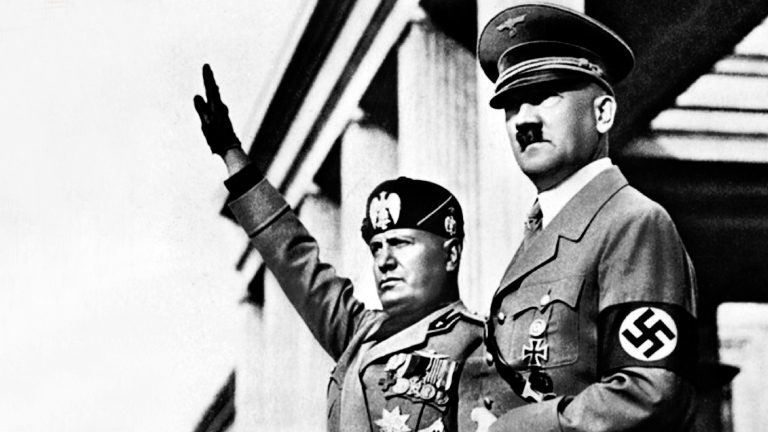
Benito Mussolini ‘Il Duce’ (The Leader) is regarded as the original Fascist. Communists, Socialists and Anarchists were the active opponents to Fascism as was seen in the Spanish Civil War which ended in 1939 at the beginning of WW2.
Original article by Jon Queally republished from Common Dreams under Creative Commons (CC BY-NC-ND 3.0).
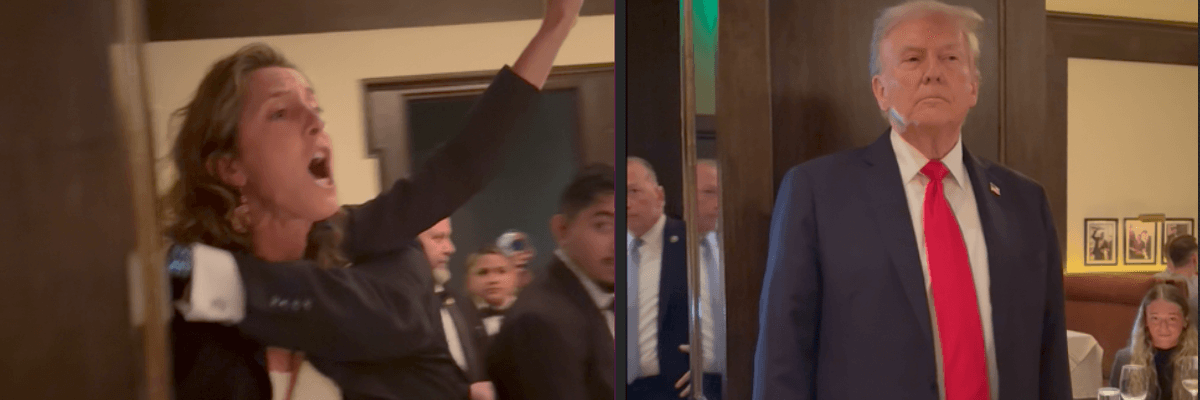
Local peace activists in Washington, DC were swiftly ejected on Tuesday night after confronting President Donald Trump and several members of his cabinet who were dining in a steak and seafood restaurant, but not before they castigated the men for “feasting” in opulence while the people of Gaza “starve” under the brutal humanitarian blockade imposed by the US and Israeli governments.
The small group of CodePink activists chanted “They feast while Gaza starves!” and “Trump is the Hitler of our time!” as Trump looked on just several feet away inside Joe’s Seafood, Prime Steak & Stone Crab restaurant, alongside Secretary of Defense Pete Hegseth, Vice President JD Vance, Secretary of State Marco Rubio, and others.
“He’s terrorizing Gaza and communities all over the world!” one activist in the group shouted at Trump while the president looked on and then shooed them to go away with a point of his finger and then a gesture to his Secret Service detail.
“While Trump, JD Vance, Marco Rubio, Pete Hegseth, and others feasted at a steakhouse, we stood our ground and told them the truth,” said Olivia DiNucci, the group’s DC organizer, in a statement following the confrontation. “Two years into genocide, Gaza is under evacuation orders, Puerto Rico and Venezuela are in the crosshairs, and the Pentagon proudly calls itself the Department of War. Trump looked us in the eyes, and we made sure he would never dine in peace while communities are under siege.”
CodePink said a Trump administration “prioritizing war and the wealthy over the needs of the American people and human rights abroad” should not be able to dine in luxury when it is causing so much pain and misery both abroad and in communities nationwide in the US, including the capital.
The group specifically condemned ongoing “support for the genocide in Gaza, reckless and illegal military strikes on vessels in the Caribbean, and the deployment of troops and ICE agents within US borders. As well as the growing threat of occupying U.S. cities with the deployment of the National Guard.”
With National Guard troops now deployed in Los Angeles and Washington, DC—and with the Trump administration announcing the launch of what it dubbed operation “Midway Blitz” in Chicago this week—CodePink said there is growing anger nationwide over the president’s authoritarian and fascist tactics that are reminiscent of how Adolf Hitler intensified his violent grip on power in Nazi Germany in the 1930s and 40s.
“We hope he sees our faces in his mind, for a long time,” said one group member who confronted Trump in the restaurant. “Because he looked us all in the eyes as we were standing there. We will continue to fight for DC. We will continue to fight for a free Palestine every single day.
The activists received high praise online for their disruptive efforts.
“Pretty gutsy in my opinion. I don’t know how they got so close,” said journalist and writer Tim Shorrock.
“Amazing!” declared writer Polly Sigh. “My hats off to these brave protesters for saying it right to his ugly orange face.”
In its statement, CodePink said that while Trump’s authoritarian march at home and warmongering abroad continues, “the very programs that support struggling Americans—healthcare, education, and addiction treatment—face severe cuts.”
“This agenda, funded by a bill providing massive tax cuts for the super-rich, is being paid for by a working class that cannot afford it,” said the group, who added that their small disruption of a dinner for some of the world’s most powerful men “represents the frustration of a majority of Americans who reject these priorities.”
Original article by Jon Queally republished from Common Dreams under Creative Commons (CC BY-NC-ND 3.0).


Original article by Thom Hartmann republished from Common Dreams under Creative Commons (CC BY-NC-ND 3.0).

People take part in a protest against the deportation of alleged Venezuelan criminals from the USA to a high-security prison in El Salvador in Caracas, Venezuela on April 9, 2025. (Photo: Jesus Vargas/picture alliance via Getty Images)
The American people just got a taste of authoritarianism wrapped in judicial robes. In a stunning 6-3 ruling this week, the Supreme Court green-lit the mass deportation of immigrants, not to their home countries but to third nations where they have no legal status, no family, and often no hope.
In her dissent, Justice Sonja Sotomayor, calling the shadow docket ruling “inexcusable,” pointed out how destructive this is to the rule of law (both U.S. and international law largely prohibit this) and to the lives of the people who may be deported without due process:
The Government has made clear in word and deed that it feels itself unconstrained by law, free to deport anyone anywhere without notice or an opportunity to be heard. The episodes of noncompliance in this very case illustrate the risks.
The Due Process Clause represents “the principle that ours is a government of laws, not of men, and that we submit ourselves to rulers only if under rules.” By rewarding lawlessness, the court once again undermines that foundational principle.
In matters of life and death, it is best to proceed with caution. In this case, the government took the opposite approach. It wrongfully deported one plaintiff to Guatemala, even though an Immigration judge found he was likely to face torture there. Then, in clear violation of a court order, it deported six more to South Sudan, a nation the State Department considers too unsafe for all but its most critical personnel.
This ruling by six corrupt Republican justices allows Donald Trump or any future president to designate any country they choose as a “safe third country” and deport people there without meaningful review, even if they’ve committed no crime and have a valid asylum claim.
If that sounds familiar, it should. It echoes one of the most cold-blooded decisions made by Adolf Hitler’s Nazi regime: to locate their extermination camps not within Germany, but in the foreign lands of occupied Poland.
Let’s be clear: Deportation is not genocide. But both decisions—then and now—are grounded in the same logic of moral evasion through geographic displacement.
When regimes want to commit acts that would stir conscience or provoke backlash at home, they find ways to outsource the cruelty.
The decision wasn’t just about deportation. It was about moral laundering, washing the blood off our hands by putting it on someone else’s tarmac.
The Nazi leadership understood that while Germany’s public had been bombarded with antisemitic propaganda for years, they still might balk at the wholesale slaughter of millions of people inside German borders. So they built Auschwitz, Treblinka, Sobibor, and Belzec far away, deep in Poland, where there were no German newspapers, no prying eyes, and no courts to second-guess their machinery of death.
As Raul Hilberg and other Holocaust historians have documented, Nazi leaders like Heinrich Himmler and Reinhard Heydrich made this decision deliberately to preserve the illusion of “moral cleanliness” at home while carrying out genocide abroad.
Today’s Trump version of this practice is more sanitized, but no less cynical.
By permitting the U.S. government to deport asylum-seekers and noncriminal undocumented immigrants to random third countries—often places they’ve never even set foot in—the Supreme Court has granted the executive branch a license to erase moral responsibility.
As long as the suffering happens somewhere else, we’re told, it’s not our fault. It’s not our soil. Not our responsibility.
That kind of logic is the death of democracy, human rights, and the rule of law. As Federal Judge Patricia Millett said of Trump’s deportation of Venezuelan prisoners to a concentration camp in El Salvador, compared with FDR’s actions in WWII, “Nazis got better treatment under the Alien Enemies Act.”
A future president with dictatorial ambitions could cite this ruling to round up political dissidents, journalists, or whistleblowers and ship them off to “safe third countries” that are anything but.
The Trump administration argued—and the court’s on-the-take, Republican-appointed majority agreed—that migrants have no right to American judicial processes once they’re transferred elsewhere. In other words, we can dodge our legal obligations under both U.S. and international law simply by putting someone on a plane.
This is the same loophole thinking that allowed George W. Bush’s administration to kidnap terror suspects and ship them to places like Egypt and Syria, where they were tortured out of view. That policy was called “extraordinary rendition.” Today, we might call this new policy extraordinary rejection: a way to deny asylum without confronting its human cost.
And here’s the truly chilling part: Once someone has been deported to a third country, they are functionally outside the U.S. legal system. They can’t sue. They can’t appeal. They may not even survive. And, to Trump’s delight, it’ll all be outside the reach of American courts and U.S. media.
This obscene policy isn’t about safety, it’s about displacement as punishment and the creation of a pseudo-legal infrastructure of indifference to the humanity of the people we’re “processing.”
Whether it’s a camp outside Kraków or a deportation center in Guatemala, the strategy is the same: create a zone of moral invisibility. A legal no-man’s-land where acts that would outrage decent people become routine, because they happen far away, beyond the reach of media, law, and conscience.
That’s not how democracies behave: That’s how authoritarian regimes insulate themselves from dissent.
And like all authoritarian tools, once it exists, it will be used again.
You may think this only affects immigrants. But consider: The legal precedent now exists for the government to forcibly remove someone from U.S. soil and drop them in another country without due process. Today it’s asylum-seekers. Tomorrow, who knows?
A future president with dictatorial ambitions could cite this ruling to round up political dissidents, journalists, or whistleblowers and ship them off to “safe third countries” that are anything but.
You think that’s paranoid? So did people in 1932 Berlin.
The genius of the American system—at least in theory—is that it puts checks on state power. The executive cannot act like a king. The courts must protect the vulnerable. And the public must have visibility into the actions done in our name.
This week, though, the Supreme Court abdicated that role. And in doing so, the six Republicans on the bench handed a dangerous tool to a man most inclined to abuse it.
Let’s not kid ourselves. The decision wasn’t just about deportation. It was about moral laundering, washing the blood off our hands by putting it on someone else’s tarmac.
The Nazis did it. So did the Bush administration. Now Trump’s backers on the court have opened the door once more.
History doesn’t repeat, but, as Mark Twain said, it rhymes. And if we’re not careful, we may soon find that rhyme turning into a full verse we’ve heard before.
Original article by Thom Hartmann republished from Common Dreams under Creative Commons (CC BY-NC-ND 3.0).

Article republished from the Guardian. The text of the letter is © 2025 Stop Return Fascism.

On 1 May 1925, with Benito Mussolini already in power, a group of Italian intellectuals publicly denounced his fascist regime in an open letter. The signatories – scientists, philosophers, writers and artists – took a stand in support of the essential tenets of a free society: the rule of law, personal liberty and independent thinking, culture, art and science. Their open defiance against the brutal imposition of the fascist ideology – at great personal risk – proved that opposition was not only possible, but necessary. Today, 100 years later, the threat of fascism is back – and so we must summon that courage and defy it again.
Fascism emerged in Italy a century ago, marking the advent of modern dictatorship. Within a few years, it spread across Europe and the world, taking different names but maintaining similar forms. Wherever it seized power, it undermined the separation of powers in the service of autocracy, silenced opposition through violence, took control of the press, halted the advancement of women’s rights and crushed workers’ struggles for economic justice. Inevitably, it permeated and distorted all institutions devoted to scientific, academic and cultural activities. Its cult of death exalted imperial aggression and genocidal racism, triggering the second world war, the Holocaust, the death of tens of millions of people and crimes against humanity.
At the same time, the resistance to fascism and the many other fascist ideologies became a fertile ground for imagining alternative ways of organising societies and international relations. The world that emerged from the second world war – with the charter of the United Nations, the Universal Declaration of Human Rights, the theoretical foundations of the EU and the legal arguments against colonialism – remained marked by deep inequalities. Yet, it represented a decisive attempt to establish an international legal order: an aspiration toward global democracy and peace, grounded in the protection of universal human rights, including not only civil and political, but also economic, social and cultural rights.
Fascism never vanished, but for a time it was held at bay. However, in the past two decades, we have witnessed a renewed wave of far-right movements, often bearing unmistakably fascist traits: attacks on democratic norms and institutions, a reinvigorated nationalism laced with racist rhetoric, authoritarian impulses and systematic assaults on the rights of those who do not fit a manufactured traditional authority, rooted in religious, sexual and gender normativity. These movements have re-emerged across the globe, including in long-standing democracies, where widespread dissatisfaction with political failure to address mounting inequalities and social exclusion has once again been exploited by new authoritarian figures. True to the old fascist script, under the guise of an unlimited popular mandate, these figures undermine national and international rule of law, targeting the independence of the judiciary, the press, institutions of culture, higher education and science, even attempting to destroy essential data and scientific information. They fabricate “alternative facts” and invent “enemies within”; they weaponise security concerns to entrench their authority and that of the ultra-wealthy 1%, offering privileges in exchange for loyalty.
This process is now accelerating, as dissent is increasingly suppressed through arbitrary detentions, threats of violence, deportations and an unrelenting campaign of disinformation and propaganda, operated with the support of traditional and social media barons – some merely complacent, others openly techno-fascist enthusiasts.
Democracies are not flawless: they are vulnerable to misinformation and they are not yet sufficiently inclusive. However, democracies by their nature provide fertile ground for intellectual and cultural progress and therefore always have the potential to improve. In democratic societies, human rights and freedoms can expand, the arts flourish, scientific discoveries thrive and knowledge grow. They grant the freedom to challenge ideas and question power structures, propose new theories even when culturally uncomfortable, which is essential to human advancement. Democratic institutions offer the best framework for addressing social injustices, and the best hope to fulfil the post-war promises of the rights to work, education, health, social security, participation in cultural and scientific life, and the collective right of peoples to development, self-determination and peace. Without this, humanity faces stagnation, growing inequality, injustice and catastrophe, not least from the existential threat caused by the climate emergency that the new fascist wave negates.
In our hyper-connected world, democracy cannot exist in isolation. As national democracies require strong institutions, international cooperation relies on the effective implementation of democratic principles and multilateralism to regulate relations among nations, and on multistakeholder processes to engage a healthy society. The rule of law must extend beyond borders, ensuring that international treaties, human rights conventions and peace agreements are respected. While existing global governance and international institutions require improvement, their erosion in favor of a world governed by raw power, transactional logic and military might is a regression to an era of colonialism, suffering and destruction.
As in 1925, we scientists, philosophers, writers, artists and citizens of the world have a responsibility to denounce and resist the resurgence of fascism in all its forms. We call on all those who value democracy to act:
This is an ongoing struggle. Let our voices, our work and our principles be a bulwark against authoritarianism. Let this message be a renewed declaration of defiance.
Article republished from the Guardian. The text of the letter is © 2025 Stop Return Fascism.


Original article by Mary Dingee Fillmore republished from Common Dreams under Creative Commons (CC BY-NC-ND 3.0).
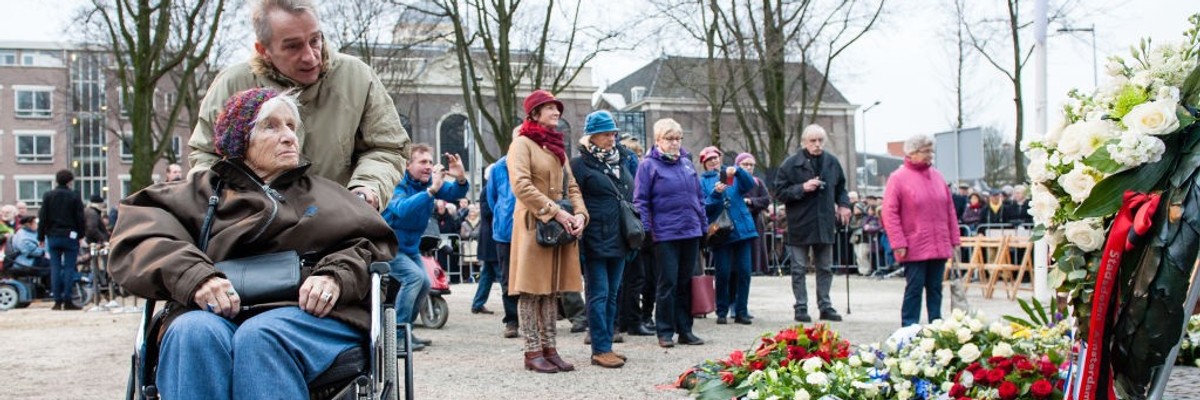
In three days, Amsterdam organized the only general strike in Europe to protest the first roundup of Jews. People poured into the streets on February 25, 1941—an estimated 300,000 of the 800,000 total who lived in the city.
The first to march were the tram and dock workers. The civil servants followed and word spread through the whole city, even to the small sewing workshop where a woman named Mientje Meijer worked. She and her husband had talked about it, and he came to the window to let her know it was really happening. She stopped her treadle, rose to her feet, and said, “Ladies, all of Amsterdam has come to a standstill because they’ve been rounding up Jews and taking them away. We’ve got to join in.”
The ladies poured out, even the boss, and joined the multitudes: teachers, metal workers, factory employees, shop clerks, people from across the political spectrum. Some were furious that their fellow citizens’ rights had been violated, some wanted to protest the Nazi occupation, and some just hated the Germans. Whatever their motives, they stopped the city in its tracks.
How did they organize so fast? A road builder and a street sweeper who belonged to the banned but well-organized Communist Party decided to call a meeting and take action. They had heard that hundreds of Jewish men had been rounded up on the square between the immense Portuguese Synagogue and the four smaller Ashkenazi ones. The communists gathered with trade union representatives and others at the Noorderkerk in the workers’ part of the city. They enlisted political and moral allies. Soon, a mimeographed leaflet urged everyone to “Strike! Strike! Strike! Shut down all of Amsterdam for a day!” And they did. The Strike even reached a few other cities before the German occupiers reacted with force.
Only limited public protest was heard the year before, at the time when Jews were fired from the civil service, including professors from the universities. Therefore, the Germans were dumbfounded in February 1941 when the Dutch, their Aryan brothers and sisters, took to the streets en masse. But the Nazis recovered fast and ordered the use of rifles and hand grenades to stop the strike.
By the time it was over a few days later, about 200 people had been arrested, nine had been killed, and 50 injured. For the rest of the war, the February Strike remained the only general strike in Europe to protest the roundups. Tragically, it was futile: about 75% of the Dutch Jewish population was mass murdered. Yet the strike remains in our memories as one of the few times ordinary people stood together against the deportation of their Jewish neighbors. It meant something to many Dutch survivors as long as they lived.
I learned about the Strike at the time of its 60th commemoration in 2001. Every year, people gather to remember, right where the first roundups took place. They stand around the statue of the Dockworker who is the symbolic figure of the Strike. Sculpted by a resistance worker who survived, the hefty figure wears a worker’s cap, looking not at us but beyond us, his hands at his sides, open but ready to form fists.
In 2001, the square was crammed with people, some old enough to have been alive at the time, others young families, others men of all ages with yarmulkes, and individuals formally dressed in black who proved to be diplomats. Everyone was quiet, even little children. The commemoration began with a few short speeches and a poem, but the main event was this: people were invited, a few at a time, to approach the Dockworker, stand for a moment, and lay flowers.
The elders approached first, those who might have been present at the Strike. Next the Jewish organizations placed their big wreaths, often laid by children. Similar offerings came from the European Trade Union Federation, from the people of Sweden and the United States, and others. But the vast majority of the flowers were small bouquets tied with ribbons, like a dozen red tulips bound by aluminum foil with a bit of wet paper inside. Some were accompanied by a personal note written in ink in a scrawly hand.
It took an hour and a half on that frigid afternoon to lay all the flowers, and they stayed there unmolested for days. The flowers remained until they were all dead and had to be carried away.
Original article by Mary Dingee Fillmore republished from Common Dreams under Creative Commons (CC BY-NC-ND 3.0).