Climate, Indigenous Groups Rip Trump GOP for ‘Handing Over the Arctic Refuge to Big Oil’

Spread the love

Article by Jessica Corbett republished from Common Dreams under Creative Commons (CC BY-NC-ND 3.0).
Caribou migrate in the Arctic National Wildlife Refuge in Alaska on June 29, 2024. (Photo by Carolyn Van Houten/The Washington Post via Getty Images)

“The oil industry’s allies in Cogress are ignoring public opinion and the undeniable realities of the climate crisis by moving to drill on the sacred Coastal Plain and endanger the freedom of local communities.”

Indigenous leaders joined with climate and wildlife defenders on Friday to blast President Donald Trump’s administration and Republicans in Congress over the newly announced fossil fuel lease sale for the Arctic National Wildlife Refuge’s Coastal Plain in Alaska.

The US Department of the Interior’s Bureau of Land Management revealed Friday that it will hold the first of four legally mandated lease sales on June 5. The so-called One Big Beautiful Bill Act—which congressional Republicans passed and Trump signed last summer—requires BLM to hold the other three sales by 2035.

RECOMMENDED…

Sen. Ted Cruz points a finger during a hearing

Climate Defenders Warn GOP Immunity Bill Puts ‘Big Oil Above the Law’

U.S. Vice President JD Vance Leads U.S. Delegation In Peace Talks With Iran In Pakistan

Iran’s Top Diplomat Says Trump Team Sabotaged Talks With Deal ‘Inches Away’

ANWR’s Coastal Plain spans over 1.5 million acres and is known for its biodiversity. As a BLM webpage details, it is also believed to contain 4.25-11.8 billion barrels of “technically recoverable oil,” according to US Geological Survey estimates.

Trump returned to the White House last year backed by Big Oil’s campaign cash, and his deputy interior secretary, Kate MacGregor, said Friday that “after three acts of Congress and several successful lawsuits making it abundantly clear that oil and gas leasing in this area of Alaska is lawful, it is a great honor to once again announce another Coastal Plain lease sale.”

MacGregor framed the forthcoming sale as just one piece of the administration’s pro-fossil fuel agenda, adding that “President Trump has long supported Alaska’s important contribution to American energy dominance, and Interior is proud to take the necessary and durable steps to unleash these important resources on behalf of the American people.”

Earlier attempts to open up ANWR to drilling suggest that the sale may not draw much industry interest. Taxpayers for Common Sense pointed out Friday that two previous ones required by the Trump GOP’s Tax Cut and Jobs Act “were originally estimated to bring taxpayers almost $1 billion in revenue but fell far short of this projection. The first lease sale, held in January 2021, brought in just $16.5 million. The second lease sale, held in January 2025, attracted no bidders and generated no revenue.”

However, as the Anchorage Daily News reported, the plan for the next sale “comes on the heels of another recent lease sale, in the National Petroleum Reserve-Alaska to the west of the refuge, that drew heavy interest from oil companies,” which “raises questions about how much bidding might occur in the refuge,” particularly as Trump’s war on Iran has driven up global oil prices.

Still, critics highlighted the previous ANWR sales—including the Wilderness Society’s Alaska senior manager, Meda DeWitt, who said: “Once again, the oil industry’s allies in Congress are ignoring public opinion and the undeniable realities of the climate crisis by moving to drill on the sacred Coastal Plain and endanger the freedom of local communities to sustain their cultures and lifestyles for generations to come.”

“Two previous lease sales have already been economic failures, proving that the absurd Arctic Refuge leasing program should be eliminated and permanent protection must be provided for the calving grounds of the Porcupine Caribou herd,” DeWitt argued.

The Arctic Refuge is the crown jewel of the American National Wildlife Refuge System – opening it up to drilling endangers the wildlife and the indigenous communities who have called the refuge their home for thousands of years.

Senate Energy Dems (@energydems.senate.gov) 2026-04-17T17:24:13.959Z

America Fitzpatrick of the League of Conservation Voters (LCV) similarly said that “time and again, the American people have said that they oppose drilling in the Arctic Refuge. The last lease sale in 2024 yielded no bids. Drilling here is not only bad economic—it’s reckless and wildly unpopular. Instead of further handcuffing us to be more dependent on fossil fuels, the administration should focus on prioritizing cleaner, more affordable, and more reliable energy sources like clean energy.”

“We simply cannot drill our way out of high energy costs,” declared Fitzpatrick, the group’s conservation program director. “The US is already producing more oil and gas than ever before, but when Trump forced a global energy crisis, prices skyrocketed once again. LCV stands with the Gwich’in people in their fight to ensure there is no drilling in the Arctic Refuge. Not now, not ever.”

The Gwich’in, Indigenous people who live in Alaska and Canada, have long defended the refuge from fossil fuel intrusion, and are currently engaged in litigation over the Trump Interior Department’s leasing program for the Coastal Plain.

“The Neets’ąįį Gwich’in have made our position clear that any development on the Coastal Plain would have irreversible, adverse effects on our people, our culture, and our way of life,” Raeann Garnett, first chief of the Native Village of Venetie Tribal Government, said Friday. “This lease sale, once again, disregards our sovereignty and is a direct threat to the sacred land that sustains our people.”

Karlas Norman, first chief of the Venetie Village Council, stressed that “no amount of money will make this land any less sacred to our people or any less vital to our way of life. The Trump administration’s most recent actions to advance oil and gas development on the Coastal Plain does not change the fact that this land is sacred, that industry has walked away, and that the Gwich’in people will never stop fighting to protect it.”

Galen Gilbert, first chief of the Arctic Village Council, charged that “the Trump administration’s relentless push to auction off this sacred land despite overwhelming public opposition and industry that has already signaled they are not interested, makes clear that this administration values corporate interests over the rights and lives of Indigenous peoples.”

Gilbert also vowed that “we will continue to fight with every tool available to protect the Coastal Plain for our children and all future generations.”

Kristen Moreland, executive director of the Gwich’in Steering Committee, also pledged that “the Gwich’in Nation remains committed to be a voice for the caribou, and to fight oil and gas development in the Arctic Refuge.”

“We condemn these efforts by the Trump administration to exploit the calving grounds of the Porcupine Caribou herd for short-term gain, and we know that the majority of Americans stand beside us in opposing development in this cherished and irreplaceable landscape,” Moreland continued. “We have been raising our voices and fight[ing] for the protection of this sacred land and our way of life for decades—and we are not backing down now.”

Also noting the US public’s position, Andy Moderow, senior director of policy at Alaska Wilderness League, put pressure on the industry to stay away from the lease sale later this spring.

“For decades, the American people have recognized that the Arctic Refuge is not an industrial zone for oil development, and this sale simply runs counter to common sense,” said Moderow. “Any oil and gas company that is even thinking about buying these leases should know that, if they do, they will be sending a clear message to the American people—that no place in Alaska is too sacred to drill in a quest for corporate profits. We urge companies to take a pass on the Arctic Refuge lease sale, and we look forward to rightfully restoring protections for this landscape in the years to come.”

According to the Anchorage Daily News, “Elizabeth Manning, a spokesperson with Earthjustice, said in an email Friday that any new leases will be subject to a lawsuit brought by Natural Resources Defense Council, Center for Biological Diversity, and Friends of the Earth.”

Article by Jessica Corbett republished from Common Dreams under Creative Commons (CC BY-NC-ND 3.0).

Neo-Fascist Climate Science Denier Donald Trump says Burn, Baby, Burn.
Nigel Farage urges you to ignore facts and reality and be a climate science denier like him and his Deputy Richard Tice. He says that Reform UK has received £Millions and £Millions from the fossil fuel industry to promote climate denial and destroy the planet.
Orcas comment on killer apes destroying the planet by continuing to burn fossil fuels.

From Your Site Articles

Continue ReadingClimate, Indigenous Groups Rip Trump GOP for ‘Handing Over the Arctic Refuge to Big Oil’

Record-breaking CO₂ rise shows the Amazon is faltering — yet the satellite that spotted this may soon be shut down

Spread the love
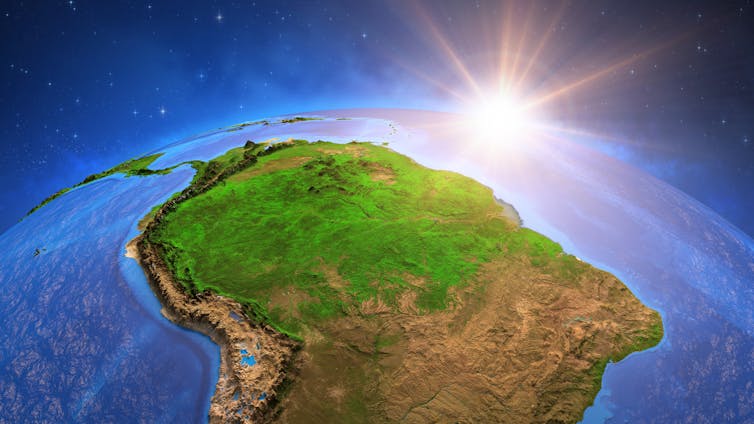
titoOnz / shutterstock

Paul Palmer, University of Edinburgh and Liang Feng, University of Edinburgh

Atmospheric carbon dioxide (CO₂) rose faster in 2024 than in any year since records began – far faster than scientists expected.

Our new satellite analysis shows that the Amazon rainforest, which has long been a huge absorber of carbon, is struggling to keep up. And worryingly, the satellite that made this discovery could soon be switched off.

Systematic measurements of CO₂ in the atmosphere began in the late 1950s, when the Mauna Loa observatory in Hawaii (chosen for its remoteness and untainted air) registered about 315 parts per million (ppm). Today, it’s more than 420ppm.

But just as important is the rate of change. The annual rise in global CO₂ has gone from below 1ppm in the 1960s to more than 2ppm a year in the 2010s. Every extra ppm represents about 2 billion tonnes of carbon – roughly four times the combined mass of every human alive today.

Across six decades of measurements, atmospheric CO₂ has gradually increased. There have been some large but temporary departures, typically associated with unusual weather caused by an El Niño in the Pacific. But the long-term trend is clear.

In 2023, CO₂ in the atmosphere grew by about 2.70ppm. That’s a large step up, but not too unusual. Yet in 2024, it was an unprecedented 3.73ppm.

How satellites observe atmospheric CO₂

Until recently, we could only monitor CO₂ through stations on the ground like the one in Hawaii. That changed with satellites such as Nasa’s Orbiting Carbon Observatory (OCO-2), launched in 2014.

The OCO-2 satellite analyses sunlight reflected from Earth. Carbon dioxide acts like a filter, absorbing specific wavelengths of light. By observing how much of that specific light is missing or dimmed when it reaches the satellite, scientists can accurately calculate how much CO₂ is in the atmosphere.

But air is always on the move. The CO₂ above any one point can come from many sources – local emissions, nearby forests, or air carried from far away. To untangle this mix, scientists use computer models that simulate how winds move CO₂ around the globe.

They then adjust these models until they match what the satellite sees. This gives us the most accurate estimate possible of where carbon is being released and where it’s being absorbed.

The decade-long data record from OCO-2 allows us to put 2023 and 2024 into historical context.

The result

From the satellite data, we infer that the largest changes in CO₂ emissions and absorption during 2023 and 2024, compared with the baseline year of 2022, were over tropical land.

shaded map of tropics
Data from 2023 and 2024 shows the areas where more carbon was emitted (in red) and withdrawn (blue) compared with the ‘normal’ year of 2022. The Amazon stands out in both years. Feng et al

The largest change was over the Amazon, where much less CO₂ is being absorbed. Similar slowdowns also appeared over southern Africa and southeast Asia, parts of Australia, the eastern US, Alaska and western Russia.

Conversely, we detected more carbon being absorbed over western Europe, the US and central Canada.

Other data backs this up. For instance, plants emit a faint glow as they photosynthesise – remarkably, we can see this glow from space. Measurements of this glow along with vegetation greenness both show that tropical ecosystems were less active in 2023 and 2024.

Our analysis suggests that warmer temperatures explain most of the Amazon’s reduced capability to absorb carbon. Elsewhere in the tropics, changes in rainfall and soil moisture were more important.

Why 2023 and 2024 were special

In many ways, these years resembled previous El Niño years such as 2015-16, when drought and heat led to less carbon absorption and more wildfires. But what’s interesting about 2023-24 is that the responsible El Niño event was comparatively weak.

Something else must be amplifying the effect. The most likely culprit is the extensive, record-breaking drought that has gripped much of the Amazon basin. When plants are already stressed by a lack of water, even modest warming can push them beyond their tolerance, reducing their ability to absorb carbon.

Small boats in shallow water
Small boats left stranded as the Tapajós river (a major Amazon tributary) dries up in late 2023. Tarcisio Schnaider / shutterstock

Roughly half of the CO₂ emitted by humans stays in the atmosphere. The other half is absorbed, more or less equally, by the land and the oceans. If drought or heat means plants are less able to absorb carbon, even temporarily, more of our emissions will remain in the air.

Our ability to meet climate targets relies on nature continuing to provide this vital carbon storage.

Satellite shutdown

It’s not yet clear whether 2023-24 is a short-term blip or an early sign of a long-term shift. But evidence points to an increasingly fragile situation, as tropical forests are stressed by hot and dry conditions.

Understanding exactly how and where these ecosystems are changing is essential if we want to know their future role in the climate, and whether drought will delay their recovery. One step is to urgently send scientists to tropical ecosystems to document recent changes in person.

That’s also where satellites like OCO-2 come in. They offer global and almost real-time coverage of how carbon dioxide is moving between the land, oceans and atmosphere, helping us separate temporary effects like El Niño from deeper changes.

Yet, despite being fit and healthy and having enough fuel to keep it going until 2040, OCO-2 is at risk of being shut down due to proposed Nasa budget cuts.

We wouldn’t be blind without it – but we’d be seeing far less clearly. Losing OCO-2 would mean losing our best tool for monitoring changes in the carbon cycle, and we will all be scientifically poorer for it.

The Amazon is sending us a warning. We must keep watching – while we still can.


Don’t have time to read about climate change as much as you’d like?
Get a weekly roundup in your inbox instead. Every Wednesday, The Conversation’s environment editor writes Imagine, a short email that goes a little deeper into just one climate issue. Join the 45,000+ readers who’ve subscribed so far.


Paul Palmer, Professor of Quantitative Earth Observation, University of Edinburgh and Liang Feng, Research Associate, Data Assimilation, University of Edinburgh

This article is republished from The Conversation under a Creative Commons license. Read the original article.

Orcas comment on killer apes destroying the planet by continuing to burn fossil fuels.
Donald Trump urges you to be a Climate Science denier like him. He says that he makes millions and millions for destroying the planet, Burn, Baby, Burn and Flood, Baby, Flood.
Nigel Farage urges you to ignore facts and reality and be a climate science denier like him and his Deputy Richard Tice. He says that Reform UK has received £Millions and £Millions from the fossil fuel industry to promote climate denial and destroy the planet.
Continue ReadingRecord-breaking CO₂ rise shows the Amazon is faltering — yet the satellite that spotted this may soon be shut down

A Third of the Arctic’s Landmass is Now a Source of Carbon: Study

Spread the love

Original article by Eloise Goldsmith republished from Common Dreams under Creative Commons (CC BY-NC-ND 3.0).

The study was published as President Donald Trump was blasted for an executive order that one critic said shows he wants to turn the Alaskan Arctic into the “the world’s largest gas station.”

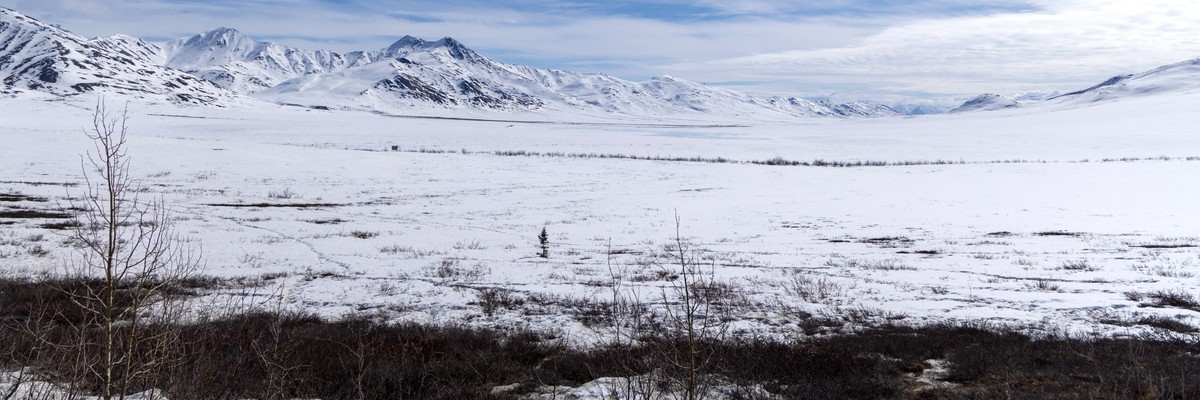
For thousands of years, the land areas of the Arctic have served as a “carbon sink,” storing potential carbon emissions in the permafrost. But according to a study published in the journal Nature Climate Change Tuesday, more than 34% of the Arctic is now a source of carbon to the atmosphere, as permafrost melts and the Arctic becomes greener.

“When emissions from fire were added, the percentage grew to 40%,” according to the Woodwell Climate Research Center, which led the international team that conducted the research.

The study, which was first reported on by The Guardian, was released the day after President Donald Trump issued multiple presidential actions influencing the United States’ ability to confront the climate crisis, which is primarily caused by fossil fuel emissions, including one directly impacting resource extraction in Alaska, a section of which is within the Arctic Circle.

Sue Natali, one of the researchers who worked on the study published in Nature Climate Change, told NPR in December (in reference to similar research) that the Arctic’s warming “is not an issue of what party you support.”

“This is something that impacts everyone,” she said.

As the permafrost—ground that remains frozen for two or more years—holds less carbon, it releases CO2 into the atmosphere that could “considerably exacerbate climate change,” according to the study.

“There is a load of carbon in the Arctic soils. It’s close to half of the Earth’s soil carbon pool. That’s much more than there is in the atmosphere. There’s a huge potential reservoir that should ideally stay in the ground,” said Anna Virkkala, the lead author of the study, in an interview with The Guardian.

The dire warning was released on the heels of Trump’s executive order titled “Unleashing the Alaska’s Extraordinary Resource Potential” that calls for expedited “permitting and leasing of energy and natural resource projects in Alaska,” as well as for the prioritization of “development of Alaska’s liquefied natural gas (LNG) potential, including the sale and transportation of Alaskan LNG to other regions of the United States and allied nations within the Pacific region.”

The order also rolls back a number of Biden-era restrictions on drilling and extraction in Alaska, which included protecting areas within the Arctic National Wildlife Refuge from oil and gas leasing.

“Alaska is warming four times faster than the rest of the planet, a trend that is wreaking havoc on communities, ecosystems, fish, wildlife, and ways of life that depend on healthy lands and waters,” said Carole Holley, managing attorney for the Alaska Office of the environmental group Earthjustice, in a statement Monday.

“Earthjustice and its clients will not stand idly by while Trump once again forces a harmful industry-driven agenda on our state for political gain and the benefit of a wealthy few,” she added.

Trump wants to turn the Alaskan Arctic into the “the world’s largest gas station,” said Athan Manuel, director of Sierra Club’s Lands Protection Program, in a statement Monday. “Make no mistake, Trump’s rushed and sloppy actions today are an existential threat to these lands and waters, and the communities and wildlife that depend on them.”

Original article by Eloise Goldsmith republished from Common Dreams under Creative Commons (CC BY-NC-ND 3.0).

Orcas comment on killer apes destroying the planet by continuing to burn fossil fuels.
Continue ReadingA Third of the Arctic’s Landmass is Now a Source of Carbon: Study

US Billboard Campaign Blasts Fossil Fuel Giants for Causing Extreme Heat

Spread the love
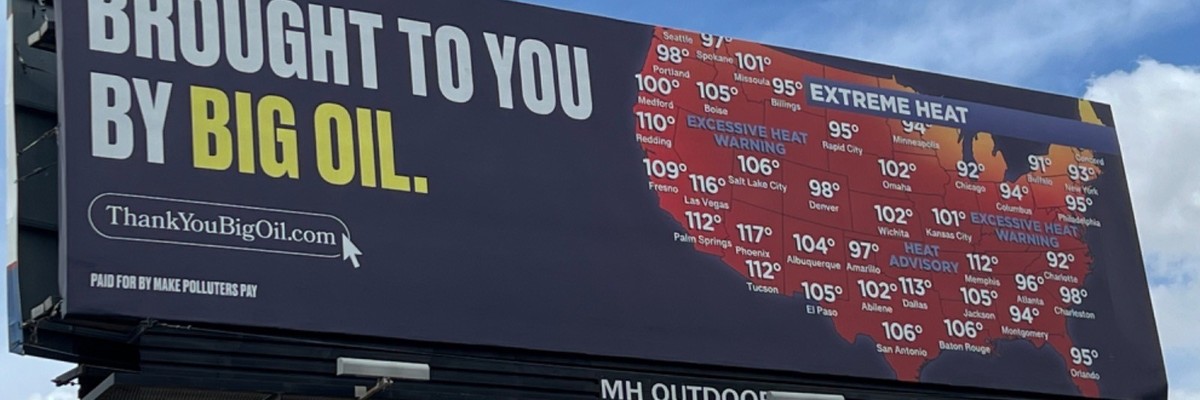
A billboard in Austin, Texas shows a U.S. map with high temperatures across the nation.
 (Photo: Fossil Free Media)

Original article by ULIA CONLEY republished from Common Dreams under Creative Commons (CC BY-NC-ND 3.0). 
“From Alaska to Maui, our communities are struggling to survive the rapidly worsening impacts of the climate crisis, all the while, Big Oil is raking in billions at our expense.”

As about 111 million people in nearly two dozen states continued to face heat advisories, with temperatures reaching as high at 115°F in some cities, the nonprofit media lab Fossil Free Media unveiled a multicity campaign with one simple goal: ensuring that all Americans understand that the intense heatwaves across much of the country this summer have not been a natural phenomenon, but the result of continued fossil fuel extraction.

Starting Thursday drivers along stretches of highway in Phoenix, Arizona; Austin, Texas; and Fresno, California will pass by prominent billboards displaying a map of record-breaking temperatures that have been recorded across the U.S. this summer.

Fresno drivers will be reminded of a 109°F day in their city while those in Phoenix will see 117°F plastered over their hometown on the map, accompanied by the words, “Brought to you by Big Oil” and ThankYouBigOil.com.

That website redirects to Fossil Free Media’s (FFM) Stop the Oil Profiteering (STOP) project, where visitors can read about the estimated cost of climate-related disasters such as hurricanes, extreme heat, and wildfires—over $600 billion from 2016-20 alone—and the 5,000 people killed by such events in that same time period.

“The fossil fuel industry has known for decades that their products are fueling climate change and extreme weather, yet they have failed to act,” reads the website. “Instead, major oil and gas companies continue to invest billions into new projects that lock in decades more fossil fuel extraction while our communities take the heat… literally.”

Jamie Henn, director of the organization, said on social media that the public “needs to understand that this summer’s brutal heatwave was brought to you by Big Oil.”

The World Weather Attribution said last month that the heatwaves experienced by people across the U.S. and Europe in July would have been “virtually impossible” without the climate crisis, which scientists have for years said is being fueled by heat-trapping emissions from oil, gas, and coal extraction.

The organization also reported this week that wildfires in eastern Canada in recent weeks were made twice as likely by the climate emergency, which as STOP said, has created “tinderbox conditions” by making droughts longer and more intense.

“From Alaska to Maui, our communities are struggling to survive the rapidly worsening impacts of the climate crisis, all the while, Big Oil is raking in billions at our expense,” said Cassidy DiPaola, spokesperson for FFM and STOP. “There’s no denying that this summer’s brutal heatwaves are being fueled by the same Big Oil companies who are spreading climate disinformation and blocking much needed climate progress.”

More than 100 people in the U.S. have died of heat-related causes so far this year, and weather experts have continued to report high temperatures throughout August after July set a world record for the hottest month in recorded history.

Jennifer Falcon, a resident of Austin, told FFM that the climate crisis has emerged as an economic justice issue in her community as Texas broke its all-time record for power consumption last month, with people across the state struggling to stay cool.

“Texans are paying 800% more to cool their homes during the extreme heat that blankets our state,” she said. “This means choosing between food on the table or cooling your home to mitigate health impacts from the sweltering heat while Big Oil profits.”

As millions of people in the U.S. faced sweltering temperatures this summer—raising the risk of heat-related illness and even severe contact burns—ExxonMobil reported $7.9 billion in profits, its second-highest profit margin for a second quarter in over a decade.

Along with the billboards, STOP unveiled an ad showcasing the Big Oil’s link to the climate extremes Americans are increasingly at risk of facing.

“Record heatwaves? You can thank Big Oil for that,” said STOP. “Deadly wildfires? Yep, that’s Big Oil. Catastrophic storms? Smog-covered cities? You guessed it—Big Oil.”

The group is one of several scheduled to lead a March to End Fossil Fuels in New York City on September 17, with the rally being held as the United Nations holds a Climate Ambition Summit.

Aimed at pressuring U.S. President Joe Biden to declare a climate emergency, Fossil Free Media said the march is expected to be “the largest climate action since before the pandemic.”

Original article by ULIA CONLEY republished from Common Dreams under Creative Commons (CC BY-NC-ND 3.0). 

Continue ReadingUS Billboard Campaign Blasts Fossil Fuel Giants for Causing Extreme Heat