Quaker group pulls New York Times ad over paper’s refusal to call Gaza bombing ‘genocide’

Spread the love

https://www.middleeastmonitor.com/20250109-quaker-group-pulls-new-york-times-ad-over-papers-refusal-to-call-gaza-bombing-genocide

The New York Times headquarters in New York, US, on 4 February, 2024 [Shelby Knowles/Bloomberg via Getty Images]

A prominent American Quaker organisation has cancelled its advertising with the New York Times (NYT) after the newspaper refused to allow an advertisement referring to Israel’s aggression in Gaza as genocide.

The American Friends Service Committee (AFSC), a century-old peace and justice organisation, had proposed an advertisement reading: “Tell Congress to stop arming Israel’s genocide in Gaza now! As a Quaker organization, we work for peace. Join us. Tell the President and Congress to stop the killing and starvation in Gaza.”

Commenting on the newspaper’s decision not to run the advertisement, AFSC General Secretary Joyce Ajlouny said: “The refusal of The New York Times to run paid digital ads that call for an end to Israel’s genocide in Gaza is an outrageous attempt to sidestep the truth. Palestinians and allies have been silenced and marginalised in the media for decades as these institutions choose silence over accountability. It is only by challenging this reality that we can hope to forge a path toward a more just and equitable world.”

US media reported that the NYT’s advertising team suggested AFSC replace the word “genocide” with “war” – a term with fundamentally different implications both colloquially and under international law. When AFSC rejected this proposal, the Times’ Ad Acceptability Team responded that “various international bodies, human rights organisations, and governments have differing views on the situation,” citing a need for “factual accuracy and adherence to legal standards.”

Ajlouny highlighted the organisation’s direct experience of the situation: “Our courageous staff members in Gaza witness daily horrors and continue to provide vital support despite Israel’s relentless attacks on their homes and families. Our ad campaign aims to shed light on these atrocities while urging people in the U.S. to pressure the President and Congress to halt weapons shipments to Israel and advocate for an end to the genocide.”

AFSC, which has operated in Gaza since 1948, currently maintains staff in the besieged Strip, Israeli occupied Ramallah and Jerusalem. Since October 2023, their Gaza team has distributed 1.5 million meals, hygiene kits and other humanitarian aid to displaced people.

The controversy comes after the International Court of Justice’s provisional ruling in January 2024 that Israel’s actions in Gaza were “plausibly genocidal” in the case brought by South Africa, now supported by 14 countries. Notably, the Washington Post has run advertisements from Amnesty International using genocide terminology.

“The suggestion that the New York Times couldn’t run an ad against Israel’s genocide in Gaza because there are ‘differing views’ is absurd,” said Layne Mullett, AFSC’s director of media relations. “The New York Times advertises a wide variety of products and advocacy messages on which there are differing views. Why is it not acceptable to publicise the meticulously documented atrocities committed by Israel and paid for by the United States?”

Read: ‘Yes, it is genocide’ in Gaza says Israeli professor of Holocaust studies

There is growing consensus among major human rights organisations, legal scholars and international experts that Israel’s military onslaught in Gaza amounts to genocide. This includes assessments from prominent organisations such as Amnesty International, Human Rights Watch, the Centre for Constitutional Rights, and the University Network for Human Rights, along with numerous Palestinian human rights groups and genocide scholars. Many of these organisations are regularly cited as authoritative sources in the New York Times’ own reporting on other matters.

The UK’s Guardian newspaper pointed out that the NYT has previously run advertisements using the term genocide. In 2016, it published an ad from the Armenian Educational Foundation thanking Kim Kardashian for opposing denial of the Armenian genocide. In 2008, presidential candidates Barack Obama, Hillary Clinton and John McCain co-signed a letter advertisement in the New York Times calling out the genocide in Sudan’s Darfur.

It also highlighted that the Times’ advertising guidelines state that its “advertising space is open to all points of view” and that submissions may be subjected to factchecking. It reserves the right to reject an ad if it is found to be deceptive or inaccurate.

This work by Middle East Monitor is licensed under a Creative Commons Attribution-NonCommercial-ShareAlike 4.0 International License.
Continue ReadingQuaker group pulls New York Times ad over paper’s refusal to call Gaza bombing ‘genocide’

Analysis Details How Israel’s Gaza Siege ‘Is Driving a Humanitarian Disaster’

Spread the love

Original article by Brett Wilkins republished from Common Dreams under Creative Commons (CC BY-NC-ND 3.0). 

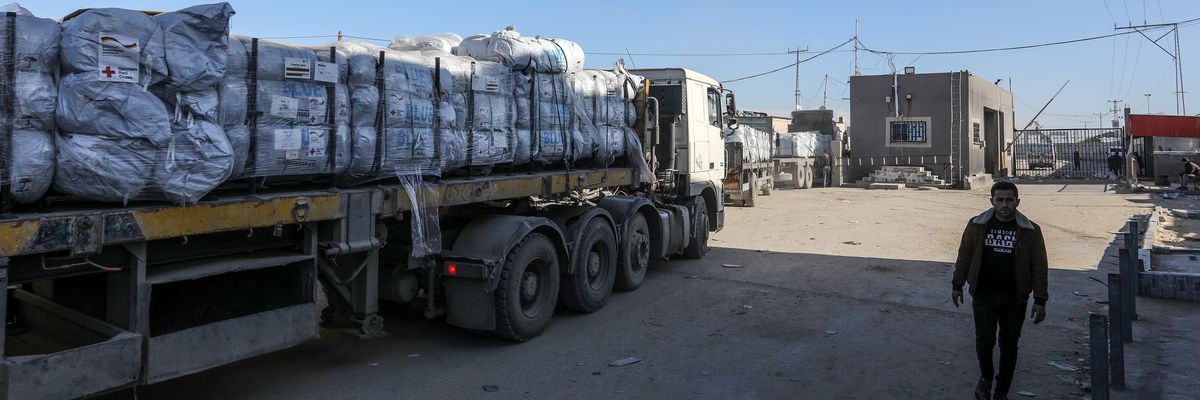
Trucks carrying aid supplies to Gaza are seen at the Karem Abu Salem border crossing on February 17, 2024. (Photo: Abed Rahim Khatib/Anadolu via Getty Images)

“Over 11 months, we have reached shocking levels of conflict, displacement, disease, and hunger,” said one campaigner.

Israel’s “complete siege” of the Gaza Strip “is driving a humanitarian disaster,” with 83% of required food aid failing to enter the embattled enclave, where the entire population is facing hunger and disease and almost half a million Palestinians are at risk of starvation, an analysis published Monday revealed.starvation,

The analysis by 15 international aid organizations noted that a record-low average of just 69 aid trucks are entering the Gaza Strip each day, compared with an already insufficient 500 daily truckloads a year ago. Additionally, the groups said that “only 17 out of Gaza’s 36 hospitals remain partially functional, and “critical infrastructure such as water networks, sanitation facilities, and bread mills” have been destroyed.

“While Israeli military attacks on Gaza intensify, lifesaving food, medicine, medical supplies, fuel, and tents have been systematically blocked from entering for almost a year,” the aid groups—which include ActionAid, American Friends Service Committee, CARE International, Christian Aid, Islamic Aid, Oxfam International, and Save the Children—said in a statement.

The publication highlights numerous ways that “lifesaving aid is systematically obstructed on a daily basis” in Gaza.

“These include the denial of safety, with more than 40,000 Palestinians and nearly 300 aid workers killed since last October; the sharp tightening of a 17-year blockade to a full siege, which prevents aid from entering Gaza; delays and denials which restrict the movement of aid around Gaza; tightly restrictive and unpredictable control of imports; the destruction of public infrastructure such as schools and hospitals; and the displacement of civilians and humanitarian workers,” the analysis’ authors wrote.

Zenab, a 33-year-old Palestinian woman pregnant with her second child, said that her pregnancy “has been the hardest time of my life.”

“It was also hard to get the medication I needed,” she continued. Sometimes I had to walk for hours to different pharmacies, hospitals, and health centers to see if anyone had my medication available. For me as a pregnant woman, there has been hardly any healthcare support, no proper hygiene and sanitation, and no suitable mattress to sleep on.”

“I was suffering from complications during my pregnancy,” Zenab added. “We didn’t have enough water to drink, and had hardly any food. The doctors again told me that my pregnancy was in danger.”

Among the report’s key findings:

  • 83% of required food aid doesn’t make it into Gaza, up from 34% in 2023;
  • An estimated 50,000 children aged between 6-59 months urgently require treatment for malnutrition by the end of the year;
  • 65% of the insulin required and half of the required blood supply are not available in Gaza;
  • Availability of hygiene items has dropped to 15% of the amount available in September 2023, with 1 million women now going without the hygiene supplies they need;
  • Only around 1,500 hospital beds in Gaza remain operational, compared to around 3,500 beds in 2023 which was already well below sufficient to meet the needs of a population of more than 2 million people; and
  • 1.87 million people are in need of shelter with at least 60% of homes destroyed or damaged as of January, yet tents for around just 25,000 people have entered Gaza since May 2024.

“There is a shortage of all humanitarian items. We are overwhelmed [with] these needs and [these] urgent requirements,” said Amjad Al Shawa, director of the Palestinian NGOs Network. “People [are] starving due to the shortage of aid. One hundred percent of the population depends on humanitarian aid.”

The authors of the analysis—which was released ahead of this week’s United Nations General Assembly in New York—are demanding that Israel secure an immediate and lasting cease-fire. They are also calling for an arms embargo on Israel and Israeli compliance with the recent International Court of Justice (ICJ) advisory opinion, which found that the occupation of Palestine is an illegal form of apartheid that must end immediately. Israel is on trial for genocide in a separate ICJ case.

“The situation was intolerable long before last October’s escalation and is beyond catastrophic now.”

“The situation was intolerable long before last October’s escalation and is beyond catastrophic now,” CARE International West Bank and Gaza country director Jolien Veldwijik said in a statement. “Over 11 months, we have reached shocking levels of conflict, displacement, disease, and hunger.”

That includes dozens of children who have died due to malnutrition, dehydration, and lack of adequate medical care.

“Aid is still not getting in, and humanitarian workers are risking their lives to do their jobs while attacks and violations of international law intensify,” Veldwijik added. “Aid, which is urgently required for 2.2 million people at risk of dying in the coming weeks and months, should never be politicized. We demand an immediate and sustained cease-fire, and the free flow of humanitarian aid into and throughout Gaza.”

Original article by Brett Wilkins republished from Common Dreams under Creative Commons (CC BY-NC-ND 3.0). 

Continue ReadingAnalysis Details How Israel’s Gaza Siege ‘Is Driving a Humanitarian Disaster’

Nations Urged to Back ICJ Case Against Israel After Experts Confirm Genocide Underway

Spread the love

Original article by JAKE JOHNSON republished from Common Dreams under Creative Commons (CC BY-NC-ND 3.0). 

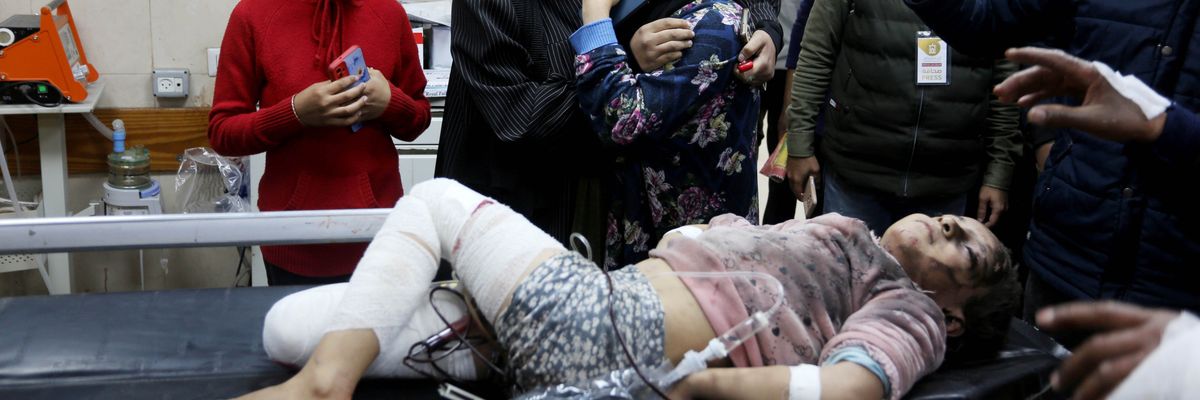
An injured Palestinian girl is brought to the al-Aqsa Martyrs Hospital after an Israeli airstrike hit al-Maghazi Refugee Camp in Deir al-Balah, Gaza on January 09, 2024.  (Photo: Ashraf Amra/Anadolu via Getty Images)

“How many more alarm bells have to ring and how many more civilians must unlawfully suffer or be killed before governments take action?” asked one human rights expert.

Human rights advocates are ramping up pressure on nations to formally back South Africa’s case against Israel at the International Court of Justice after a panel of experts determined that the Israeli military’s actions in the Gaza Strip—paired with officials’ overt statements of intent to wipe out the Palestinian population—constitute sufficient evidence that a genocide is underway.

Democracy for the Arab World Now (DAWN) and the American Friends Service Committee (AFSC) convened the expert roundtable last month, before South Africa submitted its 84-page ICJ application accusing Israel of violating its obligations under the Genocide Convention, which also requires signatories to prevent genocide.

“We have to be clear that this is a very unique case, indeed textbook, in the way that intent is articulated openly and explicitly in an
unashamed way,” Raz Segal, associate professor of Holocaust and genocide studies at Stockton University, said during his December presentation, pointing to remarks by Israeli Prime Minister Benjamin Netanyahu and other high-ranking officials signaling genocidal war aims.

South Africa’s ICJ filing, submitted to the 15-judge United Nations court on December 29, features page after page of quotations from Israeli officials and lawmakers voicing what the document calls “genocidal intent against the Palestinian people.” The first public hearing on the case is scheduled to take place on Thursday.

“Expert analysis of Israeli government statements revealing their intent to destroy Palestinians in Gaza, combined with military actions on the ground, including mass killings, forced displacement, and the deprivation of items essential to life in Gaza, suggest that the crime of genocide is being committed against the Palestinian population,” Sarah Leah Whitson, DAWN’s executive director, said Tuesday. “South Africa’s charging Israel with genocide before the International Court of Justice underscores the need for decisive international action to compel a cease-fire and hold the perpetrators of these atrocities accountable.”

Francis Boyle, the first human rights lawyer to ever win an order from the ICJ under the Genocide Convention, toldDemocracy Now! last week that based on his “careful review of all the documents so far submitted” by South Africa, he believes the country “will win an order against Israel to cease and desist from committing all acts of genocide against the Palestinians.”

Thus far, at least seven national governments and the Organization of Islamic Cooperation—which includes 57 member states—have issued statements supporting South Africa’s case against Israel. But only Jordan has signaled that it plans to officially back South Africa’s case with a Declaration of Intervention.

Such declarations allow countries to “formally express their support for the case and contribute to the legal proceedings, enhancing the case’s legitimacy and impact,” DAWN explained, noting that more than 30 nations—including the U.S., Israel’s top ally and arms supplier—submitted Declarations of Intervention in Ukraine’s genocide case against Russia at the ICJ.

“South Africa’s application to the International Court of Justice, invoking the Genocide Convention against Israel, represents a pivotal moment in the pursuit of global justice and accountability,” said Raed Jarrar, DAWN’s advocacy director. “It is time for the international community to support this process and speak with one voice to stop the genocide against the Palestinian people.”

With national and grassroots support for South Africa’s case growing, Israel has been pressuring governments around the world to speak out against the filing as it continues to wage war on Gaza’s desperate and starving population. On Tuesday, as Common Dreamsreported, U.S. Secretary of State Antony Blinken dismissed South Africa’s case as “meritless” even as the Biden administration refuses to formally assess whether Israel has adhered to international law.

Since South Africa submitted its application to the ICJ late last month, Israel has killed more than 2,100 people in the Palestinian enclave and injured thousands more, according to the Euro-Mediterranean Human Rights Monitor.

“How many more alarm bells have to ring and how many more civilians must unlawfully suffer or be killed before governments take action?” Balkees Jarrah, associate international justice director at Human Rights Watch, asked Wednesday. “South Africa’s genocide case unlocks a legal process at the world’s highest court to credibly examine Israel’s conduct in Gaza in the hopes of curtailing further suffering.”

Original article by JAKE JOHNSON republished from Common Dreams under Creative Commons (CC BY-NC-ND 3.0). 

Continue ReadingNations Urged to Back ICJ Case Against Israel After Experts Confirm Genocide Underway