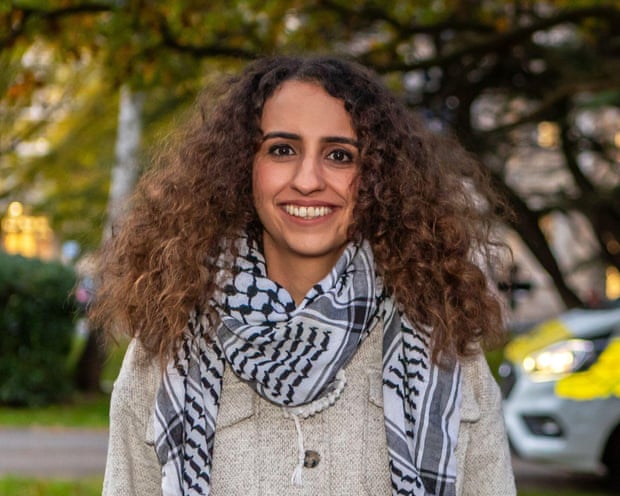
Permission for Huda Ammori’s judicial review was upheld. Photograph: Abdullah Bailey/Alamy
Judges reject Home Office attempt to block judicial review of group’s proscription under Terrorism Act
A legal challenge to the ban on Palestine Action can go ahead next month after the court of appeal rejected the Home Office’s attempt to block the case.
On Friday, three judges, led by the lady chief justice, Sue Carr, upheld Mr Justice Chamberlain’s decision to grant the Palestine Action co-founder Huda Ammori a judicial review of the group’s proscription under the Terrorism Act.
The ban, the first on a direct action group, came into effect on 5 July, categorising it alongside the likes of Islamic State and National Action. Since then, more than 2,000 people have been arrested under the Terrorism Act for allegedly supporting Palestine Action, most for holding signs reading: “I oppose genocide, I support Palestine Action.”
As well as dismissing the Home Office’s appeal, Carr said that the court of appeal was granting two further grounds on which to challenge the legality of the ban, in addition of the two already granted by Chamberlain.
dizzy: I’ve committed to participate in the November protests.
Palestine Action joke that appeared in the UK satirical magazine ‘Private Eye’.Keir Starmer objects to criticism of the IDF. He asks how could anyone object to them starving people to death, forced marches like the Nazis did, bombing Gaza’s hospitals and universities, mass-murdering journalists, healthworkers and starving people queuing for food, killing and raping prisoners and murdering children. He calls for people to stop obstructing his genocide for Israel.Orcas discuss Genocide-supporting and complicit Zionists. Donald Trump, Keith Starmer, David Lammy, Rachel Reeves, Angela Rayner and Wes Streeting are acknowledged as evil genocide-complicit and supporting cnuts.
This work by Middle East Monitor is licensed under a Creative Commons Attribution-NonCommercial-ShareAlike 4.0 International License.
Police officers stand guard as Pro-Palestine demonstrators take part in a protest on the second anniversary of October 7th to condemn the ongoing Israeli attacks on Gaza since then and to demand the stop of the war on October 07, 2025 in Muenster, Germany. [Hesham Elsherif – Anadolu Agency].
UN human rights experts on Thursday called on Germany to end what they described as the “criminalising, punishing, and suppressing” of legitimate Palestinian solidarity activism, warning that the country’s actions undermine fundamental democratic freedoms, Anadolu reports.
“We are alarmed by the persistent pattern of police violence and apparent suppression of Palestine solidarity activism by Germany,” the experts said in a statement.
They urged Berlin to uphold its human rights obligations and “to respect and facilitate the right to peaceful assembly for everyone without discrimination.” The experts stressed that “non-violent protests are protected and must not be punished,” and that dissenting political views “must not be subject to undue restrictions based on content.”
According to the experts, Germany has intensified restrictions on pro-Palestinian protests since October 2023 – when Israel’s relentless offensive on Gaza began – even though most demonstrations have been peaceful. Protesters have voiced demands such as halting arms exports to Israel, ensuring humanitarian access to Gaza, and recognizing the state of Palestine.
They said demonstrators in Berlin had been met with police violence, arrests, and bans, including cases where people were detained simply for chanting “From the river to the sea, Palestine will be free.”
The experts said German courts have issued contradictory rulings on whether the slogan constitutes protected speech or condones violence.
“Germany must support, not suppress, actions aiming to stop atrocity crimes and genocide,” the experts said. “No circumstances can justify unnecessary and excessive police violence or unjust criminalisation for exercising fundamental freedoms.”
Critics say Germany’s foreign policy stance has been mirrored by a domestic campaign to silence pro-Palestinian voices. Over the past two years, authorities have banned hundreds of rallies, canceled cultural events and academic panels, and denied visas to prominent international speakers critical of Israel.
German Chancellor Friedrich Merz, a staunch ally of Israel, has repeatedly emphasized Germany’s historical responsibility for Israel’s security, rooted in its Nazi past and the Holocaust.
Keir Starmer objects to criticism of the IDF. He asks how could anyone object to them starving people to death, forced marches like the Nazis did, bombing Gaza’s hospitals and universities, mass-murdering journalists, healthworkers and starving people queuing for food, killing and raping prisoners and murdering children. He calls for people to stop obstructing his genocide for Israel.Genocide denier and Current UK Prime Minister Keir Starmer is quoted that he supports Zionism without qualification. He also confirms that UK air force support has been essential in Israel’s mass-murdering genocide. Includes URLs https://www.declassifieduk.org/keir-starmers-100-spy-flights-over-gaza-in-support-of-israel/ and https://youtu.be/O74hZCKKdpAOrcas discuss Genocide-supporting and complicit Zionists. Donald Trump, Keith Starmer, David Lammy, Rachel Reeves, Angela Rayner and Wes Streeting are acknowledged as evil genocide-complicit and supporting cnuts.
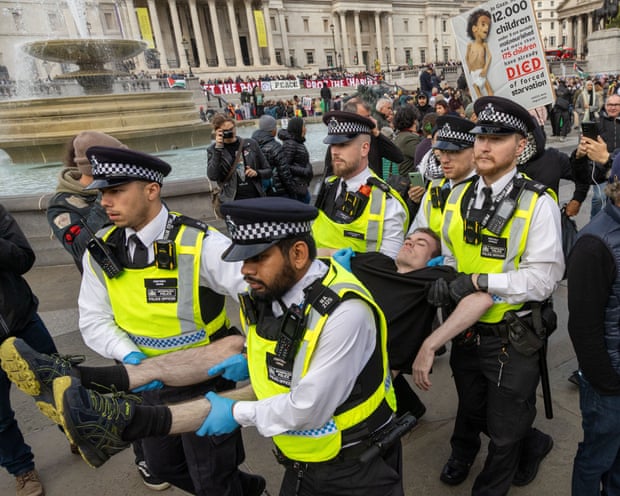
Police arrest supporters of Palestine Action taking take part in a civil disobedience protest in Trafalgar Square, London, 4 October 2025. Photograph: Tayfun Salcı/EPA
The rights we enjoy in the UK, and the movement the PM purports to lead, were built on protest. Those rights are in dire peril
…
The Labour party arose from a long wave of protests by workers against capital, calling for workers’ rights and for sweeping democratic reforms. These protests and their organisers came to be known as the labour movement. Its early actions included the radical war in Scotland, the Merthyrand Newport risings in south Wales, the Swing riots in England and the General Strike of 1842. No such protests would have meant no such movement. No such movement would have meant no such party.
Yet somehow, the party that arose from protest has formed, in terms of our rights to free expression and democratic challenge, the most illiberal government the UK has suffered since the second word war. This Labour government would have banned the labour movement.
Any government that fails to contest and reverse this trend, even if it did nothing to add to this bleak legacy, sides with illiberalism. Far from doing so, Starmer’s has already gone further than the Conservatives dared, by classifying a civil disobedience group – Palestine Action – as a terrorist organisation and banning it. It has also (so far with remarkably little resistance) inserted a clause into its crime and policing bill enabling the police to stop demonstrations “in the vicinity of a place of worship”. As our towns and cities are so richly endowed with religious buildings, that means almost any urban area.
But its latest proposal is even worse. The home secretary, Shabana Mahmood, has announced that the police should be able to stop protests that have a “cumulative impact”, by recurring in the same place. She will also consider “powers to ban protests outright”.
Keir Starmer objects to criticism of the IDF. He asks how could anyone object to them starving people to death, forced marches like the Nazis did, bombing Gaza’s hospitals and universities, mass-murdering journalists, healthworkers and starving people queuing for food, killing and raping prisoners and murdering children. He calls for people to stop obstructing his genocide for Israel.Orcas discuss Genocide-supporting and complicit Zionists. Donald Trump, Keith Starmer, David Lammy, Rachel Reeves, Angela Rayner and Wes Streeting are acknowledged as evil genocide-complicit and supporting cnuts.Palestine Action joke that appeared in the UK satirical magazine ‘Private Eye’.
This work by Middle East Monitor is licensed under a Creative Commons Attribution-NonCommercial-ShareAlike 4.0 International License.
Hamas members hand over some of the 20 Israeli hostages to International Committee of the Red Cross (ICRC) teams as part of the ceasefire and prisoner and hostage swap deal between Hamas and Israel in Gaza City, Gaza, on October 13, 2025. [Hamza Z. H. Qraiqea – Anadolu Agency]
The International Committee of the Red Cross (ICRC) announced on Monday morning the start of the process of releasing Israeli hostages in the Gaza Strip as part of a ceasefire agreement, Anadolu reports.
According to Israeli Channel 12, seven hostages were handed over to ICRC teams.
The remaining 13 living Israeli hostages will be released at 10 pm local time (0700GMT) from the central Gaza Strip, the channel added.
According to the Israeli I24 News Channel, the released Israeli hostages include Eitan Mor, Gali Berman, Ziv Berman, Matan Angrest, Omri Miran, Guy Gilboa-Dalal, and Alon Ohel, who are on their way to Israel.
US President Donald Trump announced Wednesday that Israel and the Palestinian group Hamas had agreed to the first phase of his 20-point plan aimed at implementing a ceasefire in Gaza. The plan includes the release of all Israeli captives in exchange for around 2,000 Palestinian prisoners and a gradual withdrawal of Israeli forces from the Gaza Strip. The first phase took effect on Friday.
Phase two of the plan envisions the creation of a new governing body in Gaza, excluding Hamas, the deployment of a multinational force, and the disarmament of Hamas.
Since October 2023, Israeli attacks have killed more than 67,800 Palestinians in Gaza, most of them women and children, leaving the enclave largely uninhabitable.
This work by Middle East Monitor is licensed under a Creative Commons Attribution-NonCommercial-ShareAlike 4.0 International License.
Orcas discuss Genocide-supporting and complicit Zionists. Donald Trump, Keith Starmer, David Lammy, Rachel Reeves, Angela Rayner and Wes Streeting are acknowledged as evil genocide-complicit and supporting cnuts.Keir Starmer objects to criticism of the IDF. He asks how could anyone object to them starving people to death, forced marches like the Nazis did, bombing Gaza’s hospitals and universities, mass-murdering journalists, healthworkers and starving people queuing for food, killing and raping prisoners and murdering children. He calls for people to stop obstructing his genocide for Israel.Genocide denier and Current UK Prime Minister Keir Starmer is quoted that he supports Zionism without qualification. He also confirms that UK air force support has been essential in Israel’s mass-murdering genocide. Includes URLs https://www.declassifieduk.org/keir-starmers-100-spy-flights-over-gaza-in-support-of-israel/ and https://youtu.be/O74hZCKKdpA
This work by Middle East Monitor is licensed under a Creative Commons Attribution-NonCommercial-ShareAlike 4.0 International License.
President Donald Trump gives opening remarks during a press conference with Israeli Prime Minister Benjamin Netanyahu in the State Dining Room of the White House in Washington, DC on September 29, 2025. [Stringer – Anadolu Agency]
US President Donald Trump said on Sunday that he was unsure whether former British Prime Minister Tony Blair would join the new “Peace Council” planned to oversee the governance of the Gaza Strip, amid ongoing criticism of Blair’s role in the Iraq war.
“I’ve always liked Tony, but I want to find out that he’s an acceptable choice to everybody,” Trump told reporters, without naming specific leaders who might have a say in Blair’s appointment.
The Gaza peace plan, announced by the White House last month, listed Blair as a proposed member of the new council.
Trump made his remarks to journalists aboard Air Force One during his flight to Israel, where he is scheduled to deliver a speech to the Knesset on Monday.
He also plans to attend a world leaders’ summit in Egypt aimed at formally ending the war in Gaza, as the ceasefire enters its fourth day.
Orcas discuss Genocide-supporting and complicit Zionists. Donald Trump, Keith Starmer, David Lammy, Rachel Reeves, Angela Rayner and Wes Streeting are acknowledged as evil genocide-complicit and supporting cnuts.Keir Starmer objects to criticism of the IDF. He asks how could anyone object to them starving people to death, forced marches like the Nazis did, bombing Gaza’s hospitals and universities, mass-murdering journalists, healthworkers and starving people queuing for food, killing and raping prisoners and murdering children. He calls for people to stop obstructing his genocide for Israel.Genocide denier and Current UK Prime Minister Keir Starmer is quoted that he supports Zionism without qualification. He also confirms that UK air force support has been essential in Israel’s mass-murdering genocide. Includes URLs https://www.declassifieduk.org/keir-starmers-100-spy-flights-over-gaza-in-support-of-israel/ and https://youtu.be/O74hZCKKdpA