‘The Palestinian genocide threatens our entire multilateral system’

 Relatives carry the body of 13-year-old Seraje Ebrahim, killed in an Israeli strike on a drinking water distribution point, for burial outside Al-Awda Hospital in Nuseirat, central Gaza Strip, July 13, 2025
Over 30 nations to gather in Colombia to bring a halt to the genocide in Gaza
MORE than 30 nations gather in Bogota, Colombia tomorrow [today] for an “Emergency Conference” to bring a halt to the Israeli genocide against the Palestinians in Gaza.
UN special rapporteur Francesca Albanese, who is attending the conference, said the gathering “will go down as the moment in history that states finally stood up to do the right thing.”
The conference is called by The Hague Group which was set up in January this year.
Jointly convened by Colombia and South Africa, The Hague Group’s co-chairs, the conference brings together 32 states including Brazil, China, Cuba, Indonesia, Ireland, Mexico, Nicaragua, Pakistan, Spain, Turkey and Venezuela.
Colombian President Gustavo Petro described the conference as an opportunity “to move from condemnation to collective action.”
Ahead of the conference Colombia’s Vice Foreign Minister Mauricio Jaramillo Jassir said: “The Palestinian genocide threatens our entire multilateral system.”
…
Article continues, discussing
- US imposed sanctions on UN Special Rapporteur Fransesca Albanese who is attending the Bogota conference.
- Attempts in UK Parliament by the standing group on atrocity crimes “to create a clearer legal obligation on the British government to prevent genocides, and to determine if one is occurring rather than leaving such judgements to international courts.”
- South Africa’s case against Israel at the International Court of Justice alleging violations of the Genocide Convention by Israel.
- United Nations general assembly voting to take action on “Israel’s policies and practices in the Occupied Palestinian Territory” with a 12-month deadline to deliver concrete obligations — investigations, prosecutions, sanctions, asset freezes, and cessation of imports and arms.
- Former Israeli prime ministers Yair Lapid and Ehud Olmert describing plans to create a “humanitarian city” in southern Gaza as amounting to interning Palestinians in a “concentration camp.”
- Increasing numbers of Palestinians getting killed by Israeli forces.
- More than 58,000 killed and 138,520 wounded, according to Gaza’s Health Ministry.


Our Médecins Sans Frontières staff are being killed in Gaza. Why are UK ministers enabling that?
…
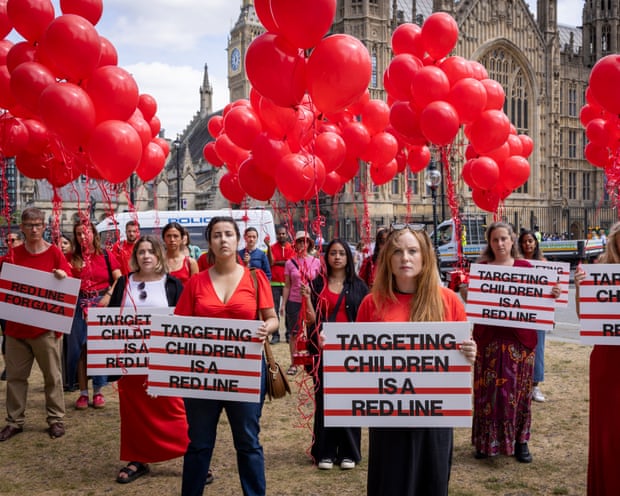
We have warned the government repeatedly: the response has been pathetic. Britain has a duty to act morally, and stop supporting this genocide.
Dr Natalie Roberts is the executive director of Médecins Sans Frontières UK
…
At the beginning of April, we at MSF UK wrote to the foreign secretary, David Lammy, detailing our first-hand observations in Gaza. We described the massive influxes of wounded patients and dead bodies being received by MSF teams in medical facilities across Gaza on 18 March, as Israeli forces unleashed attacks of unprecedented intensity, shattering the short-lived ceasefire. We explained that MSF medical staff and their patients had already had to evacuate 17 health facilities and had endured a massive number of violent incidents, including airstrikes damaging and destroying hospitals and health facilities, tanks opening fire on humanitarian shelters, ground offensives being conducted in medical facilities, and humanitarian convoys and ambulances being fired upon by the Israeli military. We noted that not a single hospital in Gaza was currently fully functional, and that about half of them were no longer functioning at all. And we described the complete siege imposed by the Israeli authorities on Gaza.
We noted that this evidence was consistent with the description of ethnic cleansing and genocide provided by legal experts and human rights organisations. We requested a meeting to brief the foreign secretary further and to hear what concrete actions the UK planned, to hold Israel to account for its atrocities against the Palestinian people.
We did not receive a response.
So on 7 May, MSF wrote an open letter to the prime minister describing the use of starvation and collective punishment as weapons of war by the Israeli government against an entire population. We implored the UK government to uphold its obligations as a permanent member of the UN security council to act under international humanitarian law to protect all civilians in Gaza. We also called on the UK government to publicly condemn the Israeli government for the atrocities it is inflicting on the people of Gaza. We warned that failure to take immediate action and to adopt a clear position on these extensively documented and flagrant war crimes and breaches of international law would leave the UK government at high risk of charges of complicity.
We did not receive a response.
…
We can only conclude that the UK government just does not want to admit what everybody else can see: that genocide is being committed in Gaza, and it is being committed with the military, diplomatic and material support of the UK.
…
More than 70 arrested at protests against Palestine Action ban
https://morningstaronline.co.uk/article/more-70-arrested-protests-against-palestine-action-ban
 Police officers remove a person after they took part in a protest in Parliament Square, London, to call for de-proscription of Palestine Action, July 12, 2025
MORE than 70 people were arrested on Saturday during protests demanding the reversal of a ban on Palestine Action.
Demonstrators held signs reading, “I oppose genocide. I support Palestine Action,” despite warnings from police that public displays of support could violate terrorism legislation.
Police made 42 arrests in London, 13 in Cardiff, 16 in Manchester and one in Leeds.
…
Another protester in London, Kris Welch, a retired special educational needs co-ordinator, said: “My father was in the Polish resistance and wanted by the Nazis and Russians.
“I grew up with the knowledge that there are some lines that cannot be crossed, and people have to stand up, whatever the consequences to them personally.
“I cannot stand by when a genocide is taking place, I cannot stand by while those who want to stop the genocide are branded as terrorists, and I cannot stand by while my government is actively complicit in the Palestinian genocide.”
…
Article continues