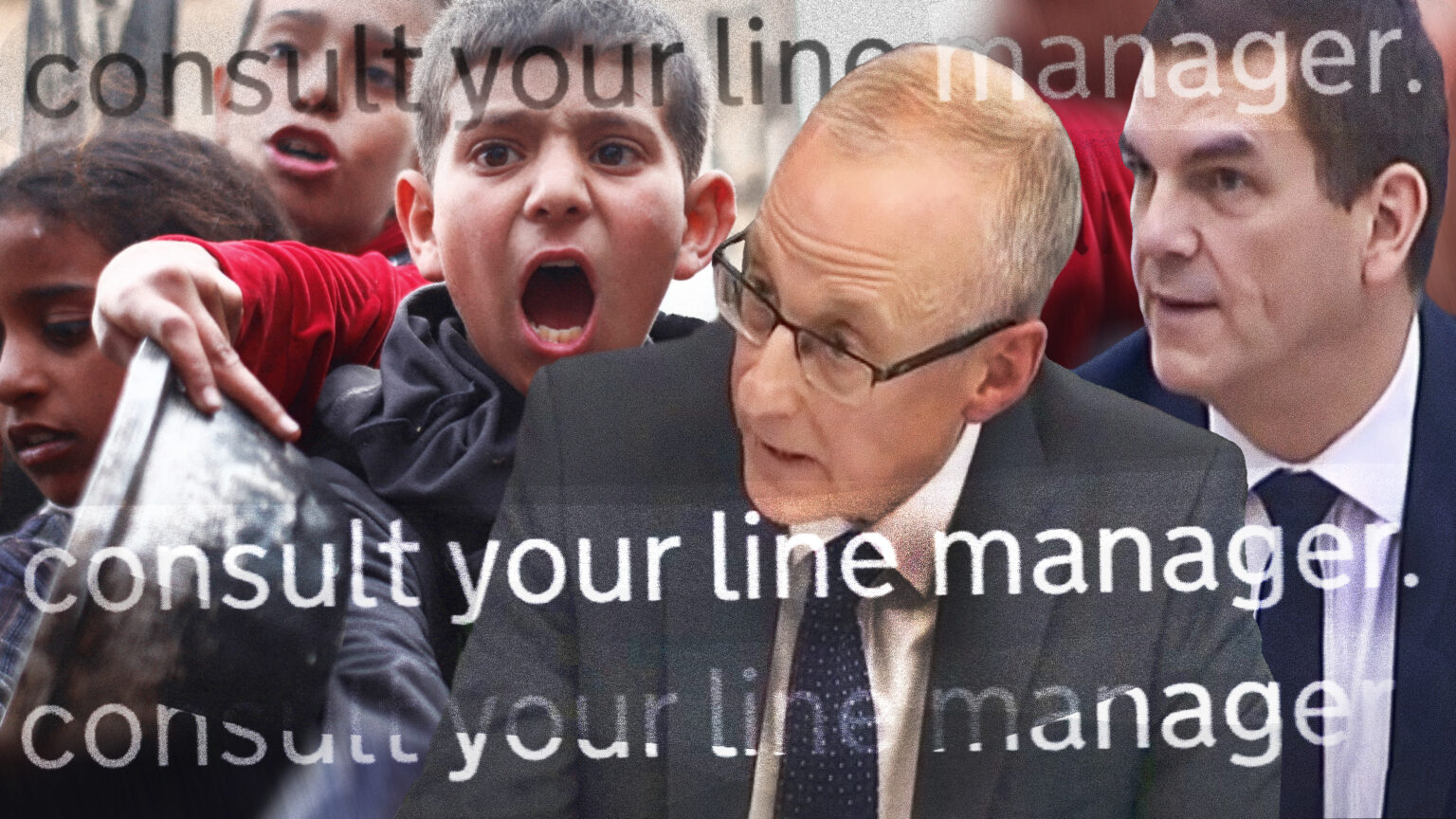
UN calls on Israel to lift its blockade of aid into Gaza and end the ‘cruel collective punishment’

Spread the love

https://morningstaronline.co.uk/article/un-calls-israel-lift-its-blockade-aid-gaza-and-end-cruel-collective-punishment

 Palestinian children receive donated food at a distribution center in Khan Younis, Gaza Strip, April 21, 2025

THE UNITED Nations emergency relief co-ordinator urged Israel today to lift its blockade of aid into the Gaza Strip, saying the halting of humanitarian aid amounts to “cruel collective punishment.”

Israel has blocked any humanitarian aid from entering the territory since it broke the ceasefire agreement with Hamas in March, throwing Gaza into what is believed to be the worst humanitarian crisis in nearly 19 months of bombings.

Israel claims that the blockade and its renewed military campaign are intended to pressure Hamas to release the remaining hostages it still holds and to disarm.Israel’s latest destruction of Gaza followed Hamas’s October 7 2023 attack, in which the militants killed about 1,200 people, mostly civilians, and abducted 251.Hamas is still holding 59 hostages, 24 of whom are believed to be alive, after most of the rest were released in ceasefire agreements or other deals.As Israel continued its strikes on the Palestinian enclave, another 18 people were killed and dozens more were wounded, Gaza’s Health Ministry said today.

Tom Fletcher, the UN under-secretary-general for humanitarian affairs and emergency relief co-ordinator, said today that while the hostages should be released and should never have been taken in the first place, international law mandates that Israel allow humanitarian aid into Gaza.

Article continues at https://morningstaronline.co.uk/article/un-calls-israel-lift-its-blockade-aid-gaza-and-end-cruel-collective-punishment

UK Labour Party government Keir Starmer, Angela Rayner and Rachel Reeves explain that they are participants and complicit in Israel's Gaza genocide providing Israel with army and air force support. They explain that they don't do gas chambers but do do forced marches, starvation, destroy hospitals, mass-murders of journalists and healthcare workers.
UK Labour Party government Keir Starmer, Angela Rayner and Rachel Reeves explain that they are participants and complicit in Israel’s Gaza genocide providing Israel with army and air force support.

Continue ReadingUN calls on Israel to lift its blockade of aid into Gaza and end the ‘cruel collective punishment’

NEU president slams Labour’s renewed austerity

Spread the love
(left to right) Chancellor of the Exchequer Rachel Reeves, Prime Minister Keir Starmer and Deputy Prime Minister Angela Rayner clap their hands during the Labour Party Conference in Liverpool, September 22, 2024

NATIONAL Education Union (NEU) president Sarah Kilpatrick slammed Labour’s renewed austerity today, telling the NEU annual conference that Tory welfare cuts had killed her disabled father.

She accused ministers of “perpetuating and repeating the shameful pattern of punching-down and finger-pointing” by “balancing the books on the backs of the poor.”

On the first day of the conference in Harrogate, North Yorkshire, she described how her father had died at the age of 56 after being stripped of his disability benefits under the Conservative-Liberal Democrat coalition government.

She said that she had experienced poverty as a working-class child in Newcastle upon Tyne and was his carer for a number of years.

“As Iain Duncan Smith gleefully applauded the welfare cuts, I represented my father in a tribunal against the DWP [Department for Work and Pensions] decision to remove his disability benefits,” she told delegates.

“He’d had his gas cut off. Couldn’t afford groceries. His elderly mother was adding tins of food to her shopping to bulk up what I was buying for him, but he isolated himself further still.

“He lost a lot of weight during that time and never really recovered.”

In 2013, her father became one of an estimated 120,000 people who died as a result of the Tories’ austerity programme, she said.

“When Wes Streeting brags to the Tories across the benches that Labour have done what they never could and slashed the welfare bill, this is what they mean,” said Ms Kilpatrick.

“Let’s be clear. Nearly two decades of economic permacrisis has not been caused by disabled people.”

Nor has it been caused by the elderly, refugees, the trans community or children in poverty, she said.

Article continues at https://morningstaronline.co.uk/article/neu-president-slams-labours-renewed-austerity

Keir Starmer says that his Labour Party is intensely relaxed about assaulting the very poorest and most vulnerable.
Continue ReadingNEU president slams Labour’s renewed austerity

Angela Rayner urged to end firefighter pension delays

Spread the love

https://morningstaronline.co.uk/article/angela-rayner-urged-end-firefighter-pension-delays

Firefighters from the Fire Brigades Union (FBU) take part in the Cuts Leave Scars rally outside the Scottish Parliament in Edinburgh, October 26, 2023

DEPUTY Prime Minister Angela Rayner was urged today to end the slow processing of firefighters’ pensions claims that leaves thousands losing out on hundreds of pounds every month.

Fire Brigades Union (FBU) general secretary Steve Wright has written to Ms Rayner, who is also head of the Ministry of Housing, Communities and Local Government, calling on her to intervene.

He said: “It is disgraceful that some fire authorities are still failing to give retired firefighters what they are legally entitled to.

“Thousands of firefighters are losing as much as hundreds of pounds a month.

“People who spent their careers protecting the public have been left in financial difficulty.”

A High Court ruling in 2018 said that about 10,500 affected firefighters were entitled to transfer seven additional years of contributions back from an older more generous pension scheme.

Judges said that the transitional arrangements of a less generous firefighters’ pension scheme imposed by the government in 2015 were discriminatory on the grounds of age.

Article continues at https://morningstaronline.co.uk/article/angela-rayner-urged-end-firefighter-pension-delays

Keir Starmer, Angela Rayner and Rachel Reeves wear the uniform of the rich and powerful. They have all had clothes bought for them by multi-millionaire Labour donor Lord Alli. CORRECTION: It appears that Rachel Reeves clothing was provided by Juliet Rosenfeld.
Angela Rayner wears her "benefits in kind" donation from multi-millionaire Lord Alli.
Angela Rayner wears her “benefits in kind” donation from multi-millionaire Lord Alli.
Continue ReadingAngela Rayner urged to end firefighter pension delays

Cuts and caps to benefits have always harmed people, not helped them into work

Spread the love
fizkes/Shutterstock

Ruth Patrick, University of York and Aaron Reeves, London School of Economics and Political Science

Keir Starmer’s government is expected to announce a host of cuts to sickness and disability support in the coming days. The UK’s ageing and increasingly unwell population has led to what has been described as “unsustainable” and “indefensible” spending on benefits.

As researchers of poverty and welfare reform, we find it both shocking and sadly unsurprising that, after more than a decade of cuts to social security, the government seems to have once again decided that austerity is the answer to the economic pressures they are facing.

We have spent many years documenting the real harms created by reforms to social security. It was disappointing to hear Starmer describe Britain’s social security system as an expensive way to “trap” people on welfare, rather than helping them find work.

The expected proposals are intended to incentivise people into work, by reducing the generosity of support offered to people claiming disability-related benefits. But in reality, many of the measures already implemented to reduce spending by cutting or capping benefits have pushed people further away from the labour market.

The relationship between welfare and work is more complex than it first appears. Around 37% of people on universal credit are currently in work.

Approximately 23% of those out of work are engaging with advisers whose job is to support them back into the labour market. The majority of the rest of universal credit claimants are people who are not expected to be in work – often people who have health challenges that make it difficult for them to work most jobs.

The UK’s social security payments cover a much smaller proportion of the average wage than most other countries in Europe.

A single person’s allowance on universal credit is £393.45 per month if they are 25 or over, while under-25s receive £311.68. This averages out at less than £100 a week to meet all essential living costs, bar support with housing.

Disabled people received additional support in the form of personal independence payments (Pip) or disability living allowance if you live in England, Wales or Northern Ireland, and adult or child disability payments in Scotland.

This support is designed to help people meet the additional costs that come with disabilities and long-term health conditions. It is not means-tested, and is available to people in employment as well as those not currently working.

Ministers are expected to make it more difficult to access Pip, freezing its value so this does not rise with inflation, and to reduce the amount of universal credit received by those judged unable to work. These proposals are likely to face strong opposition from many Labour MPs.


Want more politics coverage from academic experts? Every week, we bring you informed analysis of developments in government and fact check the claims being made.

Sign up for our weekly politics newsletter, delivered every Friday.


Currently, if people are not able to engage in paid work for long periods, they are entitled to an additional payment through universal credit. This amount – equivalent to approximately £400 a month – could go down. The problem is that this is already not enough to live on, and often necessitates going without essentials, such as food or electricity.

Families with dependent children receive additional support through child elements of universal credit, and through child benefit. But this support is subject to caps – the controversial and poverty-producing two-child limit, and the benefit cap, which restricts the support any household can receive where no one is working or claiming disability benefits.

Our research has shown that these restrictions do not work. The two-child limit is not helping families get into work, and nor is it affecting whether families have more children.

The benefit cap harms mental health, pushes people deep into poverty, and increases economic inactivity. Both policies are punitive and, in our view, need to be removed.

Other reforms to disability-related social security have left people hungry, pushed people into economic inactivity, increased depression, and may have even raised the suicide rate.

Getting Britain working?

The government is trying to solve the wrong problem. They are focusing on those who are out of work, when it is increasingly clear that one big reason people with disabilities are not in employment is because work environments have fewer roles they can fill.

While spending on disability-related support has gone up in recent years, the overall welfare bill has not. On top of that, the proportion of people who are not in work and who are claiming disability-related social security is actually about the same as it has been for the last 40 years. Indeed, the fact it is so low, given population ageing, could be read as good news.

A man and small child walking into a job centre
Research shows cutting access to benefits does not necessarily get people into work. Shutterstock

There have also been wider changes in the labour market. There has been a rapid decline in “light work”, like lift attendants, cinema ushers, or low-physical exertion roles in factories. As work environments have become more intense, people with disabilities have found it increasingly difficult to stay in work.

So, what would work to entice more people into work? The truth is we know far more about what does not work than what does.

The best evidence we have right now suggests that making it more difficult to claim social security and placing more strenuous work-search requirements on claimants will simply push people with poor health (particularly mental ill-health) further away from the labour market.

The welfare narrative

Behind the cuts currently being trailed is a popular but ill-founded logic which views social security as the cause of the country’s economic woes. Welfare itself is seen as the problem, with whole generations supposedly left parked on what is depicted as too-easy-to-claim and too-generous support.

But this narrative grossly misrepresents what it’s actually like to try and claim social security. It is, in fact, notoriously complex. Often, this complexity is intentional.

Making accessing social security difficult is not necessarily (or always) about meanness, but this “nasty strategy” is a product of a system that assumes that many people are not eligible for the support they claim.

The system has always assessed eligibility for benefits, but the way these assessments have been done in recent years has often been experienced as degrading and dehumanising. On the flip side, some have claimed that people are not being assessed regularly enough, and suggest that some people who have claimed benefits in the past may now be fit to work.

Where this is true is unclear, but the failure to reassess is also a product of cuts to this system – so taking more money out will not address this problem either.

Britain’s social security system has been stripped to the bones: it provides neither security nor enough support to those who receive it, and is ripe for reform. But the reform required is not of the type Labour is proposing, which will succeed only in further decimating what little remains of our social security safety net.

This article was co-published with LSE Blogs at the London School of Economics.

Ruth Patrick, Professor in Social Policy, University of York and Aaron Reeves, Associate Professorial Research Fellow in Poverty and Inequality, London School of Economics and Political Science

This article is republished from The Conversation under a Creative Commons license. Read the original article.

Keir Starmer, Angela Rayner and Rachel Reeves wear the uniform of the rich and powerful. They have all had clothes bought for them by multi-millionaire Labour donor Lord Alli. CORRECTION: It appears that Rachel Reeves clothing was provided by Juliet Rosenfeld.
Keir Starmer says pensioners can freeze to death and poor children can starve and be condemned to failure and misery all their lives.

Continue ReadingCuts and caps to benefits have always harmed people, not helped them into work