Fossil Free London activists dressed as suffragettes protest outside the National Gallery in London against Labour’s anti-protest laws ahead of International Women’s Day, march 6, 2026 [Photo: Andrea Domeniconi]
CLIMATE campaigners dressed as suffragettes outside the National Gallery today against anti-protest laws ahead of International Women’s Day.
The Fossil Free London group’s action took place ahead of International Women’s Day on Sunday, drawing attention to the tightening of anti-protest laws.
They held placards highlighting comparisons between the jail terms received by climate protesters and those handed to militant suffragettes in the early 20th century.
Just Stop Oil activists Phoebe Plummer and Anna Holland were sentenced to a combined 44 months in prison for throwing soup in the National Gallery in 2022.
They caused minor damage to the frame of Van Gogh’s Sunflowers painting.
Their action recalled the famous National Gallery protest by militant suffragette Mary Richardson, arrested for slashing Velazquez’s Rokeby Venus.
She was sentenced to a considerably shorter time of six months in prison.
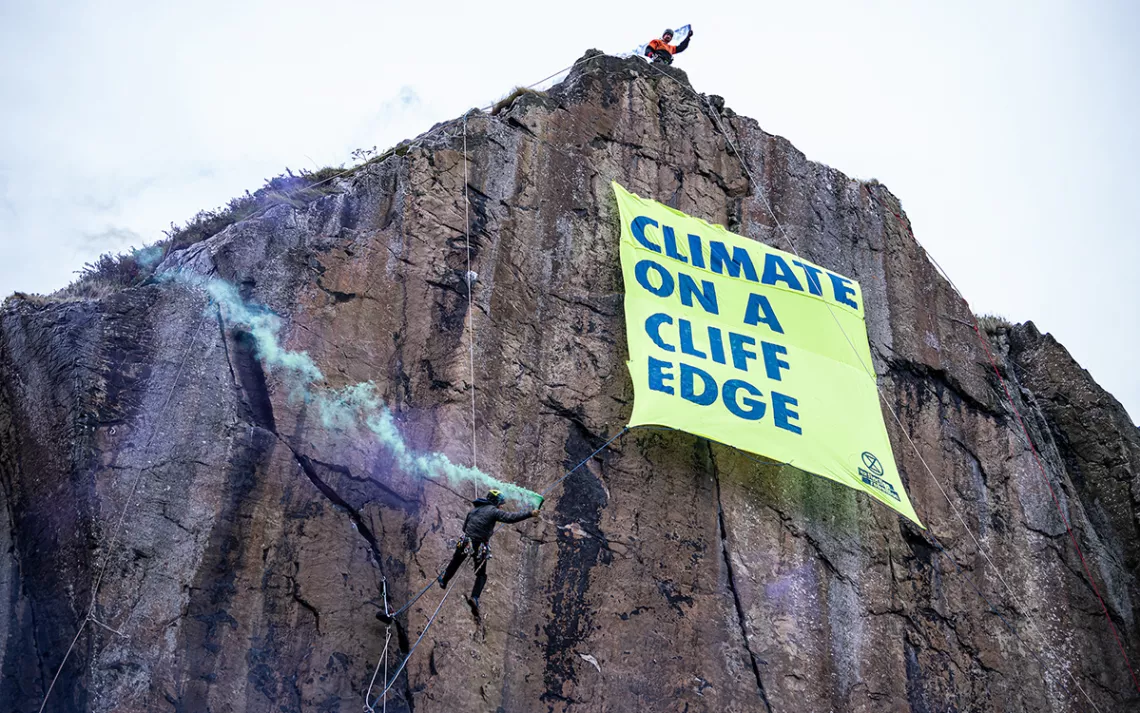
Experienced climbers scale a rock face near the historic Dumbarton castle in Glasgow, releasing a banner that reads “Climate on a Cliff Edge.” One activist, dressed as a globe, symbolically looms near the edge, while another plays the bagpipes on the shores below. | Photo courtesy of Extinction Rebellion and Mark RichardsDonald Trump urges you to be a Climate Science denier like him. He says that he makes millions and millions for destroying the planet, Burn, Baby, Burn and Flood, Baby, Flood.Nigel Farage urges you to ignore facts and reality and be a climate science denier like him and his Deputy Richard Tice. He says that Reform UK has received £Millions and £Millions from the fossil fuel industry to promote climate denial and destroy the planet.
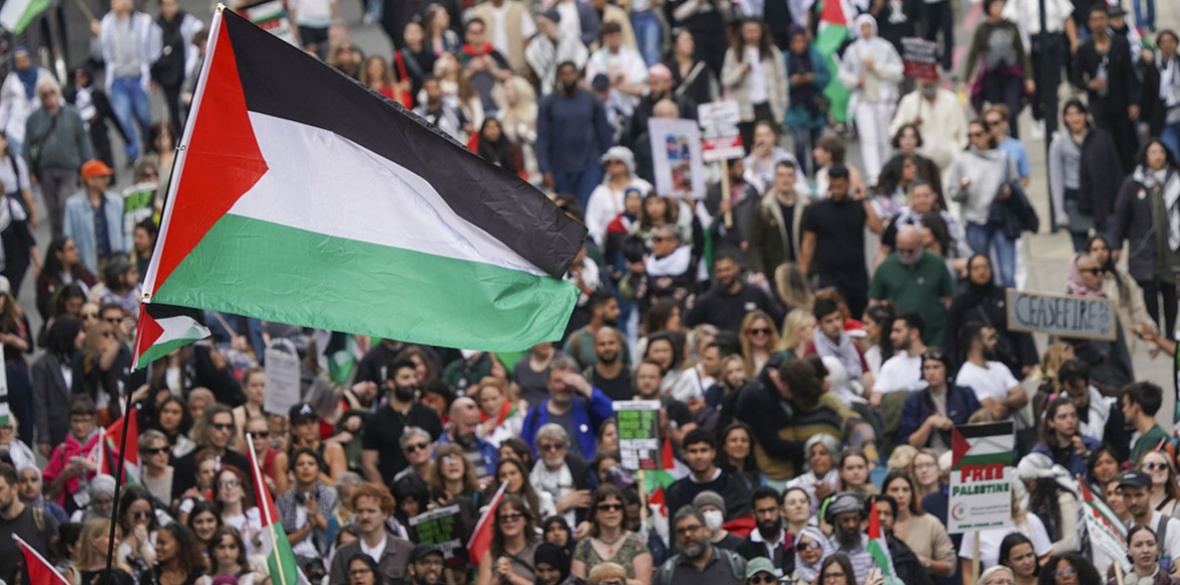
People take part in a national demonstration for Gaza from Russell Square to Whitehall in London, June 8, 2024
MORE police power to block demonstrations and jail organisers have nothing to do with protecting worshippers and everything to do with suppressing protest rights.
Government amendments to the Crime and Policing Bill will see individuals who breach police conditions imposed on protests fined up to £2,500 and demo organisers facing jail sentences.
This shores up repressive measures already deployed by the police to shut down Britain’s huge Palestine solidarity movement. The Met cited the existence of synagogues “near” planned protest routes to deny them permission on January 18, and again on March 15.
In neither case were the synagogues on the route. In the latter the two cited were over 10 minutes’ walk away. In the centre of London or other cities, such sweeping effective exclusion zones could be used to ban almost any proposed route.
…
This is rather a political move intended to shield Israel and its ally, the British state, from criticism over occupation, war crimes and ethnic cleansing in Palestine. It is cheered on by highly partisan bodies such as the Board of Deputies of British Jews, which claims the protests cause “serious and unacceptable disruption to our communal life,” without specifying how.
The fact that marches may upset people who support or identify with the state of Israel is not intimidation. It is a disgraceful sleight of hand, and a serious threat to the right to free speech and assembly, to pretend it is.
The Starmer government decided in January to crush the mass protest movement where the Tories had tried and failed.
…
Unions and many MPs have begun to revolt at the government’s anti-working-class economic agenda. That needs to be extended to its assault on democratic rights.
As for the Palestine marches: Israel’s renewed war on Gaza makes them as important as ever, and it is their size which has so far prevented their suppression. We stay on the streets.
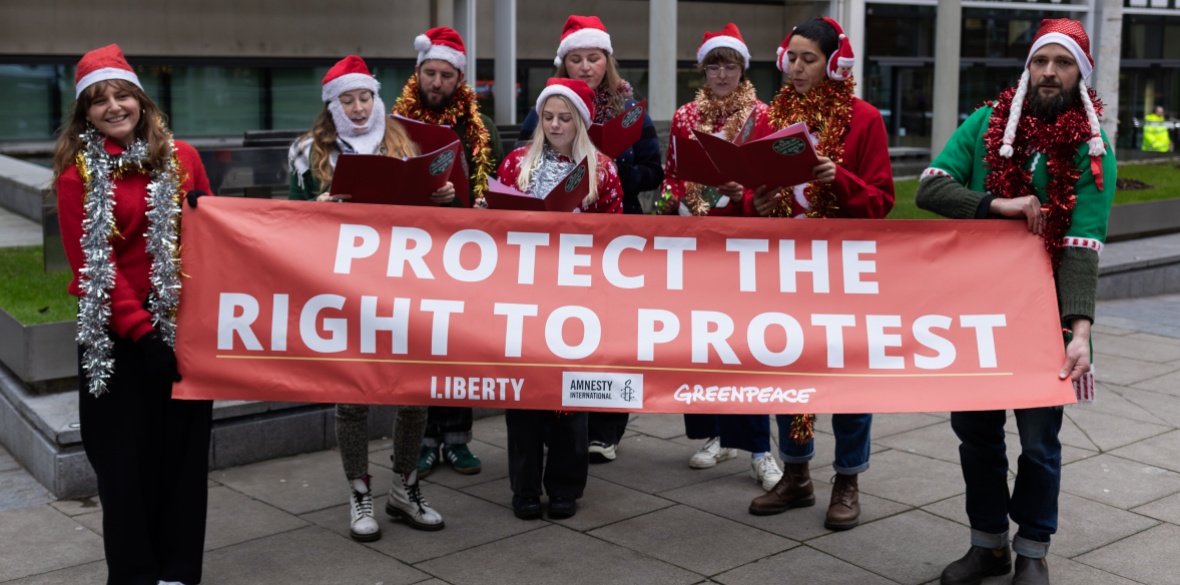
Protesters sing Christmas carols outside the Home Office, December 12, 2024Photo: Talia Woodin @taltakingpic
“AWAY in a police car” echoed outside the Home Office on Wednesday as campaigners belted out renditions of Christmas carols, calling for the government to repeal draconian anti-protest laws.
Dressed in Christmas jumpers and Santa hats, carollers from Amnesty International UK, Greenpeace and Liberty sang festive songs including The Twelve Days of Protest and Silent Protest.
They then handed in a petition to the Home Office, calling on it to scrap protest restrictions introduced by previous governments, alongside a letter to Home Secretary Yvette Cooper demanding an urgent meeting to discuss the state of protest rights in Britain.
A series of repressive laws have made the right to protest increasingly hard to exercise.
They include the Police, Crime, Sentencing and Courts Act 2022, which allows police to ban or restrict “unacceptable” protests, and the Public Order Act 2023 which criminalised protesters “locking on” and fastening themselves to each other or objects.
Punitive jail terms handed out since their enactment include one Just Stop Oil protester being sentenced to six months for slow marching on a road for 30 minutes, while five others from the group received a combined 21 years for co-ordinating a non-violent action over Zoom.
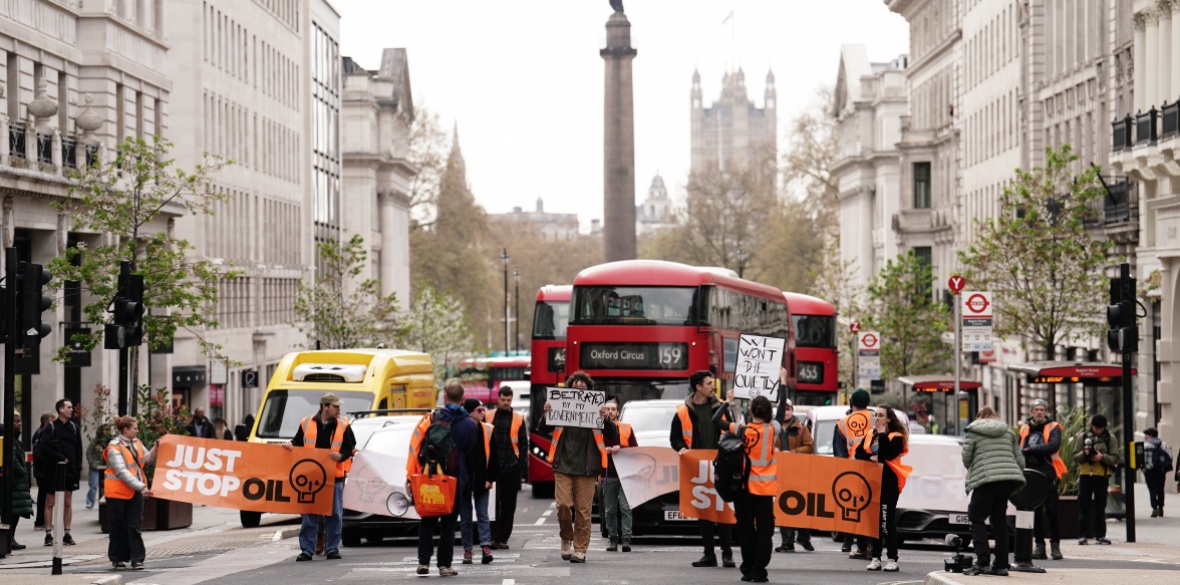
Just Stop Oil protesters as they take part in a slow march protest through London as part of the group’s campaign to convince the government to end all new oil and gas projects in the UK, April 24, 2023
THE government’s draconian anti-protest laws have been used to give a shocking six-month prison sentence to a climate activist for taking part in a peaceful slow march.
Just Stop Oil supporter Stephen Gingell, 57, was sentenced at Manchester magistrates’ court on Thursday.
The father-of-three was arrested on November 13 after taking part in a slow march in north London for about half an hour.
Mr Gingell pleaded guilty to breaching section seven of the Public Order Act, which bans any act “which interferes with the use or operation of any key national infrastructure in England and Wales.”
Passed in May, the widely condemned legislation allows police to ban peaceful protests merely on the grounds that they might become disruptive.
“It seems this government has now made walking down the road, walking on the public highway, an illegal act that is worthy of imprisonment,” a Just Stop Oil spokesperson said.
Liberty is taking the home secretary to court for ‘unlawfully’ passing legislation Parliament had already rejected
Image of Home Secretary Suella ‘Sue-Ellen’ Braverman
A human rights campaign group is taking Suella Braverman to court for “unlawfully” forcing draconian anti-protest legislation through Parliament, openDemocracy can reveal.
In June, Braverman used secondary legislation – which is subject to less parliamentary scrutiny – to allow police to restrict or shut down any protest that they believe could cause “more than minor disruption to the life of the community”.
A cross-party parliamentary committee said this is the first time secondary legislation has been used to make changes to the law that have already been rejected by Parliament. Akiko Hart, interim director of Liberty, which launched initial legal action in June, described the move as “the latest power grab from this government”.
The government previously tried to insert the new powers into the Public Order Act 2023 in January, but was blocked by the Lords. Liberty’s lawyer, Katy Watts, accused Braverman of “sneak[ing] in new legislation via the back door, despite not having the power to do so”.
Hart said: “We all want to live in a society where our government respects the rules – but the home secretary has deliberately done the opposite. The home secretary’s actions have enabled the government to circumvent the will of Parliament.”
She continued: “This is just the latest power grab from this government, which has shown it is determined to erode the ways people can hold it to account, whether that’s in Parliament or on the streets. The home secretary’s actions give the police almost unlimited powers to stop any protest the government doesn’t agree with – and the way she has done it is unlawful.”
The home secretary has long called for more police powers to tackle peaceful methods of protests by climate activists, such as road blocking, ‘locking on’, and slow marching, which she said “bring misery and chaos to the law-abiding majority”.
One supporter of Insulate Britain previously told openDemocracy that protest is “our only legitimate means to achieve the changes needed within the time frame we have”.
Another of the group’s supporters said that the criminalisation of protest – in particular, of environmental protest – “is an example of attempting to shoot the messenger” and that elected politicians “obviously don’t really care about protecting people’s democratic rights”.
Watts, Liberty’s lawyer leading the case, said Braverman’s circumventing of the Lords’ rejection is “a flagrant breach of the separation of powers that exist in our constitution”.
She added: “The wording of the government’s new law is so vague that anything deemed by police to cause ‘more than a minor’ disturbance could have restrictions imposed upon it. This same rule was democratically rejected earlier this year, yet the home secretary has gone ahead and introduced it through other means regardless.
“It’s really important the government respects the law and that the home secretary’s decision is reversed immediately.”
Liberty has also claimed the new legislation was not consulted on fairly. It has accused the government of only consulting parties it knew would support the amendments, such as the police.

 Fossil Free London activists dressed as suffragettes protest outside the National Gallery in London against Labour’s anti-protest laws ahead of International Women’s Day, march 6, 2026 [Photo: Andrea Domeniconi]