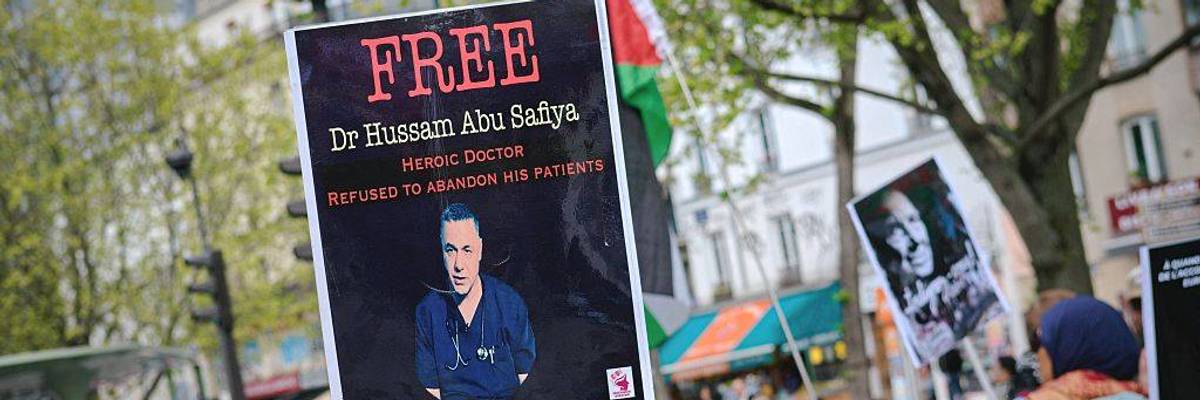
Wide view of a large crowd holding a banner reading Free Hussam Abu Safiya during a pro Palestine demonstration in Paris Ile de France France on April 18, 2026. (Photo by Djoudi Hamani/Hans Lucas/AFP via Getty Images)
“The international community cannot remain silent while a respected physician is reportedly subjected to harsh conditions, denied adequate medical care, and isolated from the outside world.”
A prominent human rights group on Friday sounded alarms upon learning that Dr. Hussam Abu Safiya, director of the Kamal Adwan Hospital in Gaza, has been sent to solitary confinement.
As reported by Haaretz, Physicians for Human Rights Israel (PHRI) said it learned on Thursday that Abu Safiya was moved to solitary confinement this week without any explanation.
According to a report from The Palestine Chronicle, an attorney representing Abu Safiya claimed that his client was placed into solitary confinement in retaliation for appealing his continued detention.
Abu Safiya was first taken into custody by Israeli forces in December 2024 and has been held since then without being charged with any criminal offenses.
In a Friday statement, the Council of American-Islamic Relations said news of Abu Safiya’s solitary confinement was “deeply disturbing” and raised “even more urgent concerns about his welfare and basic human rights.”
“Congress must demand his immediate release and insist that Israel end the arbitrary detention, abuse, and mistreatment of Palestinian medical professionals and civilians,” CAIR added. “The international community cannot remain silent while a respected physician is reportedly subjected to harsh conditions, denied adequate medical care, and isolated from the outside world without any legal justification. Dr. Abu Safiya must be released immediately.”
PHRI has for months been raising concerns about Abu Safiya’s detention, long before he was transferred to solitary confinement.
While demanding the physician’s release in April, for instance, PHRI said Abu Safiya was being held “in harsh conditions, without access to medication or medical care, as his health continues to deteriorate.”
A 2025 report from Amnesty International, which has also called for Abu Safiya’s release, said that the Gaza-based physician “was detained in the course of caring for his patients and carrying out his medical duties.”
Amnesty also noted that, prior to his detention, Abu Safiya and other colleagues at the Kamal Adwan Hospital had “provided human rights and humanitarian organizations with reliable information about the health situation” in Gaza, which has been left devastated by years of Israeli attacks that have killed at least 72,000 Palestinians.
Keir Starmer objects to criticism of the IDF. He asks how could anyone object to them starving people to death, forced marches like the Nazis did, bombing Gaza’s hospitals and universities, mass-murdering journalists, healthworkers and starving people queuing for food, killing and raping prisoners and murdering children. He calls for people to stop obstructing his genocide for Israel.Donald Trump sings and dances, says that it’s fun to kill everyone …Orcas discuss rotting brain, front Orca says Sundown Syndrome is a dead givaway and he wishes someone would Lock Him Up
Relatives of Venezuelan migrants deported from the U.S. to a maximum security prison in El Salvador attend a vigil in front of El Salvador embassy in Caracas, Venezuela on April 2, 2025. (Photo: Juan Barreto / AFP via Getty Images)
“The cruelty of the U.S. and Salvadoran governments has put these people outside the protection of the law and caused immense pain to their families,” said one human rights advocate.
Human Rights Watch on Friday accused the governments of the United States and El Salvador of “a grave violation of international human rights law” over the deportation more than 230 Venezuelan nationals by the Trump administration to a megaprison in El Salvador last month.
The actions taken against the deportees constitute both enforced disappearances and arbitrary detention, according to a statement from the group released Friday.
The governments of the United States and El Salvador have subjected more than 200 Venezuelan nationals to enforced disappearances and arbitrary detention.
“The cruelty of the U.S. and Salvadoran governments has put these people outside the protection of the law and caused immense pain to their families,” said Juanita Goebertus, Americas director at Human Rights Watch.
The group said that since their removal, the Venezuelans “have been held incommunicado” and that the United States and Salvadoran officials have not released a list of the people who were removed, though CBS News last month published a list of names the outlet obtained.
The administration invoked the Alien Enemies Act, a rarely used law that gives the president broad authority to detain or deport non-citizens during times of war, to justify dozens of the deportations—triggering a fierce legal battle.
The Trump administration invoked the Alien Enemies Act in response to an alleged “invasion” by “Tren de Aragua,” a Venezuelan gang, but the government has produced scant evidence that the people removed had ties to Tren de Aragua. One hundred and one of the deportees were removed under regular immigration procedures.
According to Human Rights Watch, the Salvadoran government has failed to offer a legal basis for detaining the Venezuelan deportees and has not indicated when or whether they will be released.
“It appears that their detention is wholly arbitrary and potentially indefinite; a grave violation of El Salvador’s human rights obligations,” the group said.
Enforced disappearance, according to Human Rights Watch, is when officials deprive someone of their liberty and then conceal the fate or whereabouts of the disappeared person. The violation is “especially serious” because it means they are outside the protection of the law.
The group is calling on U.S. authorities to publicly identify the Venezuelans who were removed to El Salvador and is urging the Salvadoran government to “confirm their current whereabouts, disclose whether there is any legal basis for their detention, and allow them contact with the outside world.”
The statement from Human Rights Watch also detailed the struggle that family members of the deported individuals have faced getting information about them.
The group has interviewed 40 relatives of people “apparently” removed to El Salvador, and all of them told Human Rights Watch that U.S. immigration authorities initially informed their relatives, who were in U.S. immigration detention, that they would be sent to Venezuela. They were not told they would be sent to El Salvador.
“Nobody should be forced to piece together bits of information from the media or to read into the authorities’ silence to find out where their relatives are being held,” Goebertus said. “Salvadoran authorities should urgently disclose the names and locations of all detainees transferred from the US, and allow them to contact their families.”
In addition to the Venezuelans who were deported in March, the Trump administration also deported a smaller number of Salvadoran nationals. U.S. Immigration and Customs Enforcement has admitted that one of the men sent to El Salvador was deported in “error.” On Thursday, the Supreme Court instructed the Trump administration to take steps to retrieve the man it had wrongly deported.
Neo-Fascist Climate Science Denier Donald Trump says Burn, Baby, Burn.Elon Musk urges you to be a Fascist like him, says that you can ignore facts and reality then.
This work by Middle East Monitor is licensed under a Creative Commons Attribution-NonCommercial-ShareAlike 4.0 International License.
The head of the Kamal Adwan Hospital, Dr. Hussam Abu Safiya [QudsNen/X]
The Palestinian Ministry of Health has called for the immediate release of Dr Hussam Abu Safiya, the director of Kamal Adwan Hospital in Gaza, along with all detained medical personnel held in Israeli custody.
In an urgent appeal, the ministry urged international health and humanitarian organisations, as well as human rights institutions, to intervene and secure the release of Palestinian medics.
It highlighted the harsh conditions suffered by Abu Safiya and his colleagues in Israeli detention.
According to Wafa news agency, a lawyer from the Al Mezan Centre for Human Rights visited him at Ofer Prison yesterday and reported that detainees are subjected to brutal and repressive treatment.
“During the visit, Dr. Abu Safiya detailed the various forms of torture and abuse to which he has been subjected both during his unlawful arrest and throughout his arbitrary detention by Israeli forces and authorities,” Al-Mezan said in a statement.
Highlighting what Abu Safiya was subjected to, his son, Ilyas, said: “My father was subjected to severe mistreatment and torture by the army in the early days of his arrest and was held in solitary confinement for 24 days. After that, he was transferred to Ofer Prison, Room 24, Section 2.”
Abu Safiya said that he has lost approximately 15 kilogrammes, suffers from an enlarged heart muscle and has been denied access to a specialist doctor or proper medical care despite repeated requests to the Israeli prison administration. His son added that he suffers from chronic high blood pressure and is only receiving minimal treatment.
“He is only provided with one meal a day, which is insufficient and of very poor quality,” Ilyas added.
The statement further revealed that upon his initial detention and transfer from Gaza, Abu Safiay was forced to strip, had his hands tied, and he was made to sit on sharp pebbles for nearly five hours.
He also suffered electric shocks and severe beatings to the chest while in Israeli custody, according to his testimony. He spent 25 days in detention at Ofer Prison, including ten days of continuous interrogation, during which he fainted due to suffocation.
The Palestinian Ministry of Health strongly condemned these repeated attacks on medical personnel, calling them grave violations of international law and the protective measures outlined in the Second Protocol of the Fourth Geneva Convention. It urged the international community to intervene immediately to secure the release of detained Palestinian healthcare workers.
Ilyas emphasised that there are no formal charges against Abu Safiya and that all accusations have been dismissed due to a lack of evidence. He expressed hope that his father could be released soon, calling for global pressure to ensure the freedom of all detained healthcare workers.
This work by Middle East Monitor is licensed under a Creative Commons Attribution-NonCommercial-ShareAlike 4.0 International License.
Genocide denier and Current UK Prime Minister Keir Starmer is quoted that he supports Zionism without qualification. He also confirms that UK air force support has been essential in Israel’s mass-murdering genocide. Includes URLs https://www.declassifieduk.org/keir-starmers-100-spy-flights-over-gaza-in-support-of-israel/ and https://youtu.be/O74hZCKKdpAUK Foreign Minister David Lammy confirms that UK government and military are active participants in Israel’s genocides and that the F-35 parts that they suspended from supplying to Israel are instead simply diverted via the United States. He says see https://youtu.be/QILgUHrdWRE
People wait in the woodland by the Greek border fence in northwest Turkey, in March 2020 | Gokhan Balci/Anadolu Agency/Getty Images. All rights reserved
I supported people who’d been violently pushed back from Greece to Turkey – and was accused of being a criminal spy
In October 2020, my colleague and I were sitting in a cafe in central Istanbul, unsure of what would come next. We were exhausted: physically and mentally tired from supporting the people being violently pushed back from Greece and Bulgaria to Turkey, documenting the violations, and fielding requests from journalists.
That morning, the apartment we had planned to move into had fallen through. Three weeks earlier, Turkey had cancelled the residence permits of two colleagues and given them just 24 hours to leave the country.
We were running out of funds, burnt out, and ill. Now, we had nowhere to live.
“What’s next?” I wondered.
My phone pinged. It was a message from Giorgos Christides, then the Greece correspondent for the German newspaper Der Spiegel. I called him back.
“You are one of them! One of the four!” he told me. He had sent a picture of the front page of a Greek newspaper. On it was a screenshot of our website and a letter from the police on Lesvos island that named our organisation, Josoor.
I can’t read Greek, but I understood what was happening. The article was following up on a press release issued by Greek police a week earlier, detailing a “secret operation uncovering a spy network” of four NGOs on Lesvos island. We had just been named as one of them.
I sat frozen as Giorgos translated the text. Espionage. Violation of state secrets. Forming a criminal organisation. Facilitation of illegal entry. Up to 35 years in prison.
How did we end up here?
Multiple crises at the border
The story starts seven months earlier, in March 2020. It had been a sleepless night: we’d been out in freezing temperatures, and our eyes were still stinging from the tear gas. The evening before, two colleagues and I had entered the closed military zone at the border to Greece near Edirne, northwest Turkey.
Our goal was to assess the feasibility of a civil society relief response to the crisis then unfolding at the border. We were three of around 180 volunteers who had met on a Facebook group for aid efforts in Greece, and we refused to just stand by and watch.
The situation was dire. Up to 20,000 people seeking protection were stranded in makeshift tents on the Turkish side. It was cold, and people had to queue for hours to receive a minimal amount of food from the Turkish disaster relief agency. There was no medical care available, and the area was regularly exposed to tear gas from both sides.
Many of those we encountered had been violently pushed back to Turkey by Greek officers, and even enlisted civilians. Two people had been shot dead.
We knew that the Turkish authorities had been obstructing organised relief before we entered the zone. But our scouting trip made it clear to us that they were also creating deliberately poor conditions. So this loose network of volunteers started distributing aid – food, clothes, sleeping bags, hygiene and first aid supplies – under the radar while also keeping the international media informed of what was going on. It was the beginning of Josoor’s work in Turkey.
Men, women and children were – and still are – arriving on Turkish land beaten, humiliated and robbed of all their possessions
The crisis we were responding to had been brewing for years. Turkey had long been threatening to ‘send’ the 3.6 million Syrian refugees in Turkey to Europe, in response to escalating tensions between the country and the European Union.
In the 2016 EU-Turkey agreement, the EU promised Turkey a €6 billion support package and visa-free travel for Turkish citizens. In exchange, Turkey promised to prevent asylum seekers from leaving its territory and to re-admit those who reached the Greek islands.
The deal was described by Amnesty International as an “abject failure”, corrosive for the EU’s human rights record, and “based purely on political convenience”. It turned people seeking protection into pawns for politics – and leverage in the hands of the Turkish government.
The agreement also led to a sharp increase in the frequency and violence of so-called pushbacks back to Turkey from Greece. This informal and illegal practice of collective expulsions had been documented at the land border for decades, but they had never been so systematic nor so violent.
Following the deal, they were also extended to the sea border. The Greek Coastguard (HCG) began disabling peoples’ dinghies and creating waves to push them back to Turkish waters. By 2020, their officers were puncturing inflatable dinghies, setting people adrift in overcrowded life rafts, and even firing live rounds at unarmed people.
People dodge tear gas near the Greek border fence in northwest Turkey | Photo taken by Josoor members
But despite the obvious “political convenience” of the deal for Europe, it didn’t keep to the bargain. By 2019, the EU had only paid Turkey half the promised amount and no progress had been made regarding travel restrictions. It did, however, continue to put pressure on Turkey over its role in the Syrian civil war. Then came the last straw: 33 Turkish soldiers were killed in an airstrike in Idlib, northwest Syria, and Turkey said it could no longer cope with holding up its end of the deal with the EU.
Just weeks after we arrived at the border area, Covid-19 struck. After forcing thousands of people to the border and trapping them there, Turkish authorities suddenly ordered people to clear the area.
People scattered. Some returned to Istanbul or went somewhere else. Those who refused to leave were forced onto buses and kept in quarantine camps before being dropped off in various locations, and stranded without supplies during Turkey’s first nationwide lockdown.
One group sent us a video from the Aegean coast, saying they’d been told by their bus driver to “try to make it to Greece”. Turkish officers apparently told another group the same thing after they were stranded in a different spot.
As we did with all the information we received, we published this on social media in our daily update. The next day, we woke to Greek media headlines alleging that “Turkey sends Covid-infected migrants to Greece as a biological weapon of hybrid warfare”. This ‘news’ had also reached right-wing outlets, only they’d added: “according to Turkish spy organisation Josoor”.
Efforts to correct the narrative were futile – the damage was done. After just a month of operating in Turkey, Josoor was now on the radar.
In hindsight, this media frenzy should have worried and prepared us for what was to come. But we were fully occupied with the situation on the ground, trying to fill the massive gap in monitoring and support for border violence survivors.
We were no longer just a bunch of volunteers trying to sort out an emergency response. Organisational structures were established and our operations were growing. We started providing accommodation, clothing, food, and medical care. And we started taking testimonies to evidence the systematic fundamental rights violations committed by European forces.
Greek, Bulgarian, and EU border and coast guard agency (Frontex) officers continued their campaign of pushbacks following the events of March 2020. There were endless reports of inhumane and degrading treatment, arbitrary detention in appalling conditions, theft, forced undressing, sexualised violence, and torture. Men, women and children were – and still are – arriving on Turkish land beaten, humiliated and robbed of all their possessions.
We joined the Border Violence Monitoring Network (BVMN) and took our evidence and advocacy to the UN, EU, and member state levels. Josoor became a key source of information for international media, collaborating with outlets from 40 countries. But unbeknownst to us, this rapid success had already triggered a first of three secret criminal investigations.
The first warning signs
“We have a right to live,” said Farzad (a pseudonym) in a video livestreamed in June 2020. Alongside the unaccompanied 17-year-old were ten other children, four babies, and 18 adults from Afghanistan, the Democratic Republic of Congo and Syria.
They had been drifting in a flimsy dinghy in the Aegean Sea for three days.
Independent search and rescue operations were effectively banned in the area. Greece’s Hellenic coast guard (HCG) was the authority in charge. But, according to Farzad, it was the coast guard itself that was responsible for their distress. He explained in his video how HCG officers had removed the dinghy’s engine, then used their boat to create waves to push the dinghy back into Turkish waters.
The video was picked up in an unexpected place. Runa Godø Sæther, a music teacher and single mother of three, was managing a Facebook page at the time, sharing posts of people on the move to a European audience from her small town in Norway.
Runa and I didn’t know each other, but we had talked online about collaborating on advocacy. She came across Farzad’s livestream and connected the boy to me, since she had no experience handling ongoing distress cases like this one.
Remarkably, Farzad’s boat eventually reached Lesvos. His desperate calls for help had reached a Turkish liaison officer aboard a German NATO ship, who pressured the crew to intervene and tow it to Lesvos.
A WhatsApp message from a person who had arrived on a dinghy to Lesvos island before being forced back into the sea by police and the Greek coast guard| Natalie Gruber
I introduced him to some journalists when he arrived, and within a short time he had spoken to multiple media outlets about his ordeal. Two days after arriving, a UNHCR official warned him to stop speaking to the press – the police were beginning to take notice.
Farzad instantly cut all ties with journalists – but it was too late. When the others from his boat were transferred to Moria reception centre, Farzad was taken into police custody. He was held there for seven months. Initially, we had no idea why Farzad had been detained. Greek police only told his lawyer he was deemed “a threat to public security”, but never filed charges.
When the Greek press splashed the news of the police letter across their front page, the one that Giorgos had translated for me over the phone, it finally became clear.
The ‘criminal network’
“The Lesvos 35”, as we came to be known, included 32 members from four civil society organisations, one independent volunteer (Runa, the Norwegian music teacher), and two asylum seekers, including Farzad.
Of the four accused organisations, only one – Mare Liberum – actually operated on Lesvos. Registered in Germany, they shared an address with Sea Watch in Berlin, who had ceased operations in Greece four years prior but was still included in the case. Our organisation, Josoor, operated in Turkey.
The other accused organisation was FFM, a research society hosting the donation account for the real target: AlarmPhone. This network of volunteers from all around the Mediterranean runs an emergency hotline for people in distress at sea.
The investigation never aimed to uncover an ‘organised human trafficking network’. It sought to defame, discredit, deter, distract, and disable
The six-month investigation run by the Greek intelligence service, anti-terror unit and HCG resembled a poorly scripted spy movie. Over the course of the investigation, they recruited two asylum seekers, who they sent back to Turkey as “agents” to return to Greece. Then armed special forces conducted a dawn raid on Mare Liberum’s ship, confiscating all electronic devices and detaining the crew for several hours – before releasing them without interrogation.
Our lawyers also strongly suspected that our phones were tapped, making everyone who was now reaching out to us for support a potential target for authorities. And everything we said or wrote in private messages and calls could possibly come back to haunt us. This put immense psychological pressure on us and forced us to censor our communication.
Despite felony charges being announced, none of the 33 organisation members were ever arrested or called to testify. Some even continued to work on the island. Greece has a well-earned reputation of overusing pre-trial detention. Had the authorities believed their own claims – that an allegedly dangerous criminal network was spying on Greek authorities – they should, and I believe would, have arrested us.
Instead, they only leaked information to servile media, while high-ranking government officials, including Prime Minister Kyriakos Mitsotakis, made numerous statements fuelling the defamation campaign.
I cannot quite put into words what this meant. On the one hand, we, the accused, knew full well that we had done nothing criminal at all, so it was hard to take the allegations seriously. But on the other hand, we were slandered and defamed, and our work was discredited. And even though it was absurd, we still faced the possibility of 35 years in prison, which is longer than I have lived.
For three years, seven months and 12 days, we faced the threat of prosecution. The constant anxiety of waiting to be summoned for trial ate away at me. Throughout this time, Greece was so geographically close to me, and a place very dear to my heart – but I couldn’t set foot in the country for fear of arrest.
That threat was finally lifted on 30 April 2024, when our lawyers received the only official communication about the case from the Greek state: a 16-page decision dropping all charges against us.
Like other cases targeting civil society organisations across Europe, this investigation never aimed to uncover an “organised human trafficking network” or to stop “spy games”. It sought to defame, discredit, deter, distract, and disable.
Defame us as a reliable source of information. Discredit our reports exposing human rights violations. Deter others from doing the same. Distract us from our work by forcing us to prepare a legal defence and campaign. Disable our operations through the financial and psychological strain of ongoing investigations.
We got close to quitting back then. But we also realised that being targeted so quickly and so viciously meant that our work so far had been successful. And every day we saw how those we had committed to support were dealt a much worse hand.
So despite the threats we continued for another two years. And each year brought another criminal investigation from Greece. The second case, which started in 2021, simply dissolved for us, but ended with severe consequences for other defendants.
Then, in May 2022 and with pressure mounting inside Turkey, the Greek media once again published claims of criminal investigations into an NGO network. This time, we were sure we were one of the accused. We tried to hang on, and for months we discussed our options.
But in August 2022, we made the difficult decision to dissolve Josoor. Not long after, another of the organisations caught up in the first case, Mare Liberum, also ceased their operations due to the pressure caused by the investigations.
Deterrence at all costs
The mental load of waiting for the day I’m summoned to defend myself against accusations of espionage is hard to describe. It was overwhelming knowing I was being constantly surveilled – sometimes in person in Turkey, and apparently digitally from Greece – while working to support people who had suffered unimaginable rights abuses at the EU border. I was propelled into burnout and PTSD.
For me, the proceedings are far from over. After we submitted a freedom of information request to Europol, the EU law enforcement agency, my co-defendants were told there was no personal information being held about them. But in May 2021, Europol denied my request on the grounds that it could cause “potential jeopardy to member state investigations”. Contacts of mine in the EU data protection authority told me it’s highly likely that Greece, and possibly Frontex, had reported me to the policing agency.
My subsequent complaint to the European Data Protection Supervisor, filed two years ago, remains unresolved, despite the conclusion of their investigation into my case earlier this year.
I was so burnt out that I was ready to accept the situation. But Statewatch and EDRi, who are engaged in crucial work on this issue, reached out to tell me they are eager to advance my case to the European courts, to seek redress for my criminalisation and wrongful entry into Europol’s databases.
Although it will be a long time before my name is cleared, the relief I felt once the charges against us had been dropped showed me just how much pressure I had been under.
Throughout these years, the EU and its member states have shown how far they will go in order to silence those who expose their crimes. And yet, we are only collateral damage. The real targets of all these criminalisation campaigns are those challenging the border regime simply by stepping across the arbitrary lines we have drawn.
Voluntarily or forced, people have moved from one place to another throughout human history. But particularly in this past decade, Europe’s only response to this simple, human phenomenon has been deterrence and externalisation.
Pushbacks are one hallmark of these brutal, costly and racially motivated policies. The criminalisation of migration is another hallmark, resulting in the widespread imprisonment of people seeking protection. By extension, authorities are also engaging in secondary criminalisation: targeting those stepping in where states fail, providing basic yet desperately needed support at Europe’s borders.
Within the Border Violence Monitoring Network, eight of the 14 organisations faced criminal proceedings across four European countries in 2022. Journalists, lawyers, doctors and other aid workers are increasingly being targeted as well.
The criminal proceedings had a huge toll on me. But as a white EU citizen, the price I paid was small – uncomparable to all those unjustly spending years or even decades in prison just for seeking protection. In the end, society as a whole pays a high price. The widespread erosion of the rule of law across Europe threatens nothing less than democracy itself – and the fundamental rights it has ensured for everyone.
Explore the rest of the series
This series looks at how the UK, EU and bordering countries are increasingly treating migration as a criminal offence, and targeting migrants and solidarity actors in the name of ‘anti-smuggling’ and ‘border control’.
dizzy: Experiencing some problems posting with WordPress today, having to use a different browser to normal and it may look a little different. So what eh?
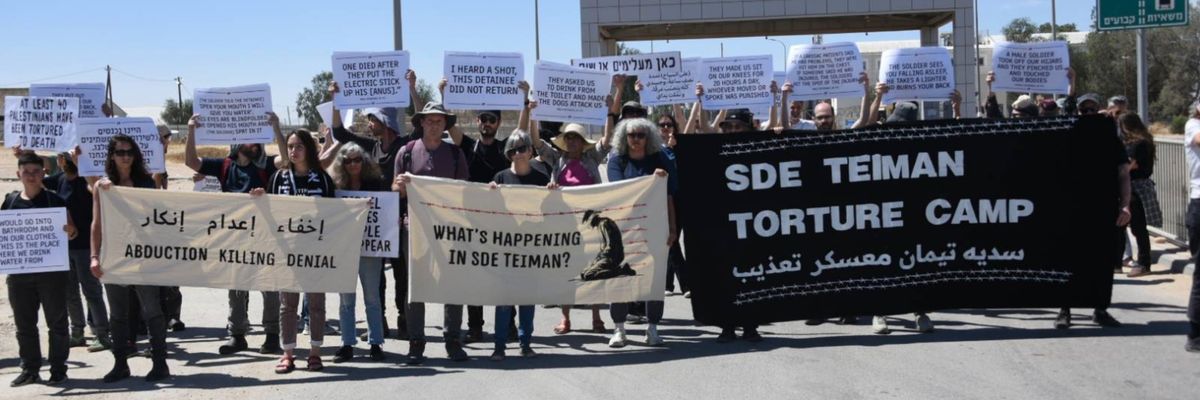
Israeli activists protest outside the notorious Sde Teiman prison in the Negev Desert on April 20, 2024. (Photo: Ofer Neiman/X)
The head of the human rights group said Israel’s Unlawful Combatants Law is enabling “rampant torture” of Palestinian detainees and “institutionalizes enforced disappearance.”
Israel is using its dubious Unlawful Combatants Law to arbitrarily detain Palestinians from the Gaza Strip—including women and children—indefinitely without charge and trial, according to an Amnesty International report published Thursday.
All 27 former detainees interviewed by the rights group described being tortured by Israeli forces.
Amnesty documented the cases of 21 men, five women, and one 14-year-old boy taken from Gaza and held in indefinite incommunicado detention in facilities including the notorious Sde Teiman camp in Israel’s Negev Desert for periods of up to four-and-a-half months, without access to lawyers or contact with their families.
“All those interviewed by Amnesty International said that during their incommunicado detention, which in some cases amounted to enforced disappearance, Israeli military, intelligence, and police forces subjected them to torture and other cruel, inhuman, or degrading treatment,” the report states.
“Israeli authorities are using the Unlawful Combatants Law to arbitrarily round up Palestinian civilians from Gaza and toss them into a virtual black hole.”
Israel’s Unlawful Combatants Law allows the Israel Defense Forces (IDF) to detain anyone from Gaza that they suspect of being engaged in the fight against Israel or posing a threat to its national security indefinitely without charge, trial, or evidence. Last December, the law was amended to allow the IDF to hold suspects for up to 96 hours without a detention order, up to 75 days without being brought before a judge, and up to three months without seeing a lawyer.
“While international humanitarian law allows for the detention of individuals on imperative security grounds in situations of occupation, there must be safeguards to prevent indefinite or arbitrary detention and torture and other ill-treatment,” Amnesty International secretary general AgnèsCallamard said in a statement. “This law blatantly fails to provide these safeguards. It enables rampant torture and, in some circumstances, institutionalizes enforced disappearance.”
“Our documentation illustrates how the Israeli authorities are using the Unlawful Combatants Law to arbitrarily round up Palestinian civilians from Gaza and toss them into a virtual black hole for prolonged periods without producing any evidence that they pose a security threat and without minimum due process,” Callamard added. “Israeli authorities must immediately repeal this law and release those arbitrarily detained under it.”
Israel is using its abusive Unlawful Combatants Law to arbitrarily detain Palestinians from Gaza indefinitely without charge or trial @amnesty gathered harrowing torture testimony from 27 former detainees who were held for up to 4.5 months under the law https://t.co/ABtZE3eXUn
According to the report, “those detained included doctors taken into custody at hospitals for refusing to abandon their patients; mothers separated from their infants while trying to cross the so-called ‘safe corridor’ from northern Gaza to the south; human rights defenders, [United Nations] workers, journalists, and other civilians.”
Former detainees at Sde Teiman said they were blindfolded and handcuffed for their entire imprisonment, forced to remain in painful stress positions for hours on end, and prevented from speaking to other prisoners or even raising their heads.
Said Maarouf, a 57-year-old pediatrician kidnapped by Israeli troops during an attack on al-Ahli Baptist Hospital in Gaza City in December 2023, was detained for 45 days at Sde Teiman. He described being constantly blindfolded and handcuffed, beaten, starved, and forced to sit on his knees for long periods.
A 14-year-old boy taken from his home in Jabalia in January was held for 24 days at Sde Teiman. He told Amnesty that he was jailed with more than 100 adults in a single barrack and was kicked, punched in the head, and repeatedly burned with cigarettes. Amnesty observed bruises and burns on the child’s body when it examined him in February. Like other detainees interviewed by the rights group, the boy said he was always blindfolded and handcuffed and was not permitted to see a lawyer or his relatives.
Earlier this year, Israeli medics working at Sde Teiman said amputations of hands and feet due to injuries from constant handcuffing were “a routine event.”
The five women interviewed by Amnesty were initially jailed at a military detention center in an illegal Israeli settler colony in the occupied West Bank, then at Dimon women’s prison in northern Israel. All five said they were beaten during transport.
One woman taken on December 6 said she was separated from her two children—ages 4 and 9 months—and initially held alongside hundreds of male prisoners. She was beaten, forced to remove her veil and photographed without it, and subjected to the mock execution of her husband.
“On the third day of detention, they put us in a ditch and started throwing sand,” she said. “A soldier fired two shots in the air and said they executed my husband and I broke down and begged him to kill me too, to relieve me from the nightmare.”
Another woman said guards threatened: “We will do to you what Hamas did to us. We will kidnap and rape you.”
“They were blindfolded, their headscarves removed .. [soldiers] jeered and laughed at them.”
A former Palestinian prisoner recounts how Israeli soldiers treated women detained as they evacuated from northern Gaza to the south using the so-called safe corridor. pic.twitter.com/hlbIEDprzj
These and other accounts are consistent with the testimonies of Israeli whistleblowers and former prisoners at Sde Teiman and other Israeli detention facilities.
Former detainees and human rights defenders have described Sde Teiman as “Israel’s Guantánamo” and “more horrific than Abu Ghraib“—the notorious U.S. military prison in Iraq where prisoners were tortured and dozens died. Palestinians held at Sde Teiman and at other detention sites described being electrocuted, mauled and even raped by dogs, constantly beaten, starved, and subjected to other torture and abuse. Other former Sde Teiman detainees said they witnessed a prisoner raped to death, possible executions, and other atrocities.
IDF officials told the Israeli newspaper Haaretz last month that the IDF is investigating the in-custody deaths of dozens of detainees, including 36 who died or were killed at Sde Teiman since October, when Israel began its retaliatory war following the attack by Hamas-led militants that left more than 1,100 Israelis and foreign nationals dead—some of whom were killed by Israeli troops.
Over 240 other people, mostly Israelis, were kidnapped and taken to Gaza. A Human Rights Watch report published Wednesday details war crimes and crimes against humanity including murder and rape perpetrated by members of five Palestinian armed groups that took part in the October 7 attacks.
Since October, Israel’s siege, bombardment, and invasion of Gaza has left at least 139,000 Palestinians dead, maimed, or missing, around 90% of Gaza’s 2.3 million people forcibly displaced, and starvation—sometimes deadly—running rampant.
Israel is on trial for genocide at the International Court of Justice in The Hague. International Criminal Court Prosecutor Karim Khan has also applied for warrants to arrest Israeli Prime Minister Benjamin Netanyahu, Defense Minister Yoav Gallant, and three Hamas leaders for war crimes and crimes against humanity, including “extermination.”