With pressure mounting on the Biden administration, its pursuit of Assange was becoming both damaging and untenable

Spread the love
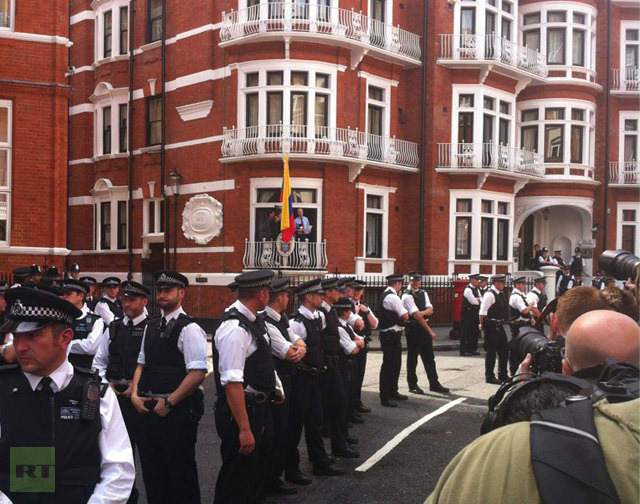
Julian Assange speaks at London's Ecuadorian Embassy
Julian Assange speaks at London’s Ecuadorian Embassy

Emma Shortis, RMIT University

Today, in a surprise development likely weeks in the planning, WikiLeaks founder Julian Assange was able to leave the United Kingdom for the first time in more than a decade after reaching a plea deal with the US government.

In the past several months, momentum has been building towards this moment. There was increasing bipartisan support in both the Australian parliament and the US Congress for the Australian citizen’s release. Australian Prime Minister Anthony Albanese has made repeated statements on his behalf, and in April, US President Joe Biden said he was “considering” a request from Australia to drop its prosecution of Assange.

This all contributed to the sense the matter might be resolved before Assange’s final UK hearing date, previously scheduled for July 9 and 10. The timing of the deal is also a welcome prelude to Albanese’s visit to Washington next week.

Such a resolution, however, was not inevitable. And it is not over yet.


A relentless, years-long pursuit

The United States’ pursuit of Assange has seemingly been relentless since WikiLeaks posted hundreds of thousands of classified military documents in 2010. It wasn’t until 2019 under the then President Donald Trump, however, that he was finally indicted on 17 counts of violating the 1917 Espionage Act.

The charges against Assange were not just considered unprecedented, they raised significant First Amendment concerns.

The apparent desire to punish Assange for the embarrassment caused by the leaks – and to deter others from taking similar action – was apparently so strong the CIA allegedly discussed plans to kidnap and even assassinate Assange during the Trump administration, according to US media reports.

In the UK courts, the US Department of Justice had argued Assange should be subject to US law and extradited to face trial for his actions. However, as a non-citizen, there were questions over whether he could rely on the legal protections afforded by those same laws – particularly the constitutional right to free speech.

The successful extradition of Assange could have set a precedent by which the US could pursue journalists anywhere in the world for publishing information it did not like, while potentially denying them their fundamental First Amendment rights.

In a crucial election year in the US that President Joe Biden is framing as an existential fight for the soul of US democracy, the continued pursuit of Assange was as inconsistent as it was ultimately untenable. Viewed from the outside, it appeared the case was causing the Biden administration international embarrassment.

Biden has been careful to maintain an appropriate distance between the presidency and the Department of Justice. He came into office promising to restore faith in the rule of law following the Trump years, and has meticulously avoided any appearance of interference in the department’s work as it has investigated and indicted his predecessor.

Assange’s case, however, is wholly different to the charges on which Trump has been indicted. It is certainly possible to interpret Biden’s comment that he was “considering” dropping the charges as a gentle public rebuke of the Department of Justice’s pursuit of the case, given its global implications for a free press.

Broader implications for the alliance

The continued pursuit of Assange was also becoming problematic in the context of Australia’s alliance with the US. That relationship is always described as one based on shared democratic values, in contrast to what Biden has repeatedly framed as the coercive and repressive instincts of “authoritarian” powers.

The decision by the US to pursue a citizen of one of its closest allies for the publication of information, while simultaneously condemning authoritarian states for doing much the same, was both hypocritical and damaging to American standing in the world.

In the context of growing concern in Australia about the terms of the AUKUS submarine deal and the Australian government’s willingness to go “all-in” with the US militarily, the continued pursuit of Assange gave the impression that Australia’s most important security ally did not take its concerns seriously. Australia appeared simply to be snapping at America’s heels.

It also added to the sense that the “capital-A Alliance” between the two countries was increasingly dominated by security concerns, often at the expense of democratic accountability.

Because of the international campaign to free Assange and the support it received in both Australian and American democratic institutions, there appears to be have been a reconsideration of this focus on security interests over democratic values.

It should be noted, though, that the US didn’t drop its prosecution in the end; Assange has agreed to plead guilty to a felony charge of violating the Espionage Act, which in itself may set a concerning precedent for press freedom.

And the fact this saga happened at all – and that it has taken more than a decade to get close to resolution – should prompt deep reflection on the values that underpin both Australia’s relationship with its most important security ally and the United States’ role in the world.

Emma Shortis, Adjunct Senior Fellow, School of Global, Urban and Social Studies, RMIT University

This article is republished from The Conversation under a Creative Commons license. Read the original article.
Continue ReadingWith pressure mounting on the Biden administration, its pursuit of Assange was becoming both damaging and untenable

‘Enough Is Enough’: Australia Says Free Assange

Spread the love

Original article by AMY GOODMAN DENIS MOYNIHAN republished from Common Dreams under Creative Commons (CC BY-NC-ND 3.0). 

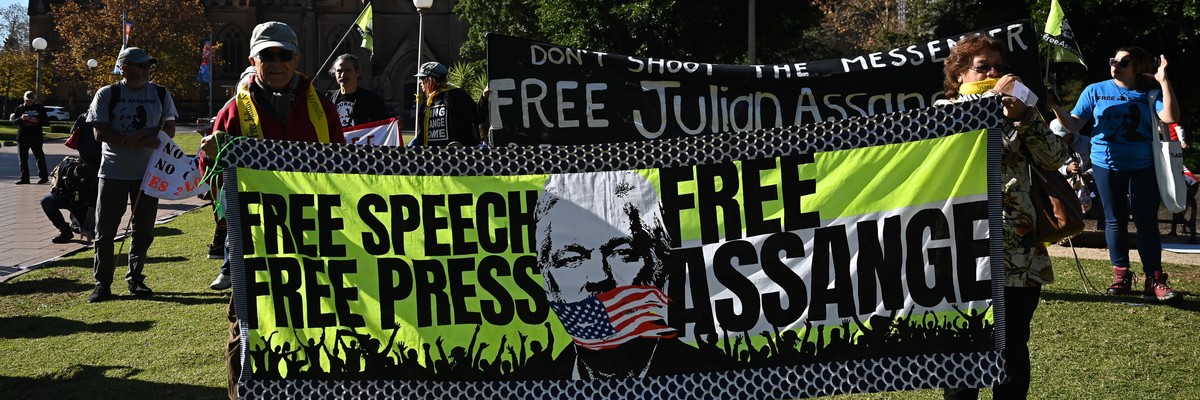
People participate in a rally demanding freedom for imprisoned WikiLeaks founder Julian Assange in Sydney, Australia, on May 24, 2023.  (Photo: Steven Saphore/Anadolu Agency via Getty Images)

U.S. and U.K. persecution of Assange has been continuous and severe.

Australian Prime Minister Anthony Albanese said during Prime Minister’s Questions on February 15, “This thing cannot just go on and on and on, indefinitely.”

The Prime Minister was addressing an action he took a day earlier, on Valentine’s Day. No, not his marriage proposal to his partner, Jodie Haydon (she said yes). He was explaining his support for a parliamentary motion that passed overwhelmingly, calling for the release of an Australian citizen, imprisoned WikiLeaks founder Julian Assange.

Albanese’s support builds on a growing demand from Australians across the political spectrum that the United Kingdom not extradite Assange to the United States, and for the U.S. to drop its espionage and hacking charges against him. Assange, who has been imprisoned in London’s notorious maximum-security Belmarsh Prison since 2019, has a court hearing in the UK.

Assange’s counsel, Jennifer Robinson, texted us on Thursday:

“The appeal next week could be Julian’s final appeal against U.S. extradition. If permission to appeal is denied, there are no further appeals available to us in the U.K.” If extradited, Assange faces up to 175 years in prison in the United States. Said Prime Minister Albanese, “Enough is enough.”

Prior to his imprisonment in Belmarsh, Julian Assange spent seven years cramped inside Ecuador’s small London embassy, where he’d been granted political asylum.

Assange founded WikiLeaks, a website that publishes leaked material while protecting the identity of the whistleblowers. While it launched in 2006, it wasn’t until 2010 that the U.S. government forcefully and publicly targeted Wikileaks and Assange, after Wikileaks made several massive disclosures of leaked documents related to the U.S. invasions and occupations of Iraq and Afghanistan.

On Monday, April 5, 2010, Julian Assange released a shocking video at the National Press Club in Washington, D.C. The video, which WikiLeaks titled “Collateral Murder,” was shot in 2007 from a U.S. military Apache helicopter flying over Baghdad, Iraq. The video shows in grainy black and white detail the gunship’s attack on a group of people on the ground. Twelve civilians, including two Reuters news employees, were mowed down by automatic fire from the helicopter. The voices of the crew were recorded, as they sought permission to “engage” with their targets, and as they laughed and cursed through the slaughter. It was a chilling video, documenting a war crime.

The video’s release was followed by the publication on Wikileaks.org of hundreds of thousands of digital records from the U.S. military, dubbed the Iraq War Logs and the Afghan War Diary. These documents provided further proof that the U.S. was committing war crimes. Some elected officials in the U.S. called for Assange to be assassinated. Then-Vice President Joe Biden called him a “high-tech terrorist.”

Not long after, the U.S. Justice Department convened a secret grand jury which issued a sealed indictment against Assange. Existence of that indictment itself was revealed on WikiLeaks, in a subsequent leak, in 2012. U.S. and U.K. persecution of Assange since then has been continuous and severe. In 2017, as revealed in 2021 by journalist Michael Isikoff and colleagues, the CIA hatched plans to either kidnap Assange from the Ecuadorian embassy or even to assassinate him.

Andrew Wilkie, an independent member of the Australian Parliament from Tasmania, introduced the resolution in support of Assange this week, saying, “This House notes that on 20 and 21 February 2024, the High Court of Justice in the United Kingdom will hold a hearing into whether Walkley Award-winning journalist Julian Assange can appeal against his extradition to the United States of America… both the Australian Government and Opposition have publicly stated that this matter has gone on for too long; and underlines the importance of the U.K. and USA bringing the matter to a close so that Mr Assange can return home to his family in Australia.”

The Australian government is not alone in calling for Assange’s release. In November, 2022, five major newspapers that collaborated with WikiLeaks—The New York TimesThe GuardianLe MondeEl Pais, and Der Spiegel—released a joint letter calling for an end to the prosecution. “Obtaining and disclosing sensitive information when necessary in the public interest is a core part of the daily work of journalists. If that work is criminalized, our public discourse and our democracies are made significantly weaker,” the letter read.

Assange’s attorney Jennifer Robinson will be in the London court for the hearing. She told us, “We have been saying for years: This is a political case which requires a political solution. The unprecedented showing of political support in the Australian Parliament overnight shows that Julian’s case is a priority for the Australian government, our parliament, and the people. The U.S. should listen to the concerns of its ally—and drop the case.”

Original article by AMY GOODMAN DENIS MOYNIHAN republished from Common Dreams under Creative Commons (CC BY-NC-ND 3.0). 

Continue Reading‘Enough Is Enough’: Australia Says Free Assange