Last year, when UN Secretary General António Guterres said PR firms were “acting as enablers to planetary destruction” by working for fossil fuel clients, he didn’t name WPP specifically. But they were the main company he was talking about. The advertising behemoth has more clients in the oil industry than any rival.
Guterres, being a diplomat, uses mild language. In my opinion, WPP is the world’s leading spin doctor for planetary death.
And so I was surprised when I checked in on who David Lammy had appointed to the Foreign Office supervisory board, to see WPP’s recent UK President Karen Blackett is now one of the four non-executive directors – as I revealed last week over on Democracy for Sale.
The supervisory board provides “strategic direction,” and “oversight” for the department. Adverts for the roles say they are “significant contributors to both the operational and strategic leadership of the department. Their primary objective is to bring independent advice, support and challenge… helping to shape the department’s work.”
In February, lawyers for campaign group Badvertising and others submitted a complaint about WPP to the Organisation for Economic Co-operation and Development, arguing it was breaching its international guidelines on corporate responsibility. Its work for a number of fossil fuel and pollution intensive corporations, the lawyers said, “directly increases demand for carbon intensive products and undermines global efforts to reduce greenhouse gas emissions”.
Why is that an organisation whose recently departed UK boss you’d want overseeing British foreign policy? Blackett spent 29 years working for WPP – three decades as a spin doctor at an advertising behemoth which represents some of the most destructive corporations on the planet. How can her advice possibly be independent? How can the perspectives and viewpoints of clients not have imprinted on her?
As the Badvertising website says, “for every rights-abusing, climate-wrecking corporation, there’s an advertising agency working hard to clean up their public image. And no one does this better than the world’s biggest ad firm, WPP”.
Last month, climate activists occupied WPP’s London headquarters, demanding it cut ties with clients including Shell, BP, Total, ExxonMobil, Drax and Saudi Aramco.
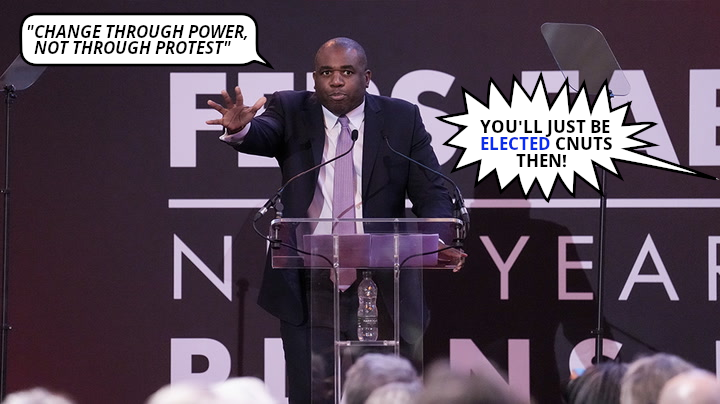
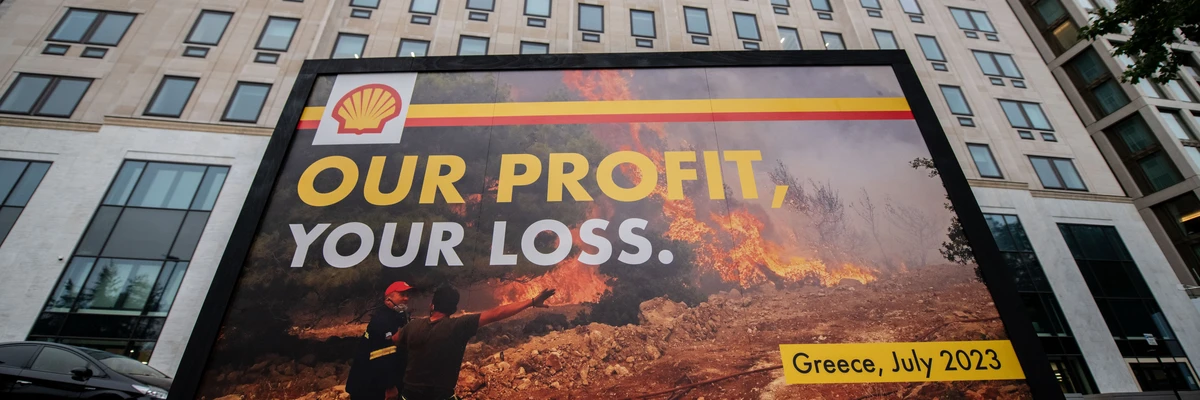
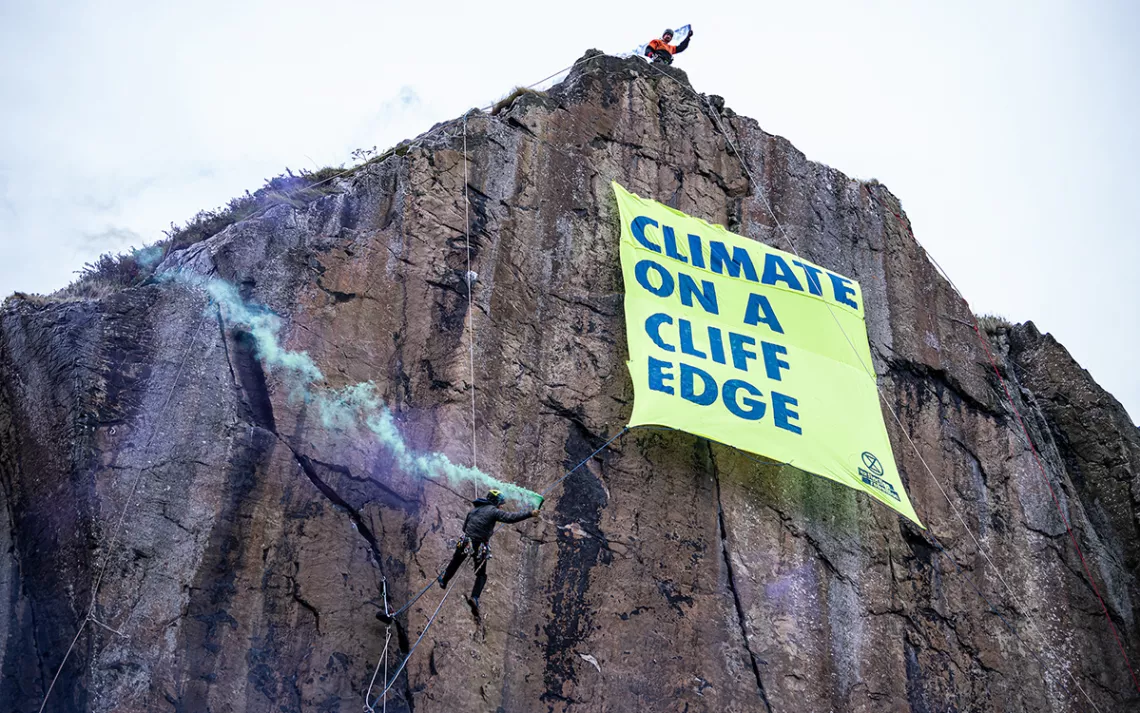
UK Labour Party Shadow Foreign Secretary repeatedly heckled at a speech to the Fabian Society over his and the Labour Party’s support for and complicity in Israel’s genocide of Gaza.Greenpeace activists display a billboard during a protest outside Shell headquarters on July 27, 2023 in London. (Photo: Handout/Chris J. Ratcliffe for Greenpeace via Getty Images)Experienced climbers scale a rock face near the historic Dumbarton castle in Glasgow, releasing a banner that reads “Climate on a Cliff Edge.” One activist, dressed as a globe, symbolically looms near the edge, while another plays the bagpipes on the shores below. | Photo courtesy of Extinction Rebellion and Mark Richards
New research from the Badvertising campaign highlights an alarming trend.
As an insurgent sport among the sweat and strain of more traditional exertions, esports — short for electronic sports and synonymous with gaming — had a chance to chart a new course. Free from the sponsorship links with polluting industries that tarnish many established sports, and with an overwhelmingly young and growing player and fanbase, esports could have created a blueprint for sport in the 21st century and the critical climate issues it faces.
Unfortunately, esports have fallen into the same trap as football, cricket, and many other popular but easily exploited sports: It has become a playground for some of the world’s biggest polluters to promote themselves and mislead fans. Competitive gaming has made the leap from dimly lit bedrooms to the world stage, but, in the process, has slipped on an oil slick.
New research from the Badvertising campaign highlights the alarming trend of esportswashing. Taking a cue from the old tobacco industry playbook, major polluters are trying to co-opt a new generation and normalise climate polluting products and lifestyles. Since just 2017, at least 33 polluting sponsorship deals have been struck between the global esports industry and high-carbon polluters. Of these, 27 have been deals with car manufacturers, five with major fossil fuel companies, and two with the armed forces of the United States — the planet’s thirstiest consumer of oil.
Petrostates too, such as Saudi Arabia and Qatar, have sensed the opportunity and spent hugely into the esports sector, sponsoring teams of young gamers and even hosting tournaments in energy-hungry, air-conditioned arenas. In fact, the inaugural Esports World Cup is culminating in Riyadh, Saudi Arabia, where over 1,500 professional gamers have competed across 21 games, with over a million fans following online.
Despite its relative novelty, esports presents a huge opportunity for polluting companies feeling the heat on climate. It is a booming industry. There are already an estimated 500 million esports fans around the world. While this is just a fraction of the three billion active gamers, there is serious room for expansion — and polluters can see the opportunity to groom the next generation.
Shrewd Move
Alongside the massive growth of the industry is the esports loyal fanbase. It’s international, overwhelmingly young, and male. In the UK, over 50 percent of esports fans are aged between 18 and 34, and overwhelmingly male. Globally, in 2021, more than six in every 10 internet users watching esports were aged between 16 and 35 years old. To put this youthfulness in perspective, only one-in-four ‘die hard’ football fans globally are between 25 and 34 years old.
Built around this fanbase is a vibrant digital culture and community, buoyed by the proliferation of streaming platforms and threaded together through memes which are indecipherable to outsiders. Like with all great sports, it is the community that brings esports to life and makes it such a spectacle. Tapping into this community, and leveraging its global digital networks, is a shrewd move for companies clinging to a dwindling social license of public acceptance.
High-carbon industries targeting younger audiences is not new and comes in many forms, but esports presents an opportunity to communicate with hundreds of millions of young and loyal fans. It is an added irony that these young audiences will be the worst hit by climate breakdown — a crisis that the latest sponsor of their beloved esports is disproportionately responsible for.
Once again, regulators are asleep at the controls. The rise of esportswashing and its potential impact on younger minds requires bolder and better advertising regulation and coordination with the game franchises. But action to date has been limited.
The immersive nature of esports presents an added challenge for regulators and the limited scope they currently exercise to protect young people from exploitative influences. In-game advertising blurs the divide between what is advertising and what is the game. Take Shell’s foray into Fortnite in 2023, where players were encouraged to fill up their digital cars at a digital petrol station to promote its V-Power Nitro+ fuel. Here, the advertisement was part of the game. It is only a matter of time before other polluting companies take Shell’s lead.
With esports fans and athletes facing a precarious future in a warmer world, those responsible for this burgeoning sport and the community built around it must take the threat posed by polluting sponsorship seriously. To protect athletes, gamers and fans around the world, esports teams and governing bodies need to align their commercial partnerships with their values, duty of care to players and audiences, and policies for a liveable future and thriving environment. And when top gamers and streamers speak out about their fears of climate breakdown, they should be supported and nurtured.
Esports are on the cusp of repeating the mistake of other traditional sports in letting themselves be used as a billboard to promote polluters, but it is not too late to clean up. Those polluters that are gaming the climate should not be given free reign to game young minds too; or it could soon be game over for everyone.
Olympic sponsorship deals with Air France, Toyota and ArcelorMittal will produce more emissions than eight coal plants running for an entire year, a new Badvertising report shows.
At the end of this month, the French capital will host humanity’s biggest and brightest celebrations of sport: the Olympic and Paralympic Games. The hype ahead of these games — the 33rd — is palpable and the organisers have promised to deliver a Games like no other.
Sustainability has been central to this promise. As humanity begins to stare down one of the greatest upheavals of the 21st century — the planetary crises of global heating and ecological catastrophe — the Games are under pressure. Almost every Olympic host nation of the recent era has promised big on environmental action, and every one has fallen short, under-delivering. For all of London’s promises back in 2012, having BP as a sponsor augured badly all along.
The question for Paris is, can it buck the trend and give the world a glimpse of what a mega sports event must look like in the era of breaking planetary ecological boundaries?
Pressure is not just coming from fans and the public. Olympians and Paralympians are increasingly speaking out about the lethal competing conditions that climate breakdown is creating. And the pioneering environmental leadership of Paris Mayor Anne Hidalgo raises expectations on those organising the Games. A major programme of urban greening and traffic reduction is under way thanks to Hidalgo which, earlier this year, also saw Parisians vote to increase charges on SUVs in the city.
But there continues to be the prospect of Olympic smoke rings made from fossil fuels hanging over the organisers’ ambitions to deliver the ‘greenest ever games’: the pervasive presence of polluting sponsors that use the Games to raise their profile, normalise high carbon products and lifestyles with billions of people, while distracting from their complicity in the worsening climate and ecological crises. At the Paris Games, just three of the sponsorship deals, those with Air France, Toyota and steelmaker ArcelorMittal, will produce more pollution than eight coal plants running for an entire year, according to new research from the Badvertising campaign ‘Olympic Smoke Rings’.
Fossil Fuel Playbook
At a larger level the oil-dependent aviation and vehicle industries have used a similar playbook to the fossil fuel companies. They’ve lobbied against climate action, sought to evade responsibility for their own pollution, and when pushed produced plans that are wildly inadequate in the face of the climate action needed. In specific, large-scale examples, some vehicle makers have been caught illegally cheating on emissions, while the aviation industry globally ignores half of its climate impact and has no realistic plans to deal with the other half.
These sectors, and the major companies within them, are responsible for a large part of global heating — and the organisers of the Games make themselves complicit through allowing the Olympics to be used for their promotion.
Historically, the Olympics has taken sponsorship from multiple oil and gas companies, airlines and vehicle makers. Fast forward to the Paris Games and little has changed. Three major polluters at these Games are not only responsible for enough carbon emissions and air pollution to make the eyes water of all the athletes and fans attending, they have also actively lobbied against ambitious climate policy and hoovered up public subsidies on the premise of decarbonisation.
Air France (an entity merged with Dutch airline KLM) continues to lobby against higher taxes or decarbonisation initiatives within the aviation sector. CEO Ben Smith argued that an EU kerosene tax would “have a negative impact on Europe’s air transport sector”. And, Air France-KLM strongly fought the proposed flight cap at the Netherlands’ Schiphol airport and took legal action against the measure.
Toyota boasts annual CO2 emissions higher than most oil and gas companies, and has production plans that will see the company overshoot Paris-aligned emissions targets by as much as 184 percent. Badvertising’s previous report, Dangerous Driving, detailed how Toyota is also ranked amongst the worst car makers globally for action on climate change, has been energetically resisting the move to cleaner, fully electric cars, and been active in lobbying against climate policy in France, the host nation of the next Olympic Games.
The steel giant ArcelorMittal is front and centre at this year’s games. In 2023 ArcelorMittal was responsible for an estimated 114.3 million tonnes of CO2 equivalent — comparable to the annual emissions of the wealthy, industrialised nation of Belgium. ArcelorMittal is producing the iconic Olympic torches for the Paris Games using ‘steel with a reduced carbon footprint’. But despite this glitzy push, ArcelorMittal does not have scientifically-validated CO2 emissions reductions targets in alignment with a 1.5C climate scenario, and continues to rely on coal-based steel production. This, however, did not stop the company from accepting around €3.5 billion in public subsidies to stimulate decarbonisation.
When keeping company like this, it’s hard to believe the Olympics and Paralympics are truly serious about the threat posed by climate breakdown to sport and all those who love it. In fact, researchers from Carbon Market Watch auditing the Paris Games’ sustainability plans noted that the sponsors are a “reflection of the credibility, or otherwise, of the games’ climate commitment” and that “all future games must break from the status quo of associating with polluting companies.”
It is clear that climate and environmental breakdown threaten the very fabric of the Games, where they can be hosted, and how well the athletes can compete at them. The Games see themselves as among the greatest gatherings of the international community. When the Secretary-General of the United Nations, another great global coming together, António Guterres, recently called on governments to ban fossil fuel adverts and phase down demand for polluting products and lifestyles, his vision would certainly have encompassed the Olympic rings. He would not want them to be made from fossil fuel smoke.
The very least the Games can do now, to play their own part in averting climate breakdown, is to cut all ties with polluting sponsors that are undermining the future of the Games and the nations, fans, Olympians and Paralympians that make it the spectacle it is.