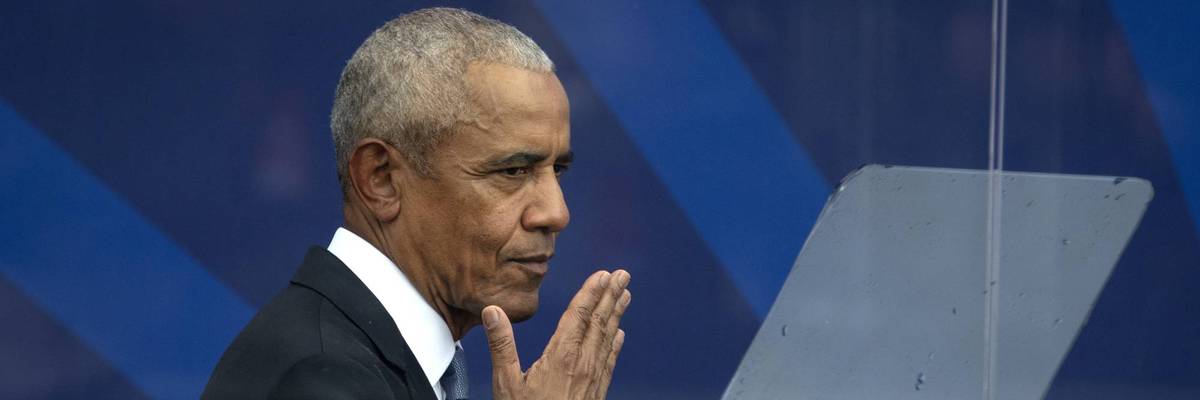
Former President Barack Obama walks off stage at the dedication ceremony for the opening of the Barack Obama Presidential Center in John Lewis Plaza on June 18, 2026 in Chicago, Illinois. (Photo by Scott Olson/Getty Images)
“The full weight of the federal government is being brought down on a law-abiding elected official because she has dared to criticize the president.”
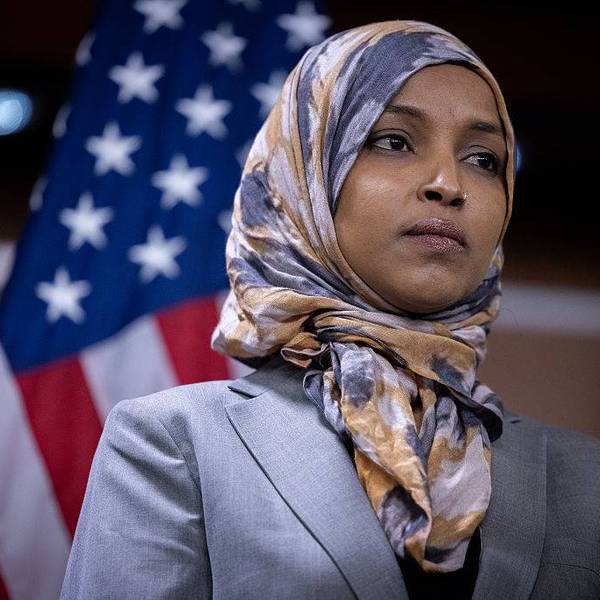
ormer President Barack Obama on Sunday spoke out against the Trump administration’s plot to strip Rep. Ilhan Omar of her US citizenship and remove her from the country.
In a lengthy social media post, Obama said the administration’s attack on Omar (D-Minn.) violates “a basic principle of American democracy that the government can’t selectively target individuals simply because of their political beliefs or what they say.”
Obama’s post came nearly one week after agents at the US Department of Homeland Security conducted a raid of Omar’s home. Days after the raid, the Wall Street Journal reported that the raid on Omar was part of an effort to build “a case to strip her of her US citizenship and ultimately deport her.”
“To understand why this is so appalling, it’s important to know the facts,” Obama wrote. “Congresswoman Omar came to this country with her father when she was 12 years old. Five years later, her father became a naturalized citizen. If Ilhan had been 18 at the time, she would have had to apply for citizenship separately. But because she was 17, she became a naturalized citizen automatically.”
Obama noted that President Donald Trump has repeatedly targeted Omar “as someone who he believes does not belong in this country,” and accused the president of seizing upon an “unsubstantiated theory that she was actually 18 when her father was naturalized” to carry out his deportation plot.
“The full weight of the federal government is being brought down on a law-abiding elected official because she has dared to criticize the president,” Obama wrote. “And it’s not the first time this has happened. Under President Trump, the Justice Department has repeatedly gone after those he considers his political enemies—from the Attorney General of New York, to the former head of the FBI, to members of the Federal Reserve.”
Obama concluded by warning that letting Trump’s actions go unchallenged would set a terrible precedent that even the president’s allies could one day live to regret.
“If this becomes the new normal, there’s no reason to believe it will stop with [Omar],” Obama wrote, “or that future presidents, in either party, won’t do the same.”
Trump rose to political prominence last decade by spreading a racist conspiracy theory falsely claiming that Obama was born in Kenya, and thus ineligible to be president.
Donald Fuhrump says that Amerikkka doesn’t bother with crimes or charges anymore, not being 100% Amerikkkan and opposing his real estate intentions is enough.Climate science denier Donald Trump confirms that he knows nothing about democracy and that more liquid gold is being secured according to his policy of global privateering.Orcas discuss Donald Trump and the killer apes’ concept of democracy. Front Orca warns that Trump is crashing his country’s economy and that everything he does he does for the fantastically wealthy.
This work by Middle East Monitor is licensed under a Creative Commons Attribution-NonCommercial-ShareAlike 4.0 International License.
Former President of the United States Barack Obama and New Jersey Democratic gubernatorial candidate for Governor Mikie Sherrill attend “Get out the vote” rally at the Essex County College gymnasium in Newark, New Jersey, United States on November 1, 2025. [Kyle Mazza – Anadolu Agency]
Former US President Barack Obama has said that Israeli Prime Minister Benjamin Netanyahu repeatedly tried to persuade him to launch a full-scale armed confrontation with Iran.
In an interview published on Monday by The New Yorker, Obama said Netanyahu used the same arguments and justifications that he later presented to US President Donald Trump.
Obama added that although Netanyahu ultimately achieved his aim, he remains highly doubtful that such a war would serve the interests of either Israeli or American citizens.
He also noted that historical records clearly show the deep disagreements that marked his relationship with Netanyahu over the Iran issue. “I think there’s an ample record of my differences with Mr. Netanyahu,” Obama said.
This work by Middle East Monitor is licensed under a Creative Commons Attribution-NonCommercial-ShareAlike 4.0 International License.
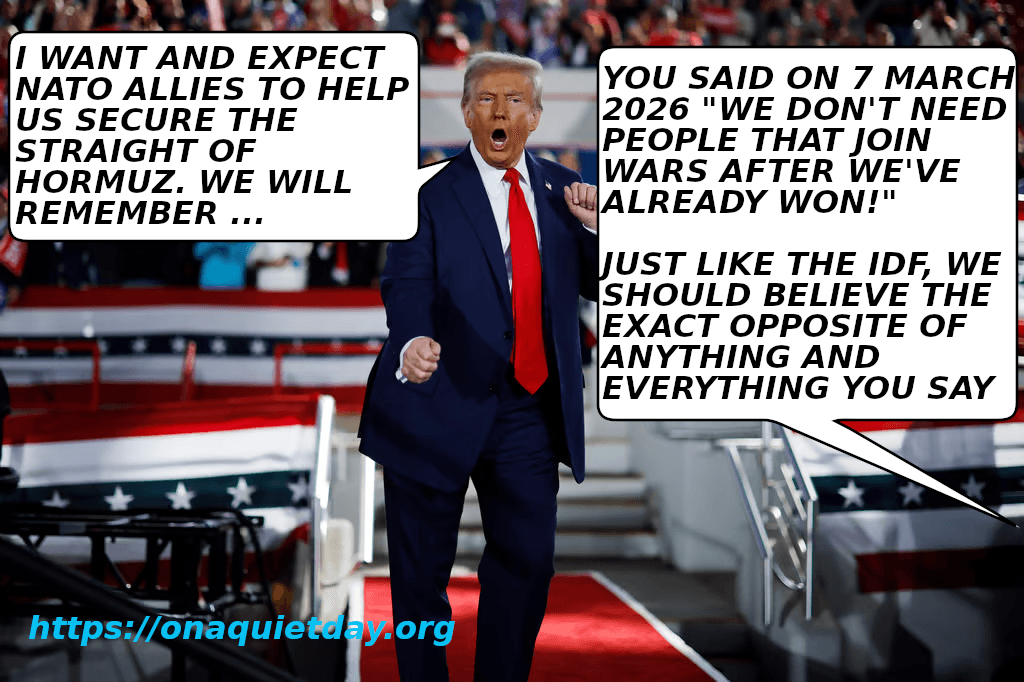
Donald Trump calls for help from NATO allies in securing the Strait of Hormuz despite saying on 7 March 2026 that they don’t need people to join wars after they’ve already won. He’s challenged with the claim that he lies as much as the IDF.Keir Starmer explains that UK is actively supporting Israel’s genocidal expansion and repeats his previous quotation that he supports Zionism “without qualification”. Keir Starmer said “I said it loud and clear – and meant it – that I support Zionism without qualification.” here: https://www.jewishnews.co.uk/keir-starmer-interview-i-will-work-to-eradicate-antisemitism-from-day-one/
Federal immigration agents in the city of Minneapolis are accused of having wrestled a 37-year-old intensive care nurse called Alex Pretti to the ground and then shooting him dead. The killing took place just over a mile from where another American citizen, Renee Good, was allegedly fatally shot by federal agents weeks earlier.
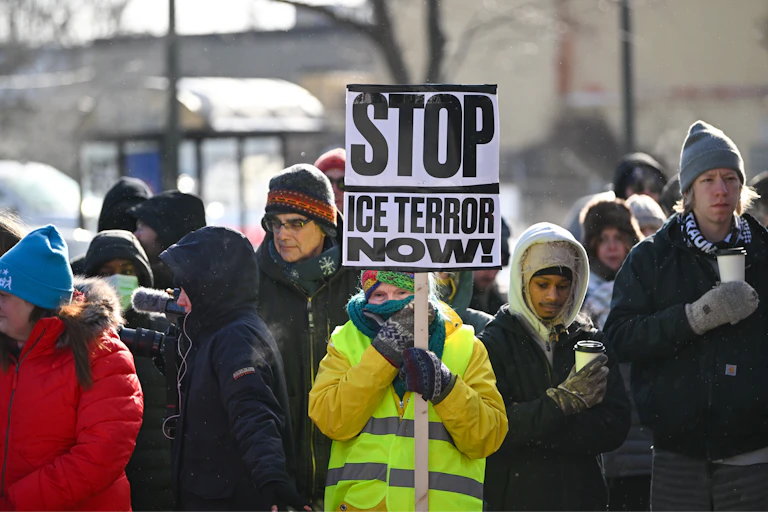
The latest incident prompted angry protests from people in Minneapolis who want the immigration enforcement operation in their city to end. We spoke to Mark Shanahan, an associate professor of political engagement at the University of Surrey, to address several key issues.
Why has sending in federal immigration agents caused such trouble in Minnesota?
Since returning to the White House in January 2025, the national guard has been deployed to several US cities to quell what have generally been Donald Trump-inflated crises, with illegal migration among the most prominent. However, in December, the Supreme Court ruled that Trump did not have authority for such deployments.
So, since then we have seen federal agents with US Customs and Border Protection and Immigration and Customs Enforcement taking the battle largely to minorities in cities with Democratic party leadership as part of the president’s violent attack on illegal immigration, a situation he has described as “the greatest invasion in history”.
Minneapolis is a Democrat-run city in a Democrat-led state. The governor is Tim Walz who ran for vice-president on the Kamala Harris ticket against Trump in the 2024 election. Walz has faced allegations, which he denies, of overlooking alleged widespread fraud in the financing of public safety net programmes, supposedly involving segments of the Somali-American community.
While most of these allegations have been refuted, they gave Trump reason to send in federal agents. This has ramped up tensions between state officials and the administration, causing brutal and unnecessary deaths in the community and pitting ordinary Minnesotans against federal government officials.
How does the situation in Minnesota reflect the second amendment right to bear arms?
It’s a reversal of virtually all of the second amendment debates that have been seen in recent years. The second amendment was introduced to the US constitution in 1791 through the Bill of Rights due to a deep mistrust of centralised military power and a desire to ensure that the newly formed federal government could not disarm the populace.
The founding fathers envisaged a “natural right of resistance and self-preservation”. Trump’s actions in sending in armed federal agents to conduct enforcement operations in various states appear to fulfil the founding fathers’ concerns.
The agents are trampling all over not only citizens’ second amendment right to bear arms (officials seemingly connected Pretti’s killing to him carrying a weapon) but also their first amendment right to freedom of assembly.
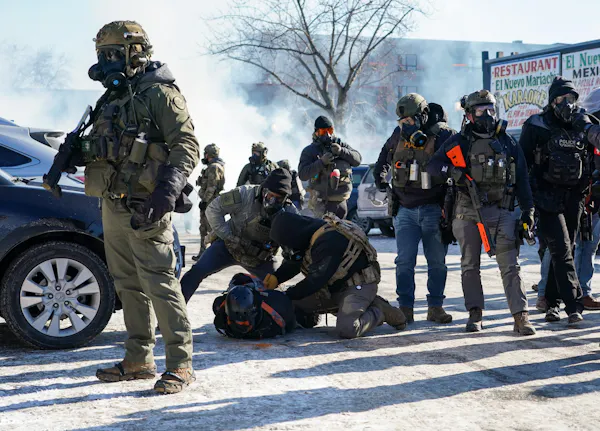
Federal officers detain a protester in Minneapolis, Minnesota, on January 24. Craig Lassig
How have the fatal shootings affected Trump’s popularity?
Trump’s popularity is on the decline. His failure to deliver on the economic promises outlined in his election campaign, scatter-gun approach to international relations and the widening gulf between rhetoric and achievement have all damaged his standing in the polls.
In a CNN poll published on January 16, almost six in ten respondents described Trump’s first year back in office as a failure with the president focused on the wrong priorities.
And what support he does have is ebbing rapidly as federal immigration agents appear out of control, targeting many more documented citizens than illegal migrants, spreading fear and operating as if they are above the law.
With what looks like high levels of gaslighting coming from Homeland Security officials, voters are turning against the increasing autocracy of this administration, believing in the evidence widespread across the media rather than highly contentious statements from Trump’s lieutenants.
Is it unusual for former presidents to speak out the way Barack Obama and Bill Clinton have?
It certainly is. There is a longstanding tradition in the US of, and implicit agreement among, former presidents to avoid public criticism of the incumbent. Such reticence to speak is generally a sign of respect for the office and an acknowledgement of the unique and difficult challenges of the presidency.
But Trump 2.0 is no normal presidency. The 47th president’s style is both combative and retributive, and there seems to be an increasing feeling of it being out of step with the desires and best interest of the country he leads.
Trump’s march to autocracy creates crises where he regards himself as the hero the country needs to overcome its ills. His predecessors take a different view.
Whether it’s Obama calling out the assault on core American values or Clinton’s condemnation of the “horrible scenes” in Minneapolis as “unacceptable” and avoidable, Democrat past presidents have not held back. Notably, the only living previous Republican president, George W. Bush, has so far kept his own counsel.
What can be done to prevent further violence?
Most simply, Trump could end the deployment of federal immigration agents to Minneapolis and refrain from similar actions in the future. He is clearly looking for an off-ramp and sending his “border czar”, Tom Homan, to Minneapolis to direct operations could be the first step to de-escalation. But Trump abhors being called out as wrong and, at least beyond Minneapolis, is far more likely to double down on the immigration enforcement activities.
Realistically, the most likely de-escalator is Congress showing some teeth and refusing to fund further federal immigration enforcement activity. Democrats could force another government shutdown over the issue, and need just a handful of Republicans to flip in order to refuse to sanction a 2026 budget for the Department of Homeland Security.
At a public level, the greater the scrutiny of immigration enforcement agencies, the closer the fact-checking of official statements and the more cohesive the opposition to Trump’s deportation policy, the greater the chance of effectively opposing it.
It is midterm year – and the greater the public pressure, the more likely Republican legislators are to cleave away from the Trump line. While he currently controls the levers of power, that control remains fragile. Even Trump may soon realise that overt, violent, coercive autocracy is not a vote winner.
Elon Musk urges you to be a Fascist like him, says that you can ignore facts and reality then.Donald Fuhrump says that Amerikkka doesn’t bother with crimes or charges anymore, not being 100% Amerikkkan and opposing his real estate intentions is enough.Orcas discuss how Trump was re-elected and him being an obviously insane, xenophobic Fascist.
When Israel launched a surprise military strike on Iran last week, it did more than risk igniting a catastrophic regional war. It also exposed long-simmering tensions in Washington—between entrenched bipartisan, pro-Israel hawks and a growing current of lawmakers (and voters) unwilling to be dragged into another Middle East disaster.
“This is not our war,” declared Rep. Thomas Massie (R-KY), one of the House’s most consistent antiwar voices. “Israel doesn’t need U.S. taxpayers’ money for defense if it already has enough to start offensive wars. I vote not to fund this war of aggression.” On social media, he polled followers on whether the U.S. should give Israel weapons to attack Iran. After 126,000 votes (and 2.5 million views), the answer was unequivocal: 85% said no.
For decades, questioning U.S. support for Israel has been a third rail in Congress. But Israel’s unprovoked attack on Iran—coming just as the sixth round of sensitive U.S.-Iran nuclear talks were set to take place in Oman—sparked rare and unusually direct criticism from across the political spectrum. Progressive members, already furious over Israel’s war on Gaza, were quick to condemn the new offensive. But they weren’t alone.
Rep. Pramila Jayapal (D-WA) called Israel’s strike “reckless” and “escalatory,” and warned that Prime Minister Netanyahu is trying to drag the U.S. into a broader war. Rep. Chuy García (D-IL) called Israel’s actions “diplomatic sabotage” and said, “the U.S. must stop supplying offensive weapons to Israel, which also continue to be used against Gaza, & urgently recommit to negotiations.”
Rep. Summer Lee (D-PA) was even more blunt. “The war criminal Netanyahu wants to ignite an endless regional war & drag the U.S. into it. Any politician who tries to help him betrays us all.”
Netanyahu’s strikes on Iran are acts of diplomatic sabotage that risk escalation, endangering civilians in both countries & across the region.
The US must stop supplying offensive weapons to Israel, which also continue to be used against Gaza, & urgently recommit to…
— Congressman Chuy García (@RepChuyGarcia) June 13, 2025
More striking, however, were the critiques from moderate Democrats and some Republicans.
Sen. Tim Kaine (D-VA), a longtime advocate for requiring congressional approval before the U.S. gets involved in new wars, blasted Israel for jeopardizing planned U.S.-Iran diplomacy. “The American people have no interest in another forever war,” he wrote. Sen. Jack Reed (D-RI), Ranking Member of the Senate Armed Services Committee, warned that strikes “threaten not only the lives of innocent civilians but the stability of the entire Middle East and the safety of American citizens and forces.”
Some pro-Israel Democrats are feeling comfortable speaking out on this conflict because it fits their anti-Trump critique. Sen. Maria Cantwell (D-WA) said:
We are at this crisis today because President Trump foolishly walked away from President Obama’s Iran nuclear agreement under which Iran had agreed to dismantle much of its nuclear program and to open its facilities to international inspections, putting more eyes on the ground. The United States should now lead the international community towards a diplomatic solution to avoid a wider war.”
Adding to this diverse chorus of opposition are some Republicans from the party’s non-interventionist wing. Sen. Rand Paul (R-KY) declared, “War with Iran is not in America’s interest. It would destabilize the region, cost countless lives, and drain our resources for generations.” Rep. Warren Davidson (R-OH) lamented that “some members of Congress and U.S. Senators seem giddy about the prospects of a bigger war.”
War with Iran is not in America’s interest. It would destabilize the region, cost countless lives, and drain our resources for generations.
We should pursue diplomacy, not destruction. Engaging in dialogue with adversaries is not weakness; it’s the strength of a confident nation…
And in a rare show of agreement with progressive critics, Rep. Marjorie Taylor Greene (R-GA) blasted the hawks in both parties. “We’ve been told for the past 20 years that Iran is on the verge of developing a nuclear bomb any day now. The same story. Everyone I know is tired of U.S. intervention and regime change in foreign countries. Everyone I know wants us to fix our own problems here at home, not bomb other countries.”
Of course, many in Congress rushed to support Israel. Senate Republican leader John Thune said, “Israel has determined that it must take decisive action to defend the Israeli people.” Democratic Sen. John Fetterman (D-PA) voiced full support for the strike and urged the U.S. to provide Israel “whatever is necessary—military, intelligence, weaponry.”
Our commitment to Israel must be absolute and I fully support this attack.
Keep wiping out Iranian leadership and the nuclear personnel.
We must provide whatever is necessary—military, intelligence, weaponry—to fully back Israel in striking Iran. https://t.co/3lm1YD6dVr
— U.S. Senator John Fetterman (@SenFettermanPA) June 13, 2025
The most crass was Senator Lindsey Graham, who posted:
Game on. Pray for Israel.”
But these crude pro-war responses, once guaranteed to go unchallenged, are now being met with resistance–and not just from activists. With public opinion shifting sharply–especially among younger voters, progressives, and “America First-ers” – the political calculus on unconditional support for Israel is changing. In the wake of Israel’s disastrous war in Gaza and its widening regional provocations, members of Congress are being forced to choose: follow the AIPAC money and the old playbook–or listen to their constituents.
If the American people continue to raise their voices, the tide in Washington could turn away from support for a war with Iran that could plunge the region into deeper chaos while offering no relief for the suffering people of Gaza. We could finally see an end to decades of disastrous unconditional support for Israel and knee-jerk support for catastrophic wars.
Feature photo | Israelis gather next to a direct hit site following an Iranian missile strike against Israel, June 16th 2025. Matan Golan | AP
Medea Benjamin is co-founder of Global Exchange and CODEPINK: Women for Peace. She is the co-author, with Nicolas J.S. Davies, of War in Ukraine: Making Sense of a Senseless Conflict, available from OR Books in November 2022. Other books include, “Inside Iran: The Real History and Politics of the Islamic Republic of Iran” (2018); “Kingdom of the Unjust: Behind the U.S.-Saudi Connection” (2016); “Drone Warfare: Killing by Remote Control” (2013); “Don’t Be Afraid Gringo: A Honduran Woman Speaks from the Heart” (1989), and (with Jodie Evans) “Stop the Next War Now” (2005).
The views expressed in this article are the author’s own and do not necessarily reflect MintPress News editorial policy.
Climate scientists are probably among those most aggrieved by Donald Trump’s return as US president.
Trump has scoffed at the increasingly dire warnings of these scientists and declared his enthusiasm for digging up and burning the coal, oil and gas that is overheating Earth. His empowerment of the far right dims prospects for collective solutions to collective problems, but what is he likely to change about US climate policy?
Trump has not published a climate agenda. To discern his impact on domestic and international policy, we have to sift through statements, appointments to political positions and the record of his first term.
Here, our academics glean grim portents for the years ahead – and some continuities with supposedly pro-climate presidents of the past.
1. It’s still ‘drill, baby, drill’
Trump’s three-word campaign slogan, “drill, baby, drill”, is intended to sum up his plans for the US oil and gas industry. It’s also an apt summary of existing US energy policy.
Since 2008, when Democrat Barack Obama was elected, oil production has soared from a 50-year low of 6.8 billion barrels a day to 19.4 billion in 2023.
“The United States is already producing more crude oil than any country ever,” says Gautam Jain, an energy and finance expert at Columbia University.
“Oil and gas companies are buying back stocks and paying dividends to shareholders at a record pace, which they wouldn’t do if they saw better investment opportunities.”
2. We won’t always have Paris (or even Rio)
Trump withdrew the US from the 2015 Paris agreement on the first day of his second term (it took him six months to do it last time).
Jain frets that he may go further and exit international negotiations entirely, by rescinding his country’s membership of the UN Framework Convention on Climate Change, which was adopted in Rio de Janeiro in 1992.
Rejoining would be “nearly impossible”, Jain says, as a future president would need the consent of two-thirds of the Senate.
The US risks dropping the mantle of climate leadership on China, he adds. A recent analysis by Oxford economists Matthew Carl Ives and Natalie Sum Yue Chung suggests that that ship may have sailed years ago.
“China already processes most of the clean energy supply materials and has an advanced manufacturing base that is more capable of scaling up production to meet the rising demand,” they say.
3. The bucks stop here?
A US retreat from international climate diplomacy would afflict people who are particularly vulnerable to the mounting crisis in Earth’s atmosphere. Jain highlights how Trump’s predecessor Joe Biden donated several billions of dollars more towards renewable energy and adaptation in the developing world, compared with Trump in his first term.
However, a 2023 study that estimated each country’s “fair share” of this climate finance pot according to income, population size and historical emissions, issued this withering assessment while Biden was president:
“Based on these metrics, we found that the US is overwhelmingly responsible for the climate finance shortfall,” says environmental economist Sarah Colenbrander (University of Oxford).
“The world’s largest economy should be providing US$43.5 billion of climate finance a year. In 2021, it gave just US$9.3 billion – a meagre 21% of its fair share.”
4. Biden’s green tax credits may endure…
Trump could keep some Biden-era investments in clean energy (tax breaks for investors in renewables, for example) as the benefits are accruing in Republican states, Jain says.
He may still cut tax credits for people buying electric vehicles, though. This would slow the transition from combustion-engine transport by making it harder for people to afford an EV. (Biden’s 100% tariff on Chinese-made EVs hasn’t help either).
5. … but his methane tax probably won’t
Jain predicts that the greatest damage inflicted by Trump will be to the regulation of fossil fuels and emissions. In his crosshairs is a federal charge for the release of methane from oil and gas wells and pipelines.
Biden identified cutting methane emissions as a potential brake on the accelerating pace of global heating. That’s because methane is a greenhouse gas that lingers in our atmosphere for decades instead of centuries like CO₂ and is far more potent in trapping heat during that time.
Reducing methane emissions could reduce climate change quickly – a climate action lifeline we will be sorry to see thrown away.
6. The nuclear option
Trump seems to have a soft spot for one low-carbon energy source: nuclear power. Perhaps because civil nuclear maintains the skills and supply chains needed for its military applications?
7. Up is down, left is right
Democrats may regret making “trust the science” their dividing line against Trump.
Eric Nast, an environmental governance expert at the University of Guelph, tracked how the first Trump administration altered language on US government websites.
He expects Trump to disguise his regulation bonfire as “strengthening transparency” (blocking air pollution standards that rely on private health data) and championing “citizen science” (dismissing academics from advisory boards for private citizens rich in time and money, who might benefit from scrapping rules and limiting scrutiny).
8. Fighting fire with money
Tesla’s Elon Musk, Amazon’s Jeff Bezos and Meta’s Mark Zuckerberg attended Trump’s second inauguration. Their presence – plus a pointed farewell speech by Biden – has provoked murmurs of “oligarchy”: rule by people whose immense wealth and influence has utterly captured ostensibly democratic societies.
“As public firefighters struggle to cope, affluent residents and businesses have turned to private firefighting services to protect their properties,” says Doug Specht, a University of Westminster geographer.
9. Arctic relations
What explains Trump’s sudden interest in the Arctic? Oil, gas and critical minerals newly liberated by thawing ice in a region warming four times faster than the global average says engineer Tricia Stadnyk at the University of Calgary.
“The second Trump administration is aware of both the new opportunities and risks as global temperatures shatter new records and thresholds, and an ice-free Arctic becomes a possibility,” she says.