Ellie Chowns, Green Party MP for North Herefordshire. CC image Wikipedia.
The Green Party has voted at its Manchester conference to recognise the Israeli government as an “apartheid” state, as defined by international treaties such as the International Convention on Apartheid (1973) and Rome Statute (1998).
The conference also voted to recognise Israeli military operations in Gaza as a “genocide” as defined under the UN Genocide Convention (1948).
Ellie Chowns, Green Party MP for North Herefordshire, said: “We don’t use terms like genocide or apartheid lightly, but they are a sad reflection of the atrocities being carried out by the Israeli State.
“This motion reflects International Humanitarian Law, including the advisory opinion of the International Court of Justice, and it is essential that British political parties unequivocally uphold these basic minimum standards of international law.”
The conference also reaffirmed support for the Boycott, Divestment and Sanctions (BDS) campaign.
Ellie Chowns said: “We will only see an end to the escalating violence in the Middle East when there are clear incentives for all involved in the war in Gaza to agree to a ceasefire, the release of all hostages and an end to the occupation.
“We will press the UK government to step up its actions, including suspending all arms export licenses to Israel, and full co-operation with the actions of the international courts.
“Without an agreement, the intolerable death toll in Gaza will continue to rise, the hostages will be at greater risk and there will be an increased chance of sleepwalking into a larger regional war.”
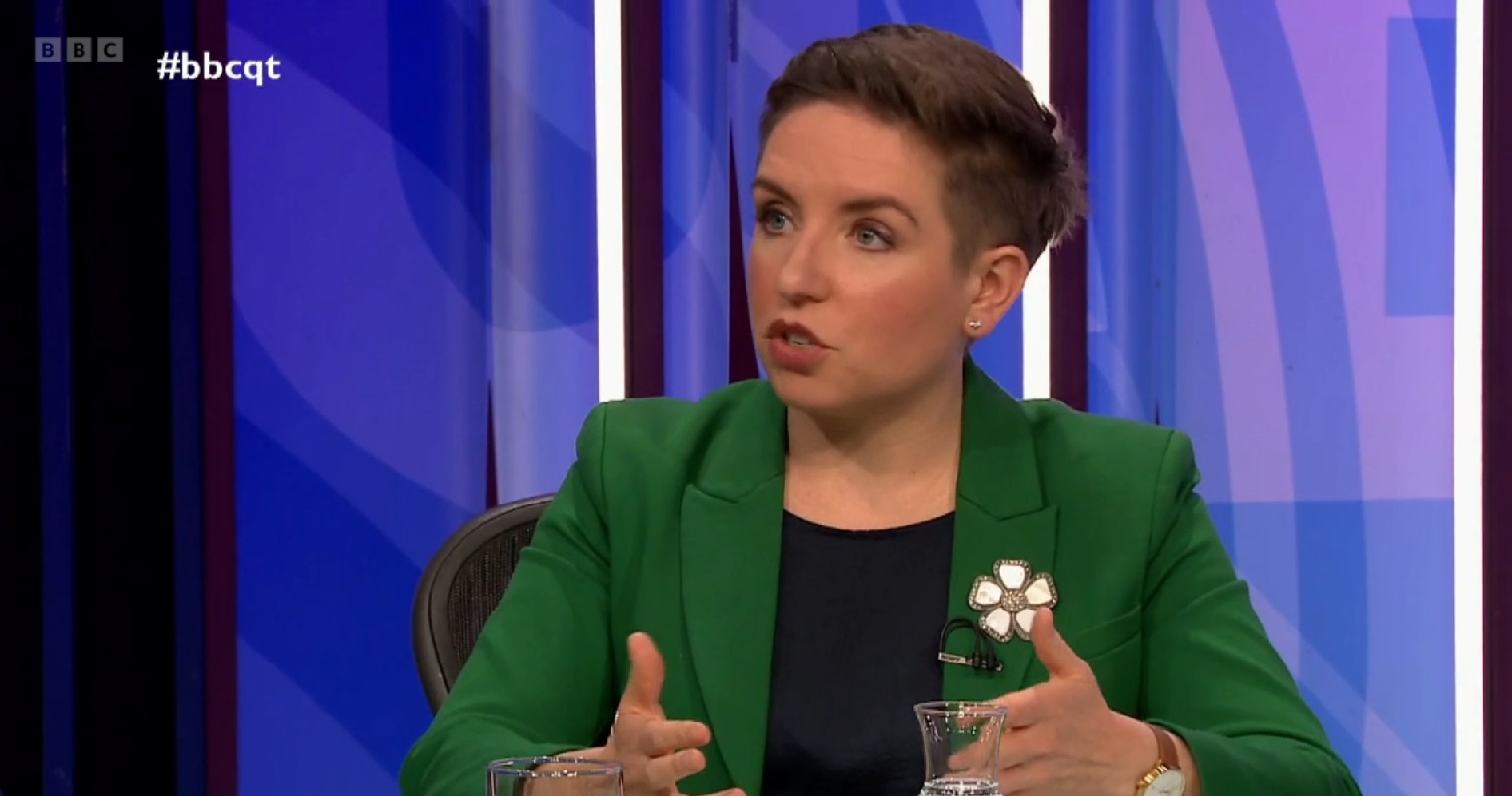
Image of the Green Party’s Carla Denyer on BBC Question Time.
Reacting to news that the UN Security Council has called for an immediate ceasefire in Gaza, without the US using its veto to block the resolution, co-leader of the Green Party Carla Denyer, said:
“The Green Party has been calling for a ceasefire since last October, so this vote is hugely welcome if long overdue. With Israel’s greatest ally the United States abstaining, the Netanyahu regime is more isolated than ever – and rightly so.
“This Security Council resolution comes too late for hundreds of thousands of people who have seen their families and friends killed, maimed, or seriously injured and their homes, hospitals and schools destroyed. Nonetheless, it ramps up international pressure on Israel to end its deadly assault on Gaza.
“However, Netanyahu is not listening – the attacks continue. The UK government must now further pressurise the Netanyahu regime by immediately suspending export licenses for arms to Israel. The Green Party also calls for further leverage through boycotts, divestment and sanctions. This means withdrawing all public money from funds with investments in Israel and suspending beneficial trade arrangements with the country.
“Only a full bilateral ceasefire and release of all hostages can stop more people dying. Israel must immediately stop blocking humanitarian aid to Gaza, where their blockade on aid is causing famine and intolerable suffering. And only a ceasefire can allow talks to begin on the long-term political solutions that will bring peace and security to everyone in the region.”
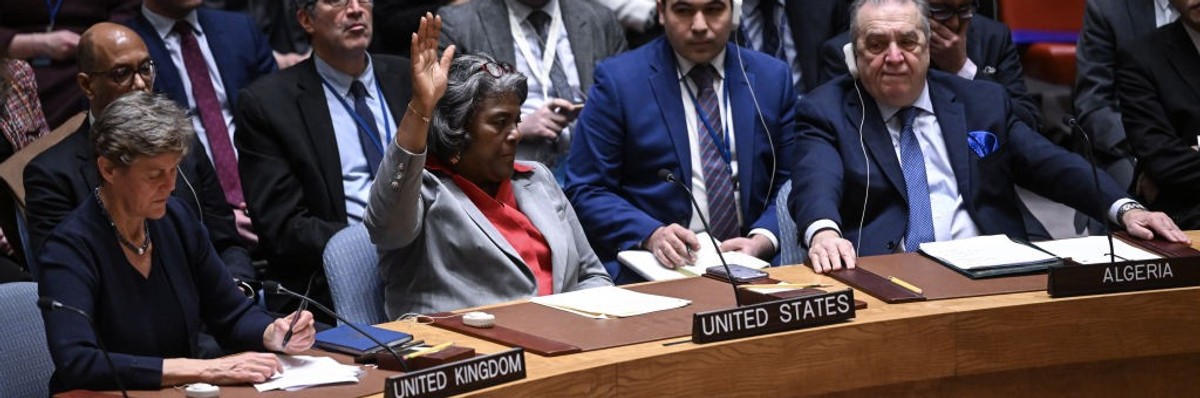
US Ambassador to the United Nations Linda Thomas-Greenfield raises her hand during the UN Security Council meeting which adopted a resolution demanding an immediate cease-fire in Gaza Strip for the month of Ramada on March 25, 2024. As many as 14 countries voted in favor of the resolution, presented by 10 elected members of the Council, while the US abstained from voting. (Photo by Fatih Aktas/Anadolu via Getty Images
Despite weaknesses and false U.S. claims that the resolution is nonbinding, it demands an end to the bombing and a massive influx of humanitarian aid. And that means the possibility of saving lives.
Five and half months into Israel’s genocidal assault on Gaza with more than 32,000 Palestinians already killed, six weeks after the International Court of Justice found Israel plausibly committing genocide and ordered it to stop, and after four earlier tries, the UN Security Council on Monday finally passed a resolution submitted by all ten elected members aiming to stop the slaughter. The resolution has lots of weaknesses and shows the effects of U.S. pressure—but it demands an end to the bombing and a massive influx of food and medicine. And that means the possibility of saving lives.
The resolution demanded an immediate ceasefire leading to a lasting and sustainable ceasefire, the release of all hostages, and compliance with international law in treatment of all those detained. The Council also demanded “the lifting of all barriers to the provision of humanitarian assistance at scale,” reminding the world of the need for massive expansion of that aid and for protection of Palestinian civilians across the entire Gaza Strip.
The resolution’s passage was uncertain until the very last moment. An hour before the vote, U.S. diplomats won a final concession—replacing the original demand for a “permanent” ceasefire” to the squishier, less clear “lasting.” And there are significant other weaknesses in the resolution.
When U.S. Ambassador Linda Thomas-Greenfield claimed that the Council vote was “nonbinding,” she was setting the stage for the U.S. government to violate the UN Charter by refusing to be bound by the resolution’s terms.
The most important flaw in the Council’s text is that it calls for a ceasefire only “for the month of Ramadan.” This most important of Muslim holidays began on March 11, so the demand for a ceasefire is only for about two weeks. And while it does demand that the immediate halt lead to a lasting ceasefire, two weeks is still a much too-short time.
Other problems reflect deliberate obfuscation of language. The demand that all parties treat “all persons they detain” in compliance with international law clearly refers to the thousands of Palestinian detainees Israel is holding, many in administration detention without even the pretense of legitimate legal procedures, whom international law requires to be immediately released. Their detention violates a host of those laws, but by not naming them directly, diplomatic wrangling always threatens to deny them their rights.
And in the paragraph focusing on the catastrophic humanitarian situation across Gaza, the Council’s demand for “lifting all barriers to provision of humanitarian aid at scale” should be a clear and straightforward message to Israel that it must open the gates, end its rejection of goods on the spurious grounds of potential “dual use,” replace its deliberately complex and time-consuming inspection processes and more. But that reference to “lifting all barriers” is hidden in a long sentence within a reference to an earlier resolution. The first part of the sentence merely “emphasizes” the need for more humanitarian aid and protection for Palestinian civilians. And in UN diplo-speak, especially in the Security Council that actually has the right to enforce its resolutions, “emphasizing” something ain’t even close to “demanding” that it happen.
Israel was still not pleased, of course. Prime Minister Benjamin Netanyahu immediately announced his delegation, expected in Washington tomorrow to discuss Tel Aviv’s planned escalation against Rafah, will stay home instead.
But even if the resolution is not all it should be, its passage (14 in favor, the U.S. abstained) still represents a powerful global rejection of the U.S.-backed Israeli assault against Palestinians in Gaza, and an important expression of support for the South African-led intervention at the International Court of Justice designed to prevent or stop Israeli genocide and to hold Israel accountable for its crimes. Importantly, and despite U.S. Ambassador Linda Thomas-Greenfield’s false claim following the vote, all decisions of the Council, as stated in Article 25 of the UN Charter, are binding on Member States.
That puts a big obligation on the U.S. and global movements for ceasefire, massive escalation of humanitarian aid, and resumption of funding UNRWA. Left to its own devices, the Council will almost never move to enforce its own decisions. That responsibility, that obligation, lies with our movements—and, in the UN context, with the General Assembly. The legacy of the South Africa anti-apartheid movement, especially through the 1970s and 80s, and into the early 1990s, shows that model. The U.S. and Britain over and over again vetoed resolutions in the Security Council for sanctions against apartheid South Africa. Over and over again the General Assembly passed the resolutions—for banking, trade, and other sanctions, for arms embargoes and much more. Eventually, public pressure against Washington and London forced a pull-back, and eventually, reluctantly and grudgingly, those governments gave in, stopped vetoing the Council resolutions and started abiding by the calls of the Assembly. It all played a huge role in ending South African apartheid.
Left to its own devices, the Council will almost never move to enforce its own decisions. That responsibility, that obligation, lies with our movements—and, in the UN context, with the General Assembly.
When U.S. Ambassador Linda Thomas-Greenfield claimed that the Council vote was “nonbinding,” she was setting the stage for the U.S. government to violate the UN Charter by refusing to be bound by the resolution’s terms. But enforcement of Council decisions can take shape in many forms—protest movements around the world can demand their governments move to pressure Israel to abide by the Council’s demands. The General Assembly can urge Member States to impose some of those same sanctions it used so successfully against apartheid South Africa. Maybe the Assembly and global movements together can escalate the call urging boycotts of Israeli products, divestment from companies profiting from Israel’s occupation or apartheid, and sanctions on banking transactions or trade, and the imposition of arms embargoes.
First things, of course, an immediate ceasefire, release of hostages and Palestinian detainees, and a flood of emergency humanitarian aid. Then maybe, just maybe, we’ll see this Security Council resolution lead to the United Nations joining the global BDS movement. It’s never too late.
Phyllis Bennis is a fellow of the Institute for Policy Studies and serves on the national board of Jewish Voice for Peace. Her most recent book is the 7th updated edition of “Understanding the Palestinian-Israeli Conflict: A Primer” (2018). Her other books include: “Understanding the US-Iran Crisis: A Primer” (2008) and “Challenging Empire: How People, Governments, and the UN Defy US Power” (2005).
Carla Denyer is the co-leader of the Green Party in England and Wales (Image: BristolLive)
Bristol Green Party candidate Carla Denyer is demanding the UK scale up action against the Israeli government over the Gaza conflict. The Greens are calling for an end to all arms sales to Israel, prosecutions of war criminals and sanctions on Israel’s leaders.
The Green Party co-leader, who will stand in Bristol Central, has called for the UK to suspend arms export licences to Israel and to take measures such as excluding Israel from music and sporting events.
Ms Denyer said: “It is clear that the Israeli government is refusing to heed warnings about the catastrophic implications of an all-out attack on Rafah. The UK government must now demand that Israel stop the killing, calling for an immediate ceasefire. Hamas must also agree to this ceasefire of course, and release all hostages.
“Decisions made by the UK government – above all its failure, month after month, to call for an immediate ceasefire – have made them complicit in the killing of almost 28,000 people to date, 12,000 of whom are children.
“Israel relies on certain weapon parts manufactured in the UK, including the F-35 Joint Strike Fighter whose essential components are made here. A Dutch court has ordered the state to cease the export of F-35 spare parts to Israel. We call on the UK government to follow suit.
“Greens would implement the requirements of the Boycott, Divestment and Sanctions campaign across the UK economy. This would include excluding Israel from international sporting and music events.
“It is clear that only outside pressure will make Israel stop its mass killing. We can increase the pressure on Israeli leaders by introducing targeted sanctions against key individuals. This would include travel bans and asset freezes on Israel’s leadership and cabinet members, in particular those calling for new settlements in Gaza and the annexation of the West Bank.
“Finally, we would encourage UK authorities including the Metropolitan Police and director of public prosecutions to pursue perpetrators of war crimes committed where UK citizens are the victims or where UK citizens are potential perpetrators.
Health activists continue to rally in solidarity with health workers in Palestine, who are being killed, targeted, and threatened by Israeli Occupying Forces
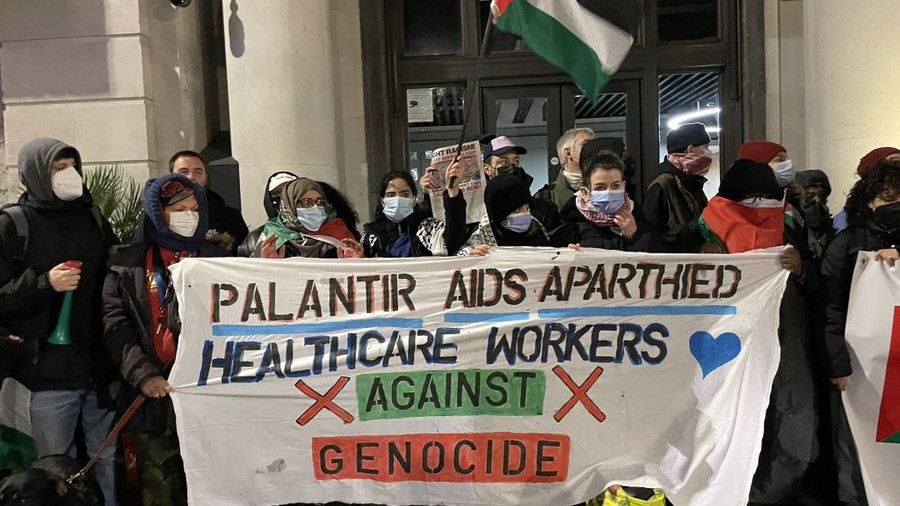
Health activists in the UK organize a mass picket line in front of the office of Palantir. Photo: PHM UK
“There is a real danger that when world leaders return from their Christmas holidays, there will be no health system left in Gaza,” warned Melanie Ward, CEO of Medical Aid for Palestinians (MAP). During the last 75 days, Israeli attacks have decimated the health infrastructure in the Gaza Strip, leaving 2.2 million without access to essential care.
According to the World Health Organization (WHO), there are no fully operational hospitals in this part of occupied Palestine left, and those still providing care are hanging by a very thin thread. MAP also reported that over the past 10 weeks of Israeli attacks, more health workers were killed than in any conflict since 2016. The official estimation of the number of health workers’ deaths puts the toll at over 300, and many more have been taken away by Israeli Occupying Forces (IOF) during raids in hospitals and health centers.
In a recent briefing organized by No Cold War and the People’s Health Movement (PHM), Mustafa Barghouti from the Palestinian Legislative Council recounted only a shred of their experience based on testimonies given by a recently released first respondent. The health worker told Barghouti and his comrades that approximately 1,000 people were held in a concentration camp in the Negev desert, where they were subjected to torture and inhuman conditions.
The health worker described how they were taken to the camp on trucks, after having been forced to strip naked, and were then beaten and exposed to waterboarding and electrical shocks. The director of Al-Shifa Hospital, Muhammad Abu Salmiya, was reportedly held in the same camp as the first-aid worker whose story Barghouti referred to and was said to be in very bad condition.
In addition to the health workers who have been arrested, the status of many more remains unknown, including Ahmed Muhanna, the director of Al-Awda Hospital in Jabalya.
The targeted detainment and kidnapping of health workers should be taken as a sign that Israel is preparing the ground for staged trials “aimed at maintaining the criminalization of the health system in Gaza,” according to Ghassan Abu Sitta, a plastic and reconstructive surgeon who has been reporting on the situation in Gaza since the beginning of the October 7 attacks.
An indication that this might already be going on was an announcement published by Israel’s security services, saying that Ahmed Al-Kahlout, director of Kamal Adwan Hospital, had confirmed the use of the hospital infrastructure by Hamas. Following the announcement, however, the Gaza Ministry of Health pointed out that the statement is extremely likely to have been extracted at gunpoint – either literally or through threats to Al-Kahlout’s life and family.
Considering the testimonies from the prisons and camps where the IOF keeps health workers and other prisoners, it is not difficult to imagine how this could have played out. Only days before, Hani Al-Haitham, the head of Al-Shifa Hospital’s emergency services, was killed in a targeted attack, along with his wife, physician Sameera Ghifari, and their five children.
“Over the past two months, he served fearlessly, among the last doctors out of Shifa as Israel besieged it. He miraculously escaped arrest as he left, which may be why he was assassinated with his family,” his friends wrote on social media.
While the attacks on health care in Gaza continue, the Global North remains complicit in Israel’s actions. The current war on Gaza is not simply an Israeli war, said Mustafa Barghouti, but is also a war in which the United States and the United Kingdom bear direct responsibility. In order to put an end to it, it is necessary to apply pressure on the governments of these countries as well.
This is something that Boycott, Divestment, Sanctions (BDS) groups in Europe have been steadily working on over the past weeks. Reflecting on their actions, Fiona Ben Chekroun from the Palestinian BDS National Committee stressed that efforts in Europe and the rest of the Global North are now aiming primarily to expose the West’s complicity in the current war on Gaza and ensuring that Israel’s impunity does not last.
Following a similar line of action, health workers in the UK organized a mass picket line in front of the local headquarters of Palantir, a US-based company that specializes in data analytics and surveillance, on December 21. Palantir, which expressed its support for Israel on multiple occasions since the beginning of the latest round of attacks against Gaza, has been awarded a contract for data management by NHS England. The health workers demanded that the contract be annulled and that companies complicit in the ongoing genocide in Gaza are not awarded for their support to the occupation.
At this point, Barghouti said during the briefing, it is essential that the pressure on Israel and on complicit governments does not wind down. “Don’t let the pressure down,” he said. “Reactivate all the solidarity movements and keep them going, especially in countries like Austria, Sweden, the Netherlands.”
People’s Health Dispatchis a fortnightly bulletin published by thePeople’s Health Movementand Peoples Dispatch. For more articles and subscription to People’s Health Dispatch, clickhere.