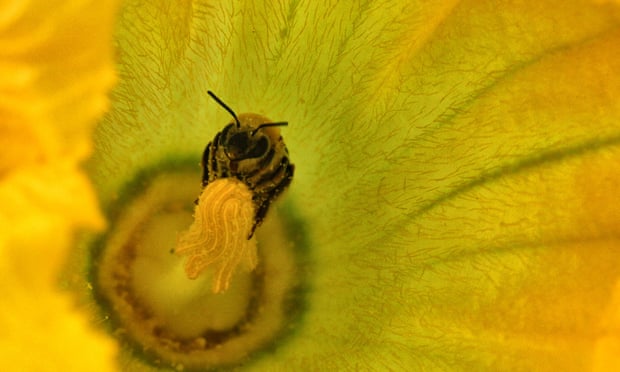
The pesticide Cruiser SB has the potential to kill off populations of bees. Photograph: Creative Touch Imaging Ltd/NurPhoto/Rex/Shutterstock
Emergency use of Cruiser SB, a neonicotinoid pesticide highly toxic to bees, to be outlawed in UK in line with EU
Bee-killing pesticides have been banned for emergency use in the UK for the first time in five years after the government rejected an application from the National Farmers’ Union and British Sugar.
The neonicotinoid pesticide Cruiser SB, which is used on sugar beet, is highly toxic to bees and has the potential to kill off populations of the insect. It is banned in the EU but the UK has provisionally agreed to its emergency use every year since leaving the bloc. It combats a plant disease known as virus yellows by killing the aphid that spreads it.
Prof Dave Goulson, a bee expert at the University of Sussex, has warned that one teaspoon of the chemical is enough to kill 1.25bn honeybees. Even at non-fatal doses it can cause cognitive problems that make it hard for bees to forage for nectar and the chemicals can stay in the soil for years.
The previous Conservative government repeatedly agreed to its use against the advice of the Health and Safety Executive (HSE) and the Expert Committee on Pesticides.
This year, ministers say they are refusing the application based on “robust assessments of environmental, health and economic risks and benefits, and advice from Defra’s chief scientific adviser, its economists, the Health and Safety Executive and the UK Expert Committee on Pesticides”.
A petition signed by more than 1.6 million people urging the government to enforce a total ban on bee-killing neonicotinoid pesticides has been handed in to the Department of Environment, Farming and Rural Affairs (Defra) by environmental campaigners [1].
The petition, which was coordinated by Greenpeace UK, has amassed a staggering 1,645,000 signatures from the British public and was delivered directly to Defra for the environment minister, Emma Hardy. It was delivered in the form of a bee hotel by campaigners dressed in ‘worker’ bee outfits carrying placards reading, ‘Pesticides Buzz Off’, ‘Protect Our Bees’ and ‘Bee Safe’. They were joined by Siân Berry, Green Party MP for Brighton Pavilion, who is a supporter of the campaign.
Separately, 15 leading climate and nature charities – including Pesticide Action Network, RSPB, Wildlife Trusts and Greenpeace – have written to the environment minister, calling for an end to the emergency authorisation of neonicotinoids on sugar beet crops [2].
In the letter they state: “By not allowing another emergency use of neonicotinoids, there will be more incentive for British Sugar and the government to fund research into alternatives, and to adopt nature-friendly farming approaches including Integrated Pest Management (IPM).”
Greenpeace UK’s campaigner, Anthony Lewis, said: “Using neonicotinoids to ‘protect’ crops is like setting fire to your house to protect it from burglars. Yes, it will destroy pests, but it will also kill bees and other vital pollinators we depend on for the food we’re trying to grow. It’s absurd.
“Bee populations have been decimated over recent years, with the use of neonicotinoids one of the drivers of this decline. As leading environmental charities and experts on nature protection, along with 1.6 million members of the public, we implore the government to implement a full and final ban on the use of all bee-killing pesticides once and for all.”
Bees are essential for our survival – pollinating much of our food and playing a critical role in sustaining ecosystems around the world. However, wild bee populations have fallen by a third, with the use of pesticides on farms a key contributor to their rapid decline.
The use of neonicotinoids, which are particularly lethal to bees and other vital pollinators, was outlawed across Europe in 2018. However, despite the ban, the previous UK government approved the ‘emergency’ authorisation of these deadly chemicals for four years in a row, against the scientific advice of the government’s own Expert Committee on Pesticides.
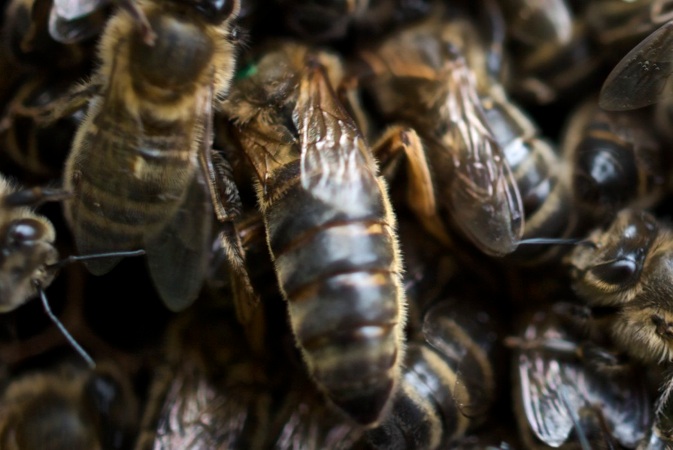
Black bees
During its election campaign, the Labour Party made a commitment to end these exemptions for bee-killing pesticides and the government announced last month that it was drawing up plans to outlaw the use of some neonicotinoids. However, whatever the proposals being brought forward in future, another ‘emergency’ derogation could be allowed. A decision on whether to grant this emergency authorisation again this year is expected imminently.
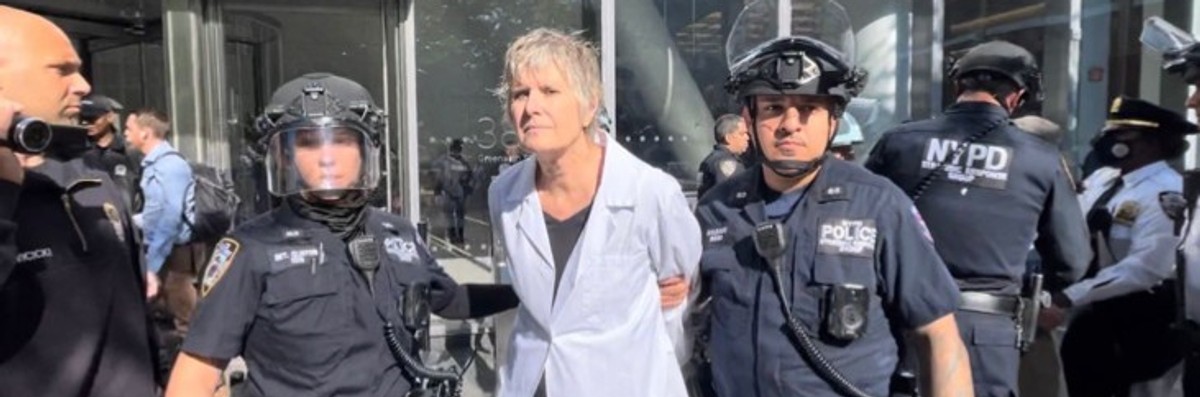
Scientist Sandra Steingraber is arrested outside Citigroup’s New York City headquarters on June 12, 2024. (Photo: Alec Connon)
I am here today to say to Citi that if you won’t listen to the data of scientists, you will need to listen to the bodies of scientists blocking your doors.
Editor’s note: The following is a speech read by Sandra Steingraber before being arrested outside Citigroup’s New York City headquarters on June 12, 2024.
My name is Sandra Steingraber. I have a PhD in biology, and I’ve worked as a scientist my whole adult life.
Here are two things biologists are worried about.
The first thing is happening in the ocean. When fossil fuels are burned and CO2 fills the atmosphere, some of it falls into the sea.
When carbon dioxide touches water, it turns into carbonic acid: H2CO3.
Acid makes calcium carbonate (CaCO3) dissolve. Seashells are made of calcium carbonate. So fossil fuels are turning our oceans into pits of acid, and animals made of shells are starting to dissolve.
I did not become a biologist to write eulogies for the species I study.
All together, the babies of animals with shells are called zooplankton.
Zooplankton are the basis of the marine food chain.
If you dissolve their parents, zooplankton disappear—along with the fish who eat them.
One half of the world’s human population depends on fish for protein. The pH of the oceans is now on track to crash the world’s fish stocks. As a biologist I worry about that.
Now let’s go on land and look at bees. Bumblebees also have babies, and they need to stay cool. So adult bees beat their wings like a thousand little ceiling fans to cool the bee nursery. But they can’t keep up due to more intense heatwaves. Baby bees are dying. Populations are crashing.
Bees help plants have sex. Bees turn flowers into fruits, nuts, vegetables. One-third of the food we eat is made for us by bees. And they do it for free. It’s called an ecosystem service.
If we lose the bees, crops fail. This is how the ecological crisis becomes a human rights crisis. Biologists are worried about this
I have studied climate change since 1982. I’ve testified. I’ve sent letters to the White House. I’ve met with the science adviser. I went to the Paris climate talks. But CO2 levels just reached a new high, and Citigroup is financing the arsonists.
Citi has poured $396 billion dollars into the fossil fuel industry just since 2016.
So, I am here today to say to Citi that if you won’t listen to the data of scientists, you will need to listen to the bodies of scientists blocking your doors. Today my body is a data point. And all together, all these data points on this blockade line make a trend. The trend is that when extinction rates accelerate, scientists get louder.
My message to Citi CEO Jane Fraser: I did not become a biologist to write eulogies for the species I study. I am morally obligated to use my knowledge to defend life against extinction and oppose those who finance it.
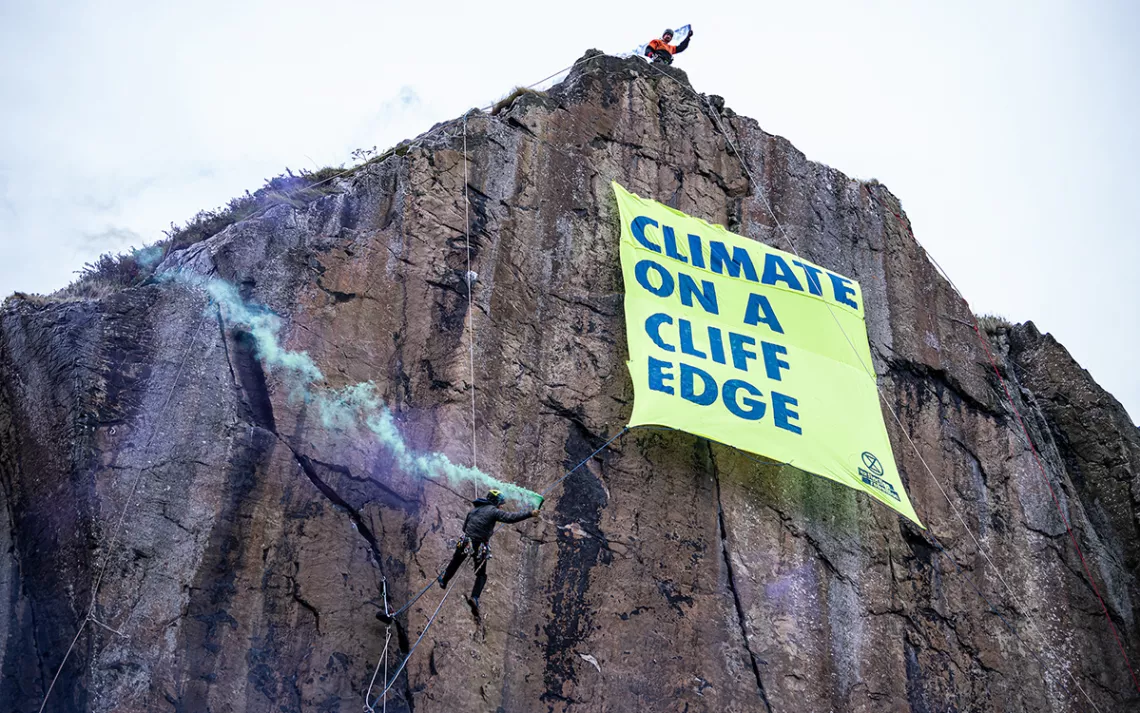
Experienced climbers scale a rock face near the historic Dumbarton castle in Glasgow, releasing a banner that reads “Climate on a Cliff Edge.” One activist, dressed as a globe, symbolically looms near the edge, while another plays the bagpipes on the shores below. | Photo courtesy of Extinction Rebellion and Mark Richards