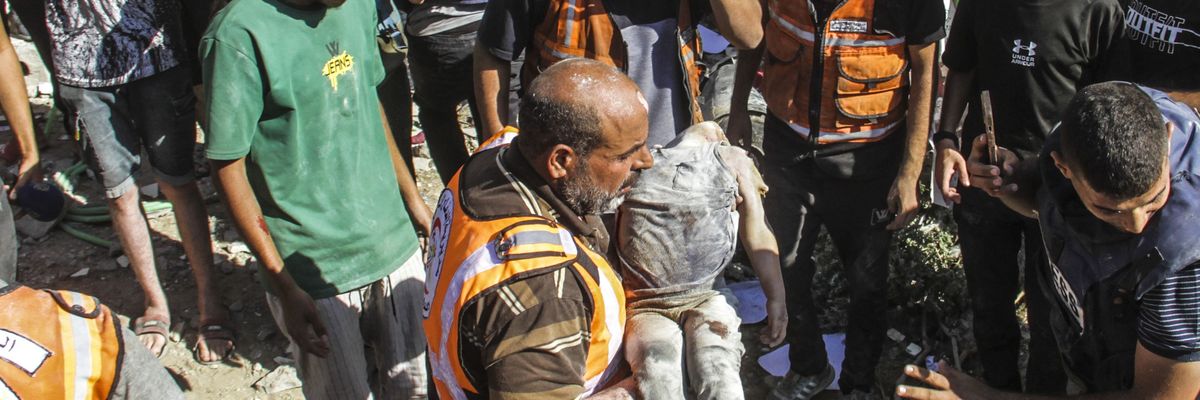
Rescue teams recover the bodies of those killed in an Israeli attack on schools in Gaza City, Gaza on August 4, 2024. (Photo: Mahmoud Issa/Anadolu via Getty Images)
“Remember that each one of those numbers is one person, a child who has been forever changed by what’s happened.”
Israeli forces killed dozens of displaced Palestinians—mostly children—on Sunday with attacks on a pair of United Nations-run schools in the Gaza Strip as diplomats in the region worked to prevent all-out war from breaking out in the aftermath of Israel’s latest assassination spree.
Al Jazeera reported that 80% of the roughly 30 people killed in the Israeli attacks on two schools in Gaza City were children. The strikes came shortly after Israel’s military bombed a hospital complex in central Gaza, killing at least five people.
“This is beyond horror now,” David Shoebridge, an Australian senator, wrote in response to the attacks on schools-turned-shelters.
Tareq Abu Azzoum of Al Jazeera noted that rescue teams were still searching the rubble of the two schools for survivors on Monday.
“At least 16 Palestinians are still missing, including children, under the remnants of these areas that were targeted by Israel without any prior warning,” Azzoum wrote. “Civil defense crews have been using only their bare hands in order to look for survivors. They have been saying that sometimes the process for recovering and pulling out victims can take days simply because there isn’t enough fuel to operate the vast majority of bulldozers, and due to the Israeli attacks on bulldozers at the municipal facilities, used in the initial months of the war to rescue victims.”
https://twitter.com/i/status/1820104591565795824
Israel’s monthslong war on the Gaza Strip has devastated the territory’s children, killing more than 14,000, wounding more than 12,000, and leaving over 20,000 missing. The physical toll has been compounded by what one Gaza mother recently described as the “complete psychological destruction” of the enclave’s youth.
Becky Platt, a British pediatric nurse who recently returned from Gaza after a stint at a field hospital there, wrote Monday that “the psychological distress that I witnessed among children and young people is like nothing I’d ever seen before.”
“It’s very easy to be overwhelmed by the numbers when we watch the news or read about what’s happening in Gaza,” Platt continued. “Remember that each one of those numbers is one person, a child who has been forever changed by what’s happened. Then multiply that one child by thousands. That’s the work that needs to be done.”
Israel’s attacks came after a round of cease-fire talks in Cairo concluded without a deal to end the assault on Gaza. Critics, including some Israeli officials, believe Israeli Prime Minister Benjamin Netanyahu is actively sabotaging cease-fire talks in a bid to remain in power.
Axios reported Sunday that “Israeli officials and families of hostages are concerned Netanyahu, who recently toughened his demands and presented new conditions for a hostage and cease-fire deal, sent the delegation [to Cairo] only to create an appearance of negotiations to relieve some of the pressure from” U.S. President Joe Biden, who has called for a cease-fire while continuing to provide military support for the war on Gaza.
“Hamas rejected Netanyahu’s new conditions, which include forming an international mechanism to prevent weapons transfers from southern Gaza to the north,” according to Axios. “Israeli officials say this and other new demands are making a deal impossible.”
Meanwhile, diplomats are trying to prevent the region from descending into full-scale military conflict following Israel’s assassination of a Hezbollah commander and Hamas’ political leader.
Late last week, the Pentagon announced it would “deploy additional fighter jets and Navy warships to the Middle East” as lawmakers and anti-war campaigners warned of deepening U.S. involvement in the regional war.
“Americans do not want to fight another war in the Middle East,” Jamal Abdi, president of the National Iranian American Council, said last week, “and the path out of the unimaginable death and destruction in Gaza that threatens to engulf the region is through a cease-fire.”
“This is what fascism and the desire for mass extermination and displacement look like,” a Palestinian-American expert said. “These criminals want to eliminate all Palestinians in Gaza, not just Hamas.”
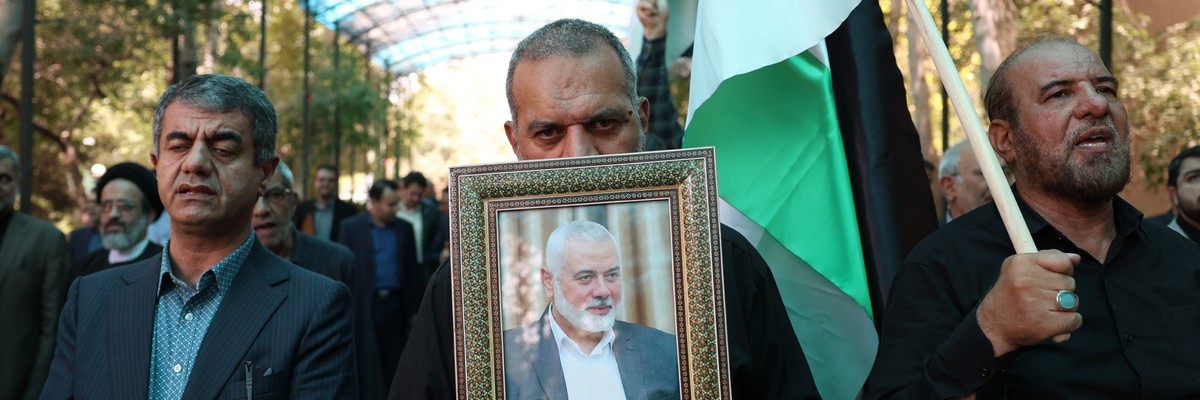
People hold up a portrait of assassinated Hamas political chief Ismail Haniyeh in Tehran, Iran on July 31, 2024. (Photo: AFP via Getty Images)
“Netanyahu isn’t playing chicken, he wants to crash the car,” said one observer.
The political leader of Hamas was assassinated early Wednesday in what the group said was an Israeli attack on his residence in the Iranian capital of Tehran, which he was visiting to attend the inauguration of the country’s newly elected president.
The killing of Ismail Haniyeh, who became the head of Hamas’ political arm in 2017, sparked warnings that Israeli Prime Minister Benjamin Netanyahu is doing all he can to undermine cease-fire talks with the Palestinian group after they showed signs of progress in recent weeks.
“Netanyahu has systematically sabotaged cease-fire talks because ending the war will likely end his political career,” Trita Parsi, executive vice president of the Quincy Institute for Responsible Statecraft, said following the assassination of Haniyeh, a key figure in the negotiations.
“The assassination buys Netanyahu several weeks, if not months, in which there will be no serious expectation of a cease-fire deal,” Parsi argued. “Thus, the war will continue, as will Netanyahu’s reign as prime minister.”
Haniyeh’s killing prompted fury from Iran, whose supreme leader vowed a “harsh response”—heightening the chances of a long-feared all-out war between Israel and Iran. Earlier this year, Israel killed several Iranian commanders in a strike on Tehran’s consulate in Syria’s capital, prompting Iran to retaliate with a drone attack.
Iranian lawmakers are expected to hold an emergency meeting about Haniyeh’s assassination later Wednesday. As of this writing, the Israel Defense Forces (IDF) has yet to comment on the killing.
The International Criminal Court’s (ICC) top prosecutor, Karim Khan, was seeking an arrest warrant against Haniyeh for war crimes committed on October 7. Khan has also applied for an arrest warrant against Netanyahu and Israeli Defense Minister Yoav Gallant.
“How can mediation succeed when one party assassinates the negotiator on the other side?”
The suspected Israeli strike in Tehran on Wednesday was launched just hours after Israel’s military bombed the Lebanese capital of Beirut, killing several people—including two children—in retaliation for a deadly attack on the occupied Golan Heights. Israel claimed its attack on Beirut killed Hezbollah commander Fouad Shukur, but subsequent reporting suggested he may have survived the strike.
News of Haniyeh’s assassination in Tehran came days after top officials from Israel, Egypt, Qatar, and the United States met in Rome over the weekend to continue negotiating a possible deal to end Israel’s assault on the Gaza Strip.
The New York Times reported that “despite progress in recent weeks, the monthslong negotiations remain stalled over several critical issues, particularly the extent to which Israeli forces would remain in Gaza during a truce.”
“Earlier in July, Israel hardened its position on maintaining checkpoints along a strategic highway south of Gaza City, weeks after suggesting that it could compromise,” the Times added. “It was unclear on Sunday if Mr. Netanyahu had allowed negotiators to show greater flexibility on the matter during the talks. Mr. Netanyahu faces pressure from members of his right-wing government to stick to a tougher line. The length of the truce is also a source of dispute: Hamas wants a permanent truce, while Israel wants the option to resume fighting.”
Egypt said Haniyeh’s killing is a signal from Israel that it lacks “political will for deescalation,” according toAl Jazeera.
Qatar’s prime minister, meanwhile, wrote on social media: “Political assassinations and continued targeting of civilians in Gaza while talks continue leads us to ask, how can mediation succeed when one party assassinates the negotiator on the other side?”
Jamal Abdi, president of the National Iranian American Council, warned that with the assassination of Haniyeh, “Netanyahu isn’t playing chicken, he wants to crash the car.”
U.S. Secretary of State Antony Blinken said Wednesday that the United States was “not aware of or involved in” the assassination of Haniyeh.
Belén Fernández, a contributing editor at Jacobin, wrote in an op-ed for Al Jazeera that “Israel made its intention to continue and expand the war clear” by killing Haniyeh.
“By assassinating Haniyeh in Tehran, Israel is literally playing with fire,” Fernández wrote. “In order to derail cease-fire prospects and keep up the killing in Gaza, then, it seems Israel is going to end up with a whole lot more regional blood on its hands.”
This story has been updated to include new comment from U.S. Secretary of State Antony Blinken.
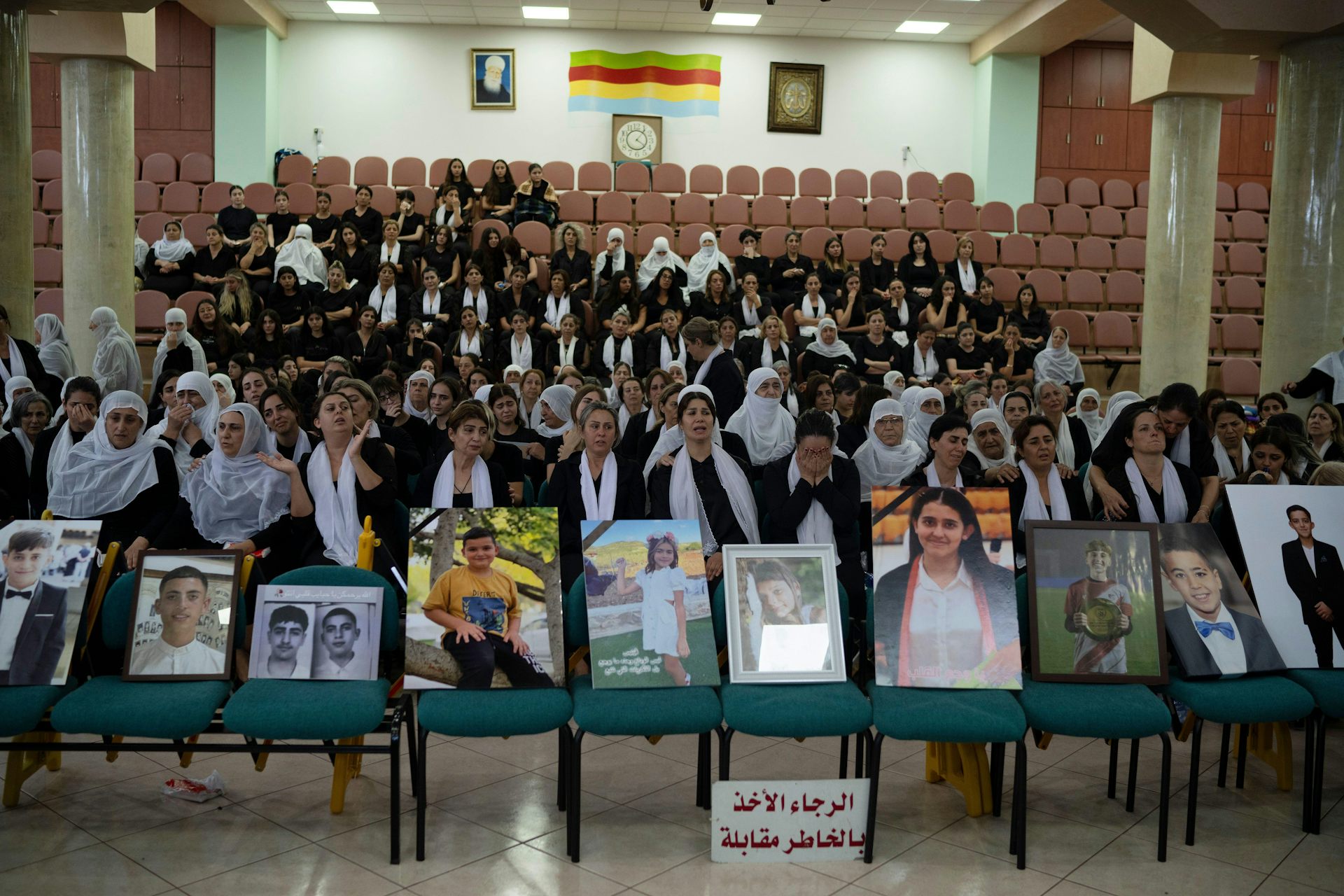
Israel’s prime minister, Benjamin Netanyahu, has threatened a harsh response to a rocket attack that on July 27 struck the Israeli-occupied Syrian Golan Heights, killing 12 children and injuring about 30 more.
Visiting the small town of Majdal Shams, where the children had been playing football when the strike occurred, Netanyahu blamed Hezbollah for the attack and said it would pay a “hefty price”. He said: “Our response will come, and it will be harsh.”
While Israel is claiming the attack targeted their citizens, all the victims of the strike were members of the Druze religious minority group located across Israel, Lebanon and Syria. Hezbollah has denied responsibility for the attack, but without an independent investigation, it remains unclear who fired the rocket.
The Golan Heights, a rocky 1,000 square kilometre region south-west of Damascus, was occupied by Israel after the 1967 Arab-Israeli war in a move that, half a century on, is often referred to as the “forgotten occupation”.
After defeating Egypt, Jordan, and Syria in the short conflict, Israel occupied the West Bank, Gaza and East Jerusalem as well as the Sinai desert and two-thirds of the Syrian Golan. Around 127,000 indigenous Syrians (95% of the population) – including Christians, Muslims and Druze – fled or were forcibly displaced. Depopulated villages were razed to the ground.
Later in 1981, Israel illegally annexed the territory, passing the Golan Heights Law. The UN security council immediately condemned this as illegal and passed resolution 497 (1981) calling on Israel to rescind its action, which would have “serious consequences for peace and security in the Middle East”.
Israel’s annexation of the Golan Heights was not recognised internationally until 2019 when the then US president Donald Trump released a “Proclamation on Recognizing the Golan Heights as Part of the State of Israel”.
Israel views its control over the Golan Heights as crucial to its security, as the region shares a border with Israel, Jordan and Lebanon. There is a buffer zone between the Israeli-occupied area of the Golan Heights and Syria, which is administered by the United Nations Disengagement Observer Force (Undof). The Golan gives whoever controls the land a vantage point overlooking Syria, which has never given up on its claim over the land.
Forgotten people
But what of the indigenous people of the Golan? Roughly 20,000 Druze people now remain, members of an Arab sect which is an offshoot of Islam that allows no intermarriage or joining from outside the religion. There are about 150,000 Druze in Israel and about 1 million across the Middle East. Druze men with Israeli citizenship are subject to military service.
Historically, Golanis have resisted the occupation via non-violent means, drawing on Druze religious beliefs, secular political ideas and the continuing assertion of their Syrian identity. The main industry in the region is agriculture and the area is known for its production of apples, cherries and olive oil.
Golanis in Majdal Shams participating in peaceful demonstration in solidarity with Palestinians. Al-Marsad
Resistance
In the years before annexation of the Golan, Israel attempted to introduce Israeli identity cards for the population. But this was rejected by Syrian communities in the Golan, who issued a wathiqa wataniya (Syrian national document), which asserted their Syrian-Arab national identity and connection to the land and opposed the annexation of the Golan.
The annexation also triggered what became known as the aldrab alkabir (great strike) that began in the February of 1982 and lasted almost six months. All segments of Golani society took part in demonstrations, discarded their Israeli ID cards and refused to pay taxes or participate in Israeli land surveys. The aim was to resist the imposition of Israeli citizenship and assert their Syrian identity.
Israel responded by placing curfews on the Druze villages, setting up blockades and restricting goods from entering, including milk and baby food. Some residents were arrested, including women who played a central role in the strike.
The Golani community responded to these restrictions by sharing resources and offering free services to one another. Palestinians also mobilised in support of Golanis by taking part in demonstrations and solidarity visits to the Golan.
This non-violent action was successful in achieving its primary aim and to this day around 80% of Golani Druze have rejected citizenship. They identify as Syrian and, unlike the Druze living in Israel, do not serve in the Israeli military.
This does mean that they are “stateless” (though not landless like many stateless people) and instead of passports they hold “laissez passer” travel documents that state their nationality is “undefined”. Without Israeli citizenship they are not allowed to vote, though they can attend Israeli educational institutions.
Meanwhile there are also an estimated 25,000 Jewish-Israelis living in the Golan Heights, across more than 30 settlements, considered illegal under international law. They are supported by the Israeli military and now together control 95% of the Golan, including much of its agriculture and industries.
Fear of escalation
There are now fears in the region that an Israeli retaliation against Hezbollah could significantly escalate the conflict. I’ve been working with local partners in the Golan Heights on a research project about Golani youth and human rights.
I spoke with a colleague in Majdal Shams this week. She told me that the people of the Golan “don’t want any other mother to scream and cry”. She said: “The Golani people are and have always been a peaceful people. Our message would be, ‘Stop the killing.’”
The 12 children were killed while playing football. Let that sink in. Then remember that it should not take their deaths to bring this forgotten occupation and these people who are forced to live under a foreign power to the world’s attention.
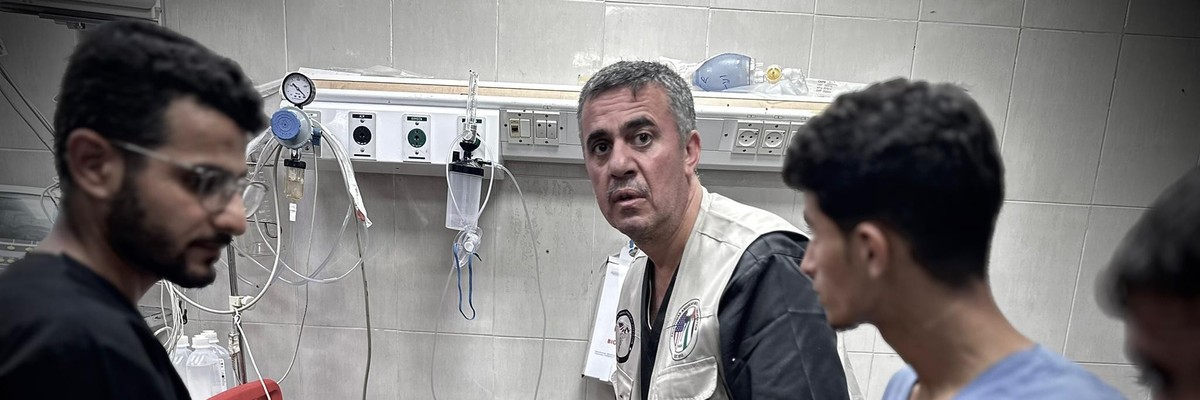
Palestinians wounded by Israeli attacks are brought to Nasser Hospital for medical treatment in Khan Younis, Gaza on July 22, 2024. (Photo: Doaa Albaz/Anadolu via Getty Images)
“Every day that we continue supplying weapons and munitions to Israel is another day that women are shredded by our bombs and children are murdered with our bullets.”
As President Joe Biden and Vice President Kamala Harris met with Israeli Prime Minister Benjamin Netanyahu at the White House on Thursday, dozens of American healthcare workers who recently volunteered in the Gaza Strip urged the U.S. leaders to do everything in their power to end Israel’s assault on the enclave, citing the horrors they witnessed firsthand.
In an open letter addressed to Biden, Harris, and First Lady Jill Biden, 45 physicians, surgeons, and nurses wrote that “we wish you could see the nightmares that plague so many of us since we have returned: dreams of children maimed and mutilated by our weapons, and their inconsolable mothers begging us to save them.”
“We wish you could hear the cries and screams our consciences will not let us forget,” the letter reads. “We cannot believe that anyone would continue arming the country that is deliberately killing these children after seeing what we have seen.”
The healthcare workers called on the Biden administration to “withhold military, economic, and diplomatic support from the state of Israel and to participate in an international arms embargo of both Israel and all Palestinian armed groups until a permanent cease-fire is established, and until good-faith negotiations between Israel and the Palestinians lead to a permanent resolution of the conflict.”
“We are not politicians. We do not claim to have all the answers,” they continued. “We are simply physicians and nurses who cannot remain silent about what we saw in Gaza. Every day that we continue supplying weapons and munitions to Israel is another day that women are shredded by our bombs and children are murdered with our bullets. President Biden and Vice President Harris, we urge you: End this madness now!”
This is an open letter addressed to @POTUS, @VP , and @FLOTUS signed by 45 American physicians and nurses, about what we saw while working in Gaza. Please feel free to distribute. A PDF can be downloaded from the link and/or QR code on page 1. pic.twitter.com/LHVvmeAFad
The letter was released as Netanyahu, fresh off his widely condemned address to the U.S. Congress, met separately on Thursday with Biden and Harris, the presumptive Democratic presidential nominee.
In remarks following her meeting with Netanyahu, Harris said that “what has happened in Gaza over the past nine months is devastating,” pointing to “the images of dead children and desperate, hungry people fleeing for safety, sometimes displaced for the second, third, or fourth time.”
“We cannot look away in the face of these tragedies,” the vice president added. “We cannot allow ourselves to become numb to the suffering. And I will not be silent.”
Harris said she told Netanyahu directly to “get this deal done”—referring to a cease-fire agreement with Hamas—but, as expected, she did not break with the administration on supplying arms to the Israeli military.
While there has been no obvious policy change from the administration now that Harris has taken over for Biden at the top of the Democratic Party’s presidential ticket, Trita Parsi of the Quincy Institute for Responsible Statecraft argued that the vice president “clearly broke with Biden on Israel in terms of rhetoric and tone.”
Parsi also contended that there was “a substance shift.”
“Biden has disingenuously claimed that Hamas blocked a cease-fire deal,” Parsi wrote on social media. “By saying that she urged Netanyahu ‘to clinch the deal,’ Kamala pointed to the real obstacle.”
BREAKING: VP Harris speaks after meeting with Israeli PM Netanyahu
Harris calling for an immediate cease-fire deal to free the hostages.
The VP saying she “will not be silent" about the suffering in Gaza, the "devastating" loss of life and the "dire" humanitarian crisis. pic.twitter.com/Fe5QPoOuFh
In their letter to Harris and Biden, the healthcare workers wrote that Israel “has directly targeted and deliberately devastated Gaza’s entire healthcare system” and “targeted our colleagues in Gaza for death, disappearance, and torture.” According to figures from the United Nations Human Rights Office, Israeli forces have killed one in every 40 healthcare workers in the Palestinian territory since October as diseases spread and the number of Gazans killed or wounded continues to grow by the hour.
The healthcare workers expressed the view that—based on available evidence and their experiences—”the death toll from this conflictis many times higher than what is reported by the Gaza Ministry of Health,” which currently stands at over 39,100.
“We also believe this is probative evidence of widespread violations of American laws governing the use of American weapons abroad, and of international humanitarian law,” they continued. “We cannot forget the scenes of unbearable cruelty directed at women and children that we witnessed ourselves.”
A wanted war criminal addressing US Congress proved to be a pitched battle between the state and tens of thousands of anti-genocide protesters
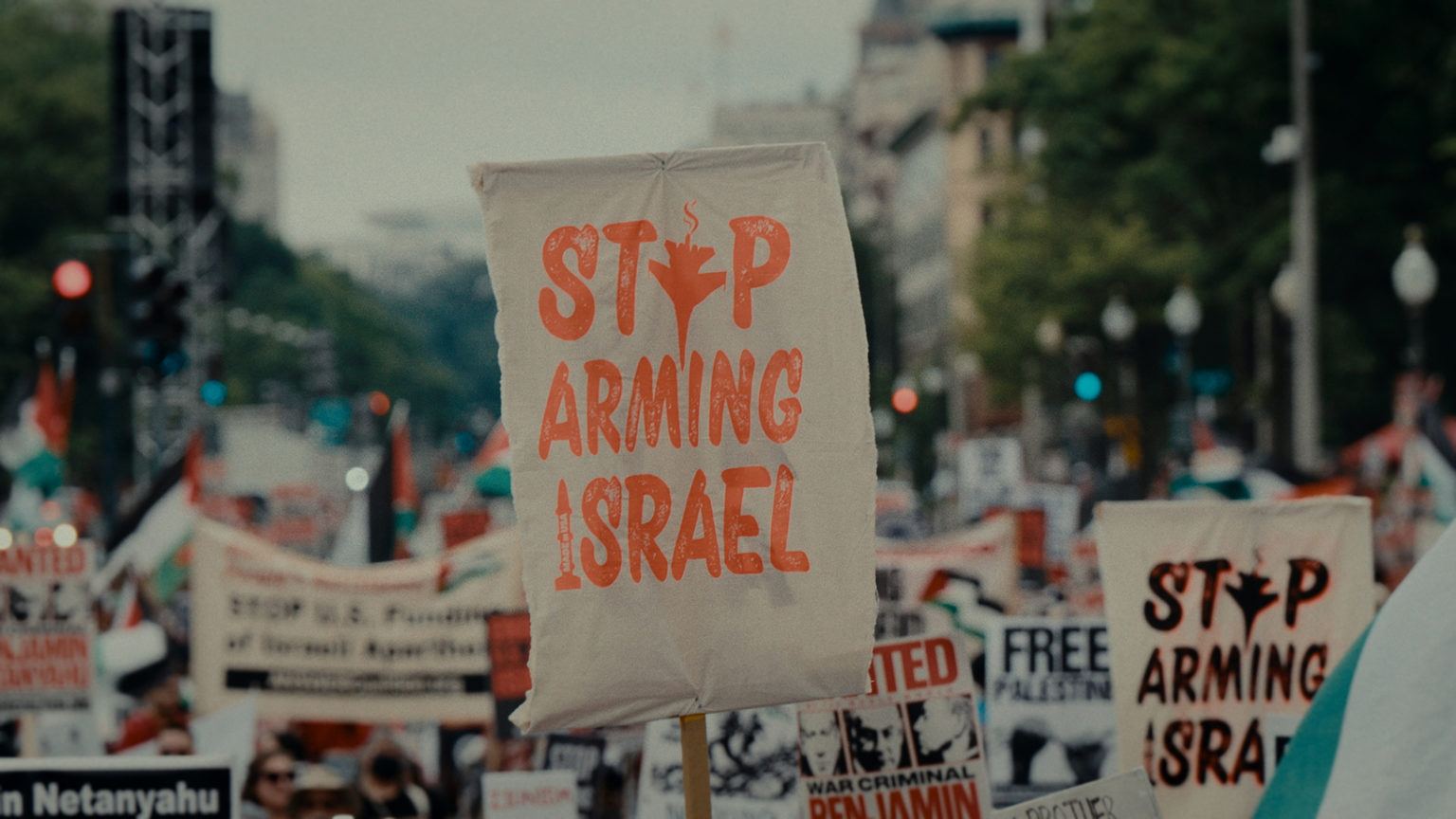
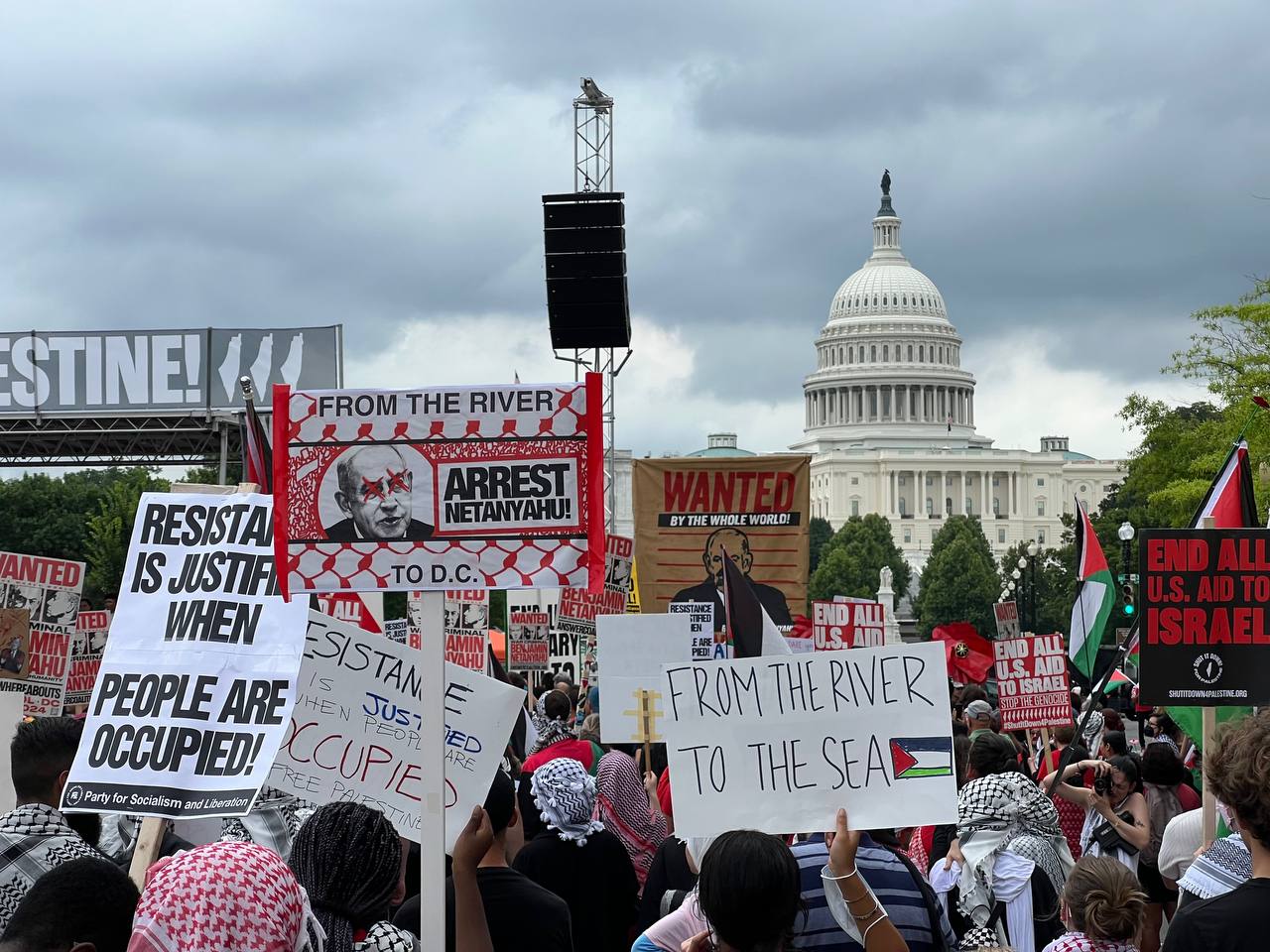
Tens of thousands of people demonstrated in Washington, DC yesterday in opposition to Benjamin Netanyahu’s joint address to Congress. While war criminal Netanyahu received a standing ovation from both chambers of Congress and both major establishment parties, thousands took to the streets directly outside the US Capitol building to register their disgust with the US’s support for and complicity in the genocide of 186,000 Palestinians.
Protesters rally in front of Capitol (Photo: Addison Clapp)
Police forces launched pepper spray at demonstrators and made several arrests, but demonstrators, who came as individuals or part of organizations of the working class such as student groups, labor unions, and tenant organizations, overcame intense police repression in order to assert their right to protest. In doing so, these protesters registered the mass discontent among the people of the United States regarding the US’s bankrolling of Israeli genocide. Recently polling has shown that as many as 61% of people in the US are against sending aid to Israel. Among people under 30, that number jumps to 77%.
The state made drastic preparations to protect Netanyahu’s speech to Congress from demonstrations. Over 200 New York Police Department officers were deployed ahead of protests. The layers of barricades and protections around the Capitol building far exceeded those on January 6, 2021 when far-right demonstrators were able to go as far as scaling the building and entering the offices of the highest-ranking politicians. “Look around the area, there are snow plows, police barricades, eight-foot high fencing,” said Brian Becker, Executive Director of the ANSWER Coalition, one of the key organizers of the demonstration, during the rally preceding the march through Washington. “This US Capitol, which says to itself, we are the people’s house, it should be renamed, it should be called Fort Netanyahu.”
Mass march experiences heavy repression
Police deploy pepper spray (Photo: Jason Bixon)
Following the rally of tens of thousands which convened in front of the Capitol, demonstrators prepared to march. Shortly after the march began, protesters were blocked by a line of police officers from multiple agencies, including DC police, Capitol police, and NYPD. After it became clear that the police intended to stop the march in its tracks, Becker addressed the crowd from the frontline, “The police have decided to block the people of the United States from exercising their constitutional right to go to the point of the protest. We say no. We have the right to go on Constitution Avenue, there’s no rule against it. The permit is called the First Amendment of the Constitution.”
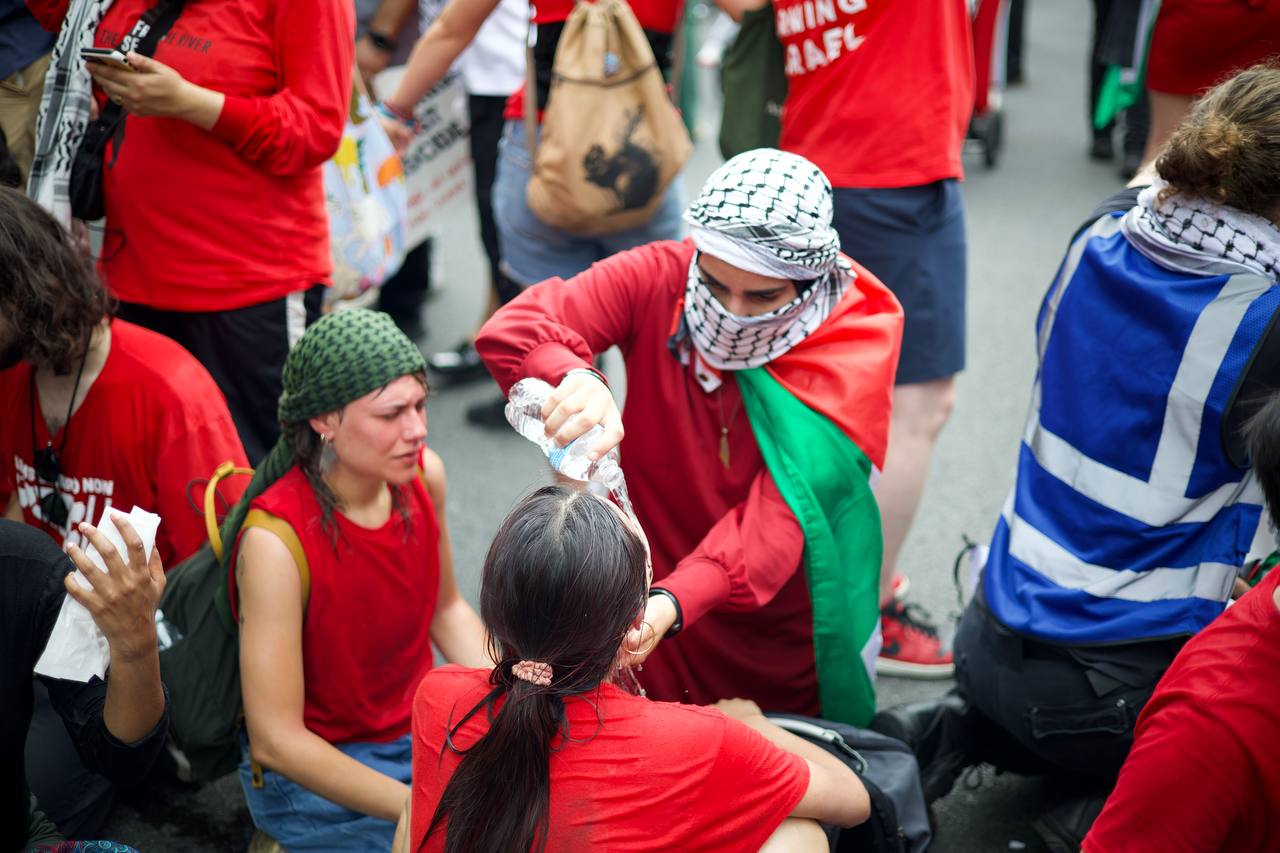
Protesters provide treatment to one another following pepper spray (Photo: Kaleigh O’Keefe)
With that, the crowd decided to press forward, after which, police deployed pepper spray liberally amongst the crowd, injuring several protesters.
“This proves to us that our police forces are training with the IDF, they’re learning tactics from the IDF,” Ibtihal Malley, an organizer with the Palestinian Youth Movement, told Peoples Dispatch directly after police pepper sprayed the crowd. “They are afraid of the people, and they’re afraid of the mass movement for Palestine, so they resort to violence to brutalize our people, just as they brutalize us in Gaza.”
“We are here in DC marching with tens of thousands of people that are asserting their right to march and to protest, and we were blockaded by tens of police,” said Lameess M., also a lead organizer in the Palestinian Youth Movement, in an interview with Peoples Dispatch following police repression. “[Police are] here to protect a war criminal and use our tax dollars to protect that war criminal, while pepper spraying the people that they claim to represent.”
The incident of state repression only made the crowd more defiant. The march quickly diverted to another street, where they continued to evade police lines for several blocks throughout Washington, DC, before rallying once again in front of Union Station. Inspired demonstrators took it upon themselves to take down three massive US flags in front of the station, replacing them with Palestinian flags, and burning the US flags along with a puppet effigy of Netanyahu.
This expression of popular anger at genocide has been seized upon by mainstream media as well as the highest-ranking politicians in the country to denounce the protests. Vice President Kamala Harris, the Democratic Party favorite for the 2024 presidential elections, released a statement making no mention of the reason that tens of thousands had gathered in Washington, DC to protest the celebration of a war criminal. Instead, she condemned “the burning of the American flag.”
“That flag is a symbol of our highest ideals as a nation and represents the promise of America. It should never be desecrated in that way,” Harris stated. “I condemn any individuals associating with the brutal terrorist organization Hamas, which has vowed to annihilate the State of Israel and kill Jews. Pro-Hamas graffiti and rhetoric is abhorrent and we must not tolerate it in our nation.”
The ANSWER Coalition released a statement following the demonstrations. “To try and misdirect people’s attention, some parts of the corporate media and the White House itself are now trying to minimize the significance of these actions,” the anti-war organization stated. “They are attempting to demonize the protests, and focus on one individual sign or some individual’s burning of the American flag. This is designed to distract the public from the actual police violence yesterday, and the true mass violence that has claimed over 40,000 Palestinian lives and millions more in U.S.-led wars across the world. But the rising of the Palestinian flag on multiple flagpoles in front of Union Station and in the shadow of the US Capitol grounds is a clear indication that the tide has turned. Public opinion has been transformed so dramatically that no attempt at deflection can turn it back.”
Organizations of the working class denounce genocide
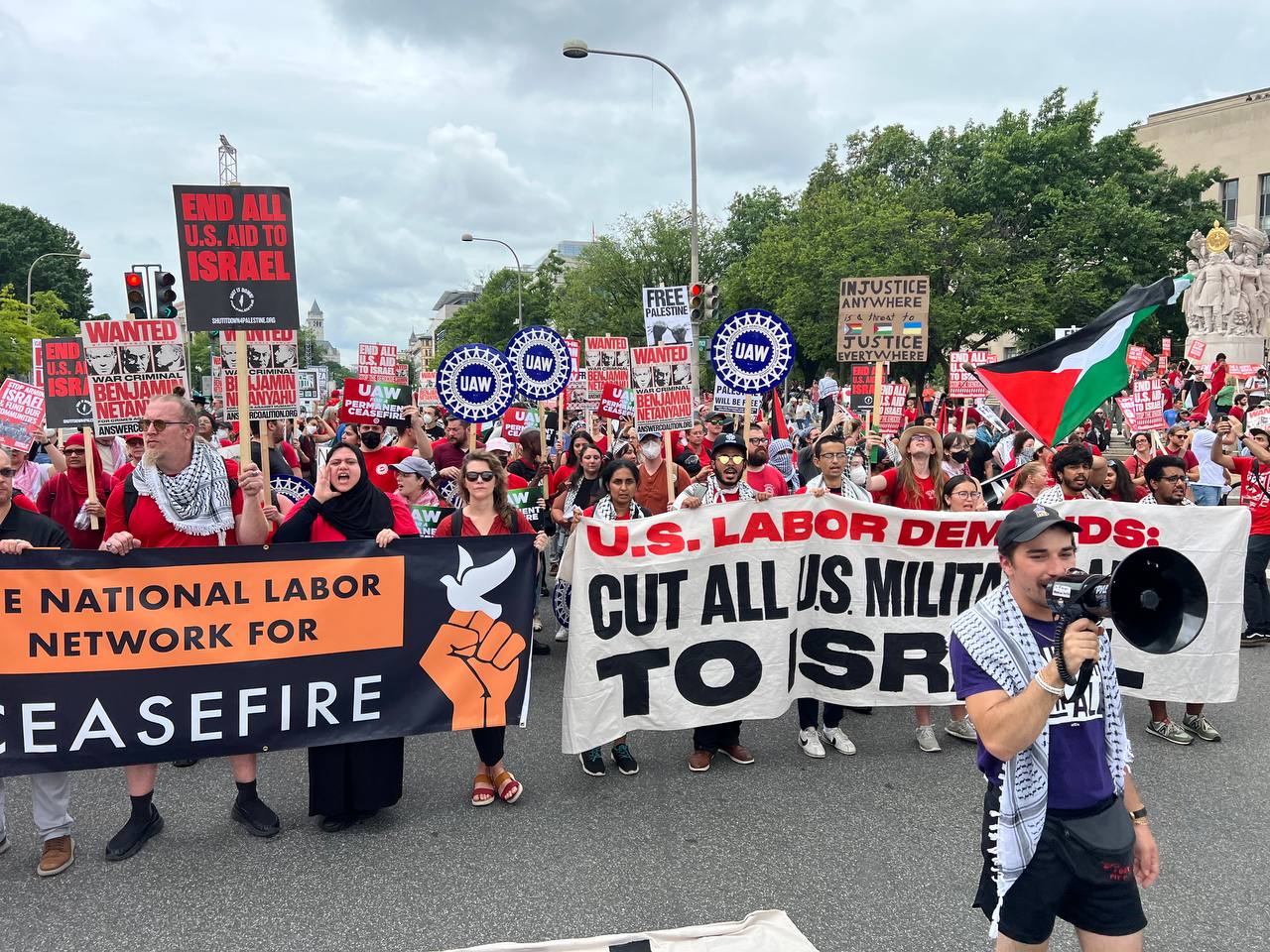
Despite heavy repression, organizations of the working class used the platform of the demonstration to denounce the US’s unconditional support for Israel. The day before the demonstration, seven major unions, representing almost half of all unionized workers in the United States, penned an open letter calling for an end to all US military aid to Israel and a ceasefire in Gaza. Leaders from some of these major unions addressed demonstrators in front of the Capitol.
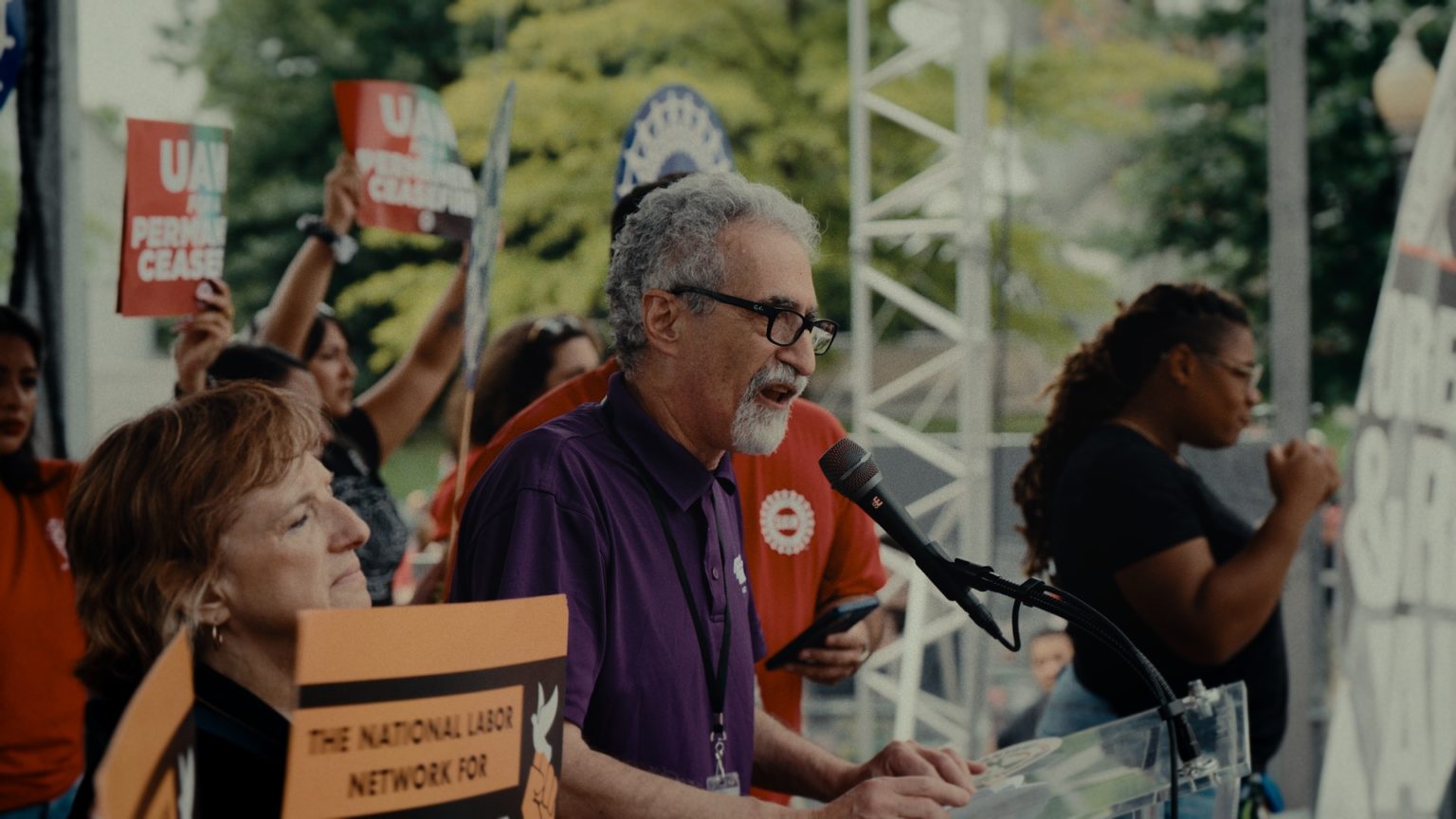
These leaders include Mark Dimondstein, President of the American Postal Workers Union. “In the spirit of working class solidarity and justice, the American Postal Workers Union… stands with humanity and the suffering people, workers and unions in Gaza, in calling for a long overdue ceasefire and massive humanitarian aid to the 2.3 million people of Gaza,” he addressed the rallying crowd. “While they are displaced, homeless, bombed, killed, injured, diseased, and starving behind the war crimes of the Netanyahu-Israeli government, fully backed by US military aid.”
Mark Dimondstein, President of the American Postal Workers Union, addresses demonstrators in Washington, DC (Photo: Craig Birchfield)
Dimondstein’s denunciation of US government policy is not only reflective of his personal opinion, but that of the workers the APWU represents. “Just last week in our convention we voted,” calling on the US government to halt military aid to the US government, “and to stop using our tax dollars for more war,” he said.
“It’s a labor issue. We believe in social justice, we believe in international solidarity,” Dimondstein told Peoples Dispatch in an interview. “Workers pay taxes, and the last thing our taxes should be used for is to kill, maim, and starve innocent men, women, and children of another country.”
“The workers are deeply affected in Palestine and the unions are deeply affected in Palestine,” he continued. “And it’s also a working class issue because there’s real danger of a wider war. And who has to fight, kill, and be killed in these unjust wars if it’s not the working class?”
“US taxpayers are basically funding a genocide,” said Arrion Brown, the director of the Support Services Division within the APWU, in an interview with Peoples Dispatch. Brown has been a postal worker for 24 years. “Those same tax dollars would do so much better in the US, helping actual working people.”
“Working people hold the power of the country, of the world. So it’s important for working class people to express our thoughts, to let the powers that be, the establishment know that they’re not going in the direction we want. Ultimately, we are the political power, we are the working power, and we are the power of the world.”
Brandon Mancilla, a leader in the international board of the United Auto Workers, also addressed the crowd on behalf of the over 400,000 workers of diverse sectors represented by the UAW. In his speech, Mancilla credited rank and file workers with pushing the leadership to call for a ceasefire in Gaza, a step the union took back in December. “Autoworkers in Dearborn, Michigan, have been personally affected by this issue, and have demanded that their union and their government stop funding a genocide. Because academic workers all across the country in countless campuses in almost every state of this country have been protesting for their literal right of free speech, to call on their universities to divest and be held accountable,” he mentioned. The UAW notably represents not only auto workers but a large portion of organized academic workers across the country. Following the brutal crackdown against the Gaza solidarity encampment at the University of California – Los Angeles (UCLA), UAW Local 4811, which represents academic workers within the University of California system, went on strike for the right to protest for Palestine, representing the first strike in US history in relation to the Palestine solidarity movement.
For Mancilla, the letter that seven unions signed onto on July 23 represents an “escalation.”
“A ceasefire has not been realized, it has not been actualized, and in order to actually make that happen, not only do we have to keep negotiations going, and agree to the framework, we have to also materially intervene, which means ending arms shipments to Israel,” Mancilla told Peoples Dispatch.
Labor unions march with demonstrators (Photo: Addison Clapp)
Unions were not the only organizations of the working class out in full force that day—Peoples Dispatch also spoke to tenants organized with CAAAV (Committee Against Anti-Asian Violence), an organization that united Asian-American communities in New York City against gentrification, among other issues. Bingjie, a young member of CAAAV from the NYC neighborhood of Chinatown, told Peoples Dispatch that it’s unjust that tax dollars are being used to fund genocide “when tenants don’t even have enough in New York.”
“The fight for Palestine is not just a fight for Palestine itself, but for liberation for the whole entire world,” she said.