Bezos’ Lavish Venice Wedding Spurs Demand for Global Billionaire Tax

Spread the love

Original article by Jessica Corbett republished from Common Dreams under Creative Commons (CC BY-NC-ND 3.0).
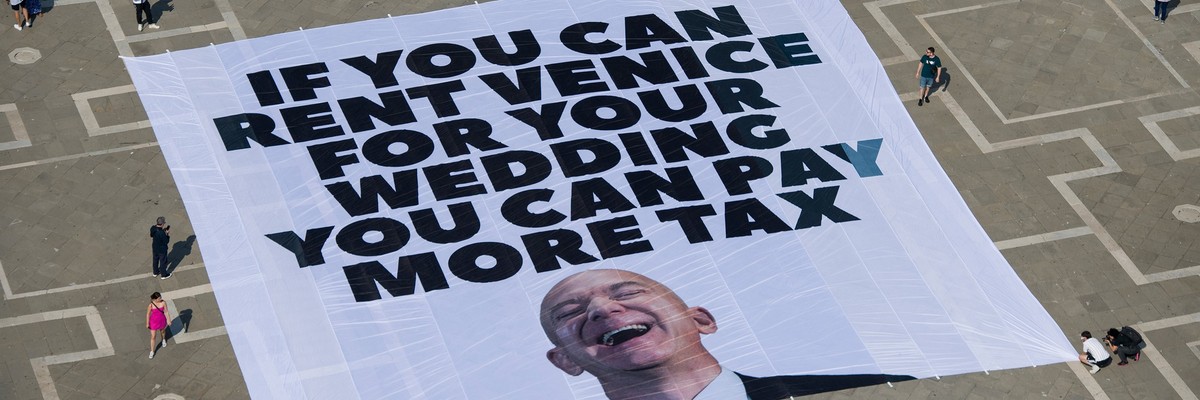
Activists from the U.K. action group Everyone Hates Elon and Greenpeace Italy unfolded a banner reading, “If you can rent Venice for your wedding, you can pay more tax,” on Piazza San Marco in the Italian city on June 23, 2025. (Photo: Michele Lapini/Greenpeace)

“This isn’t just about one person—it’s about changing the rules so no billionaire can dodge responsibility, anywhere,” said one Greenpeace campaigner.

Billionaire Amazon founder Jeff Bezos—the third- or fourth-richest person on the planet, depending on the list—is hosting various wedding events in Venice, Italy, this week, festivities that have drawn protests, including a massive banner on Monday.

Activists with Greenpeace Italy and the U.K. action group Everyone Hates Elon—targeting Elon Musk, U.S. President Donald Trump’s close far-right ally and the wealthiest person on Earth—unfolded a banner that read, “If you can rent Venice for your wedding, you can pay more tax,” in Piazza San Marco.

“While Venice is sinking under the weight of the climate crisis, billionaires are partying like there is no tomorrow on their megayachts,” Greenpeace campaigner Clara Thompson said in a statement. “This isn’t just about one person—it’s about changing the rules so no billionaire can dodge responsibility, anywhere.”

“The real issue is a broken system that lets billionaires skip out on their fair share of taxes while everyone else is left to foot the bill,” she argued. “That’s why we need fair, inclusive tax rules, and they must be written at the U.N.”

Jeff Bezos pays his staff poverty wages and dodges tax. No wonder he can afford to shut down half of Venice for his wedding this week. Tax billionaires NOW.Location: Piazza San Marco, Venice@greenpeace.org #JeffBezos #TaxTheSuperRich

Everyone Hates Elon (@everyonehateselon.bsky.social) 2025-06-23T10:53:54.552Z

Reporting on Monday’s display of the banner—which features Bezos’ face and is about 65 feet long and wide—Reuters detailed:

Local police arrived to talk to activists and check their identification documents, before they rolled up their banner.

“The problem is not the wedding, the problem is the system. We think that one big billionaire can’t rent a city for his pleasure,” Simona Abbate, one of the protesters, told Reuters.

A spokesperson from Everyone Hates Elon similarly said in a Monday statement that “as governments talk about hard choices and struggle to fund public services, Jeff Bezos can afford to shut down half a city for days on end just to get married.”

“Just weeks ago, he spent millions on an 11-minute space trip,” the spokesperson added, referring to the Blue Origin flight for multiple public figures, including Bezos’ fiancĂ©e, Lauren Sánchez. “If there was ever a sign billionaires like Bezos should pay wealth taxes, it’s this.”

Bezos and Sánchez’s event planners, Lanza and Baucina, toldCNN: “Rumors of ‘taking over’ the city are entirely false and diametrically opposed to our goals and to reality… From the outset, instructions from our client and our own guiding principles were abundantly clear: the minimizing of any disruption to the city.”

The details surrounding Bezos’ marriage to the former news anchor have been closely guarded, but CNN reported that around 30 of Venice’s 280 water taxis are thought to be reserved, the city’s nine yacht ports are booked, and one source said that special permission has been granted for private helicopters.

While Venice’s mayor and regional governor Luca Zaia have defended the billionaire’s luxury wedding events, citing economic benefits for local businesses, “the ‘No Space for Bezos’ movement—a play on words also referring to the bride’s recent space flight—has united a dozen Venetian organizations including housing advocates, anti-cruise ship campaigners, and university groups,” according toThe Associated Press.

The Bloomberg and Forbes lists tracking global billionaires put Bezos’ net worth between $223.4 billion and $231 billion as of Monday. At times in recent years, he has been believed to be the richest person in the world.

Original article by Jessica Corbett republished from Common Dreams under Creative Commons (CC BY-NC-ND 3.0).
Continue ReadingBezos’ Lavish Venice Wedding Spurs Demand for Global Billionaire Tax

Ending Oil Subsidies, Taxing the Rich Could Help Free Up $5 Trillion a Year for Climate: Report

Spread the love

Original article by Jake Johnson republished form Common Dreams under Creative Commons (CC BY-NC-ND 3.0).

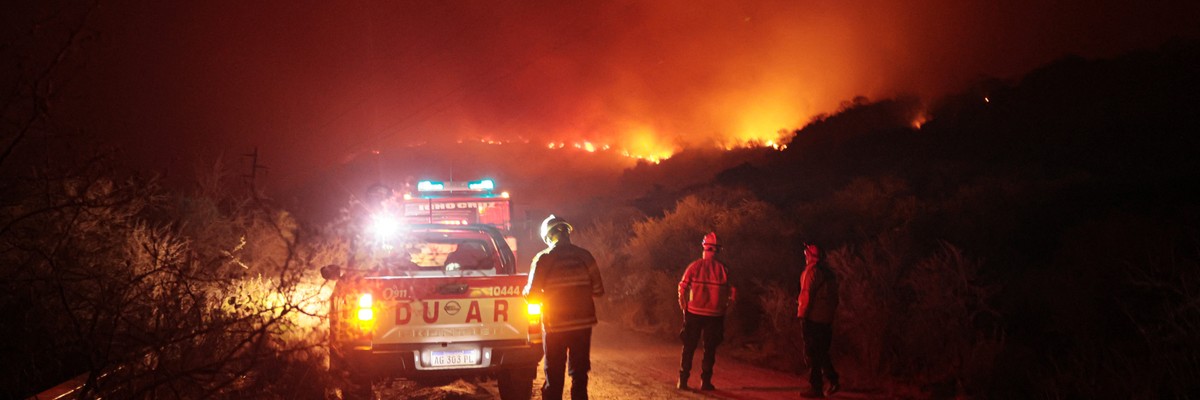
Wildfires are seen in San Marcos Sierra, Cordoba province, Argentina, on September 23, 2024. (Photo: Stringer/AFP via Getty Images)

“The real question isn’t whether we can afford to act, but whether we can afford not to.”

Research published Tuesday estimates that rich countries could mobilize over $5 trillion a year for climate action worldwide by cutting off subsidies to the oil and gas industry, imposing a levy on big polluters, and cracking down on tax evasion by large corporations and the rich.

The new report from Oil Change International (OCI) was released as world leaders gathered in New York City for high-level United Nations General Assembly talks, a meeting that comes less than two months before the COP29 climate summit in Azerbaijan.

OCI’s research, which includes a fact sheet outlining various proposals to raise funds for climate action, stresses that “there is no shortage of public money available for rich countries to pay their fair share on fair terms for climate action at home and abroad.”

“The urgency and extent of growing economic inequality, unfair sovereign debt crises, climate disasters, and fossil fuel profits have created significant momentum towards many of these measures in international and domestic policy spheres,” OCI’s research brief notes. “Finance has been in the spotlight in most major international political fora in the past few years in recognition that our current financial architecture is a major driver of these overlapping crises.”

Among the proposals laid out in OCI’s brief are an equitable end to “public finance, direct subsidies, and state-owned company investments in fossil fuels,” which could raise $846 billion a year globally; a “climate damages tax” on fossil fuel extraction, which could raise $618 billion a year; a 25% minimum corporate tax rate, which could raise $479 billion annually; and a wealth tax on billionaires, which could raise roughly $2.60 trillion a year in the Global North and over $5.6 trillion worldwide.

Laurie van der Burg, OCI’s public finance lead, said that the rich nations most responsible for the climate emergency “owe this money to Global South countries that have not caused this crisis and need fair finance to deliver strong climate plans next year that phase out fossil fuels.”

“This is essential to avoid climate breakdown and save lives,” she added.

The COP29 climate summit will take place a year after nations agreed at COP28 to transition “away from fossil fuels in energy systems” in a “just, orderly, and equitable manner.”

The success of that pledge, OCI said, depends on rich nations contributing massively to global climate finance after years of falling short of their pledges and continuing to expand fossil fuel extraction and handouts. Worldwide, environmentally harmful subsidies—including fossil fuel subsidies—have surged to $2.6 trillion a year, according to a report released last week.

“Global North countries have a responsibility to redirect their share of these subsidies in support of climate action,” OCI said Tuesday.

The new report comes on the heels of a record-hot summer and amid devastating extreme weather, from massive flooding across Europe and Africa to wildfires in South America.

Andreas Sieber, associate director of policy and campaigns at 350.org, said Tuesday that “the real question isn’t whether we can afford to act, but whether we can afford not to.”

“It is a bitter irony that rich nations hide behind claims of fiscal restraint, yet trillions are still spent on fossil fuel subsidies and militarization,” said Sieber. “The truth is simple: the money exists, but the political will does not. By treating climate finance as a zero-sum game, wealthy countries not only deepen global inequality but also undermine their own futures.”

“The energy transition isn’t charity—it’s an investment in global stability and security,” Sieber added. “Ignoring the need for support only worsens the climate crisis, which knows no borders.”

Original article by Jake Johnson republished form Common Dreams under Creative Commons (CC BY-NC-ND 3.0).

Continue ReadingEnding Oil Subsidies, Taxing the Rich Could Help Free Up $5 Trillion a Year for Climate: Report