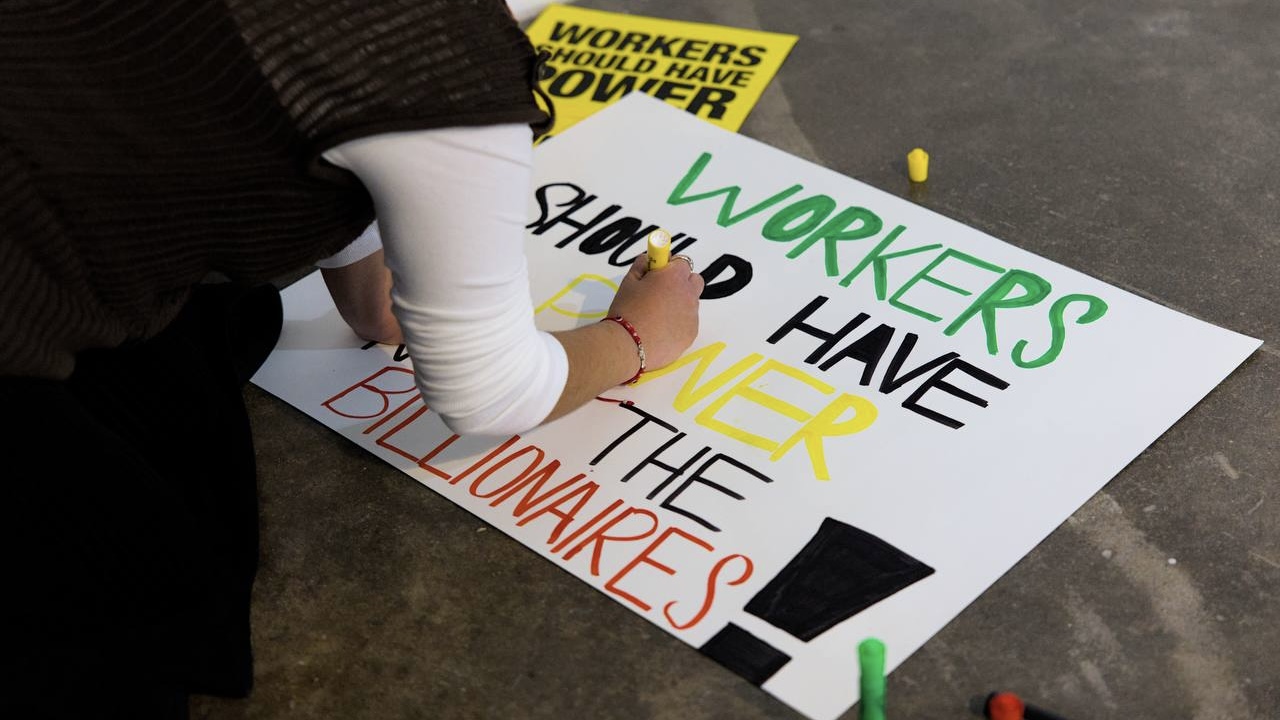
Activists in Houston, Texas designing signs for Inauguration Day protests. Photo: Vivek Venkatraman
Demonstrators mobilizing in over 40 US states to launch movement pledging to oppose “ultra-right, billionaire agenda”
Demonstrations have been called in more than 80 US cities, in over 40 states, on the day of incoming President Donald Trump’s inauguration. These cities include Washington DC, New York, Boston, Los Angeles, Portland, Seattle, Atlanta, Charlotte, Montgomery, Chicago, Houston, and New Orleans.
These demonstrations, intended to mark the start of a movement against Trump’s “ultra-right, billionaire agenda”, have been endorsed by a variety of working class and grassroots organizations. These include the Party for Socialism and Liberation, United Auto Workers Local 4811, the Palestinian Youth Movement, United Educators of San Francisco, Black Men Build, the Democratic Socialists of America, the People’s Forum, the Palestinian Youth Movement, the ANSWER Coalition, the US Palestinian Community Network, UNITE HERE Local 2, Artists Against Apartheid, CODEPINK, the Los Angeles Tenants Union, and Dream Defenders.
Conveners of the demonstrations have spoken to the variety of Trump’s promised attacks on working people. “Trump is planning to wage war on immigrant families through a brutal mass deportation campaign,” said Claudia De La Cruz, who ran on a socialist platform in her campaign for president against both Harris and Trump, on the ticket of the Party for Socialism and Liberation. “We will stand up and say NO to these attacks. Trump is a billionaire, was elected with the help of other billionaires, and runs the government on behalf of the billionaire class. All working people, no matter where you were born, should stand together in solidarity against the billionaire class that wants to rob and exploit us all.”
Brian Becker, the national director of the ANSWER Coalition, does not believe Trump’s promises to “put American Workers first.” According to Becker, Trump “ran a con game during the election.”
“His real agenda is to destroy worker’s rights, deport millions of immigrant families,” Becker said. Trump plans to “pave the way for a complete corporate takeover by ending regulations to protect the environment, firing thousands of public sector workers, and transferring ever-larger parts of the national treasury to the military industrial complex.”
Manolo De Los Santos, Executive Director of The People’s Forum, said, “The Trump victory in the 2024 election represents the complete failure of the Democratic Party to stop the rise of the ultra-right.”
“We can defeat the Trump program not by following the Democratic Party establishment, but by building a massive movement against the ruling class and the political system that gives everything to billionaires while impoverishing an ever larger section of the population.”
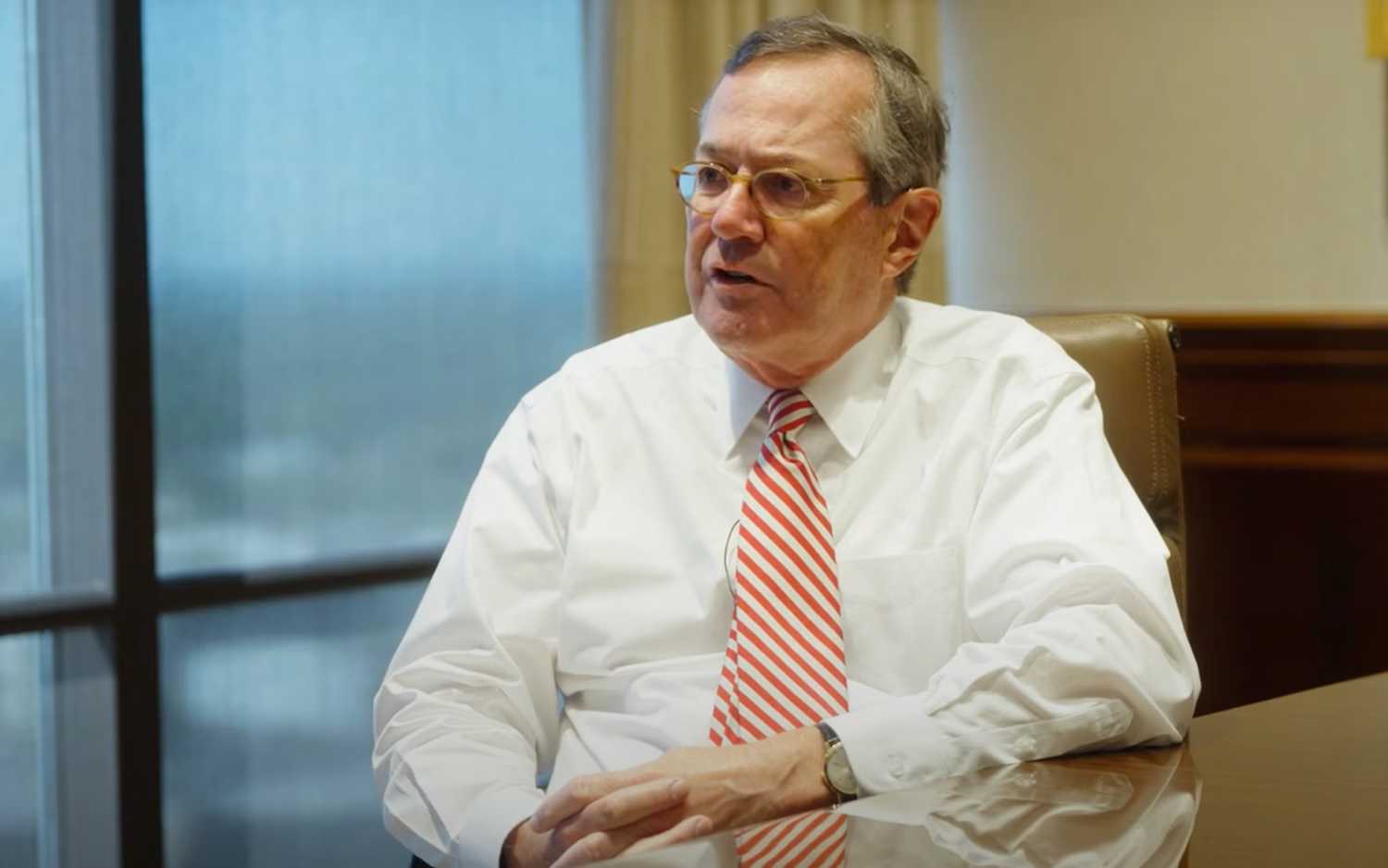
Warren Stephens. Credit: The Golfer’s Journal / YouTube
Campaigners warn that the UK will face “pressure from American fossil fuel interests” to slow its energy transition.
U.S. president-elect Donald Trump’s pick to be UK ambassador runs a firm with investments in several oil and gas companies, DeSmog can reveal.
Billionaire Warren Stephens, a major Trump donor who was nominated on Monday to be the next UK ambassador, is chairman, president, and CEO of Stephens Inc., one of the largest privately-owned investment banks in the U.S..
The firm’s portfolio includes at least five companies that make their money from oil and gas exploration and production, including one, Stephens Natural Resources, which is “solely owned” by the Stephens family business.
“President-elect Trump’s promise to boost U.S. fossil fuel production is reflected in his choice of UK ambassador, raising concerns about the potential impact on the UK’s own climate leadership”, said Fossil Free Parliament campaigner Carys Boughton.
Tessa Khan, executive director of the environmental campaign group Uplift, told DeSmog the appointment was a sign that “the UK is going to be under pressure from American fossil fuel interests to slow its transition away from oil and gas”.
Trump has vowed to “drill, baby, drill” for oil and gas in the U.S. while his presidential campaign received the backing of major fossil fuel interests. The president-elect has called climate change a “hoax” and is expected to once again pull the U.S. out of the flagship 2015 Paris Agreement, which established a global ambition to limit warming to 1.5C above industrial levels.
The Stephens hire comes just weeks after the UK Labour government unveiled an ambitious new climate target to cut emissions by 81 percent by 2035. The move was criticised by Conservative Party leader Kemi Badenoch, who this week flew to Washington DC reportedly to build ties with senior Republicans ahead of a second Trump presidency.
As DeSmog revealed last week, Badenoch has hired advisors who have criticised climate action and have links to fossil fuel-funded think tanks. Badenoch, who describes herself a “net zero sceptic” has also received donations from the head of Net Zero Watch, a climate science denial group.
Oil and Gas Investments
Stephens Inc.’s investments in oil and gas include Stephens Natural Resources, a company run by Warren’s uncle Witt Stephens.
The company, which trades as Stephens Production, “has a rich history of drilling and producing both oil and natural gas”, according to its website, and “continues to expand its production and reserves in the continental U.S. and offshore Gulf of Mexico”.
The company is “solely owned” by the Stephens family, whose investment stretches back to 1953, according to the website.
Stephens Inc.’s other current investments, which date back to the mid-2010s, include Four Corners Petroleum, an oil exploration and production company based in Colorado.
Stephens Inc. lists RK Supply in its portfolio, a “leading distributor of piping, oil and gas valves, fittings, and other oilfield service equipment” based in Texas. It also lists Dakota Midstream, a company that “provides infrastructure support to oil and gas exploration and production”, based in Colorado.
Another company in the Stephen Inc. portfolio, Texas-based Basin Oil & Gas, buys “non-operating oil and gas interests”, and is developing carbon capture and sequestration projects. Carbon capture is a favoured climate solution of the oil and gas industry, and is often used simply to extract more fossil fuels.
Stephens Inc. lists a firm called Capture Point in its portfolio, which specialises in enhanced oil recovery – a method for extracting hard-to-get oil. Capture Point told DeSmog that Stephens Inc. was not an investor in the company, though did not respond when asked if Stephens Inc. was previously an investor.
All the companies cited were approached for comment.
Trump Tensions
Stephens’s appointment comes at a critical time for the UK’s energy transition, and highlights the differences between the new Labour government and the incoming Trump administration.
Prime Minister Keir Starmer last month attended the COP29 climate summit in Baku, Azerbaijan, pledging that the UK would restore its role “as a climate leader on the world stage”. In its 2024 election manifesto, Starmer’s Labour Party pledged to ban all new licenses for oil and gas exploration in the North Sea. However, after five months in office, the government has yet to implement that promise.
“While the UK government has pledged to turn the UK into a ‘clean energy superpower’, it has not enacted its manifesto commitment to ban new licenses, nor provided a plan for a just transition away from fossil fuels”, Carys Boughton told DeSmog.
“Trump’s choice of ambassador will gift the fossil fuel industry yet more influence within UK politics, which is particularly concerning while the government is still wavering on the future of fossil fuels.
“It is therefore yet more important that the government take action to restrict fossil fuel industry influence – to protect its developing climate and energy policy from the industry’s polluting interests.”
As DeSmog has reported, Trump’s would-be energy secretary Chris Wright, chief executive of fracking company Liberty Energy, has praised Danish climate crisis denier Bjorn Lomborg as a friend. Wright’s nomination was welcomed by the CO2 Coalition, a climate science denial group which has received funding from the Koch Industries oil dynasty.
Analysis by the climate outlet Heated found that all of Trump’s cabinet picks have made misleading statements about climate change.
Science denial and an enthusiasm for fossil fuels are also views shared by Trump’s UK supporters. In September, DeSmog reported that Trump ally Nigel Farage, the Clacton MP and leader of Reform UK, was a keynote speaker at an event in Chicago run by the Heartland Institute, where he called on the U.S. to “drill, baby, drill” for more fossil fuels.
“It’s no surprise that this appointment – like the rest of Trump’s administration – is shot through with oil and gas interests”, Uplift’s Tessa Khan, told DeSmog.
“Fossil fuel companies will prove extremely influential in the incoming U.S. government, and they want nations across the world to remain hooked on oil and gas for years to come just so they can keep profiting.
“The UK is going to be under pressure from American fossil fuel interests to slow its transition away from oil and gas. To succumb would be against the UK’s national interest”.
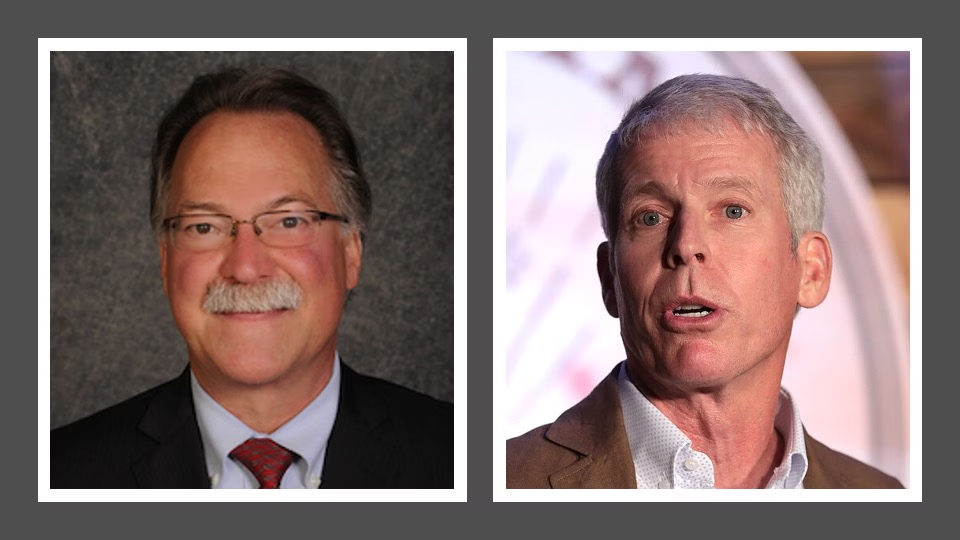
Climate denier Gregory Wrightstone (left) has nothing but praise for Trump’s energy secretary pick, Chris Wright (right). Credit: DeSmog
The head of the CO2 Coalition tells DeSmog that Wright agrees carbon dioxide is “not the demon molecule, it’s the miracle molecule.”
Donald Trump’s pick to lead the Department of Energy, Chris Wright, is receiving enthusiastic approval from a climate obstruction organization that argues global carbon dioxide emissions should be increasing because the gas is “essential for life.”
“I had a chance to sit down one-on-one with Chris in 2022 in his Denver office,” claimed Gregory Wrightstone, executive director of a group called the CO2 Coalition. For nearly a decade, the organization has publicly disputed the fundamentals of climate science while receiving donations from foundations linked to corporate backers, including the oil and gas billionaireCharles Koch.
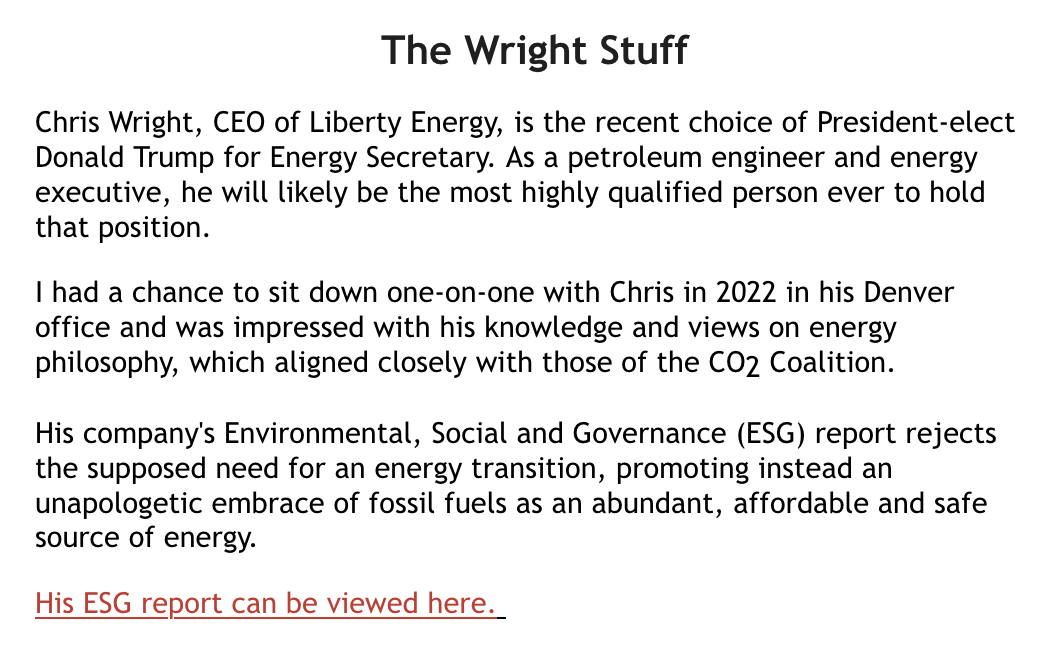
Wrightstone, who detailed the encounter with Wright in a recent newsletter, “was impressed with his knowledge and views on energy philosophy, which aligned closely with those of the CO2 Coalition.”
In a phone interview with DeSmog, Wrightstone elaborated on that alignment, explaining that “the main thing that he and I and the CO2 Coalition agree on is that increasing CO2 is a net benefit, it’s not the demon molecule, it’s the miracle molecule.”
Wright is currently the CEO of the fracking services company Liberty Energy and would bring no political or government experience to the role of energy secretary. Yet Wrightstone concluded that because Wright is “a petroleum engineer and energy executive, he will likely be the most highly qualified person ever to hold that position.”
After Trump announced the nomination last week, some industry observers hailed the appointment as a sign of political moderation within the Republican cabinet, with the head of the Colorado Oil and Gas Associationarguing that Wright is “a pragmatic problem solver” and “not a climate denier.”
Yet the full-throated praise that Wright is receiving from the likes of Wrightstone raises serious questions about whether the future energy secretary even thinks climate change is a problem worth addressing, said Connor Gibson, an independent research specialist who’s spent years tracking the CO2 Coalition and other groups that obstruct climate action including for Greenpeace USA.
“The CO2 Coalition has been a persistent voice undermining the ABCs of climate change — that it’s happening, that it’s caused by human fossil fuel use, and that it’s going to be dangerous,” he told DeSmog.
Wright didn’t respond to questions via his company Liberty Energy nor via the Trump-Vance transition team.
Screenshot from CO2 Coalition emailed newsletter. Credit: CO2 Coalition
Backed by Koch
In email correspondence with DeSmog, Wrightstone explained how his meeting with the future nominee for energy secretary came about several years ago: “I was speaking at an event in Denver and set up a meeting in his office,” he wrote.
“We had a wide-ranging conversation, but I can’t recall any particular details,” he added during a phone interview. Yet Wright made a positive impression on the executive director of the CO2 Coalition. “The key takeaway is that he’s a big supporter of the continuing use of fossil fuels, including coal, oil, and natural gas,” Wrightstone said.
According to Wrightstone, he and Wright’s views align on other key points, including the factually incorrect or dubious claims that “there is no man-made climate crisis,” “science is not consensus and consensus is not science,” “fossil fuels cannot be replaced by intermittent and unreliable solar and wind power,” and “history tells us that warmer periods have been beneficial, while cold periods have been horrific to humanity.”
These talking points have for years been disseminated by the CO2 Coalition, which was recently cited by Alberta’s United Conservative Party in a resolution that abandoned the oil-producing Canadian province’s net-zero targets and officially recognized “that CO2 is a foundational nutrient for all life on Earth.”
During the first Trump administration, William Happer of the CO2 Coalition was appointed to the National Security Council but exited after only a year. White House advisors reportedly feared that his extreme views were a liability to Trump’s reelection. In 2017, Happer argued that the “demonization” of carbon dioxide “really differs little from the Nazi persecution of the Jews, the Soviet extermination of class enemies, or ISIL slaughter of infidels.”
Nevertheless, the CO2 Coalition received more than $76,000 from foundations linked to the oil and gas billionaires Charles and David Koch during Trump’s first term, according to Gibson’s report. Greenpeace calculations show the group got $620,000 in Koch-related contributions between 2004 and 2015.
“We have not received Koch Industries money since I’ve been here,” Wrightstone, who took over in 2021, said when asked about Koch contributions.
Gibson argues that Wright, as a fossil fuel executive, is slightly more nuanced in expressing his views on climate change than his supporters at the CO2 Coalition. Wright acknowledges that human-caused global heating is real and potentially a problem while saying in a video posted to his LinkedIn last year that “there is no climate crisis.”
“It seems to me to be the calculated words of a CEO who recognizes that there is a potential liability of telling an outright lie to the public,” Gibson said. “Yet the effect of his comments is to leave people with the impression that climate change is not happening.”
The richest people on the planet, representing a small sliver of the total population, are emitting carbon dioxide at a rate that’s imperiling hopes of keeping global heating below 1.5°C, prompting fresh calls for government action to rein in “luxury” pollution and combat the intertwined crises of inequality and climate change.
New research by the Institute for European Environmental Policy (IEEP) and the Stockholm Environment Institute (SEI) shows that by 2030, the carbon footprints of the wealthiest 1% of humanity are on track to be 30 times larger than the size compatible with limiting global warming to 1.5°C by the end of the century, the Paris Agreement’s more ambitious temperature target.
If current trends continue, the richest 1% will account for 16% of global CO2 emissions in 2030.
The carbon emissions of the poorest half of the global population, meanwhile, “are set to remain well below the 1.5°C-compatible level,” according to the analysis, which was commissioned by Oxfam International and published Friday. The planet has already warmed by roughly 1.1°C, and scientists have said any heating beyond 1.5°C would have destructive consequences worldwide.
“The emissions from a single billionaire spaceflight would exceed the lifetime emissions of someone in the poorest billion people on Earth,” Nafkote Dabi, Oxfam’s climate policy lead, said in a statement. “A tiny elite appear to have a free pass to pollute. Their oversized emissions are fueling extreme weather around the world and jeopardizing the international goal of limiting global heating.”
“The emissions of the wealthiest 10% alone could send us beyond the agreed limit in the next nine years,” Dabi added. “This would have catastrophic results for some of the most vulnerable people on Earth who are already facing deadly storms, hunger, and destitution.”
Authored by Tim Gore, head of the Low Carbon and Circular Economy program at IEEP, the new research paper notes that “while carbon inequality is often most stark at the global level, inequalities within countries are also very significant.”
“They increasingly drive the extent of global inequality, and likely have a greater impact on the political and social acceptability of national emissions reduction efforts,” the paper reads. “It is therefore notable that in all of the major emitting countries, the richest 10% and 1% nationally are set to have per capita consumption footprints substantially above the 1.5⁰C global per capita level.”
To slash the outsized planet-warming emissions of the global rich, the study calls on policymakers to pursue restrictions on mega-yachts, private jets, and recreational space travel. In a paper published last month, French economist Lucas Chancel estimated that “an 11-minute [space] flight emits no fewer than 75 tonnes of carbon per passenger once indirect emissions are taken into account (and more likely, in the 250-1,000 tonnes range).”
“At the other end of the distribution, about one billion individuals emit less than one tonne per person per year,” Chancel observed. “Over their lifetime, this group of one billion individuals does not emit more than 75 tonnes of carbon per person. It therefore takes a few minutes in space travel to emit at least as much carbon as an individual from the bottom billion will emit in her entire lifetime.”
In addition to targeting sources of “luxury carbon consumption,” the analysis by IEEP and SEI also proposes restrictions on “climate-intensive investments like stock-holdings in fossil fuel industries.”
“The global emissions gap to keep the 1.5°C Paris goal alive is not the result of the consumption of most of the world’s people: it reflects instead the excessive emissions of just the richest citizens on the planet,” Gore said in a statement. “It is necessary for governments to target measures at their richest, highest emitters―the climate and inequality crises should be tackled together.”
Emily Ghosh, a scientist at SEI, agreed, arguing that “carbon inequality must urgently be put at the center of governments efforts to reduce emissions.”
“Our research highlights the challenge of ensuring a more equitable distribution of the remaining and rapidly diminishing global carbon budget,” said Ghosh. “If we continue on the same trajectory as today, the stark inequalities in income and emissions across the global population will remain, challenging the equity principle at the very heart of the Paris Agreement.”
Our work is licensed under Creative Commons (CC BY-NC-ND 3.0). Feel free to republish and share widely.