‘Fossil Fuels Are Killing Us’: Scientists Publish Sweeping Review of Industry Harms

Spread the love

Original article by Jessica Corbett republished from Common Dreams under Creative Commons (CC BY-NC-ND 3.0).

U.S. Army Corps of Engineers contractors in protective gear remove hazardous materials from a home destroyed in the Eaton Fire on March 26, 2025 in Altadena, California. (Photo: Mario Tama/Getty Images)

“We’ve got to work fast to end fossil fuel operations near our homes, schools, and hospitals and trade fossil fuel infrastructure for healthy, clean energy,” said one co-author.

“The evidence is clear that fossil fuels—and the fossil fuel industry and its enablers—are driving a multitude of interlinked crises that jeopardize the breadth and stability of life on Earth.”

That’s the first line of the abstract for an article published Monday by top scientists who reviewed “the vast scientific evidence showing that fossil fuels and the fossil fuel industry are the root cause of the climate crisis, harm public health, worsen environmental injustice, accelerate biodiversity extinction, and fuel the petrochemical pollution crisis.”

The new paper in the peer-reviewed journal Oxford Open Climate Change highlights the diverse impacts of “every stage of the fossil fuel life cycle” and stresses that the “industry has obscured and concealed this evidence through a decadeslong, multibillion-dollar disinformation campaign aimed at blocking action to phase out” its deadly products.

“The fossil fuel industry has spent decades misleading us about the harms of their products and working to prevent meaningful climate action,” said co-author Naomi Oreskes, professor of the history of science at Harvard University, in a statement. “Perversely, our governments continue to give out hundreds of billions of dollars in subsidies to this damaging industry. It is past time that stops.”

“The most polluted communities should be prioritized for clean energy investments and removal and cleanup of dirty fossil fuel infrastructure.”

While the researchers focused on the United States, “as the world’s largest oil and gas producer and dominant contributor to these fossil fuel crises,” their review—including proposed “science-and-justice-based solutions” for an economywide effort to “forge a path forward to sustaining life on Earth”—applies to the whole world, which is quickly heating up due to emissions from coal, gas, and oil.

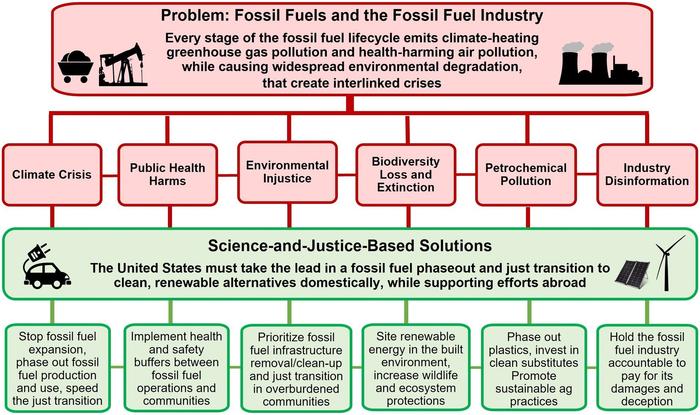
The article features sections on the fossil fuel-driven climate crisis, public health harms, environmental injustice, biodiversity loss and extinction, petrochemical pollution, and industry disinformation. Each section lays out the “problem” and “solutions.”

The climate emergency section includes details such as “the production and combustion of oil, gas, and coal are responsible for nearly 90% of human-caused carbon dioxide (CO2) emissions and approximately 79% of total greenhouse gas emissions,” and “failures in political will to implement necessary climate action have made the 1.5°C benchmark nearly impossible to achieve without overshoot,” referring to a primary goal of the 2015 Paris agreement.
Although the current U.S. administration has demonstrated its alliance to the fossil fuel industry—including with President Donald Trump’s recent energy emergency declaration—the scientists still emphasized what’s possible in the country.

“In the USA, powerful policy levers are available to governments and civil society at the local, state, national, and international levels to phase out fossil fuels and transition to a clean, renewable energy economy,” they wrote. “These levers include regulation (e.g. applying and enforcing existing laws), legislation (e.g. polluters pay laws, fossil fuel subsidy reform, land use laws limiting drilling), and litigation (e.g. holding fossil fuel companies accountable, defending existing law).”

They also warned that “last-ditch efforts to prolong the fossil fuel industry are proliferating. These include counterproductive false solutions, like carbon capture and storage (CCS), which would perpetuate fossil fuel use while capturing only some of the resulting emissions, and hydrogen made from fossil fuels.”

The public health section notes that “air pollution from fossil fuel combustion accounts for 8.7 million (equaling 1 in 5) premature deaths per year worldwide and 350,000 premature deaths per year in the USA. In a single year, air pollution from oil and gas production in the USA resulted in 410,000 asthma exacerbations, 2,200 new cases of childhood asthma, and 7,500 premature deaths in 2016.”

Co-author David J.X. González, an assistant professor of environmental health sciences at the University of California, Berkeley, said Monday that “we’ve got to work fast to end fossil fuel operations near our homes, schools and hospitals and trade fossil fuel infrastructure for healthy, clean energy.”

“Oil, gas, and coal will continue to condemn us to more deaths, wildlife extinctions, and extreme weather disasters unless we make dirty fossil fuels a thing of the past.”

The paper points out that “climate change is increasing incidence of physical and mental health impacts and mortality through multiple pathways: worsening extreme events including heatwaves, severe storms, floods, droughts, and wildfires; shifting ranges of disease vectors; threats to food security; and displacement and forced migration, which restrict access to healthcare and other basic services.”

“These harms, though broadly felt, also disproportionately impact marginalized communities which are already disproportionately burdened by other socioenvironmental hazards, as well as susceptible populations including young children, people with certain disabilities, people experiencing homelessness, pregnant people, people with chronic diseases, and older adults,” the publication continues.

University of Montana associate professor of environmental studies Robin Saha, another co-author, said that “decades of discriminatory policies, such as redlining, have concentrated fossil fuel development in Black, Brown, Indigenous, and poor white communities, resulting in devastating consequences.”

“For far too long, these fenceline communities have been treated as sacrifice zones by greedy, callous industries,” Saha added. “The most polluted communities should be prioritized for clean energy investments and removal and cleanup of dirty fossil fuel infrastructure.”

The paper’s other co-authors are Robert Bullard of Texas Southern University, Boston University’s Jonathan J. Buonocore and Mary D. Willis, Trisia Farrelly of the Cawthron Institute, William Ripple of Oregon State University, and the Center for Biological Diversity’s Nathan Donley, John Fleming, and Shaye Wolf.

“The science can’t be any clearer that fossil fuels are killing us,” declared Wolf, the paper’s lead author and the center’s climate science director. “Oil, gas, and coal will continue to condemn us to more deaths, wildlife extinctions, and extreme weather disasters unless we make dirty fossil fuels a thing of the past. Clean, renewable energy is here, it’s affordable, and it will save millions of lives and trillions of dollars once we make it the centerpiece of our economy.”

Original article by Jessica Corbett republished from Common Dreams under Creative Commons (CC BY-NC-ND 3.0).

Orcas comment on killer apes destroying the planet by continuing to burn fossil fuels.
Continue Reading‘Fossil Fuels Are Killing Us’: Scientists Publish Sweeping Review of Industry Harms

A quarter of freshwater animals threatened with extinction, finds major new study

Spread the love

Iwan Jones, Queen Mary University of London

For far too long, the decline in the biodiversity of our rivers and lakes has been out of sight and out of mind. As a freshwater ecologist I have long felt frustrated as conservation and research is dominated by land and sea species, even though our rivers, lakes, ponds and other wetlands host a hugely disproportionate amount of the world’s biodiversity in their relatively small area.

The first comprehensive assessment of the risk of extinction of freshwater species, now published in the journal Nature, is set to change this. The scientists involved in the new study used the recently completed “red list” for freshwater fishes, and the one for dragonflies and damselflies.

Red lists are official inventories of conservation status compiled by the International Union for Conservation of Nature (IUCN). They combined this with data from the previously published red list for freshwater crabs, crayfishes and shrimps. In total, they assessed more than 23,000 species.

The authors conclude that close to a quarter (24%) of freshwater species are threatened with extinction. That is, they have been officially assessed as vulnerable, endangered, critically endangered or extinct in the wild.

These include the critically endangered European eel, and the endangered white-clawed crayfish, both of which were abundant in the streams of my childhood.

small crayfish on river weed
Once abundant, now endangered: a juvenile white clawed crayfish. valda butterworth / shutterstock

There is some uncertainty in the estimates, especially as there is insufficient data to establish the extinction risk for some species. The authors use an accepted and robust method to address this uncertainty but note that this lack of data affects a substantially larger proportion of freshwater species than those that live on land.

In fact, despite indications that a greater proportion of freshwater mollusc species are at risk of extinction, the authors could not include molluscs in their analysis as so many species are data deficient.

Furthermore, we have only the most rudimentary understanding of the status of the wide array other freshwater species, particularly invertebrates such as mayflies, stoneflies, or various beetles, many of which are highly sensitive to pollution. Although this new study represents an important step forward in our understanding, it should also act as a clarion call to galvanise efforts to fill these critical data gaps.

Freshwater species overlooked

While shocking, this figure of 24% of freshwater species threatened with extinction is comparable with the estimate for predominantly land-based amphibians, reptiles, birds and mammals, of which 23% are threatened. Comprehensive assessments of birds, amphibians and mammals have been available for over 20 years, with repeat assessments now available.

Rivers and lakes support whole ecosystems with all sorts of species. Martine Liu 58 / shutterstock

As the IUCN’s red lists are used to document trends in biodiversity and therefore to inform national and global strategy, data on terrestrial vertebrates has dominated conservation science and policy. Hence, to date, global environmental governance has focused on land and sea ecosystems, despite evidence that freshwaters require distinct management needs.

With this assessment, it is now clear that policy will have to be developed that protects and delivers improvements for freshwater species. That means thinking about entire river basins as a whole, rather than the immediate area occupied by the species.

It also means considering things like how rivers and lakes are connected and how the water available varies from season to season. Bodies of freshwater are like islands in a sea of land. Facilitating movement between these islands can help preserve species, particularly where they disappear seasonally.

Most species face multiple threats

In the new study, pollution, dams, water abstraction, land-use change, over-exploitation, invasive species and disease feature prominently as threats, with most species impacted by more than one. Freshwaters in areas of limestone and other porous calcium-rich rocks host consistently more threatened species than would be expected, highlighting the importance of chalk streams for example, where pressure due to exploitation of water resources and pollution is pronounced.

Chalk streams are valuable habitats for salmon, trout, otters, kingfishers and many other species. Tony Martin Long / shutterstock

While current efforts to hold UK water companies responsible for reducing inputs of sewage to rivers and lakes are commendable, water use efficiency and run-off should be considered throughout the decision-making process, from building design and town planning though to our individual daily use of water. Nature-based solutions such as tree planting or wetland protection offer a way forward that simultaneously benefit biodiversity and human well-being.

A lack of understanding can no longer be used as an excuse for inaction. As the authors of the new study point out, freshwaters support more than 10% of all known species, including about a third of vertebrates and half of fishes, while covering less than 1% of the surface of the Earth.

Many of the freshwater species considered in this study are socially and economically important. Freshwater fish provide an important source of protein for many human societies, and species such as Atlantic salmon support a fishing-tourism industry critical to many areas with limited opportunities to generate income.

Other species, while superficially unimportant to human society, thrive in clean water. The widespread decline in these species reflects increasing pollution and other pressures, which does not bode well for our society in the face of climate change and diminishing water availability.

Iwan Jones, Freshwater Ecologist and Head of the River Communities Group, Queen Mary University of London

This article is republished from The Conversation under a Creative Commons license. Read the original article.

Continue ReadingA quarter of freshwater animals threatened with extinction, finds major new study

North Atlantic’s Largest Marine Protected Area Created by Portugal’s Azores Islands

Spread the love

https://www.ecowatch.com/portugal-azores-islands-marine-protected-area.html

Dolphins off the coast of the island of San Miguel in the Azores. Juan Miguel Cervera Merlo / iStock / Getty Images Plus

The regional assembly of the Azores Islands — a nine-island archipelago in Portugal — has approved the North Atlantic’s largest marine protected area.

Its creation will allow Portugal to meet the United Nations goal of safeguarding 30 percent of the planet’s land and sea by the end of the decade.

“We have acted in advance of the international conservation goals for 2030 with the creation of the largest marine park in the North Atlantic, with fully protected areas and highly protected areas,” Bernardo Brito e Abreu, maritime affairs adviser to the Azorean government, told Reuters.

The new marine sanctuary will encompass nearly 115,830 square miles, providing protection for its vast and unique biodiversity — including deep-sea corals and hydrothermal vents.

https://www.ecowatch.com/portugal-azores-islands-marine-protected-area.html

Continue ReadingNorth Atlantic’s Largest Marine Protected Area Created by Portugal’s Azores Islands

Campaigners Demand Global Ban on Deep-Sea Mining

Spread the love

Original article by JESSICA CORBETT republished from Common Dreams under Creative Commons (CC BY-NC-ND 3.0). 

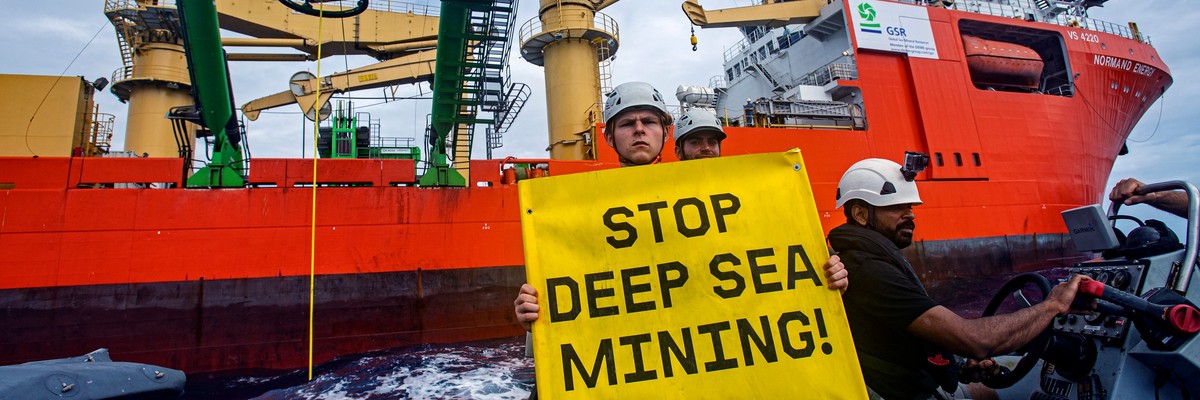
Greenpeace International activists attach a flag reading “Stop Deep Sea Mining” to the cable holding the prototype robot, Patania II, to disturb a deep-sea mining impact test by the company Global Sea Mineral Resources. (Photo: © Marten van Dijl / Greenpeace)

As talks resume, supporters of a moratorium are also calling for the ouster of the International Seabed Authority’s leader, who faces an election on July 29.

As talks to establish global policies on deep-sea mining resumed in Jamaica on Monday, Greenpeace International renewed its demand for a moratorium on the practice, the path also backed other civil society and Indigenous groups, at least hundreds of science and policy experts, and 27 countries.

“The science is clear—there can’t be deep-sea mining without environmental cost and the only solution is a moratorium. The more we know about deep-sea mining, the harder it is to justify it,” said Greenpeace campaigner Louisa Casson, who is attending the United Nations-affiliated International Seabed Authority’s (ISA) 29th session in Kingston.

“Governments at the ISA must not dance to the tune of the industry and approve rushed regulations for the benefit of a few over the interests of Pacific communities and the opinion of scientists,” Casson argued, as companies and countries see chances to cash in on the clean energy transition by extracting metals including cobalt, copper, and nickel.

“The deep ocean sustains crucial processes that make the entire planet habitable, from driving ocean currents that regulate our weather to storing carbon and buffering our planet against the impacts of climate change.”

The Associated Press reported Monday that although the ISA has not allowed any extraction during debates, it “has granted 31 mining exploration contracts,” and “much of the ongoing exploration is centered in the Clarion-Clipperton Fracture Zone, which covers 1.7 million square miles (4.5 million square kilometers) between Hawaii and Mexico.”

The Mexican government last year endorsed a moratorium and Democratic Hawaii Gov. Josh Green last week signed a bill banning seabed mining in state waters, citing “environmental risks and constitutional rights to have a clean and healthy environment.”

Ahead of the meeting in Jamaica, Deep Sea Conservation Coalition campaign lead Sofia Tsenikli highlighted that “gouging minerals from the seafloor poses an existential threat that goes far beyond the immediate destruction of deep-sea wildlife and habitats.”

“The deep ocean sustains crucial processes that make the entire planet habitable, from driving ocean currents that regulate our weather to storing carbon and buffering our planet against the impacts of climate change,” Tsenikli said. “States must now protect the ocean and not allow any more damage.”

The ISA was established under the 1982 U.N. Convention on the Law of the Sea and a related 1994 agreement, and is responsible for waters not under the control of specific nations. As Common Dreams reported earlier this month, some diplomats have accused British lawyer Michael Lodge, its current secretary-general, of trying to speed up the start of mining.

“The rush to complete the mining code was triggered by the Pacific island state of Nauru, which is expected to submit a mining license application on behalf of Canada’s the Metals Company (TMC) later this year, regardless of whether or not regulations are complete,” Reuters noted Monday.

After ISA’s 36-member Council negotiates the “Mining Code” over the next two weeks, its full Assembly is scheduled to meet on July 29 to vote on the next secretary-general, with Lodge facing a challenge from Brazil’s Leticia Carvalho for the top post.

“It is time for change at the ISA,” Casson of Greenpeace declared Monday. “A third term for Michael Lodge would not only put the oceans under threat but also risk further damaging public trust in the regulator. Mining companies are impatient to get started and mounting evidence indicates that Lodge is overstepping his supposedly-neutral role to align with commercial interests.”

“The ISA must listen to millions of people and the growing number of governments calling for a halt to deep-sea mining,” she added. “It is time to put conservation at the heart of the ISA’s work.”

In preparation for the talks in Kingston, Environment Oregon Research & Policy Center, U.S. Public Interest Research Group (PIRG) Education Fund, and Frontier Group last month released a report showing that not only would deep-sea mining destroy “a vibrant, biodiverse place, teeming with complex ecosystems and thousands, possibly millions of species,” but also it isn’t necessary.

“Disposable electronic devices are creating a toxic e-waste mess. Now, some mining companies are trying to convince policymakers that we need to wreak havoc on the ocean to source the materials to make more,” said Charlie Fisher of the Oregon State PIRG Foundation. “This report shows that we don’t need to ruin the deep sea to make the products we need. There is a more sustainable path: Make long-lasting, fixable electronics and recycle them when they no longer work.”

Original article by JESSICA CORBETT republished from Common Dreams under Creative Commons (CC BY-NC-ND 3.0). 

Continue ReadingCampaigners Demand Global Ban on Deep-Sea Mining

Politicians ‘awol’ on the environment despite 60,000 strong protest, charity says

Spread the love
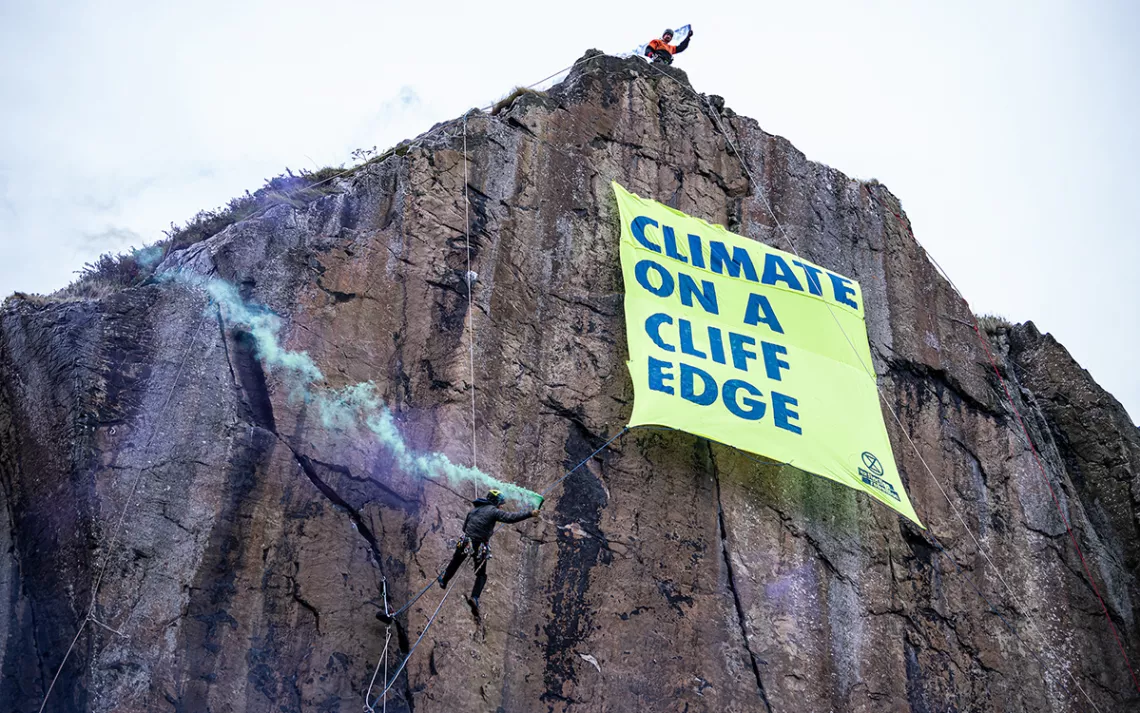
Experienced climbers scale a rock face near the historic Dumbarton castle in Glasgow, releasing a banner that reads “Climate on a Cliff Edge.” One activist, dressed as a globe, symbolically looms near the edge, while another plays the bagpipes on the shores below. | Photo courtesy of Extinction Rebellion and Mark Richards

https://morningstaronline.co.uk/article/politicians-awol-environment-despite-60000-strong-protest-charity-says

POLITICIANS have gone “awol” on the environment despite four in five voters expressing concern about the climate and the natural world, conservationists warned today.

New polling for conservation charity WWF shows that while 80 per cent say they care about issues relating to climate, nature and the environment, only 45 per cent believe that politicians share their level of concern.

They face increasing pressure to do more on the environment after tens of thousands of people marched through London at the weekend.

WWF warned today that the next five years will be “absolutely vital” for conservation efforts in Britain and abroad, with native wildlife from puffins to bluebells and mountain hares at risk from climate change, pollution and habitat loss.

Chief executive Tanya Steele said: “Our polling shows the environment is clearly a key issue for the public and they deserve to hear what the next government plans to do to restore nature and meet our climate targets.

“Unfortunately, politicians have largely gone awol on the environment during this campaign, but the next five years will be absolutely vital in bringing nature back from the brink, both at home and around the world.

“As the campaign enters the final straight, we’re calling on all parties to commit to action on nature and climate that’s hugely popular with the public.”

https://morningstaronline.co.uk/article/politicians-awol-environment-despite-60000-strong-protest-charity-says

Continue ReadingPoliticians ‘awol’ on the environment despite 60,000 strong protest, charity says