Italy’s Unions Lead General Strike for Gaza

Spread the love

Original article by Brett Wilkins republished from Common Dreams under Creative Commons (CC BY-NC-ND 3.0). 
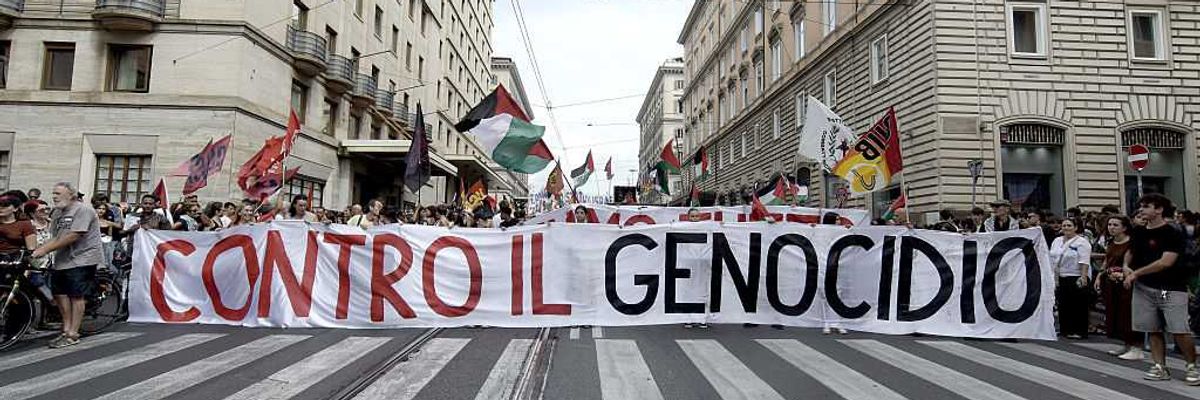
Palestine defenders rally with a banner reading, “Against the Genocide” in Rome on September 22, 2025. (Photo by Simona Granati/Corbis via Getty Images)

“Meloni should take a stand with the facts against those who have slaughtered 20,000 children, rather than limiting herself to saying ‘I do not agree,’” said one critic of Italy’s right-wing prime minister.

Italian labor unions led a massive 24-hour general strike on Monday to protest Israel’s ongoing genocide in Gaza, with estimates of hundreds of thousands of demonstrators rallying in dozens of cities across Italy.

Protesters took to squares, streets, transport hubs, ports, university campuses, and other spaces in more than 75 cities and towns, rallying under the call to “Block Everything.” Places including schools, train stations, and retail stores were shut for the day.

“The strike is called in response to the ongoing genocide in the Gaza Strip, the blockade of humanitarian aid by the Israeli army, and the threats directed against the… Global Sumud Flotilla, which has on board Italian workers and trade unionists committed to bringing food and basic necessities to the Palestinian population,” explained Unione Sindacale di Base (USB), a grassroots union confederation known for its militant stance on labor and political issues.

In Rome, tens of thousands of Palestine defenders rallied at the Termini rail station, Italy’s largest, with many of the demonstrators occupying the building.

While protest activities snarled traffic in some parts of the Italian capital, many Roman motorists showed solidarity with the demonstrators by honking their horns and raising their fists into the air.

Watch: Pro-Gaza protesters who blocked a highway near Rome were met with visible solidarity from drivers. Regional news coverage of the paralyzed Central Station showed only people expressing support for the protest.Source: Paolo Mossetti on X (@paolomossetti)

Drop Site (@dropsitenews.com) 2025-09-22T18:35:27.997Z

Milan saw an estimated 50,000 people turn out to locations including the central rail station, where some protesters damaged property and clashed with police, who said 10 people were arrested and 60 officers were injured.

“If we don’t block what Israel is doing, if we don’t block trade, the distribution of weapons and everything else with Israel, we will not ever achieve anything,” protester Walter Montagnoli, who is the Base Unitary Confederation’s (CUB) national secretary, told The Associated Press at a march in Milan.

In Bologna—home to the world’s oldest continuously operating university—students occupied lecture halls and thousands of demonstrators took to the streets, including the Tangenziale, the ring highway around the city, where police attacked them with water cannons and tear gas.

Dockworkers and other demonstrators marched and blocked ports in cities including Genoa, Trieste, and Livorno.

Thousands of protesters also blocked the main train station in Naples.

Source: Potere al Popolo via X (@potere_alpopolo)

Drop Site (@dropsitenews.com) 2025-09-22T18:06:50.797Z

In the Adriatic seaside resort of Termoli, hundreds of student-led Palestine defenders rallied in St. Anthony’s Square and, with Mayor Nicola Balice’s permission, draped a Palestinian flag from the façade of City Hall.

“Faced with such an important subject, the genocide in Palestine, we students… said this would be a nonpartisan demonstration because in the face of what is happening in the Gaza Strip—hospitals bombed, children killed every day—there can be no political ideology,” said one Termoli protester. “We must all be united.”

Some participants in Monday’s general strike pointed the finger at their own government.

“In the face of what is happening in Gaza you have to decide where you are,” Italian General Confederation of Labor leader Maurizio Landini told La Stampa. “If you don’t tell the Israeli government that you have to stop and don’t send them more weapons, but instead you keep sending them… you actually become complicit in what’s happening.”

While European nations including Ireland, Norway, Spain, Slovenia, the United Kingdom, Portugal, France, Luxembourg, and Denmark have formally recognized Palestine or announced their intent to do so since October 2023, Italy has given no indication that it will follow suit. More than 150 of 193 United Nations member states have recognized Palestine.

Although increasingly critical of Israel’s 718-day genocidal assault—which has left at least 241,000 Palestinians dead, wounded, or missing in Gaza—right-wing Italian Prime Minister Giorgia Meloni has been accused of complicity in genocide for actions including presiding over arms sales to the government of Israeli Prime Minister Benjamin Netanyahu, who is wanted by the International Criminal Court for alleged war crimes and crimes against humanity. Meloni has rejected the ICC warrants and said Netanyahu would not be arrested if he enters Italy.

“Meloni should listen to the voice of those who are peacefully protesting and asking her to act, rather than curling up to Washington to protect her friend, the war criminal Netanyahu,” Giuseppe Conte, who leads the independent progressive Five Star Movement, said Monday on social media. “Meloni should take a stand with the facts against those who have slaughtered 20,000 children, rather than limiting herself to saying, ‘I do not agree.’ And she should stop running away from the debate in Parliament.”

Original article by Brett Wilkins republished from Common Dreams under Creative Commons (CC BY-NC-ND 3.0). 
Continue ReadingItaly’s Unions Lead General Strike for Gaza

Italian left party demands answers over police infiltration scandal

Spread the love

Original article by Ana Vračar republished from peoples dispatch under a Creative Commons Attribution-ShareAlike 4.0 (CC BY-SA) license.

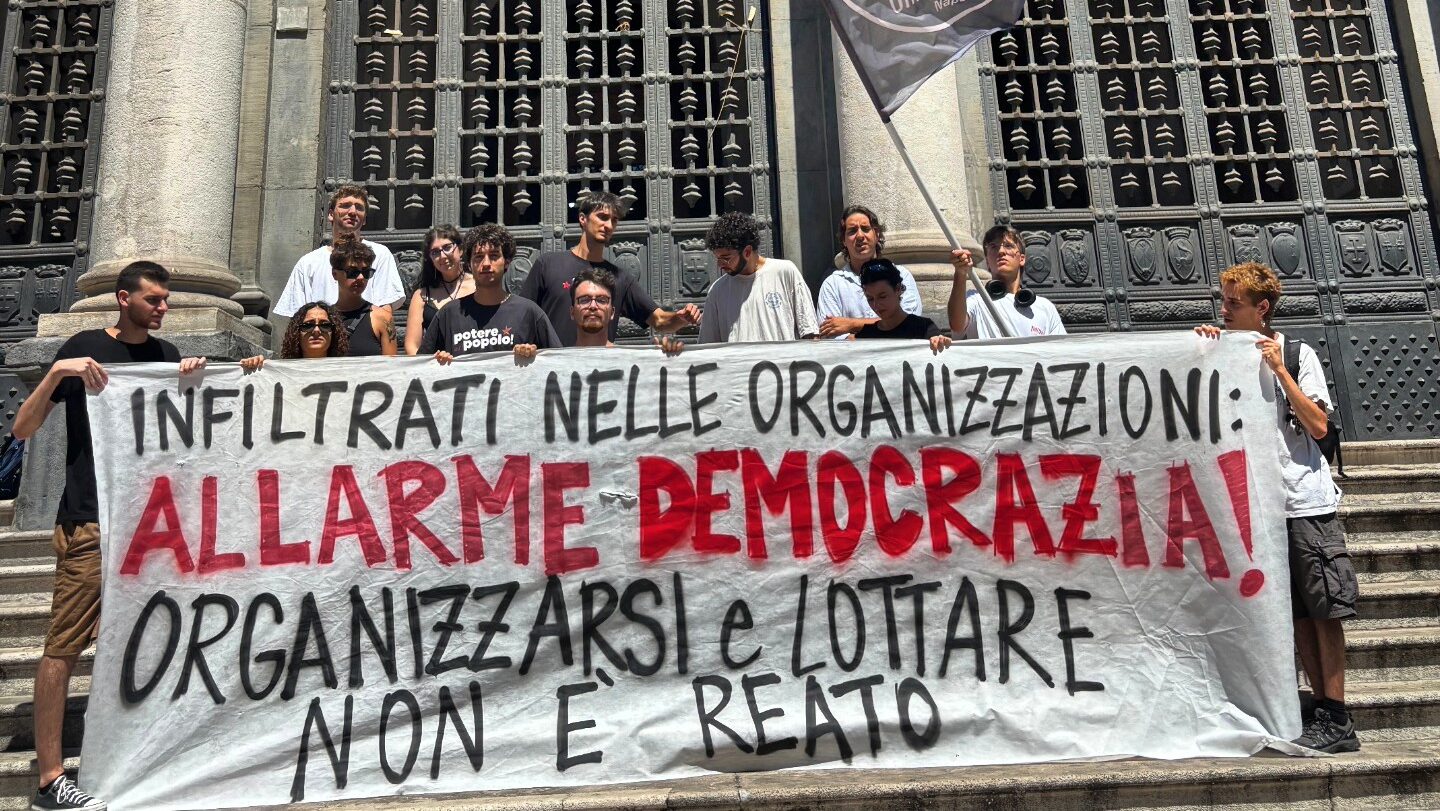
Activists protesting against police infiltrations in Italy. Source: Cambiare Rotta/Facebook

Potere al Popolo is pressing the Meloni government to explain five police infiltration attempts targeting the party’s youth organizations.

Italian left party Potere al Popolo! (Power to the People!) continues to demand full government transparency following revelations that multiple police agents infiltrated the party’s youth groups, Collettivo Autorganizzato Universitario (Self-Organized University Collectives, CAU) and Cambiare Rotta (Changing Course). For approximately eight months, undercover police officers infiltrated or attempted to infiltrate chapters in Naples, Milan, Bologna, and Rome, only to be uncovered through by the party’s internal investigation and independent media outlet Fanpage.

Speaking to Peoples Dispatch, Giuliano Granato, one of Potere al Popolo’s spokespeople, stated that the party is exploring all potential avenues for action, emphasizing that it will not wait passively in the meantime. A key priority is compelling the relevant institutions, including Prime Minister Giorgia Meloni and Interior Minister Matteo Piantedosi, to publicly explain what happened. “They owe the public some answers,” Granato says. “Who ordered this operation? Who planned it? And on what grounds?”

Read more: Italian left party uncovers more cases of police infiltration in their ranks

Meloni’s government and institutions, however, are not known for responding transparently to uncomfortable questions. This became evident again after the first case was exposed in May, when official statements ranged from evasive to outright absurd. One explanation offered, Granato recalls, was that the officer who infiltrated the youth group in Naples had done so not as part of an official assignment, but rather because he had “fallen in love with a Potere al Popolo activist.”

“Are we now supposed to believe five officers from the same training course all suddenly fell in love with five of our activists at the same time?”

Another line of defense claimed that while the infiltrations were official operations, they did not target Potere al Popolo as a political party, but only the specific youth collectives. Yet, even if one was to accept the dubious legitimacy of undercover operations in youth organizations on campuses, that explanation raises new questions. As Granato notes, there are many youth collectives across Italy active on similar issues, including Palestine solidarity and housing. “And yet, the only ones where infiltrators were discovered are the ones organically tied to Potere al Popolo.”

A state increasingly intolerant of dissent

Granato also stresses the importance of keeping public attention on the issue. Since the revelations in May, Potere al Popolo! has received solidarity from grassroots networks and trade unions, civil society organizations, and even a few opposition parties that submitted formal inquiries to the government. “In contrast to this, there has been no media uptake of the case,” Granato said. “Apart from Fanpage, only Il Fatto Quotidiano and il manifesto covered it. The rest of the mainstream media landscape? Radio silence. All the big self-declared progressive media ignored it.”

“This is a very grave thing,” he continues, “because these are the same center-left media that now and then raise concerns about Meloni’s authoritarian drift.” By choosing not to cover the infiltrations in Potere al Popolo, Granato suggests, they show that they will only raise issues when it benefits them, ignoring the public interest when it doesn’t.

The tendency is particularly worrying in the current context, Granato says, considering the infiltration of Potere al Popolo is not an isolated case but part of a broader trend. He points to connections to other recent cases, such as the surveillance of Fanpage journalists and of activists from Mediterranea Saving Humans, who have challenged the government’s deadly migration policies through their work. He also mentions the government’s so-called security decree and an ongoing campaign against the right to strike. “If we connect all these little dots, what emerges is a picture of a government and institutions that are less and less tolerant of dissent,” Granato explains.

Read more: “Disarmiamoli!” brings 30,000 to Rome against NATO and war

Yet it is not individual dissent they are afraid of. Instead, what state authorities and institutions fear is collective dissent that organizes people and gives them the tools to change the status quo, Granato says. This fear is one of the reasons why they would want to infiltrate Potere al Popolo, as they recognize it as a political force capable of posing a real threat to the structures they want to protect.

One way to resist this tendency, Granato concludes, is to remain persistent in showing solidarity, including to those who have been infiltrated by the police. “Publicly showing solidarity means publicly showing there’s still a democratic fabric that hasn’t been destroyed, both in Italy and beyond.”

Original article by Ana Vračar republished from peoples dispatch under a Creative Commons Attribution-ShareAlike 4.0 (CC BY-SA) license.

Continue ReadingItalian left party demands answers over police infiltration scandal

Cerberus heatwave: Why is it so hot in Europe and how long will it last?

Spread the love

https://www.euronews.com/green/2023/07/13/cerberus-heatwave-why-is-it-so-hot-in-europe-and-how-long-will-it-last

Why is it so hot in Europe?

Extreme temperatures have hit Europe this year as the world swelters through the El Niño weather pattern, and greenhouse gas emissions warm our climate.

But the latest highs have been made worse by an anticyclone dubbed ‘Cerberus’. This area of high pressure started in the Sahara before moving across northern Africa and into the Mediterranean.

The heatwave was named by the Italian Meteorological Society after the fiery-eyed, three-headed dog that guards the gates of the underworld in Greek mythology.

How hot will Europe get?

The Italian islands of Sardinia and Sicily could simmer in 48°C in the coming days, potentially reaching “the hottest temperatures ever recorded in Europe,” according to the European Space Agency (ESA).

In August 2021, Sicily hit 48.8°C – the current record.

Rome, Bologna and Florence are among the 10 Italian cities currently under red alert for extreme heat.

Spain’s weather service said thermometers could potentially hit 45°C southeastern areas of the Iberian Peninsula, which are also under an alert for extreme heat. The temperature of the ground in parts of the country has hit more than 60°C.

https://www.euronews.com/green/2023/07/13/cerberus-heatwave-why-is-it-so-hot-in-europe-and-how-long-will-it-last

Continue ReadingCerberus heatwave: Why is it so hot in Europe and how long will it last?