Just 36 Companies Drove Half the World’s Climate-Altering Emissions in 2023: New Report

Spread the love

Original article by Sharon Kelly republished from DeSmog.

Hurricane Harvey, downgraded to a tropical storm when it hit Vidor, Texas, flooded an Exxon gas station, Sept. 1, 2017. Credit: ©Julie Dermansky

Companies and states most responsible for climate change are also those working hardest to prevent climate action, new Carbon Majors report finds.

Half of the world’s carbon dioxide emissions in 2023 came from just three dozen companies, according to a new report released today by the Carbon Majors project, with the list dominated by coal, cement, and oil producers.

Saudi Arabia’s Saudi Aramco, the year’s worst offender, drove 4.4 percent of the world’s carbon dioxide pollution alone in 2023, the report found.

Five publicly-traded oil companies — ExxonMobil, Chevron, Shell, TotalEnergies, and BP — combined to produce an additional 4.9 percent of the year’s global carbon dioxide emissions from fossil fuels, the report adds.

The Carbon Majors database builds on the innovative work published by researcher Richard Heede of the Climate Accountability Institute (CAI) begun in 2013. For the first time, instead of attributing the build-up of industrial carbon dioxide and methane emissions to each of the world’s nations, Heede managed to trace those emissions to 90 specific “carbon major” companies. Last year, the nonprofit think tank InfluenceMap collaborated with CAI to produce major updates to the database — and today’s report marks the first annual update to that report, incorporating global data from 2023.

The year’s top carbon polluters were a mix of investor-owned and state-owned or national companies — but they have one thing in common.

“They’re some of the most obstructive actors towards climate policy,” Emmett Connaire, a senior analyst at the Carbon Majors project and one of the authors of the report, told DeSmog.

“I think it kind of kills the argument from industry that they’re not responsible for their CO2 emissions because we need fossil fuels to grow,” Connaire said, “when they’re the most obstructive and trying to keep up the demand for their products in the face of the overwhelming scientific opinion.” 

Eight of the nine public companies most responsible for carbon emissions in 2023 were “highly active or strategic” in their climate lobbying, the report notes. And their lobbying efforts took aim at regulating climate-altering pollution or sought to impede the energy transition.“ Of these 9 companies, 5 score a D or below, indicating unsupportive positions on climate policy,” the new report finds, citing data from InfluenceMap’s LobbyMap database, which grades companies based on their alignment with the Paris Agreement. “The remaining 4 score only slightly higher at C-.”
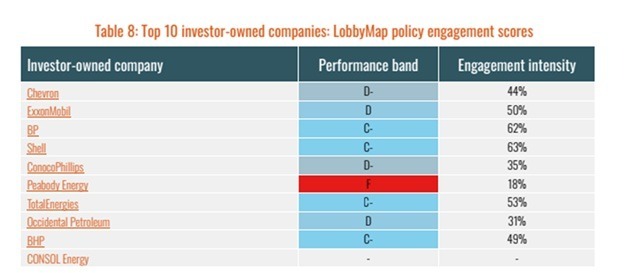
Top 10 investor-owned companies: LobbyMap engagement scores.
InfluenceMap gave climate policy lobbying scores to the top 10 investor-owned companies, all oil, gas, and coal firms. Credit: Carbon Majors 2025 report

None of the five top oil companies named in the report immediately responded to a request for comment from DeSmog.

Investor-owned companies aren’t the only ones actively fighting to prevent climate action, the Carbon Majors report notes.

“State-owned companies are even more oppositional to climate regulation globally according to LobbyMap research,” the report finds, listing Saudi Aramco, Russia’s Gazprom, Mexico’s Pemex, and China’s CHN Energy among the worst actors.

“The ‘Carbon Majors’ are keeping the world hooked on fossil fuels with no plans to slow production,” former United Nations climate chief and Paris Agreement architect Christiana Figueres said in a response accompanying the report. “While states drag their heels on their Paris Agreement commitments, state-owned companies are dominating global emissions — ignoring the desperate needs of their citizens.”

A sizable majority — 80 percent — of the year’s 20 worst offenders are state-owned, the report found.
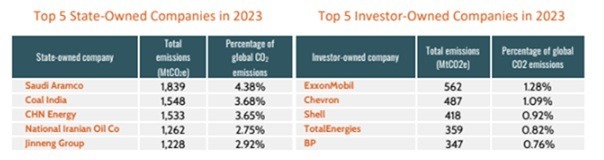
The 2025 Carbon Majors report compared the total CO2 emissions and percentage of total emissions for the top 5 state-owned (Saudi Aramco, Coal India, CHN Energy, National Iranian Oil, Jinneng Group) and top 5 investor-owned (ExxonMobil, Chevron, Shell, TotalEnergies, BP) companies in 2023
State-owned fossil fuel companies dominated global climate emissions in 2023, compared to public companies, the Carbon Majors report noted. Credit: Carbon Majors report 2025

Throughout history, responsibility for driving climate change is concentrated among a strikingly small number of corporations, the report suggests.

Two-thirds of all fossil fuel and cement emissions worldwide from 1750 through 2023 can be traced to just 181 entities, the report finds, adding that one-third of emissions came from just 26 companies.

These findings may have significant legal consequences. During 2024, New York state and Vermont both enacted “Climate Superfund” laws that aim to hold fossil fuel producers and oil refiners responsible for the damage done by their climate-altering products — and the Carbon Majors database is a proposed tool to assess companies’ relative liabilities, according to InfluenceMap. Its earlier findings have been cited in civil lawsuits brought by U.S. cities and counties against fossil fuel producers and an inquiry in the Philippines (which has seen some of the strongest typhoons in recorded history) into corporate responsibility for human rights violations.

The report approaches companies’ contributions to climate change based on production data —  meaning that it focuses on the companies that do the drilling and mining (which helps avoid double-counting, Connaire told DeSmog). Those production figures are self-reported by companies but are widely used by governments to assess taxes and by investors in public companies. That methodology means that, for example, natural gas pipeline companies and natural gas utilities aren’t included in the report’s rankings. 

Nonetheless, natural gas producers figure among the report’s list of all-time top polluters. That includes the former Chesapeake Energy, which first rose to prominence — and some notoriety — during the shale gas fracking boom only to implode into bankruptcy in 2020. Chesapeake later emerged from bankruptcy and has since merged into the newly formed Expand Energy.

As the Carbon Majors database traces emissions throughout history, it accounts for the effects of mergers and acquisitions in the tumultuous oil industry, known for its booms and busts. “For example, the multiple smaller companies into which the Standard Oil Trust was broken up have evolved to become some of the most recognizable companies in the database today,” the report notes. “Some are direct descendants of Standard Oil, like ExxonMobil, with both Exxon and Mobil as descendants separately, and Chevron. Others have resulted from mergers with descendants of Standard Oil, such as BP and ConocoPhillips.”
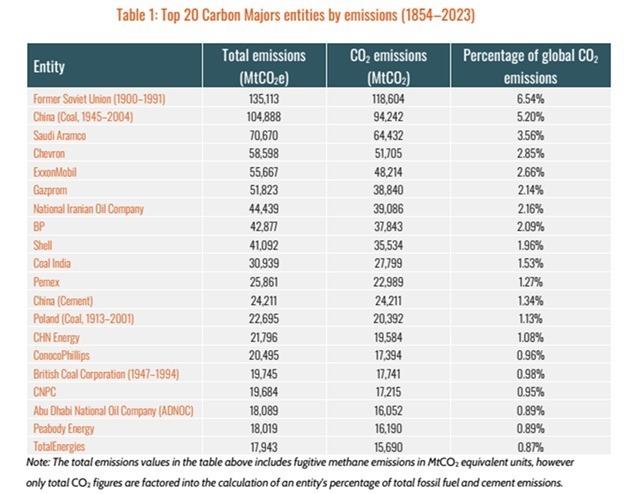
Top 20 carbon majors entities by emissions, from 1854-2023: Former Soviet Union (1900-1991), China (Coal, 1945-2004), Saudi Aramco, Chevron, ExxonMobil, Gazprom, National Iranian Oil Company, BP, Shell, Coal India, Pemex, China (Cement), Poland (Coal, 1913-2001), CHN Energy, ConocoPhillips, British Coal Corporation (1947-1994), CNPC, Abu Dhabi National Oil Company (ADNOC), Peabody Energy, TotalEnergies
The Carbon Majors database traces the historical cumulative emissions of the top individual entities, such as Chevron or the former Soviet Union, from 1854 through 2023. Credit: Carbon Majors report 2025

It also calls attention to the importance of coal pollution — not just historically, but also in 2023.

“In 2023, coal remained the largest source of emissions, contributing 41.1 percent of emissions in the database,” the new report finds, “continuing a steady increase since 2016.”

Emissions from the cement industry — also a major driver of carbon pollution — increased significantly in 2023, rising 6.5 percent year-over-year, which the Carbon Majors report noted was “the largest relative rise” found. “Four of the five companies with the greatest relative increases in emissions in 2023 were cement companies — Holcim Group, Heidelberg Materials, UltraTech Cement, and CRH — with cement emissions seeing the largest relative rise among the four commodity types.”

Cement producers aren’t the only ones, however. In fact, emissions from most of the top emitters rose in 2023, the Carbon Majors report found. 

“It is truly alarming that the largest fossil fuel companies continue to increase their emissions in the face of worsening natural disasters caused by climate change, disregarding scientific evidence that these emissions are harming us all,” said Tzeporah Berman, founder of the Fossil Fuel Non-Proliferation Treaty Initiative. “It is clearer than ever that dirty private companies, driven by profits and business as usual, will never choose to self-regulate. Governments around the world must use their power to end fossil fuel expansion and transition their economies before fossil fuel companies destroy the planet.”

Original article by Sharon Kelly republished from DeSmog.

Greenpeace activists display a billboard during a protest outside Shell headquarters on July 27, 2023 in London.
Greenpeace activists display a billboard during a protest outside Shell headquarters on July 27, 2023 in London. (Photo: Handout/Chris J. Ratcliffe for Greenpeace via Getty Images)
Neo-Fascist Climate Science Denier Donald Trump says Burn, Baby, Burn.
Continue ReadingJust 36 Companies Drove Half the World’s Climate-Altering Emissions in 2023: New Report

Canceled Canadian CCS Project Deemed ‘Not Economically Feasible’

Spread the love

Original article by Taylor Noakes republished from DeSmog.

https://www.desmog.com/2024/05/06/capital-power-generation-genesee-power-plant-canceled-canadian-ccs-project-not-economically-feasible/

Capital Power Generation pulled the plug on a $2.4 billion carbon capture and storage project at the Genesee Generating Station. Credit: Wikimedia Commons (CC BY-NC-ND 2.0)

Repeal accompanies a new report that confirms existing carbon capture projects continue to underperform.

Capital Power Generation has canceled a $2.4 billion carbon capture and storage (CCS) project at their Genesee Generating Station, claiming it is “technically viable but not economically feasible.”

The project aimed to capture and sequester up to 3 million tons of carbon dioxide emissions from the Genesee Power Plant, located southwest of Edmonton, Alberta, a plant that’s in the process of being converted from coal to natural gas.

Julia Levin, associate director of National Climate with Environmental Defence, characterized the cancellation as yet another failure for carbon capture.

“This decision is just the latest failure in carbon capture’s terrible track record,” Levin said in a statement. “It should serve as a lesson for governments on how reckless it is to be using taxpayer dollars to subsidize these projects.”

She indicated that the project had already received $5 million from the Government of Alberta, and was further eligible for additional tax breaks from both the federal and provincial governments.

“Carbon capture has not been successfully used in the power sector,” said Levin. 

“Most projects never make it off the ground,” she added. “The few that do, like the Boundary Dam coal plant, capture a fraction of the promised rate.” Levin also noted that equipping power plants with carbon capture makes fossil fuel-generated power even more expensive, while the cost of renewable energy has plummeted.

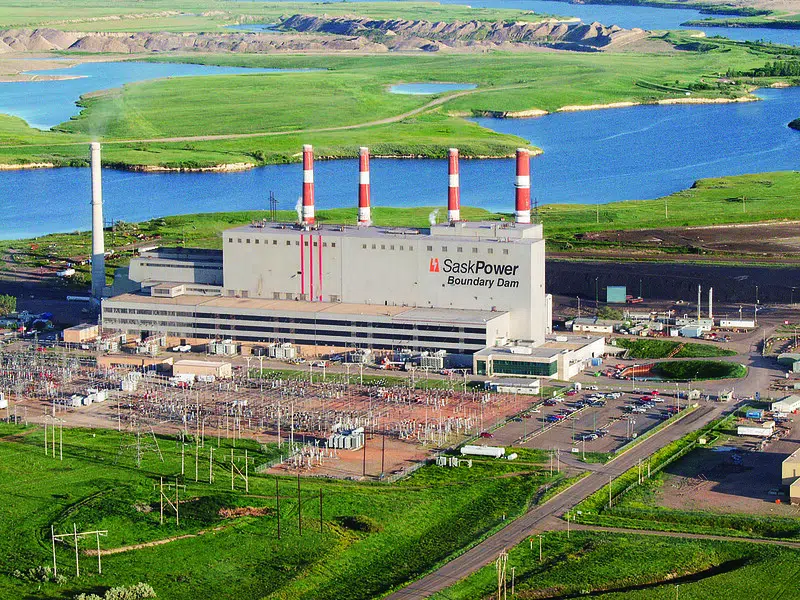
The Boundary Dam carbon capture and storage facility in Saskatchewan never met the 90 percent capture rate originally promised. Credit: SaskPower/Flickr

The Institute for Energy Economics and Financial Analysis (IEEFA) recently released new research that shows the failures of carbon capture in the Boundary Dam coal facility. After nine years and $1 billion spent retrofitting the plant with CCS equipment, the facility never met the 90 percent capture rate owner-operator SaskPower originally promised. 

Moreover, all the carbon that Boundary Dam captured was used for enhanced oil recovery (EOR), a process where carbon dioxide is pumped into old wells to extract otherwise unobtainable oil. The IEEFA study further reveals that the Boundary Dam facility’s carbon capture rate is below 60 percent in total over nine years of operation.

“Canadians should not be proud of the money and resources wasted on carbon capture, and they should be especially concerned about the billions of dollars now earmarked for additional carbon capture investments,” said the IEEFA report’s authors, David Schlissel, director of resource planning analysis at the organization, and Mark Kalegha, an IEEFA energy finance analyst, in a statement. 

“Carbon capture is not a solution to the world’s climate crisis, especially when coupled with enhanced oil recovery,” they said. 

Part of a Decarbonization Plan

Capital Power Generation is an independent power company based in Edmonton, Alberta’s capital city. The company has described the Genesee plant’s conversion from coal to natural gas as part of its decarbonization effort. The company set a goal to decarbonize by 2045. The conversion is also in line with the coal phase-out goals of the Canadian government.

Despite claims by politicians and industry that natural gas is a bridge fuel, or that it is cleaner than coal, the reality is that natural gas is not a carbon-neutral energy source, nor a viable method of decarbonizing the energy grid. Rather, natural gas is a destructive fossil fuel. Research from Robert W. Howarth, a professor of ecology and environmental biology at Cornell University, shows that methane emissions from natural gas is on par with coal’s.  

Natural gas is not considered a viable method of decarbonizing the energy grid. Credit: Felton Davis/Flickr

Emissions Reduction Alberta, a government funded group, previously claimed that the Genesee repowering and carbon capture projects could potentially remove about 6.4 million tons of carbon dioxide per year, with CCS projects handling about half that amount.

Though Capital Power Generation justified its decision to cancel the project by stating it wasn’t financially feasible, news reports show the company was holding out for additional financial support from various levels of government. As Global News reported, Altius Royalty Corp., owner of the coal mine that feeds the Genesee plant, had demanded $190 million in compensation from the federal and provincial governments to phase out coal. It argued that government efforts to terminate coal production for health and environmental reasons was equivalent to expropriation.

Altius filed the claim in 2018, and it was rejected by the Court of Appeal of Alberta in April.

In March, the Globe and Mail reported that Capital Power was considering shelving the Genesee CCS project because it couldn’t come to an agreement with the government to provide revenue certainty. The Canada Growth Fund (CGF), a $15 billion federal financing agency, is tasked with guaranteeing a minimum value for emissions-reduction credits earned under Canada’s industrial carbon-pricing system. The March news report claims that representatives from Capital Power argued that negotiations with the CGF had not produced a structure or price that would allow them to proceed with the project. A CGF representative countered that such frameworks and prices had already been negotiated with other companies.

Regardless of what specifics led Capital Power to cancel the Genesee CCS project, the fact remains that CCS is expensive, is often used for EOR, and has a long, well-documented history of under-delivering on the crucial issue of capturing carbon dioxide. Critics say the considerable amount of financial resources already dedicated to CCS have effectively been wasted, particularly when the means to cheaply decarbonize the grid – such as solar panels or wind turbines – are already available.

“The most effective way to deal with carbon dioxide emissions is to prevent them from ever being created,” said Levin with Environmental Defence, “rather than trying to pluck them from the air or smokestacks and inject them underground.”

Original article by Taylor Noakes republished from DeSmog.

Continue ReadingCanceled Canadian CCS Project Deemed ‘Not Economically Feasible’

Planet-Warming CO2 Emissions Surged to Record High in 2023: IEA

Spread the love

Original article by THOR BENSON republished from Common Dreams under Creative Commons (CC BY-NC-ND 3.0).

A sign reading “Stop, extreme heat danger” is seen in Death Valley National Park in California. (Photo: Patrick T. Fallon/AFP via Getty Images)

“The clean energy transition has undergone a series of stress tests in the last five years—and it has demonstrated its resilience,” said IEA Executive Director Fatih Birol.

Carbon emissions reached a record high in 2023, but the increased adoption of renewable energy is helping slow the pace, according to the International Energy Agency.

The IEA said in a new report that global CO2 emissions “increased by 410 million tonnes, or 1.1%, in 2023—compared with a rise of 490 million tonnes the year before—taking them to a record level of 37.4 billion tonnes.”

But the agency found that carbon emissions “rose less strongly in 2023 than the year before even as total energy demand growth accelerated… with continued expansion of solar PV, wind, nuclear power, and electric cars helping the world avoid greater use of fossil fuels.”

The report notes that “exceptional droughts” decreased the amount of hydropower that could be produced last year. Demand for coal fell to “levels not seen since the early 1900s.” It says CO2 emissions would have been three times larger had renewable energy not been utilized to generate electricity.

An IEA report from September found that rapid adoption of clean energy technologies could keep the world from surpassing the 1.5°C warming target. The Energy Information Administration forecast in December that 2024 could become the first year that wind and solar power generate more electricity than coal in the U.S.

The world will need to adopt a lot more renewable energy to address the climate crisis. Last month was most likely the warmest February on record, and records like that are being set every year. The more countries burn fossil fuels, the higher the temperatures will go.

“The clean energy transition has undergone a series of stress tests in the last five years—and it has demonstrated its resilience,” said IEA executive director Fatih Birol. “A pandemic, an energy crisis and geopolitical instability all had the potential to derail efforts to build cleaner and more secure energy systems. Instead, we’ve seen the opposite in many economies.”

Original article by THOR BENSON republished from Common Dreams under Creative Commons (CC BY-NC-ND 3.0).

Imperiling Climate Goals, Global Resource Extraction Set to Surge 60% by 2060

‘Frightening’: Greenland Losing 33 Million Tons of Ice Per Hour Due to Climate Crisis

2023 Destroys Global Heat Record as Fossil Fuel Emissions Boil the Planet

Continue ReadingPlanet-Warming CO2 Emissions Surged to Record High in 2023: IEA

Within Decade, Planet’s Natural World Facing Largest Mass Extinction Event Since Dinosaurs

Spread the love

Latest analysis by World Wildlife Fund warns humanity—possible “victim of it own lifestyle”—might ultimately be added to list of threatened species.

JULIA CONLEY December 30, 2021

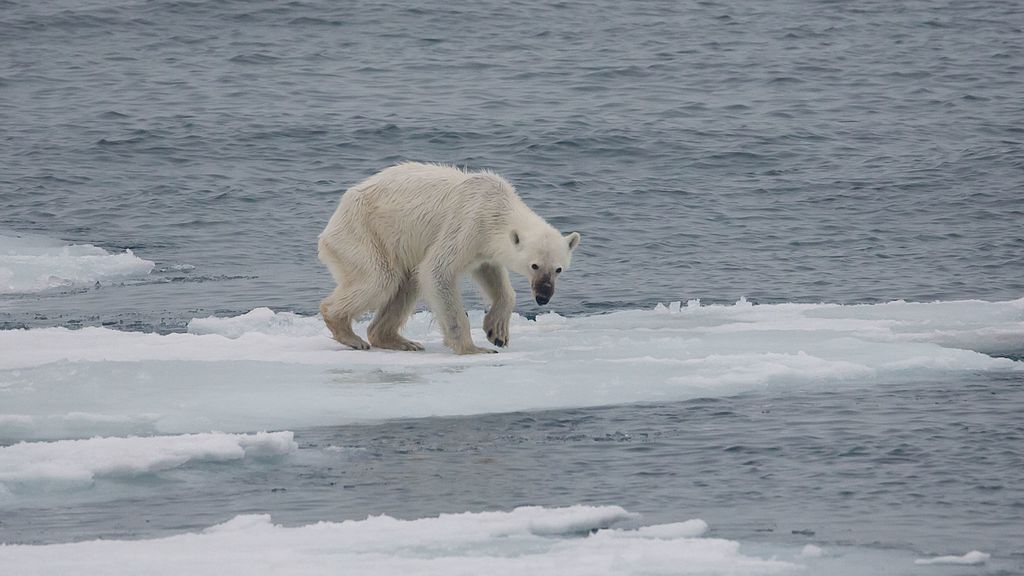
In summer, some polar bears do not make the transition from their winter residence on the Svalbard islands to the dense drift ice and pack ice of the high arctic where they would find a plethora of prey. This is due to global climate change which causes the ice around the islands to melt much earlier than previously. The bears need to adapt from their proper food to a diet of detritus, small animals, bird eggs and carcasses of marine animals. Very often they suffer starvation and are doomed to die. The number of these starving animals is sadly increasing.AWeith This file is licensed under the Creative Commons Attribution-Share Alike 4.0 International license.
https://en.wikipedia.org/wiki/File:Endangered_arctic_-_starving_polar_bear.jpg

Increasingly dire ecological damage and severe impacts of the climate crisis are pushing the natural world towards a mass extinction event unparalleled since the age of the dinosaurs, conservationists in Germany warned this week, with humanity possibly facing self-annihilation if behaviors do not change.

Releasing its annual “Winners and Losers” list on Wednesday, the World Wildlife Fund’s German branch said 40,000 of the 142,500 species listed on the Red List of Threatened Species by the International Union for Conservation of Nature (IUCN) are “threatened with extinction.”

“If the earth is sick, so will the people [be], because we depend on vital ecosystems and biodiversity for our own safe and healthy life.”

The Red List is now longer than it has ever been since the IUCN began cataloging threatened species in 1964.

More than 40% of amphibians, 27% of shark and ray species, a third of reef building corals, and more than a quarter of all mammals on the Red List are threatened with extinction.

At the current rate of species loss, “around one million species could go extinct within the next decade—which would be the largest mass extinction event since the end of the dinosaur age,” WWF Germany said in a statement.

With planet-heating atmospheric carbon dioxide emissions reaching a record high this year—contributing to drought, habitat loss, extreme weather, and health problems in humans as well as other species—the organization noted that humans should view the extinction crisis as one that could affect them directly.

“Species conservation is no longer just about defeating an environmental problem, but is rather about the question of whether or not humanity will eventually end up on the Red List in an endangered category—and thereby become a victim of its own lifestyle,” WWF Germany director Eberhard Brandes said.

“If the earth is sick, so will the people [be],” he added, “because we depend on vital ecosystems and biodiversity for our own safe and healthy life.”

The “losers” on the WWF’s list include the polar bear, which is already suffering from the erosion of its Arctic habitat as the northern region becomes warmer. The Arctic Ocean could be completely free of ice by 2035 at the current rate of loss, making it increasingly difficult for the bears to find food.

Sharks and rays also made the list, the result of overfishing, habitat loss, and the climate crisis. A third of all sharks and rays in the oceans were classified as threatened in 2021, the WWF said.

African forest elephants have been considered “critically endangered” for the first time this year, as their population in Central and West Africa has plummeted by 86% in the past three decades.

The inclusion of 40,000 species on the IUCN’s list of threatened species represents a major acceleration of biodiversity loss. In 2010, 17,300 species were considered to be under threat, according to The Guardian.

The WWF’s list of “winners” this year includes bearded vultures, which have benefited from a resettlement program in the last 30 years that’s resulted in more than 300 of the birds now living in the Alpine region; the Iberian lynx, whose population has increased more than tenfold in the past 18 years; and Siamese crocodiles in Cambodia. Eight young crocodiles were found by researchers this year, marking the first time in more than a decade that the species has reproduced in nature.

“The winners of the list show that there are still opportunities for species protection,” said Brandes. “If we implement effective nature conservation measures, we can protect plants, animals and, ultimately, the climate.”


From https://www.commondreams.org/news/2021/12/30/within-decade-planets-natural-world-facing-largest-mass-extinction-event-dinosaurs licensed under Creative Commons (CC BY-NC-ND 3.0). Feel free to republish and share widely.

Continue ReadingWithin Decade, Planet’s Natural World Facing Largest Mass Extinction Event Since Dinosaurs