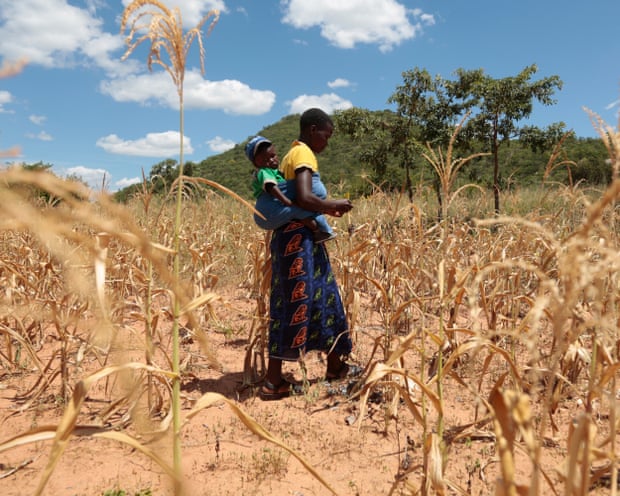
A maize crop affected by lack of rain in Zimbabwe. ‘The biggest food security impact, in southern Africa, will be during the 2027 to 2028 lean season,’ one expert said. Photograph: Aaron Ufumeli/EPA
UN forecasters warn of worsening conditions in 45 countries currently experiencing severe food insecurity
About 50 million people are likely to be pushed into acute hunger before the end of next year by the rapidly developing El Niño weather system, according to forecasting.
This is in addition to the hundreds of millions of people already facing dangerous levels of hunger, owing to years of drought in parts of Africa and pressure on food prices from the war in Iran.
Even if the forecast El Niño is less strong than some models predict, it will tip many countries over the edge, adding more than a fifth to the 225 million people in 45 countries currently in acute food insecurity, the UN’s World Food Programme (WFP) warned on Wednesday.
Central and South America, the Caribbean and southern Africa are likely to be worst affected, according to the analysis. In south and south-east Asia there is likely to be less rainfall than usual, which would cause serious problems for agriculture and farmers.
This year’s El Niño – a weather system that develops every few years in the Pacific Ocean and brings changes to rainfall patterns around the world – is shaping up to be the strongest in at least 70 years. Some are calling it a “super El Niño”, though this term is not officially recognised.
Nigel Farage urges you to ignore facts and reality and be a climate science denier like him and his Deputy Richard Tice. He says that Reform UK has received £Millions and £Millions from the fossil fuel industry to promote climate denial and destroy the planet.Donald Trump urges you to be a Climate Science denier like him. He says that he makes millions and millions for destroying the planet, Burn, Baby, Burn and Flood, Baby, Flood.Power-mad orange gasbag Donald Trump says Burn, Baby, Burn.
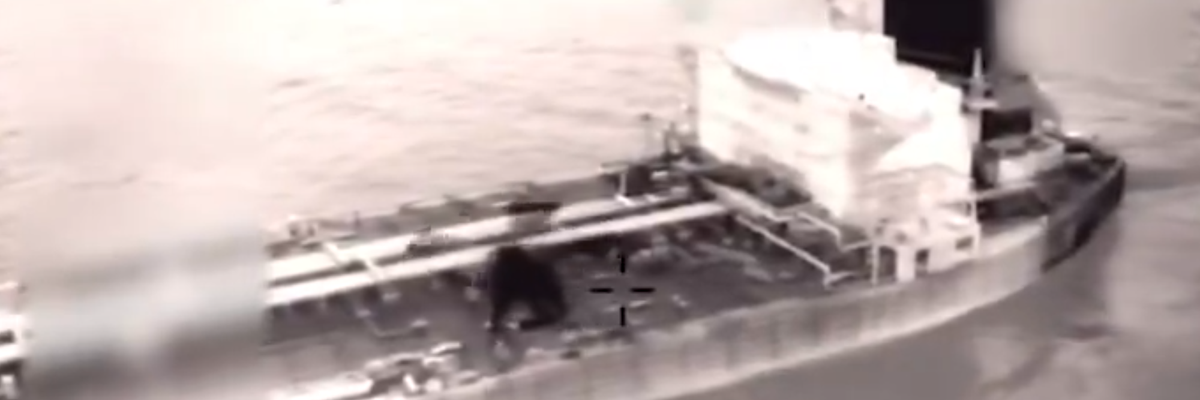
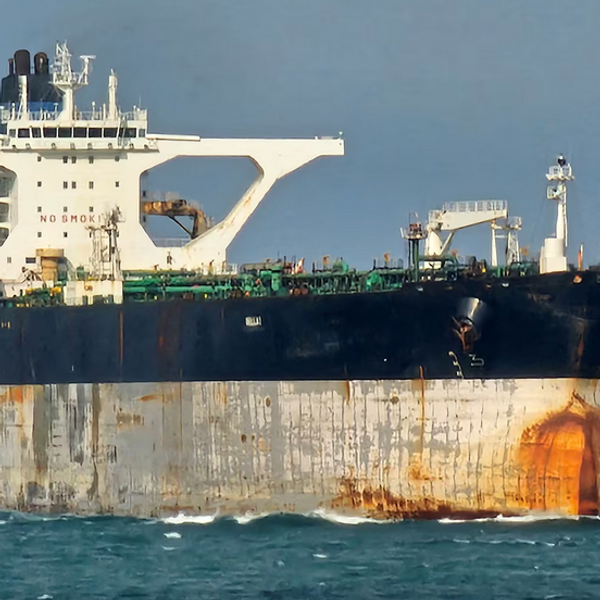
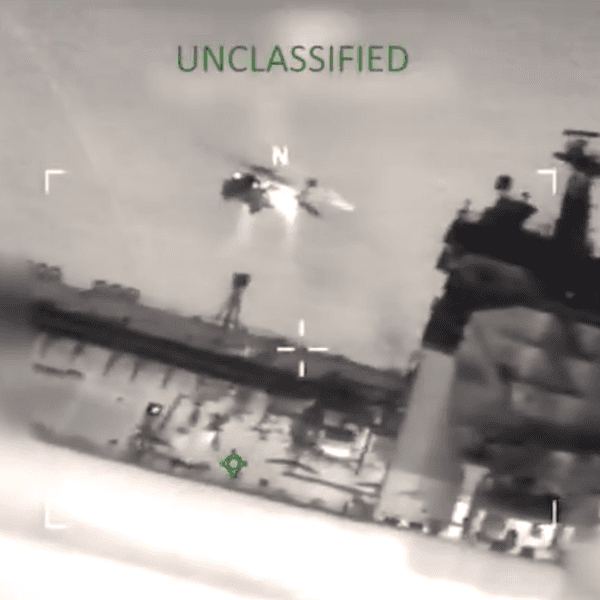
The oil tanker Olina is seized by US forces off the coast of Trinidad on January 9, 2025. (Screenshot from a video posted by Secretary of Homeland Security Kristi Noem)
The US has purloined over $300 million of oil in a month while enforcing a blockade, which UN experts say has “seriously undermined the human rights of the Venezuelan people.”
As President Donald Trump geared up for a meeting with fossil fuel executives about plans for them to tap into the “tremendous wealth” of Venezuela’s vast oil supply, the US militaryseized another oil tanker in the Caribbean off the coast of Trinidad on Friday morning.
Homeland Security Secretary Kristi Noem posted unclassified footage from US Southern Command of explosives being deployed and soldiers boarding the vessel Olina on social media.
“As another ‘ghost fleet’ tanker ship suspected of carrying embargoed oil, this vessel had departed Venezuela attempting to evade US forces,” she said. “This is owning the sea.”
The world’s criminals are on notice.
Early this morning, the @USCG executed a boarding and seizure of the Motor Tanker Olina in international waters east of the Caribbean Sea. As another "ghost fleet" tanker ship suspected of carrying embargoed oil, this vessel had departed… pic.twitter.com/vvS3u3nrvl
Olina, which was reportedly carrying around 700,000 barrels of crude, is at least the fifth tanker seized by the military in recent weeks and the third in the last three days after the Trump administration imposed a blockade on sanctioned oil tankers leaving Venezuela in December, a move that has been credited with hastening the country’s economic collapse.
Earlier this week, US Energy Secretary Chris Wright said the US plans to manage Venezuela’s oil sales and revenues indefinitely following its illegal operation last weekend to topple and abduct President Nicolás Maduro.
According to the ship-tracking database TankerTrackers.com, the US has “seized five tankers and 6.15 million barrels in the span of a month, with the oil valued at over $300 million.”
The US has described Olinaand other ships it has seized as part of a “shadow fleet” that uses deceptive tactics—including flying false flags—to secretively transport oil for sanctioned countries, including Venezuela, Russia, and Iran.
The US has justified its blockade of Venezuela’s oil, as well as the overthrow of Maduro generally, based on the claim that its government is part of an alleged foreign terrorist organization known as the “Cartel de los Soles.”
In late December, a group of United Nations experts condemned the blockade and denounced this justification, stating that the alleged cartel does not exist. The US Department of Justice later acknowledged that the cartel was not an actual organization in its indictment of Maduro this week. Maduro has pleaded not guilty to US narco-terrorism charges.
The group of international experts, which included Ben Saul, the UN’s special rapporteur on human rights and counterterrorism, and Gina Romero, the special rapporteur on freedom of association and assembly, described the blockade as “violating fundamental rules of international law.”
“There is no right to enforce unilateral sanctions through an armed blockade,” the experts said, citing the United Nations Charter, which describes blockades without UN Security Council approval as illegal acts of aggression.
They added that “there are serious concerns that the sanctions are unlawful, disproportionate, and punitive under international law, and that they have seriously undermined the human rights of the Venezuelan people.”
Elon Musk urges you to be a Fascist like him, says that you can ignore facts and reality then.Donald Fuhrump says that Amerikkka doesn’t bother with crimes or charges anymore, not being 100% Amerikkkan and opposing his real estate intentions is enough.Orcas discuss how Trump was re-elected and him being an obviously insane, xenophobic Fascist.
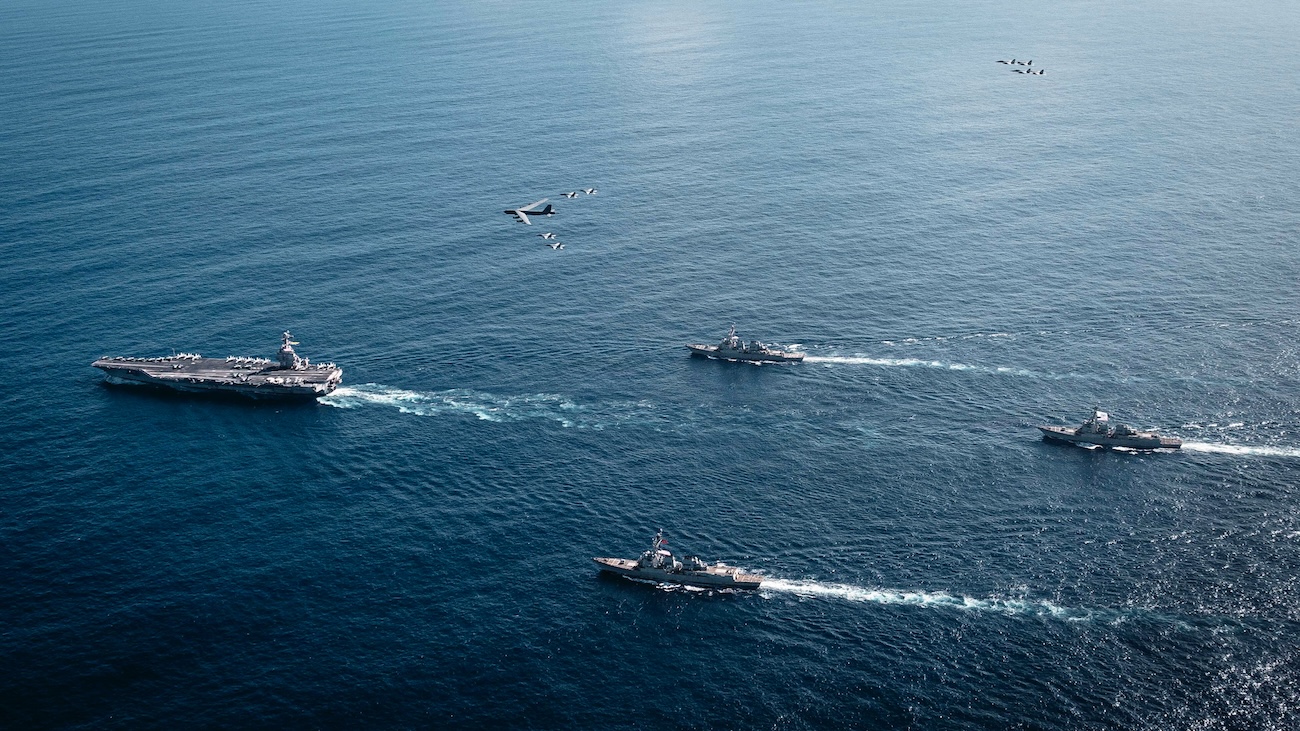
US war ships in the Caribbean. Photo: US Secretary of Defense/War
The US aggression against Venezuela has fomented divisions within the Caribbean, with many calling on countries like Trinidad and Tobago to refuse cooperation with the US in its military endeavors against the peoples of the region
US President Donald Trump has authorized the USS Gerald R. Ford to enter the Caribbean. It now floats north of Puerto Rico, joining the USS Iwo Jima and other US navy assets to threaten Venezuela with an attack. Tensions are high in the Caribbean, with various theories floating about regarding the possibility of what seems to be an inevitable assault by the US and regarding the social catastrophe that such an attack will occasion. CARICOM, the regional body of the Caribbean countries, released a statement affirming its view that the region must be a “zone of peace” and that disputes must be resolved peacefully. Ten former heads of government from Caribbean states published a letter demanding that “our region must never become a pawn in the rivalries of others”.
Former Trinidad and Tobago Prime Minister Stuart Young said on August 21, “CARICOM and our region is a recognized zone of peace, and it is critical that this be maintained”. Trinidad and Tobago, he said, has “respected and upheld the principles of non-intervention and non-interference in the internal affairs of other countries and for good reason”. On the surface, it appears as if no one in the Caribbean wants the United States to attack Venezuela.
However, the current Prime Minister of Trinidad and Tobago, Kamla Persad-Bissessar (known by her initials as KPB), has openly said that she supports the US actions in the Caribbean. This includes the illegal murder of eighty-three people in twenty-one strikes since September 2, 2025. In fact, when CARICOM released its declaration on the region being a zone of peace, Trinidad and Tobago withdrew from the statement. Why has the Prime Minister of Trinidad and Tobago gone against the entire CARICOM leadership and supported the Trump administration’s military adventure in the Caribbean?
Backyard
Since the Monroe Doctrine (1823), the United States has treated all Latin America and the Caribbean as its “backyard”. The United States has intervened in at least thirty of the thirty-three countries in Latin America and the Caribbean (90 percent of the countries, in other words) – from the US attack on Argentina’s Malvinas Islands (1831-32) to the current threats against Venezuela.
The idea of the “zone of peace” emerged in 1971 when the UN General Assembly voted for the Indian Ocean to be a “zone of peace”. In the next two decades, when CARICOM debated this concept for the Caribbean, the United States intervened in, at least, the Dominican Republic (after 1965), Jamaica (1972-1976), Guyana (1974-1976), Barbados (1976-1978), Grenada (1979-1983), Nicaragua (1981-1988), Suriname (1982-1988), and Haiti (1986).
In 1986, at the CARICOM summit in Guyana, the Prime Minister of Barbados, Errol Barrow, said “My position remains clear that the Caribbean must be recognized and respected as a zone of peace… I have said, and I repeat, that while I am prime minister of Barbados, our territory will not be used to intimidate any of our neighbors be that neighbor Cuba or the USA.” Since Barrow made that comment, Caribbean leaders have punctually affirmed, against the United States, that they are nobody’s backyard and that their waters are a zone of peace. In 2014, in Havana, all members of the Community of Latin American and Caribbean States (CELAC) approved a “zone of peace” proclamation with the aim “of uprooting forever [the] threat or use of force” in the region.
Persad-Bissessar or KPB has rejected this important consensus across political traditions in the Caribbean. Why is this so?
Betrayals
In 1989, trade union leader Basdeo Panday formed the United National Congress (UNC), a centre-left formation (whose former name was the Caucus for Love, Unity, and Brotherhood). KPB joined Panday’s party and has remained in the UNC since then. Throughout her career till recently, KPB stayed at the center of the UNC, arguing for social democratic and pro-welfare policies whether as opposition leader or in her first term as Prime Minister (2010-2015). But even in her first term, KPB showed that she would not remain within the bounds of the centre-left but would tack Far-Right on one issue: crime.
In 2011, KPB declared a State of Emergency for a “war on crime”. At her home in Phillipine, San Fernando, KPB told the press, “The nation must not be held to ransom by groups of thugs bent on creating havoc in our society”, “We have to take very strong action”, she said, “very decisive action”. The government arrested seven thousand people, most of them released for lack of evidence against them, and the government’s Anti-Gang Law could not be passed: this was a policy that mimicked the anti-poor campaigns in the Global North. Already, in this State of Emergency, KPB betrayed the legacy of the UNC, which she dragged further to the Right.
When KPB returned to power in 2025, she began to mimic Trump with “Trinidad and Tobago First” rhetoric and with even harsher language against suspected drug dealers. After the first US strike on a small boat, KPB made a strong statement in support of it: “I have no sympathy for traffickers, the US military should kill them all violently”. Pennelope Beckles, who is the opposition leader in Trinidad and Tobago, said that while her party (the People’s National Movement) supports strong action against drug trafficking, such action must be “lawful” and that KPB’s “reckless statement” must be retracted. Instead, KPB has furthered her support of the US militarization of the Caribbean.
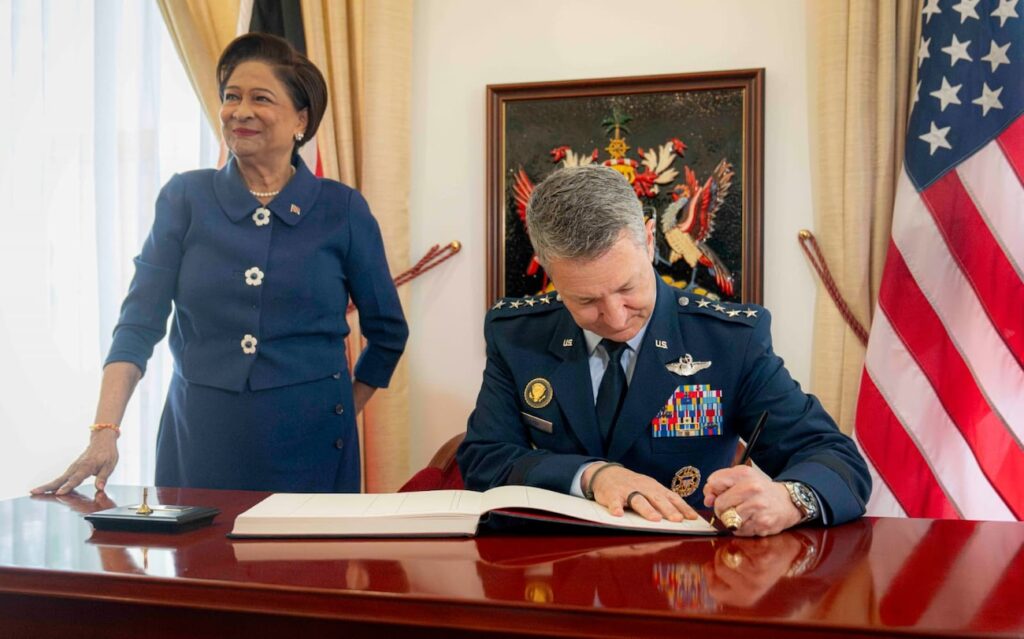
Trinidad and Tobago PM Kamla Persad-Bissessar with US Joint Chief of Staff General Dan Caine on November 25, 2025. Photo: US Embassy / X
Problems
Certainly, Trinidad and Tobago faces a tight knot of economic vulnerability (oil and gas dependence, foreign exchange shortages, slow diversification) and social crises (crime, inequality, migration, youth exclusion). All of this is compounded by the weakness of State institutions to help overcome these challenges. The weakness of regionalism further isolates small countries such as Trinidad and Tobago, which are vulnerable to pressure from powerful countries. But KPB is not only acting due to pressure from Trump; she has made a political decision to use US force to try and solve her country’s problems.
What could be her strategy? First, get the United States to bomb small boats that are perhaps involved in the centuries-old Caribbean smuggling operations. If the US bombs enough of these little boats, then the small smugglers would rethink their transit of drugs, weapons, and basic consumer commodities. Second, use the goodwill generated with Trump to encourage investment into Trinidad and Tobago’s essential but stagnant oil industry. There might be short-term gain for KPB. Trinidad and Tobago requires at least USD 300 million if not USD 700 million a year for maintenance and for upgrading its petrochemical and Liquified Natural Gas plants (and then it needs USD 5 billion for offshore field development and building new infrastructure). ExxonMobil’s massive investment in Guyana (rumored to be over USD 10 billion) has attracted attention across the Caribbean, where other countries would like to bring in this kind of money. Would companies such as ExxonMobil invest in Trinidad and Tobago? If Trump wanted to reward KPB for her unctuousness, he would tell ExxonMobil CEO Darren Woods to expand on the deepwater blocks investment his company has already made in Trinidad and Tobago. Perhaps KPB’s calculation to set aside the zone of peace ideas will get her some more money from the oil giants.
But what does this betrayal break? It certainly disrupts further any attempt to build Caribbean unity, and it isolates Trinidad and Tobago from the broader Caribbean sensibility against the use of the waters for US military confrontations. There are real problems in Trinidad and Tobago: rising gun-related violence, transnational trafficking, and irregular migration across the Gulf of Paria. These problems require real solutions, not the fantasies of US military intervention. US military interventions do not resolve problems, but deepen dependency, escalate tensions, and erode every country’s sovereignty. An attack on Venezuela is not going to solve Trinidad and Tobago’s problems but might indeed amplify them.
The Caribbean has a choice between two futures. One path leads toward deeper militarization, dependency, and incorporation into the US security apparatus. The other leads toward the revitalization of regional autonomy, South-South cooperation, and the anti-imperialist traditions that have long sustained the Caribbean’s political imagination.
Donald Fuhrump says that Amerikkka doesn’t bother with crimes or charges anymore, not being 100% Amerikkkan and opposing his real estate intentions is enough.Elon Musk urges you to be a Fascist like him, says that you can ignore facts and reality then.
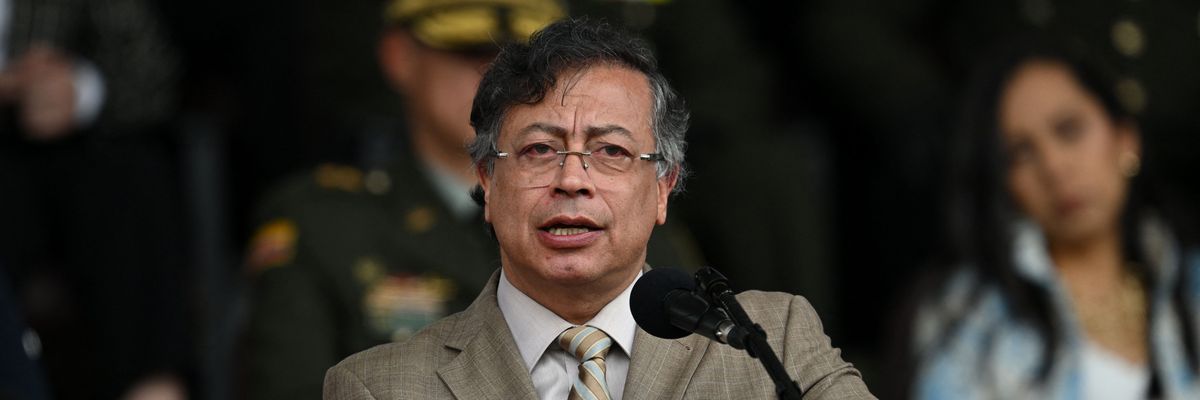
Colombia’s President Gustavo Petro delivers a speech during the commemoration of the 134th anniversary of the National Police and the promotion of officers at the General Santander Police Academy in Bogotá on November 13, 2025. (Photo by Raul Arboleda/AFP via Getty Images)
Rep. Gregory Meeks, who introduced a war powers resolution, said Trump’s actions combine the “worst excesses of the war on drugs and the war on terror.”
As Democrats in the US House of Representatives introduced their latest measure to stop President Donald Trump from continuing his attacks against alleged drug cartels without approval from Congress, the president said he wouldn’t “rule out” deploying US ground troops in Venezuela—and warned he could escalate attacks across Latin America, with possible strikes in Mexico and Colombia as well.
Shortly after the Department of Defense, called the Department of War by the Trump administration, announced its 21st illegal airstrike on what they’ve claimed, without evidence, to be “narco-terrorist” vessels mostly in the Caribbean—attacks that have killed at least 83 people—Trump told reporters in the Oval Office on Monday that he may soon begin similar operations against drug cartels in mainland Mexico.
“Would I launch strikes in Mexico to stop drugs? It’s OK with me. I’ve been speaking to Mexico. They know how I stand,” he said. “We’re losing hundreds of thousands of people to drugs. So now we’ve stopped the waterways, but we know every route.”
Earlier this month, following reports from US officials that the Trump administration had started “detailed planning” to send US troops to Mexico, the nation’s president, Claudia Sheinbaum, retorted that “it’s not going to happen.”
In his comments Monday, Trump threatened to carry out strikes in Colombia as well, saying: “Colombia has cocaine factories where they make cocaine. Would I knock out those factories? I would be proud to do it personally.”
Colombian President Gustavo Petro has been one of Latin America’s fiercest critics of Trump’s extrajudicial boat bombings, last week referring to the US president as a “barbarian.” Trump, meanwhile, has baselessly accused Petro of being “an illegal drug leader,” slapping him and his family with sanctions and cutting off aid to the country.
In response to Trump’s threats on Monday, Petro touted the number of cocaine factories that have been “destroyed” under his tenure. According to figures from the Colombian Ministry of Defense, around 18,000 of them have been taken out of commission since Petro took office in 2022, a 21% increase from Colombia’s previous president.
Immediately after Trump issued his threat against Colombia, he backpedaled, saying: “I didn’t say I’m doing it, I would be proud to do it.”
However, reporting from Drop Site News earlier this month has suggested that Sen. Lindsey Graham (R-SC) “was briefed by Secretary of War Pete Hegseth on the new list of hard targets inside Venezuela, Colombia, and Mexico in early October, and lobbied fellow senators on expanding the war to include drug-related sites in Colombia.”
The senator had alluded to the plans on CBS News’ “Face the Nation,” saying: “We’re not gonna sit on the sidelines and watch boats full of drugs come into our country. We’re gonna blow them up and kill the people who want to poison America. And we’re now gonna expand our operations, I think, to the land. So please be clear about what I’m saying today. President Donald Trump sees Venezuela and Colombia as direct threats to our country, because they house narco-terrorist organizations.”
On Tuesday, a group of Democrats in the US House of Representativesintroduced another measure that would stop Trump from continuing his attacks against alleged drug cartel members without approval from Congress.
The measure would require the removal of “United States Armed Forces from hostilities with any presidentially designated terrorist organization in the Western Hemisphere,” unless Congress authorizes the use of military force or issues a declaration of war. Previous measures to stall Trump’s extrajudicial attacks have been narrowly stymied, despite receiving some support from the Republican majority.
“There is no evidence that the people being killed are an imminent threat to the United States of America,” said Rep. Gregory Meeks (NY), the top Democrat on the House Foreign Affairs Committee, who introduced the resolution.
Meeks added that Trump’s campaign of assassinations in Latin America combines “the worst excesses of the war on drugs and the war on terror.”
Trump’s threats of military action come after Hegseth announced what he called “Operation Southern Spear” last week, which he said would be aimed at “remov[ing] narco-terrorists from our hemisphere.” In a description that evoked the 19th-century Monroe Doctrine, Hegseth wrote on social media that “the Western Hemisphere is America’s neighborhood—and we will protect it.”
In the Oval Office, Trump declared, without evidence, that with each strike his administration carries out against Venezuelan boats, “we save 25,000 American lives,” which experts say is obviously false since Venezuela plays a very minor role in global drug trafficking.
Several international legal experts have said Trump’s strikes constitute a war crime. Earlier this month, Oona A. Hathaway, a professor of international law at Yale Law School, said that members of the Trump administration “know what they are doing is wrong.”
“If they do it, they are violating international law and domestic law,” Hathaway said. “Dropping bombs on people when you do not know who they are is a breach of law.”
The Trump administration has argued that its actions are consistent with Article 51 of the UN’s founding charter, which requires the UN Security Council to be informed immediately of actions taken in self-defense against an armed attack.
The administration has not provided evidence that its attacks constitute a necessary form of self-defense. But last month, a panel of independent UN experts said that “even if such allegations were substantiated, the use of lethal force in international waters without proper legal basis violates the international law of the sea and amounts to extrajudicial executions.”
Donald Fuhrump says that Amerikkka doesn’t bother with crimes or charges anymore, not being 100% Amerikkkan and opposing his real estate intentions is enough.
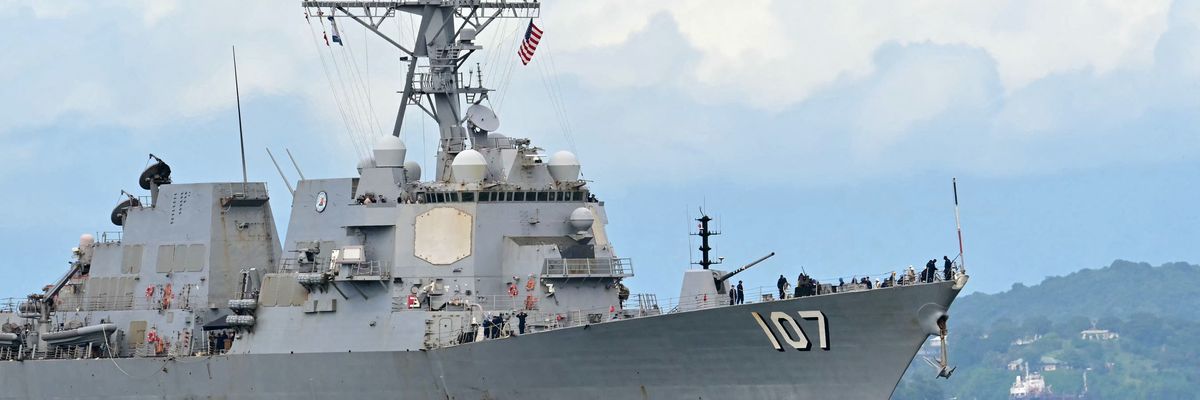
The USS Gravely enters the port at Port of Spain, Trinidad and Tobago on October 26, 2025. (Photo by Martin Bernetti/AFP via Getty Images)
“This is a colonial operation of military aggression that seeks to turn the Caribbean into a space for lethal violence and US imperial domination.”
The government of Venezuelan President Nicolás Maduro said Sunday that his country’s security forces captured a group of mercenaries aligned with the US Central Intelligence Agency, less than two weeks after President Donald Trump confirmed his authorization of covert CIA action against the South American nation.
Venezuela “reports that it has captured a mercenary group with direct information from the US intelligence agency, CIA, being able to determine that a false-flag attack is underway from waters bordering Trinidad and Tobago, or from Trinidad or Venezuelan territory itself,” the Venezuelan government said in a statement.
“This planned action perfectly evokes the provocation of the Battleship Maine and the Gulf of Tonkin, which gave rise to the war against Spain to seize Cuba in 1898 and allowed the US Congress to authorize involvement in an eternal war against Vietnam in 1964, from which they emerged defeated by the Vietnamese people after facing incalculable destruction and regrettable human loss,” the statement continues.
“The government of Prime Minister Kamla Persad-Bissessar has renounced the sovereignty of Trinidad and Tobago to act as a military colony subordinate to US hegemonic interests, turning its territory into a US aircraft carrier for war throughout the Caribbean against Venezuela, Colombia, and all of South America,” Caracas asserted.
Confirmed statement by Venezuela: US-CIA mercenaries were caught coming from Trinidad & Tobago to infiltrate Venezuela and initiate a false flag operation.
As expected, Trinidad has positioned itself to serve as the staging ground for US intervention in the region: pic.twitter.com/dwULCHMEvc
By folding to Washington’s militaristic agenda, Persad-Bissessar not only intends to attack Venezuela, a country that has always maintained a policy of energy cooperation, mutual respect, and Caribbean integration, and break our historic bonds of brotherhood; she also violates the United Nations Charter, the proclamation of Latin America and the Caribbean as a Zone of Peace approved by [the Community of Latin American and Caribbean States], and the principles of [the Caribbean Community], which protect all peoples of the Caribbean.
These are not defensive exercises: this is a colonial operation of military aggression that seeks to turn the Caribbean into a space for lethal violence and US imperial domination.
“Venezuela does not accept threats from any vassal government of the US. We are not intimidated by military exercises or war cries,” the statement says, adding that the country “will always defend its sovereignty, its territorial integrity, and its right to live in peace against foreign enemies and [their] vassals.”
Venezuela’s accusation came amid joint military exercises between the US and Trinidad and Tobago in the Caribbean Sea and follows a string of deadly US attacks on vessels the Trump administration claimed—without evidence—were transporting drugs bound for the United States. According to the Trump administration, at least 43 people have been killed in the US boat strikes in the southern Caribbean and Pacific Ocean since early last month.
Trinidad and Tobago challenged Venezuela to provide proof of the alleged false-flag operation and said the joint military operation with the United States “aims to bolster the fight against transnational crime and build resilience through training, humanitarian activities, and security cooperation.”
The Trump administration—which had already deployed an armada of warships and thousands of troops to the southern Caribbean—said Friday that it ordered the USS Gerald R. Ford carrier strike group off the coast of Venezuela, which possesses the world’s largest oil reserves.
The US has been meddling in Venezuelan affairs since at least the late 19th century, going back to the 1895 border dispute between Venezuela and Britain. Since then, the United States has helped install and prop up brutal dictators and assisted in the subversion of democratic movements, including by training Venezuelan forces in torture and repression at the notorious US Army School of the Americas.
In the 21st century, successive US administrations beginning with George W. Bush have tried to thwart the Bolivarian Revolution that was launched by former President Hugo Chávez and continued under Maduro. During the first Trump administration, Venezuela foiled an attempt by a group of mercenaries, including two Americans, to invade the country and topple Maduro.
Tens of thousands of Venezuelans have also died as a result of US economic sanctions, according to research from the Center for Economic and Policy Research.
Taunting the Venezuelan president during a Sunday appearance on CBS “60 Minutes,” Sen. Rick Scott (R-Fla.) said, “If I was Maduro, I’d head to Russia or China right now.”
However, senior Venezuelan officials waxed defiant in the face of the latest US threat.
“Once again, the empire and its accomplices seek to bend the sovereign will of the Venezuelan people through a criminal economic siege that flagrantly violates the Charter of the United Nations and international humanitarian law,” Venezuelan Foreign Minister Yván Gil Pinto said Monday.
“These actions are not only illegal,” he added, “they are an unconventional act of war that we are determined to face and defeat in all scenarios.”
Donald Fuhrump says that Amerikkka doesn’t bother with crimes or charges anymore, not being 100% Amerikkkan and opposing his real estate intentions is enough.Orcas discuss Donald Trump and the killer apes’ concept of democracy. Front Orca warns that Trump is crashing his country’s economy and that everything he does he does for the fantastically wealthy.