This work by Middle East Monitor is licensed under a Creative Commons Attribution-NonCommercial-ShareAlike 4.0 International License.
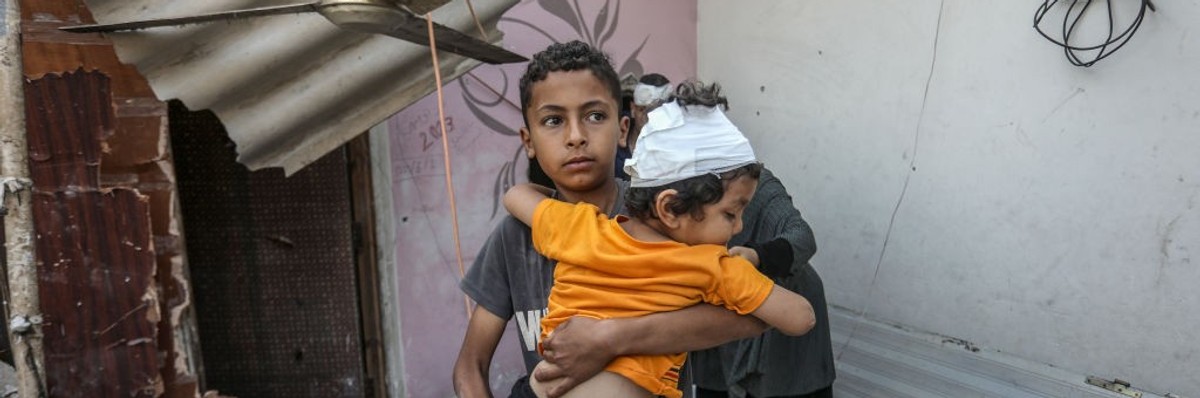
Injured Palestinians, including children are brought to al-Ahli Baptist Hospital for medical treatment aftermath of Israeli attack on Gaza City, Gaza on July 16, 2025. [Dawoud Abo Alkas – Anadolu Agency]
During a session at the UN Security Council on Wednesday, the Executive Director of UNICEF, Catherine Russell, revealed alarming figures about the impact of the ongoing Israeli offensive on Gaza.
She confirmed that more than 17,000 children have been killed since the beginning of the war, at an average rate of 28 children each day– the equivalent of an entire classroom.” It is as if we are losing an entire classroom of pupils every single day for two years.”
“Children are not political actors. They do not start conflicts, and they are powerless to stop them. But they suffer greatly, and they wonder why the world has failed them,” she added.
Meanwhile, the UN Under-Secretary-General Mr Tom Fletcher warned that the health situation in Gaza has reached catastrophic levels.
“Only 17 of 36 hospitals and 63 of 170 primary healthcare centres are functioning, all only partially, even as mass casualties arrive daily,” he highlighted.
Fletcher indicated that half of all medical equipment has been damaged, with the ongoing fuel crisis remaining critical, despite its vital role in powering ambulances and other essential services.
Expressing concern over the alarming rates of child starvation in June, he revealed that “more than 5,800 girls and boys have been diagnosed as acutely malnourished.”
“Last week, amid this hunger crisis, children and women were killed in a strike while waiting for the food supplements to keep them alive,” he warned.
This work by Middle East Monitor is licensed under a Creative Commons Attribution-NonCommercial-ShareAlike 4.0 International License.
Premature babies face serious health risks due to limited access to both breast milk and infant formula at the Patient Friends Benevolent Society Hospital in Gaza, on June 25, 2025. [Hamza Z. H. Qraiqea – Anadolu Agency]
UN Children’s Fund (UNICEF) chief Catherine Russell on Monday warned of a deepening nutrition crisis among infants in the Gaza Strip as humanitarian access remains severely restricted, Anadolu reports.
“Thousands of babies in Gaza lack proper nutrition as aid access remains severely hampered,” Russell wrote on X.
Highlighting the impact of Israel’s ongoing attacks on women and children, she said: “Many mothers have been killed or are too malnourished to breastfeed, leaving infants at risk of dying or with permanent health damage.”
“Every minute counts in saving their lives,” she added.
Despite international calls for a ceasefire, Israel has pursued a genocidal war on Gaza, killing more than 57,500 Palestinians, most of them women and children, since October 2023.
The International Criminal Court issued arrest warrants last November for Netanyahu and his former Defense Minister Yoav Gallant for war crimes and crimes against humanity in Gaza.
Israel also faces a genocide case at the International Court of Justice for its war on the enclave.
Palestinians, including children, collect remaining belongings from the rubble of destroyed houses after Israeli attacks on May 1, 2024 in Rafah, Gaza. (Photo: Abed Rahim Khatib/Anadolu via Getty Images)
A full-scale Israeli assault on the crowded southern Gaza city “would bring catastrophe on top of catastrophe for children.”
That’s how Catherine Russell, executive director of the United Nations Children’s Fund (UNICEF), concluded a brief video Wednesday about the harrowing conditions across the Gaza Strip, particularly in Rafah, where about 1.5 million of the besieged enclave’s 2.3 million residents have sought refuge from Israel’s devastating assault.
The video was released nearly seven months into Israel’s retaliation for the Hamas-led October 7 attack—which has killed at least 34,596 Palestinians in Gaza, wounded another 77,816, and left thousands more missing—and as a full-scale Israeli assault of Rafah looms.
The war has already taken “an unimaginable toll,” and a major military operation against the crowded southern Gaza city “would bring catastrophe on top of catastrophe for children,” Russell warned. “Nearly all of the some 600,000 children now crammed into Rafah are either injured, sick, malnourished, traumatized, or living with disabilities.”
“Many have been displaced multiple times and lost homes, parents, and loved ones,” the UNICEF chief noted. “There is nowhere safe to go in Gaza. Homes throughout the Gaza Strip lie in ruin. Roads are destroyed and the ground littered with unexploded ordnances.”
“Rafah is also the main hub for the humanitarian response, which includes UNICEF, and the city has some of the last functioning healthcare facilities,” she explained.
Israeli forces launched at least 435 attacks on health facilities or personnel during the first six months of the war, and just 10 of the enclave’s 36 hospitals remain partially functional, according to the World Health Organization. As Common Dreams reported Wednesday, thousands of Palestinian child amputees are struggling to recover due to the destruction of Gaza’s healthcare system.
“UNICEF continues to call for the protection of all women and children in Rafah and throughout the Gaza Strip—and the protection of the infrastructure, services, and humanitarian aid they rely on,” said Russell. “We repeat our calls for the unconditional release of all hostages in Gaza who need to be home with their children and families. The violence must end.”
An immediate and long-lasting humanitarian cease-fire;
Safe and unrestricted humanitarian access;
The immediate, safe, and unconditional release of all abducted children, and an end to any grave violations against all children;
Respect and protection for civilian infrastructure; and
Allow patients with urgent medical cases to safely access critical health services or leave.
As Russell called for peace in video form, James Elder, UNICEF’s global spokesperson, penned a Wednesday opinion piece for The Guardian following his recent trips to Gaza. He began with a startling anecdote:
The war against Gaza’s children is forcing many to close their eyes. Nine-year-old Mohamed’s eyes were forced shut, first by the bandages that covered a gaping hole in the back of his head, and second by the coma caused by the blast that hit his family home. He is nine. Sorry, he was nine. Mohamed is now dead.
“From looming famine to soaring death tolls, the latest fear is the much-threatened offensive in Rafah in southern Gaza,” he wrote. “Can it get any worse? It always seems to.”
“Rafah will implode if it is targeted militarily,” Elder stressed. “Water is in desperately short supply, not just for drinking but sanitation. In Rafah there is approximately one toilet for every 850 people. The situation is four times worse for showers. That is, around one shower for every 3,500 people. Try to imagine, as a teenage girl, or elderly man, or pregnant woman, queueing for an entire day just to have a shower.”
On October 31, just weeks after the start of what the International Court of Justice has since determined is Israel’s plausibly genocidal assault, UNICEF called Gaza a “graveyard” for children.
“Can it get any worse? It always seems to.”
“Last month I saw new graveyards in Rafah being constructed. And filled,” wrote Elder. “Every day the war brings more violent death and destruction. In my 20 years with the United Nations, I have never seen devastation like that I saw in the Gaza Strip cities of Khan Younis and Gaza City. And now we are told to expect the same via an incursion in Rafah.”
Elder recalled that “in the north of the territory, close to where a UNICEF vehicle came under fire last month, a woman clutched my hand and pleaded, over and over, that the world send food, water, and medicine. I will never forget how, as I felt her grasp, I tried to explain we were trying, and she continued to plead.”
“Why? Because she assumed the world did not know what was happening in Gaza. Because if the world knew, how could they possibly let this happen?” he continued. “How, indeed. The world has certainly been warned about Rafah. It remains to be seen how many eyes stay, or are forced, shut.”
![Injured Palestinians, including children are brought to al-Ahli Baptist Hospital for medical treatment aftermath of Israeli attack on Gaza City, Gaza on July 16, 2025. [Dawoud Abo Alkas - Anadolu Agency]](https://i0.wp.com/www.middleeastmonitor.com/wp-content/uploads/2025/07/AA-20250716-38579326-38579324-ISRAELI_ATTACK_ON_GAZA_LEAVES_MULTIPLE_CASUALTIES-1-1.jpg?fit=920%2C613&ssl=1)