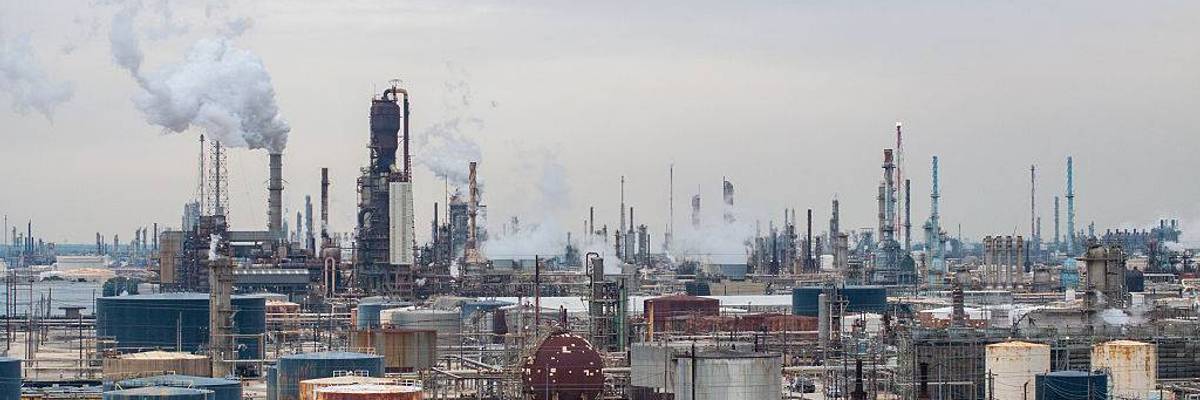
As reported by the New York Times, the court has agreed to hear arguments related to a petition filed by ExxonMobil and Canadian energy firm Suncor related to a 2018 lawsuit by the city of Boulder, Colorado that seeks financial damages from the companies for their role in causing global climate change.
The Times report noted that dozens of similar lawsuits have been filed by states and municipalities over the last decade, and they generally seek money from energy firms to help mitigate or repair damage done by extreme weather exacerbated by the climate crisis.
According to the Associated Press, attorneys for the energy companies are petitioning to have the case moved from state courts to federal courts that have in the past dismissed similar complaints.
“The use of state law to address global climate change represents a serious threat to one of our nation’s most critical sectors,” the attorneys claimed.
The Supreme Court’s decision to hear the case comes months after the Colorado Supreme Court ruled that Boulder’s lawsuit could initiate the discovery process and move toward a trial.
In an interview with the Colorado Sun, Boulder County Commissioner Ashley Stolzmann said that the city wasn’t backing down from its efforts make the fossil fuel industry pay for the damage it’s done.
“The oil companies have tried every avenue to delay our climate accountability case or move it to an out-of-state court system,” said Stolzmann. “As everyone continues to face rising costs that put budgets under pressure, we must hold oil companies accountable for the significant harm they’ve caused our communities.”
Richard Wiles, president of the Center for Climate Integrity, said that the merits of the Boulder lawsuit are clear, regardless of the Supreme Court’s intervention.
“Big Oil’s climate lies are the most consequential and harmful corporate deception campaign in history,” Wiles said, “and the communities paying the price for that deception deserve to put these companies on trial. Exxon’s desperation to escape accountability does not change the evidence of their wrongdoing or the law that lower courts agree is on Boulder’s side.”
Alyssa Johl, vice president of legal and general counsel at the Center for Climate Integrity, said the Supreme Court should simply affirm lower court rulings stating that “communities like Boulder have the right to seek accountability in their state courts when corporations have knowingly caused local harms.”
Donald Fuhrump says that Amerikkka doesn’t bother with crimes or charges anymore, not being 100% Amerikkkan and opposing his real estate intentions is enough.Orcas discuss Donald Trump and the killer apes’ concept of democracy. Front Orca warns that Trump is crashing his country’s economy and that everything he does he does for the fantastically wealthy.Elon Musk urges you to be a Fascist like him, says that you can ignore facts and reality then.
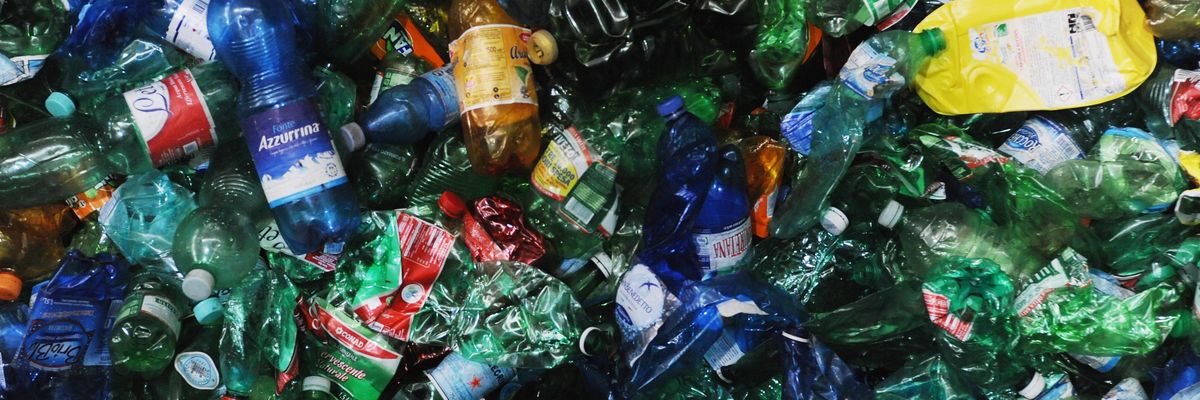
More than 90% of plastics disposed of between 1950 and 2015 were not recycled. (Photo: Laura Lezza/Getty Images)
“The oil industry’s lies are at the heart of the two most catastrophic pollution crises in human history,” one advocate said.
The petrochemical industry—including major oil companies like ExxonMobil—knew for decades that recycling was not a sustainable solution to the problem of plastic waste, yet continued to promote it in order to avoid regulation and deceive consumers into continuing to buy and use their products, a report released Thursday by the Center for Climate Integrity reveals.
The report, titled The Fraud of Plastic Recycling: How Big Oil and the Plastics Industry Deceived the Public for Decades and Caused the Plastic Waste Crisis, includes newly disclosed industry documents proving that companies and trade groups knew that plastics could not be recycled indefinitely in the 1980s and 90s even as they launched a massive public relations campaign to sell voters and policymakers on the process.
“This evidence shows that many of the same fossil fuel companies that knew and lied for decades about how their products cause climate change have also known and lied to the public about plastic recycling,” Center for Climate Integrity (CCI) president Richard Wiles said in a statement. “The oil industry’s lies are at the heart of the two most catastrophic pollution crises in human history.”
Big Oil and the plastics industry 🤯knew decades ago that recycling plastic is not viable at scale 🧐deceptively promoted plastic recycling as a false solution 😡directly fueled the plastic waste crisis
Plastic pollution is a major environmental and public health crisis. If current trends continue, plastics are expected to outweigh fish in the ocean by 2050, and the toxic fumes from plastic production facilities and incineration are a major environmental justice hazard for frontline communities. Humans in general also ingest an estimated credit-card’s worth of plastic each week, with unknown but potentially serious health impacts.
Recycling is often touted as a solution for keeping plastic out of the environment, but this has proven to be ineffective and insufficient: More than 90% of the plastics disposed of between 1950 and 2015 were either burnt, sent to landfills, or dumped into the environment. There are several technical and economic reasons why plastic recycling doesn’t work at scale. Plastics lose quality as they are recycled and can only really be reused once or potentially twice. The decline in quality also means that recycled plastics are more likely to leach toxins added during production or picked up from other waste items. Economically, it is cheaper to produce new plastics than recycle older ones, and only two types of plastic—PET and HDPE—actually attract markets that will recycle them.
The industry has long been aware of these limitations. In 1969, the American Chemical Society declared, “It is always possible that scientists and engineers will learn to recycle or dispose of wastes at a profit, but that does not seem likely to happen soon on a broad basis.”
“We are committed to the activities, but not committed to the results.”
Despite this, petrochemical companies and their trade groups began to push plastic recycling in the 1980s and 90s as a response to growing public concern over plastic waste, and the threat that this would lead to bans on plastic products.
“No doubt about it, legislation is the single most important reason why we are looking at recycling,” Wayne Pearson, the executive director of industry front group the Plastics Recycling Foundation and a DuPont marketing director, said in 1988.
The plastics industry used various strategies to sell the public on recycling, according to the report. These included:
Funding front groups to promote recycling;
Running ad and PR campaigns;
Investing in recycling research to convince the public that it was taking action;
Setting unrealistic internal recycling goals;
Writing educational material promoting recycling to school children;
Advocating for “advanced recycling,” a term for breaking plastics down to chemical components that can theoretically be reused but are not in practice; and
Claiming, against evidence, that recycling can be part of a “circular economy.”
CCI provides new evidence that, while the industry was employing these strategies, it was simultaneously aware of recycling’s limitations.
For example, a report from the Vinyl Institute trade group concluded in 1986 that “recycling cannot be considered a permanent solid waste solution, as it merely prolongs the time until an item is disposed of.”
In 1994, Exxon Chemical Vice President Irwin Levowitz told employees of the American Plastics Council that “we are committed to the activities, but not committed to the results.”
CCI argued that the petrochemical industry should face legal consequences for its “campaign of deception” similar to suits brought against tobacco and opioid companies.
“When corporations and trade groups know that their products pose grave risks to society, and then lie to the public and policymakers about it, they must be held accountable,” Wiles said. “Accountability means stopping the lying, telling the truth, and paying for the damage they’ve caused.”
CCI vice president of legal and general counsel Alyssa Johl added: “Big Oil and the plastics industry’s decades-long campaign to deceive the public about plastic recycling has likely violated laws designed to protect consumers and the public from corporate misconduct and pollution.”
“Attorneys general and other officials should carefully consider the evidence that these companies defrauded the public and take appropriate action to hold them accountable,” Johl said.
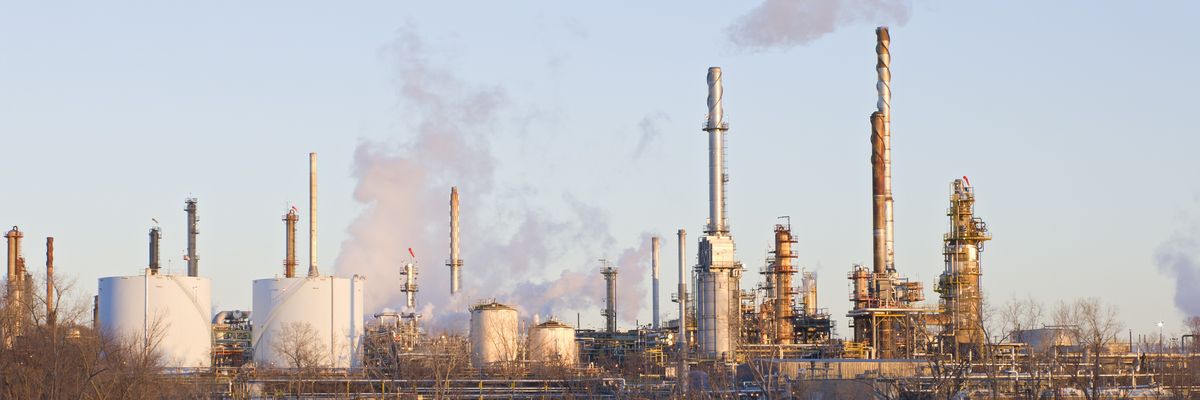
An oil and petroleum refinery is shown in St. Paul Park, Minnesota. (Photo: jferrer/iStock/Getty Images Plus)
“Big Oil companies will continue fighting to escape justice, but for the third time in a year, the U.S. Supreme Court has denied their desperate pleas,” said one campaigner.
For the third time in less than a year, the U.S. Supreme Court on Monday allowed a key case against the fossil fuel industry to proceed in state court, delivering a win for the movement to make polluters pay for driving the climate emergency.
“This decision is another step forward for Minnesota’s efforts to hold fossil fuel giants accountable for their climate lies and the harm they’ve caused,” said Center for Climate Integrity president Richard Wiles, pointing to the previous denials of other cases last April and May.
“Big Oil companies will continue fighting to escape justice, but for the third time in a year, the U.S. Supreme Court has denied their desperate pleas to overturn the unanimous rulings of every single court to consider this issue,” he continued.
“It’s time for these polluters to give up their failed arguments to escape state courts.”
As legal leaders of dozens of U.S. states and municipalities have launched climate lawsuits in recent years, the fossil fuel industry has attempted to evade accountability by shifting the cases to federal court—a strategy that’s proven unsuccessful.
Wiles argued that “after three strikes, it’s time for these polluters to give up their failed arguments to escape state courts and prepare to face the evidence of their climate deception at trial.”
The U.S. Supreme Court’s Monday decision came in a case filed in 2020 by Democratic Minnesota Attorney General Keith Ellison against ExxonMobil, Koch Industries, and the American Petroleum Institute (API), based on the state’s consumer protection laws.
“The fraud, deceptive advertising, and other violations of Minnesota state law and common law that the lawsuit shows they perpetrated have harmed Minnesotans’ health and our state’s environment, infrastructure, and economy,” Ellison said at the time.
The justices declined Big Oil’s request to review the 8th U.S. Circuit Court of Appeals’ March decision that the case belongs in state court. Justice Brett Kavanaugh, an appointee of former GOP President Donald Trump, would have taken the case, in line with his position last year.
“I appreciate the court’s consideration and decision,” Ellison said in a statement Monday. “It aligns with 25 federal court decisions across the country, all of which have found that cases like ours rest on these defendants’ failures to warn and their campaigns of deception around their products’ contributions to the climate crisis. The court’s decision confirms these cases are properly filed in state courts.”
“Taken together, the defendants’ behavior has delayed the transition to alternative energy sources and a lower-carbon economy, resulting in dire impacts on Minnesota’s environment and enormous costs to Minnesotans and the world,” he stressed. “Now, the case can move forward in state court, where it was properly filed, and we can begin to hold these companies accountable for their wrongful conduct.”
Cassidy DiPaola, communications director for Fossil Free Media and the Make Polluters Pay campaign, declared Monday that “today’s decision is an important step forward for accountability and justice.”
“The Supreme Court has now laid out an unmistakable path forward,” she added, “for not only Minnesota’s consumer protection case against ExxonMobil, Koch Industries, and API, but the dozens of cases against the fossil fuel industry popping up across the county.”
This post has been updated with comment from Keith Ellison.
‘Direct air capture’ of carbon pollution is still experimental, but a fossil fuel company is embracing it as a way to keep drilling.
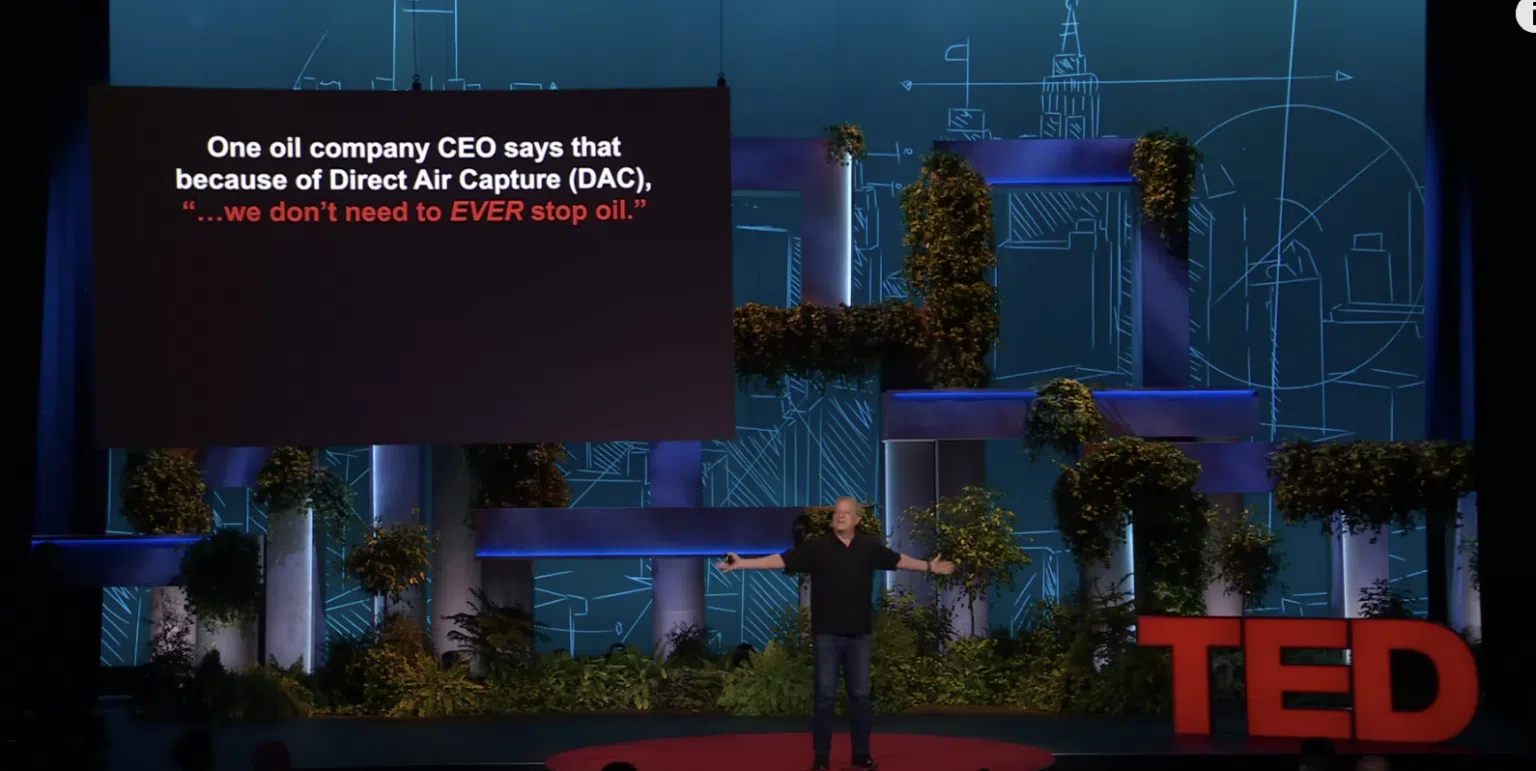
In a new TED Talk posted on August 7, 2023, former Vice President Al Gore pointed to Occidental CEO Vicky Hollub’s acknowledgement that direct air capture enables a fossil fuel forever strategy. Credit: Screen grab of <a href=”https://youtu.be/xgZC6da4mco”TED Talk video via YouTube.
The U.S. Department of Energy has announced that a subsidiary of U.S.-based oil company Occidental Petroleum will receive a grant to develop a commercial-scale direct air capture (DAC) facility in southern Texas.
It is one of two DAC projects selected under a $1.2 billion federal program to scale up DAC, which the Energy Department has called the “world’s largest investment in engineered carbon removal in history.”
This new DOE funding is part of a larger $3.5 billion allocation from Congress – under the Infrastructure Investment and Jobs Act, part of the Biden administration’s signature climate legislation – to develop four large-scale DAC hubs. But some critics contend that the federal government’s involvement in this new climate technology is giving fossil fuel companies cover, allowing them to create the impression that they are part of the transition to greener energy while they continue to focus most of their activities and money on their core oil and gas businesses.
Direct air capture is a nascent technology designed to capture carbon dioxide from the ambient air. In theory, it could help remove “legacy emissions,” or the carbon pollution that has already been emitted. Research and development projects to date have not yet shown how DAC can be scaled up to a global scale that would have an effect on slowing climate change.
Yet major polluters are already capitalizing on the conceptual promise of this technology to promote it as a climate solution.
“Oxy has said out loud that this is a ‘get out of jail free’ card, enabling the oil and gas industry to continue business as usual,” said researcher Kert Davies, director of special investigations with the Center for Climate Integrity, referring to Occidental Petroleum’s stock ticker symbol, “instead of heeding the urgent fossil fuel phaseout warning scientists have shouted in our faces for decades.”
Climate advocate and former Vice President Al Gore noted in a recent TED Talk that Occidental CEO Vicky Hollub has said that because of DAC, “we don’t need to ever stop oil,” and that the technology gives the fossil fuel industry “a license to continue to operate.”
According to Gore, “They’re using it in order to gaslight us, literally.”
Direct air capture may play a role someday, but the best option now is to halt carbon emissions in the first place, said John Fleming, senior scientist at the Center for Biological Diversity’s Climate Law Institute. “[Direct air capture] requires large amounts of energy, spurring more demand for the same fossil fuels that caused the climate crisis,” Fleming said.
Two of the four DAC hubs funded by the Department of Energy will be located on the Gulf Coast. In addition to Occidental’s hub in Kleberg County, Texas, a project proposed by Battelle, Climeworks, and other partners, called “Project Cypress,” will be constructed in Calcasieu Parish, Louisiana. On paper, the two projects together will have the capacity to remove two million metric tons of CO2 from the atmosphere per year. It is unclear exactly how much each project will receive in government funding, as they will be undergoing award negotiations.
DOE has not yet announced selection of the other two DAC hub projects. “We’re expecting in 2024 or soon thereafter that we will have another solicitation for additional hubs,” said Kelly Cummins, deputy director of DOE’s Office of Clean Energy Demonstrations.
Under the Inflation Reduction Act’s expanded tax credits for carbon capture technologies – a subsidy under section 45Q of the Internal Revenue Code for developers to capture CO2 from polluting facilities or from the atmosphere – qualifying DAC projects can receive $180 per ton of CO2 captured and stored, a significant increase from the previous credit of $50 per ton.
Occidental subsidiary 1PointFive, which focuses on developing carbon capture, utilization and storage (CCUS) and DAC projects, will be developing the South Texas DAC facility, according to DOE’s announcement. The company is currently building a smaller DAC facility in Ector County, Texas, in the Permian Basin, where Occidental continues to operate as one of the largest extractors of oil and gas.
Occidental has indicated that CO2 captured from its Permian Basin DAC plant could be used to drill for more oil through a process it has long used known as enhanced oil recovery (EOR). In its latest annual report, the company stated that its CO2 EOR operations “are critical to Occidental’s long-term strategy.”
However, according to DOE’s Cummins, this hub is not expected to be linked to enhanced oil recovery (EOR) operations.
A ‘Gimmick of the Fossil Fuel Industry’
Researchers who have analyzed the technical requirements of direct energy capture, such as energy load, warn that it is little more than a boondoggle. A 2020 analysis published in Nature Communications found that “the energy and materials requirements for [DAC] are unrealistic even when the most promising technologies are employed.”
In a 2019 study that examined the impacts of direct air capture, Mark Jacobson, a professor of civil and environmental engineering at Stanford University, found that it would increase CO2 emissions, air pollution, fossil mining and fossil infrastructure, largely because of the enormous amount of energy required to extract, compress, and separate the CO2.
Even if renewable energy is used to operate DAC, Jacobson told DeSmog that this would simply divert renewables away from directly replacing fossil fuels. At least for the next several decades or until fossil fuels are eliminated, “it is impossible for there to be a benefit of DAC, only an opportunity cost. It will only delay our solution to the climate problem,” Jacobson said.
“DAC is simply a gimmick of the fossil fuel industry to keep themselves operating and pretend they are doing something useful,” he added.
We really need to be smarter than this if we want to hold out any hope of solving global warming, air pollution, and energy security problems.
In a statement, Occidental’s Hollub said the company looks forward to partnering with DOE to “deploy this vital carbon removal technology at climate-relevant scale.”
June Sekera, a climate researcher who has studiedDAC, said that the feasibility of actually getting to that scale is “absurd,” and that DAC is meaningless from a climate change perspective.
Sekera, a research fellow at the Global Development and Environment Institute at Tufts University, told DeSmog that “the IPCC has said that DAC is going to be removing [essentially] zero CO2 by 2030.” The one commercial-scale DAC plant currently operating anywhere in the world, in Iceland, is designed to remove just 4,000 tons of CO2 a year, she said.
The IPCC, or Intergovernmental Panel on Climate Change, is the United Nations body that issues regular reports on the latest climate change science.
U.S. Secretary of Energy Jennifer Granholm told reporters on Thursday that if deployed at a commercial scale, DAC technology “can help us make serious headway on our net zero goals.” But climate and environmental justice advocates are largely opposed to the kinds of “carbon management” projects that fossil fuel interests are promoting, including direct air capture, and see them as a way for industrial polluters to continue operating as usual.
“We know that engineering-based removal activities are technologically and economically unproven, especially at scale, and pose unknown environmental and social risks,” said Marion Gee, co-executive director of Climate Justice Alliance.
Fenceline Watch, a Texas-based environmental justice organization, said in a statement that DOE’s funding of DAC hubs in Texas and Louisiana “represents, once again, the sacrifice of our communities along the Gulf Coast in the interest of the oil, gas, and petrochemical industry.”
Carbon180, an organization supporting carbon removal, told DeSmog that addressing environmental justice issues and not catering to polluters’ interests are key to building industrial-scale carbon removal in an equitable way. “We believe that the carbon removal industry can and should be built to redress the harms and injustices of the past. We’re keen to see DOE prioritize the interest of communities and not those of the fossil fuel industry,” said Sasha Stashwick, director of policy at Carbon180.
But Fenceline Watch contends that direct air capture further endangers communities already overburdened by industrial pollution.
“While the industry positions direct air capture facilities as a viable solution to removing carbon from the air, the reality is these hubs have never proven to be able to achieve these claims,” the organization said in an emailed statement. “This is a greenwashing campaign that will continue to put our communities’ health, environment, and safety at risk.”