UK shares findings of damning climate crisis national security report suppressed under Starmer
Tag: Chris Packham
Why pick on Chris Packham?

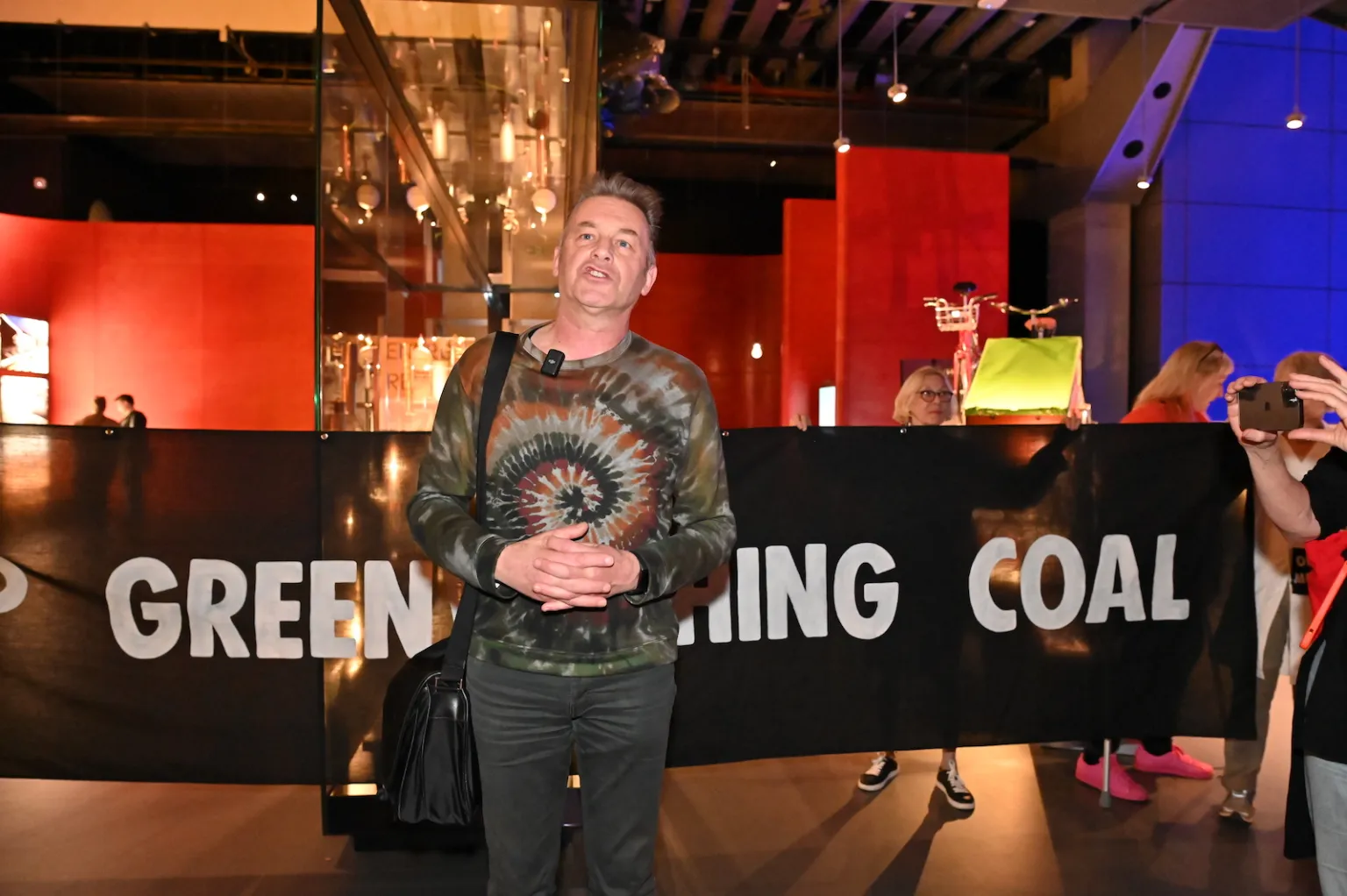
Naturalist Chris Packham at the Science Museum occupation 12 April 2024. Image: Extinction Rebellion. https://www.taxresearch.org.uk/Blog/2026/08/12/why-pick-on-chris-packham/#gsc.tab=0 Under copyright law, I am only able to quote small parts of this article. I recommend the whole article, it is a detailed, complex argument and I have only been able to select portions of it.
As I have already noted today, The Times has chosen to question whether Chris Packham is really autistic, despite the fact that he has a diagnosis saying that he is. I have already discussed some aspects of this issue. I also think it is worth asking why they have done this.
I stress that question because I cannot know the motivation of those involved. I have no access to the editorial discussions at The Times, and I am not suggesting that I do. But newspapers make choices. They decide whom to feature, what questions to ask, which doubts to amplify and what associations they want their readers to make. So asking why Chris Packham has become a target is entirely reasonable.
There are, I think, several possible explanations, and they obviously overlap, creating a credible explanation as a consequence.
The first is that Chris Packham is becoming an important figure in British public life. He is no longer simply a television presenter who talks about wildlife. Increasingly, he appears to be assuming the mantle that Sir David Attenborough wore for decades.
That matters. Attenborough acquired authority because millions of people trusted him. He could talk about the destruction of the natural world in a way that politicians could not because people did not think of him as a politician. They thought of him as someone who knew what he was talking about.
Packham has some of that authority, but there is an important difference. He is more explicitly political. He does not simply say that a species is disappearing or that an ecosystem is under threat. He asks why that is happening, who is responsible and what we should do about it. That makes him potentially threatening to some powerful interests.
Packham is a prominent advocate of action on climate change. He challenges the fossil fuel economy. He questions environmentally destructive forms of agriculture. He supports environmental protest. More broadly, he challenges the idea that the pursuit of profit should take priority over the survival of the ecosystems on which human beings depend.
…
Chris Packham’s diagnosis tells us nothing about whether he is right about climate change. The evidence on climate change stands or falls on its own merits. If The Times, or anyone else, disagrees with what Packham says about the climate, biodiversity, fossil fuels or the environment, there is an obvious response available to them. They should challenge his arguments. But what they should not do is challenge who he is, or seek to undermine him, and others, by doing so. That is not just unethical, it provokes prejudice to support profit at cost to many.
We should not be surprised that profit is promoted at cost to many. That is what extractive capitalism does. That is not a flaw in its design. It is what it is designed to do. The well-being of millions and maybe billions of people have been sacrificed to that false god over decades and maybe centuries. But should Chris Packham be added to that list, to be discarded by being discredited because he asks awkward questions? I think not. And that is why this case matters.
…
https://www.taxresearch.org.uk/Blog/2026/08/12/why-pick-on-chris-packham/#gsc.tab=0 Under copyright law, I am only able to quote small parts of this article. I recommend the whole article, it is a detailed, complex argument and I have only been able to select portions of it.
EXPANDED and UPDATED: Zack Polanski’s ‘reality check’ to the Prime Minister: act now on extreme heat emergency
At a press conference today, Zack Polanski delivered a ‘reality check’ to the Prime Minister as he sounded the alarm on the emergency of extreme heat and outlined three immediate actions he would take to tackle the crisis.
After highlighting the multiple threats we face – to our safety, our food and water supply, and our way of life – Zack called for action to keep people cool and safe, taxes on oil and gas giants to fund our fire services, and public ownership of water to end the failed experiment of privatisation.
Zack was joined on stage by an ex-soldier and engineer, a doctor, and a firefighter, who described the consequences of extreme weather they had seen in their work – as well as broadcaster and environmental campaigner Chris Packham who warned of the present and future risks of the climate crisis.
“Trees reduced to charcoal”
Zack started his press conference with a vivid description of the consequences of the extreme heat that has hit the UK this year.
The day before he had witnessed the aftermath of the devastation caused by a wildfire in Oxfordshire.
“Trees reduced to charcoal. Cars turned to burnt out wrecks. The smell of smoke still lingering in the air, on the site of what was once a thriving local business – now reduced to ash.
“Wildfires. Literal scorched earth. And that looming sense that this is only the beginning.
“These days feel exceptional, but what we’re living through right now are likely some of the least extreme summer temperatures we’ll experience in our lifetimes.”
This is an alarm that needed sounding.
The week before, while a wildfire the size of two hundred football pitches was raging across Suffolk, Zack had called on the Prime Minister to urgently call a COBRA meeting to address the crisis.
Six days later, and with another heat alert having just ended, where is the Government response? There has been no COBRA meeting, no emergency briefing, no new plan.
And so Zack stepped up to challenge the Prime Minister to act.
“We are facing the biggest threat to this country since the Second World War”
His challenge to the PM started with a stark reality check: “We are facing the biggest threat to this country since the Second World War.”
“Extreme weather is now the new normal – and without action, the impact on the people of this country will be unimaginably grave.”
And Zack broke down exactly what that impact will be.
First, the threat to our safety.
The dangers of extreme heat to our health are very real – especially for older people and those with pre-existing conditions – forcing people to stay indoors for days on end, to try to wait out the heat.
But the heat takes its toll.
As Zack explained, “Almost three thousand people have died from the effects of extreme heat this summer.”
Those “whose bodies were under such intense strain in trying to stay cool that their hearts or kidneys could no longer cope.”
And then there are the fires – forcing hundreds to evacuate their homes, “while many thousands more wait anxiously with flames on the horizon and smoke in their lungs.”
And Zack pointed to Europe as a warning of how bad things can get.
“Hundreds of thousands evacuated. Half a million acres burnt.
“The sheer scale of the devastation is hard to comprehend. But we need to look it in the face – because this is only a taster of what’s to come if we don’t act now.”
Decimated crops, leaking pipes, and no new reservoirs since 1992
After the danger to our physical safety, the second threat Zack identified concerned the basis of any society: our food and water supply.
Half of England is currently experiencing serious drought, and eight of our water reservoirs are at risk of running dry.
“The threat is so severe”, Zack said, “that the UK’s national risk register warns that if we had three years of exceptionally dry weather like this, we could face water rationing.”
And what of the private water companies?
The private water companies that haven’t built a single new reservoir since 1992.
Well, they are losing nearly three billion litres of water a day from leaky pipes – or as Zack put it “five times more than a nationwide hosepipe ban would save”.
Our farmers and growers, meanwhile, are on the frontlines of climate breakdown – facing in turn the extreme rainfall and flooding of recent winters, and the extreme heat and drought of our summers.
Zack noted that despite farmers working through the nights to avoid the heat, food production has been hit by this chaotic combo of flooding and drought, and food prices are set to rise as a result.
“A threat to our way of life”
The third threat Zack named was far-reaching: the threat to our way of life.
“Parents unable to take their children to the playground because the slides are so hot it could burn their skin off. Temperatures so high they keep us inside for days for the sake of our health. Cities feeling like ghost towns. Parks turned into deserts.”
As climate change progresses – bringing more frequent, more damaging extreme weather – the way each of us lives our life will be more severely impacted.

Zack Polanski holds a press conference to deliver an urgent message to Prime Minister Andy Burnham. (Photo: Aldo Ciarrocchi) And we don’t have to look far to see what may face us in the years ahead.
Zack pointed to the “apocalyptic” scenes of “Wildfires. Droughts. Deadly floods.” coming out of Europe, noting that the continent “is heating at twice the rate of the rest of the world.”
It is there for all of us to see.
And yet the response from the Government, and most of the media, has been to look the other way.
In Zack’s words: “It’s an astonishing dereliction of duty from those whose first responsibility is to keep us safe.”
Zack’s demands for action: cool spaces, water in public hands, and taxing oil and gas giants to fund fire services
The need for action is urgent.
And Zack set out immediate steps the Prime Minister could take “to protect people right now and keep us safe from what we know is coming down the track.”
“We need to keep people safe from extreme temperatures. That means a free, accessible cool space in every local area. And financial support for households to heatproof their home.”
Secondly, Zack called for a robust wildfire prevention strategy – and a fire service with the resources it needs to tackle blazes when they come.
“This should be funded,” Zack said, “by taxing the fossil fuel giants who are profiting from fuelling these infernos.”
And thirdly Zack called for public ownership of our water.
“To secure our water supply, prevent droughts and protect our food system we need to bring water back into public hands.”
“Every penny households pay for their water needs to go back into strengthening our infrastructure, building new reservoirs, and protecting us from the droughts of the future.”
Zack’s message to the PM: “There can be no new drilling for oil and gas”
Before handing the microphone over to the assembled experts, Zack finished with a powerful message direct to the Prime Minister.
“If we are to secure a liveable future for our children and grandchildren, there can be no new drilling for oil and gas. On this, the science is crystal clear.
“As politicians, we have a moral responsibility to do what’s right for the people we serve, even when it’s not politically convenient.
“And I know that whatever our differences, we both care deeply about the people of this country – and the future of our world.
“So when the time comes, I hope you will have the courage to be truthful, be brave – and hold firm to your party’s commitment to no new oil and gas drilling in the north sea – including both Rosebank and Jackdaw.
“Some will say we can’t afford to make these changes. These last few weeks are showing we can’t afford not to.”
“A dereliction of duty”: four expert voices on extreme heat
Zack was followed by four speakers with unique expertise on the extreme heat emergency.
First up was Carl Benfield, a former soldier and engineer, who since leaving the military has turned his engineering expertise to the challenges posed by climate breakdown.
His view? “Climate change is the single greatest threat to human security that we face.”
And his conclusion on successive governments’ failure to prioritise this threat was damning: “A government’s first duty is to keep its citizens safe. Ignoring extreme heat and raging fires isn’t just complacency, it’s a dereliction of duty.”
He was clear about what’s required: “We need an immediate COBRA-level response. We need climate change reinstated at the top of our defence and security agenda. And we need the bold leadership of Zack Polanski for our nation.”
Next to speak was London firefighter James Rodgers.
His powerful testimony of a worker on the frontlines of extreme heat highlighted the immediacy of the crisis, and how rapidly the conditions in which firefighters work are changing due to extreme heat.
“When people talk about climate change, they often talk about the year 2050. I’m a firefighter and I want to talk about now.”
“Because for firefighters, climate change isn’t a prediction. It’s a shift we are already working.
“Climate change is the fire call to multiple back gardens alight, children’s clothing burning on the washing line.
“Climate change is the acrid smell as you affect entry into a flat because someone has succumbed to heat stroke and hasn’t been checked on in weeks. Climate change is the sound of people in floods of tears when they are stuck in a lift 20 floors up in 30 degree heat.
“Climate change is the taste of dust in your dry mouth, watching a fire sweep uncontrollably across a park you used to play football in as a child in your summer holidays. Climate change is this becoming a day to day reality. ”
Dr Veena Aggarwal speaks at the press conference on the emergency of extreme heat. (Photo: Aldo Ciarrocchi) Next was Dr Veena Aggarwal, a GP in Bristol and the Climate and Sustainability Co-Lead and Clinical Adviser at the Royal College of GPs.
She emphasised the growing danger to health, and – as with the fire services – the extreme pressure placed on health services by the heat:
“As a GP, I’ve been seeing firsthand the health impact of the recent heat waves.
“Ambulances are so stretched we couldn’t get an ambulance for a patient with sepsis or another one with very low oxygen levels, because the ambulance service was so completely overwhelmed.
“The London Ambulance Service saw its busiest ever day during the heatwave in June, on 26th June. That’s even busier than the days at the height of the Covid pandemic emergency.
“We’re seeing people having more asthma attacks; having flares up of their chronic lung disease so extreme they need to be in hospital; more people having heart attacks, strokes; or having falls and collapsing due to the heat, especially those who are frail and more vulnerable.”
Dr Aggarwal also highlighted the impact of the heat on staff and patients in NHS buildings, the human cost of the heat waves, and the need for immediate action.
“An extra almost 3000 deaths occurred within just one week in June during the heatwaves. That’s almost double what was recorded in that season in 2025. In Europe those deaths are 14,000 in that same period.
“We need to act now. The climate crisis is a health crisis.”
Chris Packham speaks at the press conference on the emergency of extreme heat. (Photo: Aldo Ciarrocchi) The final speaker was broadcaster and nature campaigner Chris Packham.
Chris was excoriating in his appraisal of the Government and media’s response to the climate crisis.
Citing the same death figures as Dr Aggarwal, he said “If these deaths had been the result of terrorism or a pandemic, the Government would have cancelled its summer holiday.
“There would have been COBRA meetings, and there would have been public information campaigns the likes of which we saw during Covid, designed to protect us in this time of crisis.”
“And yet what do we get?
“We get rumours of possibly more drilling for oil and gas, and we get articles in the Telegraph suggesting we ought to adapt to a Mediterranean climate…
“If that isn’t reckless and irresponsible, I don’t know what is.”
Long video of the Press Conference. What we told UK leaders about climate and nature at a national emergency briefing
Food security professor Paul Behrens (centre) joined a panel of climate scientists at the national emergency briefing to MPs in London in November 2025. Vuk Valcic/Alamy Paul Behrens, University of Oxford
I joined eight other experts to deliver a national emergency briefing in late November on the climate and nature to around 1,200 of the UK’s leaders — across politics, business, faith and culture — in Central Hall Westminster.
Much like the televised national briefings delivered during COVID, the aim was to deliver sober, science-based overviews of the various climate and nature crises that the UK faces. Chaired by the academic and author Mike Berners-Lee, the aim was to set off a tipping point of engagement among politicians, faith leaders, CEOs, sport and cultural figures. TV presenter and naturalist Chris Packham opened the event.
The alignment among the scientists speaking was clear. Several of us had never met before, yet our research all linked to tell a story of unprecedented threat and opportunity.
Nathalie Seddon, a professor of biodiversity at the University of Oxford, laid bare the nature crisis. Nature, she emphasised, is not a luxury. It is critical infrastructure, and the state of depleted nature across the country is a national security issue.
Kevin Anderson, a professor in energy and climate change at the University of Manchester, presented the clear carbon arithmetic of how quickly we need to cut emissions. He pointed out what our political discourse studiously avoids: “It is now too late for non-radical futures.”
Hayley Fowler, spoke about how Valencia-style flooding is perfectly possible in the UK. Tim Lenton, a professor of Earth system science at the University of Exeter, spoke about how climate-driven changes in ocean currents may impact the UK.
I spoke about food security and the great food transformation that’s needed, including dietary change, waste reductions, production improvements and increased resilience. I explained how more plants in our diets are necessary to reduce climate and nature impacts, improve our health, increase food resilience and reduce reliance on imports.
Hugh Montgomery, chair of intensive care medicine at UCL, said: “You don’t respond to an emergency with talk and homeopathy. You respond with genuine action. … Climate change is the greatest threat to human health in the 21st century.”
Lieutenant General Richard Nugee, a retired senior British Army officer, spoke on national security implications and how the energy transition means greater stability and security for the UK, as the country would be less vulnerable to petrostates and the inherent volatility of fossil fuels.
Angela Francis, director of policy solutions at the environmental charity World Wide Fund for Nature, spoke about how innovation is the key to productivity and healthy economies. She highlighted how faster energy transitions are cheaper, and the cost of the UK energy transition is now 73% cheaper than what was thought five years ago. Had we made the transition already, recent inflation would have been 7% lower.
Tessa Khan is an environmental lawyer and the co-founder of the Climate Litigation Network: a global coalition of organisations using litigation to compel governments to ramp up their climate mitigation ambition. She described how the price of renewables has dramatically reduced, their efficiency has soared, and how investment in renewables pays dividends.
The science was news to many
The message was consistent: these are not distant projections but rapidly accelerating realities that will profoundly affect every aspect of British life.
There was anger too. Frustration at vested interests blocking action, and at the inequality of climate impacts. The UN’s annual climate summit, Cop30, had just concluded in Belém, Brazil, attended by a record 1,600 fossil fuel lobbyists.
The words “fossil fuel” were removed from the final Cop30 text. Our current collective response could not be more inadequate.
Some people I spoke to suggested that the panel at this event was preaching to the choir. It’s important to remember that MPs radically underestimate the urgency of the situation. Fewer than 15% of the 100 MPs surveyed in one study knew that global emissions needed to peak by 2025 to have any chance of limiting warming to 1.5°C.
The science was news to many present. The planet is heading into dangerous overshoot above 1.5°C within the next few years. As Anderson pointed out: for the UK to meet its fair share obligations in emissions reductions without relying on highly speculative and costly carbon dioxide removal, we would need to see roughly 13% year-on-year reductions for just 2°C – let alone 1.5°C.
There was a catharsis during the briefing. Knowing that people with the power to act were finally hearing the full picture: the health effects, the extreme weather, the collapsing nature, the food insecurity, the economic and geopolitical risks. As Rabbi Jonathan Wittenberg, senior rabbi of Masorti Judaism (a traditional movement for modern Jews), wrote afterwards in the Observer: “Those facts were hard to hear, but I also felt thank goodness, we’re being told it as it is.”
A just, equitable transition to a clean economy would improve countless aspects of our lives, from creating jobs and improving health to strengthening communities and increasing resilience. We will look back on this moment bewildered that we did not act sooner, if we are able to act in time.
This is why we are calling for a televised national emergency briefing, so that what happened in Central Hall Westminster can reach the public. Anyone can sign this open letter, calling on the prime minister, Keir Starmer, and the heads of the BBC, ITV, Channel 4, Channel 5, S4C and the media regulator Ofcom, for urgent, honest communication about the scale of the crisis and the solutions available.
Don’t have time to read about climate change as much as you’d like?
Get a weekly roundup in your inbox instead. Every Wednesday, The Conversation’s environment editor writes Imagine, a short email that goes a little deeper into just one climate issue. Join the 47,000+ readers who’ve subscribed so far.Paul Behrens, British Academy Global Professor, Future of Food, Oxford Martin School, University of Oxford
This article is republished from The Conversation under a Creative Commons license. Read the original article.

Donald Trump urges you to be a Climate Science denier like him. He says that he makes millions and millions for destroying the planet, Burn, Baby, Burn and Flood, Baby, Flood. 
Nigel Farage urges you to ignore facts and reality and be a climate science denier like him and his Deputy Richard Tice. He says that Reform UK has received £Millions and £Millions from the fossil fuel industry to promote climate denial and destroy the planet. 
Orcas comment on killer apes destroying the planet by continuing to burn fossil fuels. Leaders urged to ‘listen to the science’ and act on climate crisis
https://morningstaronline.co.uk/article/leaders-urged-listen-science-and-act-climate-crisis
A crowd of people watching the setting sun from a hill in Ealing, west LondonPOLITICIANS, business leaders and celebrities were urged to “listen to the science” at Britain’s first “national emergency briefing” on the climate and nature crisis today.
The event, held at Westminster Hall, was called by National Emergency Briefing, a group of experts in the field backed by organisations as diverse as the Royal Meteorological Society, the National Trust, the University of Reading and teaching union NEU.
Lancaster University’s Professor Mike Berners-Lee, panel chair, said: “Business as usual means normalising catastrophe — homes destroyed by flood and wildfire in Britain, price shocks, food shortages and a destabilised economy.
“We are drowning in fossil fuel misinformation, and it is no accident. Fossil fuel companies are spreading messages in the media and in Westminster designed to stall action.”
In the day’s keynote address, broadcaster and naturalist Chris Packham challenged attendees: “Why are we unbelievably pulling back on rapidly and forthrightly addressing the greatest crisis to ever threaten our species, climate breakdown and biodiversity loss?
“Climate denialism has been a mainstream thing again, thanks to the well-oiled machines of the rich, powerful and influential lobbyists from the fossil fuel and other industries.
“A dangerous wave of misinformation and lies fill our lives, but worse, it fills the lives of our decision makers and these are the people who shape policy.”
Calling on politicians to stand up to fossil fuel lobbyist who remain “significant contributors” to some parties’ coffers, he urged them to “listen to the science,” warning: “If you don’t, things go wrong and lives are lost.”
…
Article continues at https://morningstaronline.co.uk/article/leaders-urged-listen-science-and-act-climate-crisis
Nigel Farage urges you to ignore facts and reality and be a climate science denier like him and his Deputy Richard Tice. He says that Reform UK has received £Millions and £Millions from the fossil fuel industry to promote climate denial and destroy the planet. Donald Trump urges you to be a Climate Science denier like him. He says that he makes millions and millions for destroying the planet, Burn, Baby, Burn and Flood, Baby, Flood.


 A crowd of people watching the setting sun from a hill in Ealing, west London