Pope Francis Dies at 88 After Final Appeal for Gaza Cease-Fire

Spread the love

Original article by Common Dreams Staff republished from Common Dreams under Creative Commons (CC BY-NC-ND 3.0).
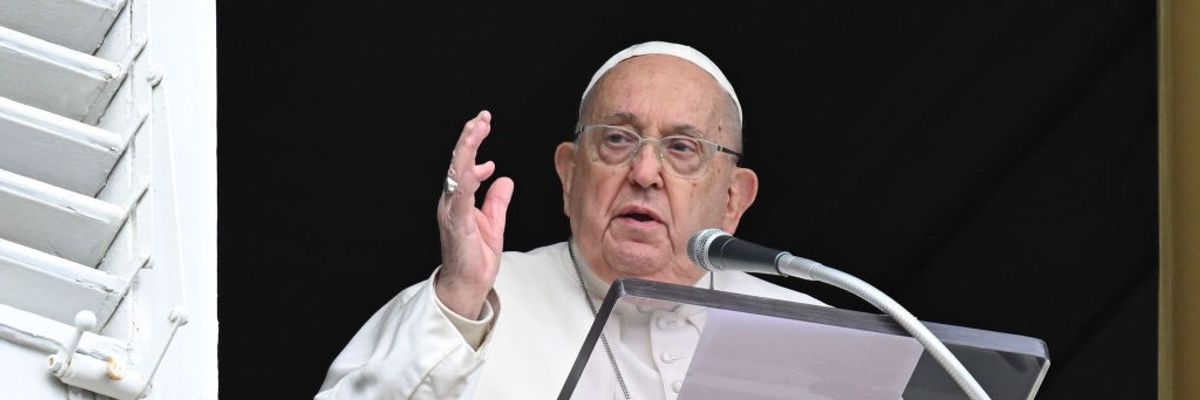
Pope Francis delivered a Sunday Angelus blessing from the window of his studio overlooking St. Peter’s Square on January 12, 2025 in Vatican City.  (Photo: Vatican Media via Vatican Pool/Getty Images)

“Will the millions who will mourn his death these coming days respect this wish of his? Will they care for Gazans and Palestinians the way he did?”

The Vatican announced Monday that Pope Francis has died at the age of 88, hours after he appeared at an Easter mass and appealed for an end to Israel’s war on the Gaza Strip.

The pope’s Easter address, read aloud by Archbishop Diego Ravelli, decried the “terrible conflict” in Gaza that “continues to cause death and destruction and to create a dramatic and deplorable humanitarian situation.”

“I appeal to the warring parties: call a cease-fire, release the hostages, and come to the aid of a starving people that aspires to a future of peace!” said the message from the pope, an outspoken opponent of military conflict and war profiteersclimate destruction, and runaway economic inequality.

“In the face of the cruelty of conflicts that involve defenceless civilians and attack schools, hospitals, and humanitarian workers, we cannot allow ourselves to forget that it is not targets that are struck, but persons, each possessed of a soul and human dignity,” the pope’s address continued.

News of Pope Francis’ death came after a bout with double pneumonia left him hospitalized for more than a month. The Vatican did not specify a cause of death in its announcement.

The Nation‘s John Nichols wrote Sunday that Pope Francis’ calls for peace have made him “arguably the most consistent high-profile defender of the humanity of the Palestinian people during a period when the Israeli assault on Gaza has been pursued with relentless violence.”

Nichols continued:

With a boldness and specificity that has often sparked controversy, this pope has challenged economic injustice, racism, environmental neglect, militarism, and the abuses of new technologies that increase inequality. He has faced his share of criticism, not just from conservatives who disapprove of his views but also from reformers who sincerely wish that he would do more to modernize the church. Yet, in a time of too much indifference and impunity, this pope has remained uniquely engaged with the embattled regions that political and media elites neglect or abandon.

That’s been especially true when it comes to Gaza, where Pope Francis has long argued for cease-fires, arms blockades, aid convoys, and a diplomatic urgency that recognizes that Palestinians and Israelis are “fraternal peoples [who] have the right to live in peace.”

In a tribute to Pope Francis, Palestinian theologian Munther Isaac wrote Monday that “he conveyed true compassion to Palestinians, most notably to those in Gaza during this genocide.”

“The pope left our world today, and the occupation and the wall remained. Even worse, he left our world while a genocide continues to unfold,” Isaac wrote, pointing to the pontiff’s call for a thorough international investigation of Israel’s assault on Gaza.

“Today I wonder: Will the millions who will mourn his death these coming days respect this wish of his?” Isaac asked. “Will they care for Gazans and Palestinians the way he did?”

Original article by Common Dreams Staff republished from Common Dreams under Creative Commons (CC BY-NC-ND 3.0).
Continue ReadingPope Francis Dies at 88 After Final Appeal for Gaza Cease-Fire

As Europe Reels From Flood Damage, Calls Grow for Big Oil to Pay for Climate Destruction

Spread the love

Original article by Julia Conley republished from Common Dreams under Creative Commons (CC BY-NC-ND 3.0).

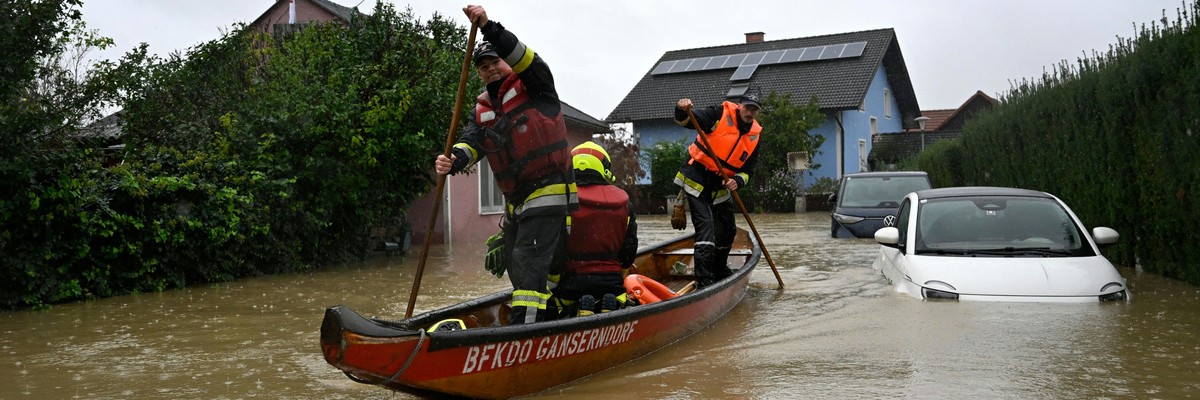
Firefighters in a boat make their way past a car submerged by the floods in Rust im Tullnerfeld, Austria, on September 16, 2024. (Photo: Helmut Fohringer/APA/AFP via Getty Images)

“We are deeply worried such events will get worse until oil and gas giants like Shell, Total, Equinor, Exxon, OMV, and ENI are forced to stop drilling for fossil fuels driving climate change,” said one campaigner.

The international climate group Greenpeace on Friday called on European leaders to “reciprocate” the courage shown by first responders in several countries over the weekend by forcing fossil fuel giants to pay for climate damages.

Calling out leaders including Polish Prime Minister Donald Tusk, Czech Prime Minister Petr Fiala, and Romania Prime Minister Marcel Ciolacu, Greenpeace campaigner Ian Duff said Central and Eastern European countries should end their “support for fossil fuels and [make] climate polluters pay for this disaster,” as emergency workers rescued people from catastrophic flooding.

The death toll on Monday rose to at least 16, with many more people missing and hundreds of thousands of people displaced in countries including Austria, the Czech Republic, Hungary, Romania, and Slovakia after the low-pressure system Storm Boris dumped torrential rains on the region for days starting late last week.

Two men, aged 70 and 80, drowned in their homes in northeastern Lower Austria after being trapped by rising floodwater, and confirmed deaths in Poland rose to six.

About 70% of Litovel, about 140 miles east of the Czech capital of Prague, was underwater Monday, while a power plant servicing the country’s third-largest city was forced to shut down and leave residents without heat and hot water.

“Greenpeace is horrified by damages brought by floods across Central and Eastern Europe, claiming lives, leaving homes without power and farmers with ruined fields, after being already ravaged by drought,” said Duff, head of Greenpeace’s Stop Drilling Start Paying campaign. “We are deeply worried such events will get worse until oil and gas giants like Shell, Total, Equinor, Exxon, OMV, and ENI are forced to stop drilling for fossil fuels driving climate change.”

In the U.S., the notion of big polluters being required to pay for damages caused by the climate crisis has recently gained traction, with lawmakers introducing a bill in Congress last week.

In Europe, a “polluter pays” principle is followed for many kinds of pollution, but advocates have called for it to be applied to planet-heating greenhouse gas emissions.

The flooding in Europe comes, as London-based meteorologist Scott Duncan explained on the social media platform X, after “an exceptional summer for the Mediterranean Sea,” with heat records broken—just as scientists have warned this year that record heat in the North Atlantic and other oceans around the globe would mean “a busy hurricane season.”

“Warmer sea surface temperatures allow more moisture to evaporate, like fuel for a storm. The warmer the water, the greater the evaporation,” said Duncan.

Liz Stephens, science lead for the Red Cross Red Crescent Climate Center, noted that in Central and Eastern Europe, “climate change is known to be playing a role in increasing the risk of flooding,” with the World Weather Attribution saying in 2021 that disastrous flooding that hit Germany and Belgium was tied to “a rapidly warming climate.”

Reports by the Intergovernmental Panel on Climate Change (IPCC), Stephens added, “have indicated that we have already observed an upward trend in heavy rainfall, surface water, and river flooding, and climate models show high confidence of further increases into the future.”

“The flooding looks set to be the worst in the region since 2002,” she said. “Lessons will have been learned from previous big European floods, but forecasts for some locations are for flooding of unprecedented magnitude, and history tells us that people are often surprised by the seemingly unimaginable consequences of such events.”

Journalist and climate advocate George Monbiot pointed out on Al Jazeera that storms previously described as “once-in-1,000-year occurrences [are] happening several times now in the past decade. We’re seeing a massive acceleration and intensification of extreme weather events, and unfortunately this is exactly what climate scientists were predicting.”

Climate action group Friends of the Earth echoed Greenpeace’s demand to “leave fossil fuels in the ground and instead invest in a green future,” and Duff emphasized that communities across Central and Eastern Europe are far from the only ones “reeling from deadly floods and torrential rains,” with Typhoon Yagi causing flooding and landslides that killed at least 250 people in Southeast Asia in recent days and heavy rains across West and Central Africa leading to floods that killed more than 1,000 people.

“The fossil fuel industry,” said Duff, “is worsening weather extremes everywhere.”

Original article by Julia Conley republished from Common Dreams under Creative Commons (CC BY-NC-ND 3.0).

Continue ReadingAs Europe Reels From Flood Damage, Calls Grow for Big Oil to Pay for Climate Destruction