Israel calls up reservists as concern over Gaza ceasefire mounts

Spread the love

This work by Middle East Monitor is licensed under a Creative Commons Attribution-NonCommercial-ShareAlike 4.0 International License

Israeli soldiers and reservists in Southern Israel on November 13, 2023 [Alexi J. Rosenfeld/Getty Images]

Israel’s military has called up reservists in preparation for a possible resumption of its offensive in Gaza if Hamas fails to meet a Saturday deadline to release more Israeli hostages and a nearly month-old ceasefire breaks down, Reuters has reported.

Concern that the ceasefire will collapse is growing as fury mounts in Arab countries over President Donald Trump’s plan for the United States to take over Gaza, displace its Palestinian inhabitants and build an international beach resort.

Under the ceasefire deal in force since 19 January, Hamas agreed to free three more hostages on Saturday. However, the Palestinian resistance movement said this week it was suspending the handover because of what it said were Israeli violations of the ceasefire terms. Trump responded by saying that all hostages must be freed by noon on Saturday or he would “let hell break out”.

Israeli Prime Minister Benjamin Netanyahu then warned on Tuesday that his country would resume “intense fighting” if Hamas did not meet the deadline, but he did not say how many hostages should be freed.

Netanyahu added that he had ordered the military to gather forces in and around Gaza, and the military announced it was deploying additional forces to Israel’s south, including mobilising reservists.

READ: Israel opposes disclosure of full deal signed with Hamas

The head of Hamas in Gaza, Khalil Al-Hayya, arrived in Cairo on Wednesday for a surprise visit to discuss the fragile ceasefire. A Hamas official told Reuters that mediators Egypt and Qatar had stepped up efforts to end the current impasse.

The standoff threatens to reignite a conflict in which Israel has devastated the Gaza Strip, internally displaced most of its people, caused shortages of food and running water and pushed the Middle East to the brink of a wider regional war.

Palestinians in Gaza expressed alarm that the ceasefire might collapse and urged Hamas and Israeli leaders to agree on an extension.

“We had barely started believing that a truce would happen and that a solution was on the way, God willing,” said Lotfy Abu Taha, a resident of Rafah in southern Gaza. “The people are suffering. The people are the victims.”

Israeli officials said government ministers had endorsed Trump’s threat to cancel the ceasefire unless all hostages are released on Saturday. Hamas, meanwhile, said it remained committed to the agreement, but that Israel must fulfil what it agreed to do when it signed the deal. Despite the Trump and Netanyahu threats, the movement has not agreed to release the hostages on Saturday.

READ: Israel’s actions drove Hamas to suspend captive release, say Israeli experts

Arab League Secretary General Ahmed Aboul Gheit said in Dubai that Trump’s vision for Gaza could lead the Middle East into a new cycle of crises with a “damaging effect on peace and stability.”

Trump has said Palestinians in Gaza could settle in countries such as Jordan and Egypt. Both reject the proposal.

Egypt will host an emergency Arab summit on 27 February to discuss “serious” developments for Palestinians.

In a sign of Arab anger over Trump’s vision of Gaza, two Egyptian security sources said Egyptian President Abdel Fattah Al-Sisi would not go to Washington for talks if the agenda included Trump’s plan to displace Palestinians. The date for such a visit has not been announced, and the Egyptian presidency and foreign ministry did not comment.

The Gaza war — described by the International Court of Justice as “plausible genocide” — followed the Hamas-led cross-border incursion on 7 October, 2023, in which at least 1,200 people were killed, many of them by the Israel Defence Forces carrying out the controversial “Hannibal Directive”. An estimated 250 Israelis and Thais were taken into Gaza as hostages, according to Israeli tallies.

In response, Israel began its military offensive against Hamas which has killed at least 48,000 Palestinians in small, densely populated Gaza, according to Gaza health officials. Around 112,000 have been wounded, and 11,000 are missing, presumed dead, under the rubble of their homes and other civilian infrastructure destroyed by the apartheid state.

Hamas has freed 16 Israeli hostages from an initial group of 33 children, women and older men to be exchanged for hundreds of Palestinian prisoners and detainees in the first stage of the ceasefire deal. It also returned five Thai hostages.

Negotiations on a second phase, which mediators hoped would include agreement on releasing the remaining hostages and a full Israeli troop withdrawal from Gaza, should be under way in Doha but an Israeli team returned home on Monday.

Palestinians fear a repeat of the 1948 Nakba (Catastrophe), when nearly 800,000 people were driven out by Zionist terrorists when Israel was created in occupied Palestine. Trump has said that Palestinians would lose their legitimate right to return to their homes under his plan for Gaza.

Meanwhile, he wants Saudi Arabia, which wields heavy influence in other Arab and Muslim countries, to normalise ties with Israel. Riyadh has previously said that it will not establish ties with Israel without the creation of a Palestinian state.

Under his first administration in 2017-21, Trump brokered normalisation accords between Israel and some Arab states, including the United Arab Emirates. Asked if the UAE could find common ground with Washington on Gaza, Abu Dhabi’s ambassador to the US, Yousef Al-Otaiba, said the US approach was difficult. “But at the end of the day we’re all in a solution-seeking business, we just don’t know where it’s going to land yet,” he said.

UAE President Sheikh Mohammed Bin Zayed Al-Nahyan told US Secretary of State Marco Rubio on Wednesday that peace efforts in the region should be on the basis of a two-state solution for the Israeli-Palestinian conflict, state news agency WAM reported.

Trump’s Gaza plan upended decades of US Middle East policy which called for a Palestinian state co-existing in peace alongside Israel as the solution to one of the world’s most complex and volatile problems.

The Arab League’s Aboul Gheit said that the idea of the Arab Peace Initiative drawn up by Saudi Arabia in 2002 — in which Arab nations offered Israel normalised relations in return for a statehood deal with the Palestinians and full Israeli withdrawal from territory captured during the June 1967 war — would be reintroduced.

READ: Gaza: 118 Palestinians killed, 822 wounded since ceasefire began

This work by Middle East Monitor is licensed under a Creative Commons Attribution-NonCommercial-ShareAlike 4.0 International License

UK Foreign Minister David Lammy confirms that UK government and military are active participants in Israel’s genocides and that the F-35 parts that they suspended from supplying to Israel are instead simply diverted via the United States. He says see https://youtu.be/QILgUHrdWRE
Experiencing issues with this image not appearing. I suspect because it's so critical of Zionist Keir Starmer's support of and complicity in Israel's genocides.
Genocide denier and Current UK Prime Minister Keir Starmer is quoted that he supports Zionism without qualification. He also confirms that UK air force support has been essential in Israel’s mass-murdering genocide. Includes URLs https://www.declassifieduk.org/keir-starmers-100-spy-flights-over-gaza-in-support-of-israel/ and https://youtu.be/O74hZCKKdpA
Continue ReadingIsrael calls up reservists as concern over Gaza ceasefire mounts

How much do people around the world care about climate change? We surveyed 80,000 people in 40 countries to find out

Spread the love

This article is republished from The Conversation under a Creative Commons license. Read the original article.


ra2 studio / shutterstock

Simge Andı, University of Oxford and James Painter, University of Oxford

New survey results from 40 countries shows that climate change matters to most people. In the vast majority of countries, fewer than 3% said climate change was not serious at all.

We carried out this research as part of the University of Oxford’s Reuters Institute annual Digital News Reports. More than 80,000 people were surveyed online in January and February of this year.

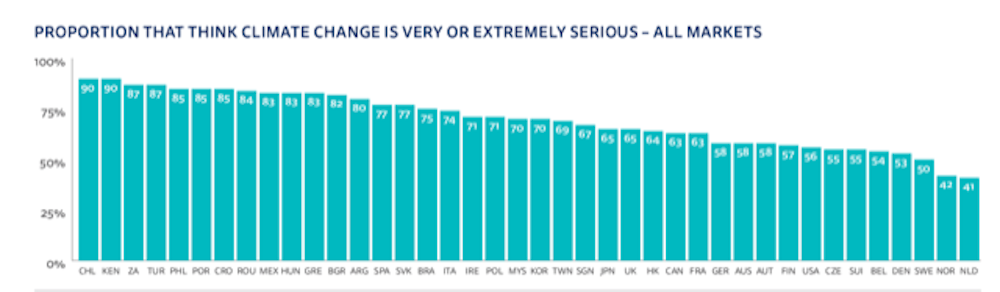
Almost seven in ten think climate change is “a very, or extremely serious, problem”, but the results show notable country differences. Lack of concern is far higher in the US (12%) as well as in Sweden (9%), Greta Thunberg’s home country. Despite disastrous bush fires at the time of our fieldwork, 8% of respondents in Australia report that climate change is not serious at all. These groups with low levels of concern tend to be right wing and older.

Four of the five countries showing the highest levels of concern (85-90%) were from the global south, namely Chile, Kenya, South Africa and the Philippines. However, in countries with lower levels of internet penetration, our online survey samples over-represent people who are more affluent and educated.


Almost everyone in Chile and Kenya thinks climate change is serious. But that’s not the case in Scandinavia and the Low Countries.
Reuters Institute Digital News Report, Author provided

Perhaps surprisingly, the five countries with the lowest levels of concern are all in Western Europe. In Belgium, Denmark, Sweden, Norway and the Netherlands, only around half (or less) think that climate change is a serious problem.

It is the first time that results from survey questions on climate change have been included in the Reuters Institute’s reports, so it is difficult to draw out historical trends. However, results in 2015 from the Pew Center based on surveys in 40 countries (with different questions and countries to those in our survey) found that 54% of those surveyed thought that climate change was “a very serious” problem.

So it looks like concern for climate change may be rising globally. There is certainly strong evidence that it is increasing in some countries. In the US, in November 2019 two in three Americans (66%) said they were at least “somewhat worried” about global warming, an increase of 10 percentage points over the past five years.

In the UK, data from the CAST centre at Cardiff University showed that in 2019 levels of “worry” about climate change were at their highest recorded point. Extreme weather events, media reporting and wider publicity were mentioned by respondents as reasons for their increase in concern.

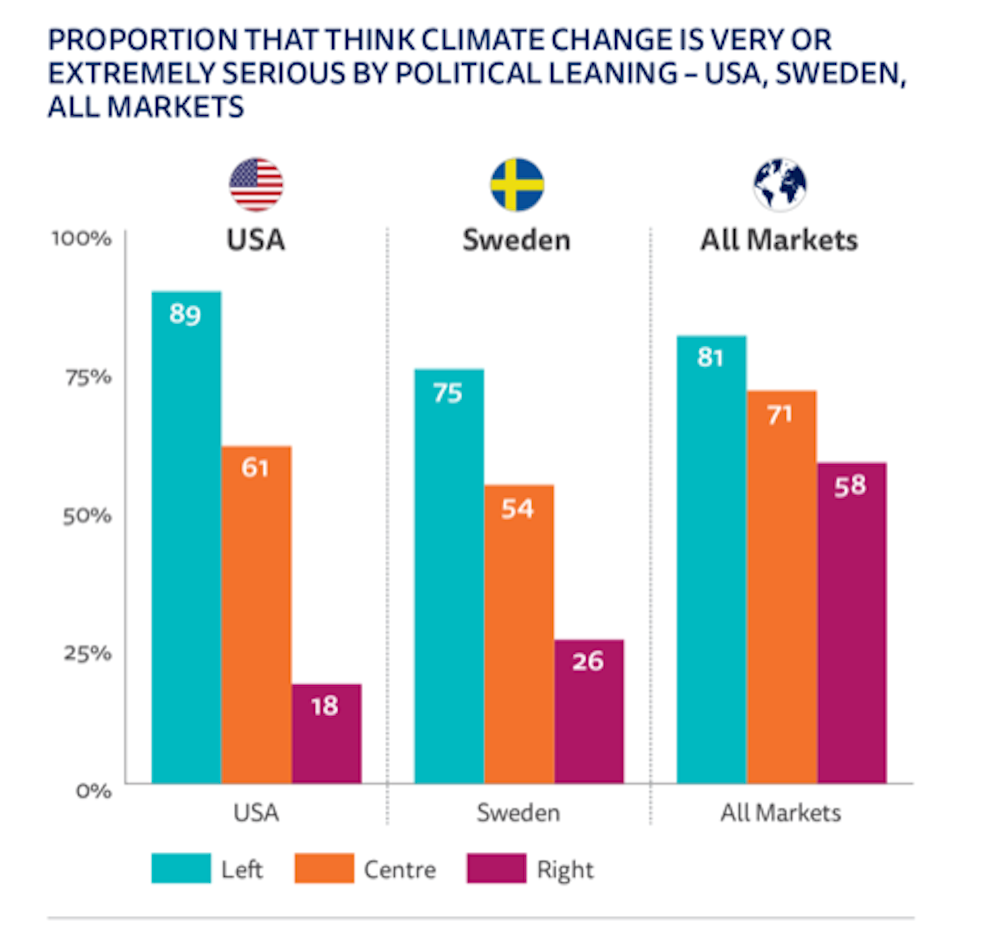
In our survey, across countries and markets, individuals who identify as left-wing tend to report higher levels of concern. This finding is even more visible in more polarised societies such as the US where 89% of those who self-identify on the left note that climate change is serious, compared to only 18% of those who self-identify on the right.


Right-wingers tend to take climate change less seriously – especially in the US and Sweden.
Reuters Institute Digital News Report, Author provided

We also find a similar divide in Sweden. As Sweden is widely considered one of the world’s most progressive nations, these results surprised us and we asked Martin Hultman, a researcher in climate denialism at Chalmers University in Gothenburg, what to make of them.

“These figures do not surprise me”, he told us in an email. “Since 2010, the leadership of the far-right political party Sweden Democrats has been against all types of policies to tackle climate change, including the Paris Agreement.”

“And we know that the spread of climate change denial ideas and rhetoric is widespread in Sweden – not least when digitally-born far-right media sites spread conspiracy theories about Greta Thunberg.”

TV news still dominates

Across all countries, people say they pay most attention to climate news on television (35%). Online news sites of major news organisations are the second most popular news source (15%), followed by specialised outlets covering climate issues (13%), then alternative sources such as social media and blogs (9%).

Figures from the UK, US and Australia are broadly in line with these preferences. Printed newspapers and radio are way down, with only around 5% saying each was the source they paid most attention to. In Chile, where the concern is high, specialised outlets covering climate issues (24%) as well as alternative sources such as social media (17%) are nearly as popular as television (26%).

The differences in climate news consumption are also visible among different age groups. Younger generations, more specifically the so-called Generation Z (aged 18-24), are more likely to report paying attention to alternative sources on climate change (17%) as well as TV (23%) and online news sites from major news organisations (16%). Older people, however, rely more heavily on TV (42%) and use less of the online news sites (12%) or alternative sources such as social media (5%).

Respondents from both sides of the political spectrum criticise the media for either being too doom-laden, or not bold enough, in their coverage of climate change. That said, our survey shows that almost half of our respondents (47%) think that news media generally do a good job of informing them about climate change, and 19% think that they do a bad job.

However, those who have low levels of concern are much more inclined to say that the news media are doing a bad job (46%). This might indicate a lack of trust in climate change coverage or a more general loss of confidence in the news media.The Conversation

Simge Andı, Postdoctoral Research Fellow, Reuters Institute for the Study of Journalism, University of Oxford and James Painter, Research Associate, Reuters Institute, University of Oxford

This article is republished from The Conversation under a Creative Commons license. Read the original article.

Continue ReadingHow much do people around the world care about climate change? We surveyed 80,000 people in 40 countries to find out