The government’s official position of genocide denial contradicts the consensus of actual genocide scholars who dedicate their lives to the field. That includes Israeli academics such as Omer Bartov, a pre-eminent professor of Holocaust and genocide studies, who said that as a former IDF officer he agonised over reaching his conclusion: “But I have been teaching classes on genocide for a quarter of a century. I can recognise one when I see one.”
Those who have facilitated or justified this abomination have no excuses, no place to hide. More than a year ago, South Africa’s legal team composed a dossier detailing statements of genocidal and criminal intent issued by Israeli leaders and officials: it was 121 – pages long, and is now completely out of date. There is more video footage of civilians being slaughtered and civilian infrastructure being destroyed than any other war crime as it was happening in history.
Yet not only does Britain supply Israel with those crucial F-35 components, its government refuses to describe a single Israeli act as a “war crime”, because it knows that then imposes sweeping legal obligations. Britain continues its annual trade with Israel, which last year was worth £5.8bn. Days after its tokenistic gesture of suspending trade treaty talks, Britain’s embassy in Israel celebrated the arrival of the UK trade envoy. When Britain imposed sanctions on two far-right Israeli ministers, it did so on the grounds of their “horrendous extremist language”, rather than actions, because the latter implicates the British government. They refuse to impose meaningful sanctions on Israel itself.
By proscribing Palestine Action, the government has assured that it is opponents of genocide who face being hauled before the dock in the here and now. Our foreign secretary no doubt believes that the impunity traditionally enjoyed by western leaders and Israel itself will protect him and his colleagues for ever. That assumes the winds will never change. There is no statute of limitation for complicity in genocide. Israel’s crime is not yet complete. Lammy must believe that his freedom is safe for ever: that there will be no knock on his door in five, 10, 20 years. That is quite the bet.
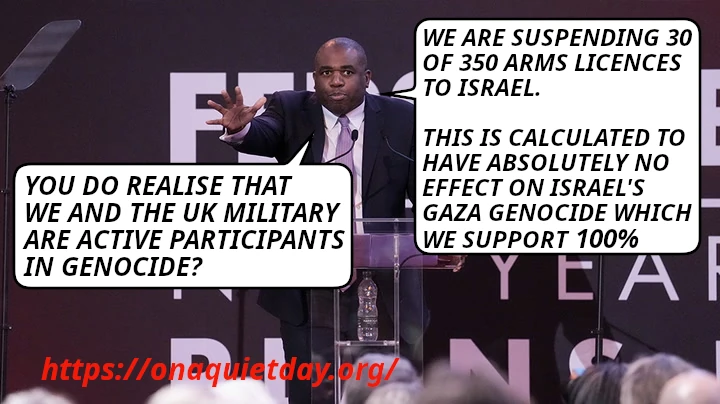
Genocide denying UK Foreign Secretary David Lammy says that UK is suspending 30 of 350 arms licences to Israel. He also confirms the UK government’s support for Israel’s Gaza genocide and the UK government and military’s active participation in genocide.Keir “I support Zionism without Qualification” Starmer supporting genocide.UK Labour Party government ministers Keir Starmer, Angela Rayner and Rachel Reeves explain that they are partners complicit in Israel’s Gaza genocide. The UK has provided Israel with arms, military and air force support. They explain that they don’t do gas chambers but do do forced marches, starvation, destroy hospitals, mass-murders of journalists and healthcare workers.
The acclaimed 1990 film Awakenings tells the story of a neurologist who discovers a drug which rouses catatonic patients from decades of “sleep”. It’s a true story, based on Oliver Sacks’ 1973 memoir of the same name.
Sadly, the awakening doesn’t last. The drug wears off. The mirage fades. After a brief window of hope, the patients return to their catatonic state.
Listening to UK prime minister Rishi Sunak’s recent speech, in which he announced the rolling back of policies to achieve net zero, I had a nagging sense that I had seen this movie before.
I had been there when the UK miraculously built a cross-party consensus around climate change. As early as 1989, I’d attended a high-level seminar convened by Sir James Goldsmith (father of Tory peer Zac Goldsmith) to advise Margaret Thatcher on climate policy.
I’d applauded John Prescott’s tireless leadership in negotiating the Kyoto Protocol in 1997. I’d given evidence to the Royal Commission on Environmental Pollution, whose influential 2000 report on Energy – the Changing Climate set the UK on the path to a world-leading Climate Change Act. When it came to a vote only five MPs stood against it.
I’d had what you might call a front row seat as a political consensus on climate change emerged in the UK. But during the long and uncomfortable 25 minutes of Sunak’s speech, I felt I was witnessing a homage to catatonia.
There was so much patently wrong in the speech that it’s difficult to know where to start. Most obviously, the prime minister’s insistence that the UK can still meet its climate commitments, despite putting a brake on policy, bucks his own advisors’ assessment of the country’s progress towards net zero emissions. It also reveals a deep misunderstanding of the science.
Delay is costly
Remaining within the 1.5° or even 2°C thresholds set out in the Paris agreement to avoid catastrophic climate change requires substantial emission reductions now. The climate is indifferent to the date on our targets. Its concern is the volume of carbon in the atmosphere.
As my own analysis has shown, the UK’s fair share of the global carbon budget, taking into account the development needs of the poorest parts of the world, will be exhausted before 2030. Forget 2050. The science is clear. Delay is tantamount to capitulation.
A key economic principle follows from this: the sooner you act, the lower the final bill. The 2006 Stern Review on the economics of climate change showed why. There may be some upfront costs in reaching net zero, and it is clearly the job of government to ensure that these do not fall on the poor. But the long-term costs of refusing to pay are catastrophic.
Those costs are already being counted: fires in Europe and Canada, droughts in North America and Africa, floods in Libya. All this will keep getting worse. Homes in some parts of the US are already “essentially uninsurable” because of climate risk.
The same lesson applies to the transition itself. Research I led has established the principles on which (to use the prime minister’s words) “a fair and proportionate” response to climate change should be based.
Early signals on the direction of regulation; financial and technical support for business and households to make the transition; transparent guidance for those who stand to benefit; and appropriate compensation for those who stand to lose: these are the foundations for clear and consistent policy.
As the chair of Ford UK put it on the same day Sunak tore up Boris Johnson’s 2030 target for the phase-out of diesel and petrol cars: “Our business needs three things from the UK government: ambition, commitment and consistency. A relaxation of 2030 would undermine all three.”
Sunak wasn’t listening. A target set by a predecessor, even from his own party, carries no truck with this prime minister.
He also ditched a ban on new domestic oil boilers in off-grid locations (which could have reduced costs and improved air quality for rural households) and minimum energy efficiency standards for privately rented homes (which could have saved poorer families thousands in energy bills).
Just to emphasise the point, he scrapped a host of made-up policies such as taxes on meat and regulations on carsharing which had never actually existed.
It’s no surprise to find an embattled political party trying to draw clear blue water between itself and the opposition. Buoyed by Labour’s narrow defeat in the Uxbridge and South Ruislip byelection (widely attributed to a backlash against London’s Ulez policy) Tory strategy is now turning net zero into election fodder.
Sunak was swift to deny this charge when it was posed to him by a sympathetic Sun journalist in what seemed like a carefully rehearsed question. Casually couched within a cricket joke, Rishi-the-cricket-fan was able to laugh it off. “No, this is not actually about politics,” he said. “It’s about doing what’s right for the country in the long term.”
It was a stunning revelation. From Aristotle to Hannah Arendt, genuine politics was always about doing what’s right for the long term. Only today is it reduced to shallow electioneering. Not content with betraying the interests of the future, Sunak’s speech has helped turn climate change into a sordid culture war.
After 13 years, single-party rule has become a dangerous thing. Not so much because it stifles dissent, but rather because it has destroyed a vital consensus.
Perhaps consensus is a commodity yet more fragile than consciousness. But its disappearance still carries a sense of political and social loss more tragic even than the final scenes of Awakenings.
Don’t have time to read about climate change as much as you’d like?
Tim Jackson, Professor of Sustainable Development and Director of the Centre for the Understanding of Sustainable Prosperity (CUSP), University of Surrey