Tory plan to scrap net zero target puts UK climate leadership at risk

Spread the love
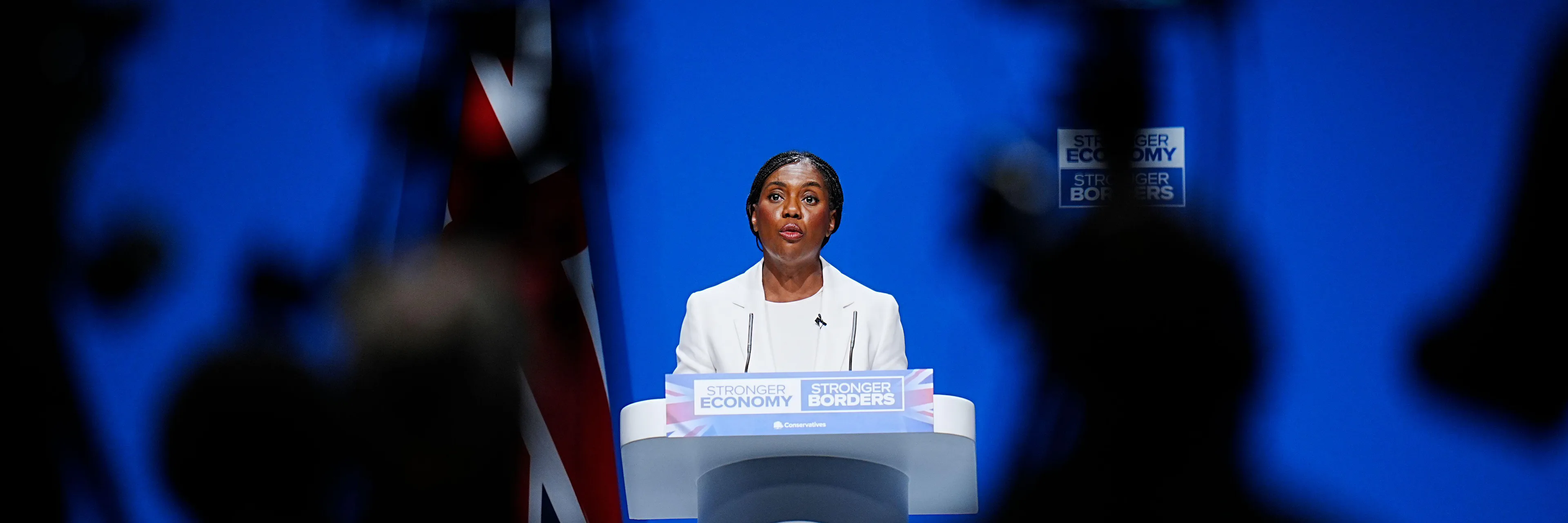
Kemi Badenoch wants to scrap the UK’s Climate Change Act. Danny Lawson / PA

Sam Fankhauser, University of Oxford

In the mid-2000s, soon after becoming Conservative leader, David Cameron hugged a husky on a trip to the Arctic, in what was widely described as an attempt to “detoxify” the Tory brand. Eighteen years later, Kemi Badenoch has promised to scrap the law that once made that rebranding credible.

Her announcement that the Conservatives will repeal the 2008 Climate Change Act if they win the next general election has the potential to be a major own goal – politically, environmentally and economically.

To understand why, we need to remember how the Climate Change Act came about. The bill was put forward by the Labour government of Gordon Brown, but it had enthusiastic support from the Conservative opposition, which tabled several amendments to strengthen it. Cameron had concluded that green policies were a good way to modernise his party and lead it back into power.

It worked, both for Cameron, who became prime minister in 2010, and for UK climate policy, which has enjoyed a unique period of consensus and stability. Over seven governments, multiple economic crises, Brexit, COVID-19 and the war in Ukraine, there has been clarity about Britain’s climate change objectives. Policies were chopped and changed, often to the frustration of investors, but the institutional framework was stable and widely appreciated.

The Climate Change Act gives the UK a statutory long-term emissions target – initially an 80% cut from 1990 levels by 2050, strengthened to net zero by 2050 by Theresa May, another Tory prime minister.

Progress is managed through a series of five-year carbon budgets, legislated 12 years in advance and monitored by a powerful independent body, the Climate Change Committee (CCC). For much of its existence, the CCC has been chaired by yet another environmentally-minded Tory, Lord Deben (John Gummer). It is this framework the Conservatives now say they want to dismantle.
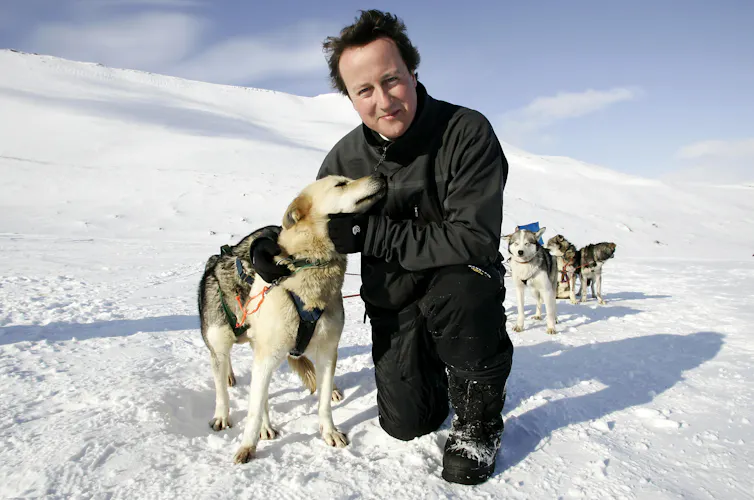
Husky hugger David Cameron visits Svalbard, Norway, in 2008. Andrew Parsons / PA

Yet the Climate Change Act has delivered, both in terms of process and substance. Indeed, the UK model has been emulated around the world. Nearly 60 countries have UK-style climate change laws and over 20 countries have CCC-style advisory bodies, cementing the UK’s position as a climate leader.

The act gives the UK a steady institutional rhythm. Relevant businesses and other organisations know the formal set pieces, such as the CCC’s annual report to parliament, and can time their interventions accordingly.

When colleagues and I interviewed people from business and civil society about the act a few years ago, they emphasised the predictable process, the clear rules on accountability and the evidence-based discourse it has enabled. This all reduces uncertainty and enables long-term planning.

Importantly, the Climate Change Act has delivered environmentally too. Compared to 1990, UK greenhouse gas emissions are down by 50%. The UK economy now uses three times less carbon per unit of economic output than in 1990. Emissions are at their lowest level since 1872.

This trend started before the act, but it was helped and accelerated by it. This is perhaps most noticeable in the radical transformation of the electricity sector: coal has been completely phased out, while offshore wind and other renewables have flourished.

Most people want climate action

Voters value this progress more than politicians appreciate. A University of Oxford survey found that internationally public support for climate action is almost twice as high as policymakers assume. In the UK, three out of four people are fairly or very concerned about climate change.

Badenoch’s announcement comes just as households are starting to reap the financial benefits of clean technology. Colleagues and I have estimated that four out of five UK households, particularly those owning a car, would be better off if net zero was achieved. The typical savings are £100-£380 per household and year.

It is true that households do not yet see the benefits of renewables on their energy bills. We are still paying for the high costs of early investments in clean power, before technology and sheer scale brought the price down.

Successive governments have chosen to recoup these learning costs through electricity bills, rather than general taxation, which would have been easier on most households. But recent analysis suggests renewables are now cutting electricity prices by up to a quarter.

The policy uncertainty generated by the Tory announcement and similar pronouncements by Reform UK will eventually find its way into the risk premiums for investors, though for the time being this effect is still small.

But the reputational damage is immediate. Undoing the act would signal that the UK no longer values the long-term stability that has driven clean investment and made its climate policy admired around the world.

Climate policy requires debate. Deeply political choices need to be made about different decarbonisation strategies, how to pay for necessary investments or the role of controversial technologies like nuclear energy. The past 17 years have shown that these debates are best had within an agreed framework, with support from all major parties. That is what the Climate Change Act provides.


Don’t have time to read about climate change as much as you’d like?
Get a weekly roundup in your inbox instead. Every Wednesday, The Conversation’s environment editor writes Imagine, a short email that goes a little deeper into just one climate issue. Join the 45,000+ readers who’ve subscribed so far.


Sam Fankhauser, Professor of Climate Economics and Policy, Smith School of Enterprise and the Environment, University of Oxford

This article is republished from The Conversation under a Creative Commons license. Read the original article.

UK Conservative Party leader Kemi Badenoch explains her reality that the Earth is flat, the Moon is made of cheese and that she was born from Unicorn horn dust
UK Conservative Party leader Kemi ‘not a genocide’ Badenoch explains her reality that the Earth is flat, the Moon is made of cheese and that she was born from Unicorn horn dust
Nigel Farage urges you to ignore facts and reality and be a climate science denier like him. He says that Reform UK has received £Millions and £Millions from the fossil fuel industry to promote climate denial and destroy the planet.
Orcas discuss how Trump was re-elected and him being an obviously insane, xenophobic Fascist.
Continue ReadingTory plan to scrap net zero target puts UK climate leadership at risk

Starmer plans to ‘embed profit-seeking parasites’ into NHS, campaigners warn

Spread the love

https://morningstaronline.co.uk/article/starmer-plans-to-embed-profit-seeking-parasites-into-nhs-campaigners-warn

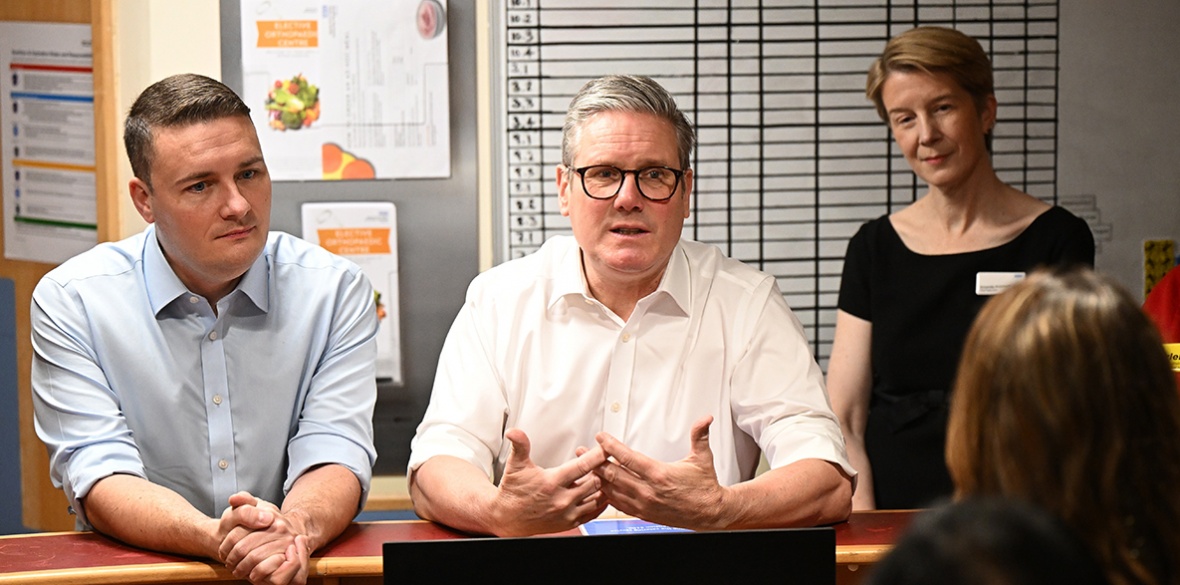
Prime Minister Sir Keir Starmer (centre) and Health Secretary Wes Streeting (left), with NHS CEO Amanda Pritchard (right) during a visit to Elective Orthopaedic Centre in Epsom, Surrey, to highlight his ‘plan for change’ commitments on health, January 6, 2025

TARGETING a 20 per cent increase in the use of the private sector to cut waiting lists risks “permanently embedding the profit-taking parasite” into the health service, campaigners have warned.

Prime Minister Sir Keir Starmer claimed he is “not interested in putting ideology before patients” as he unveiled the NHS’s growing use of private healthcare in a major speech today.

Private operators will receive an extra £2.5 billion a year in government funding under his new elective reform plan to address a waiting list for planned care on which 6.4 million people are waiting for 7.5m treatments.

This amounts to as many as a million extra appointments, scans and operations a year by the for-profit sector, with the official aim of patients no longer having to wait more than 18 weeks for non-urgent hospital care by spring 2029.

During his speech in Surrey, the prime minister acknowledged some people will “not like” expansion of the private sector in the NHS, but said: “To cut waiting times as dramatically as possible, our approach must be totally unburdened by dogma.”

Keep Our NHS Public co-chair Dr Tony O’Sullivan said: “The commitment of Keir Starmer and Wes Streeting to long-term contracts with the private sector threatens to permanently embed the profit-taking parasite in the NHS host, undermining the prospect of NHS recovery as a publicly provided universal service meeting the needs of the population.

“Starmer says he will ‘not let ideology stand in the way’ but it is their ideological choice that will stand in the way of sustainable NHS recovery.

“Safe and prompt community care will only be delivered through an urgent expansion of skilled staff.”

We Own It lead campaigner Johnbosco Nwogbo said: “Using the private sector to cut waiting lists was the centrepiece of the Conservative government’s Elective Recovery Plan in February 2022, but waiting lists kept going up.

“Starmer’s ‘new’ initiative looks suspiciously similar to the Conservatives’ failed plan.

“Hospitals are crumbling while the NHS is haemorrhaging at least £10m a week to private shareholder profits — money which could build a new operating theatre every week.

Article continues at https://morningstaronline.co.uk/article/starmer-plans-to-embed-profit-seeking-parasites-into-nhs-campaigners-warn

Keir Starmer commits to play the caretaker role for Capitalism through the "hard times".
Keir Starmer commits to play the caretaker role for Capitalism through the “hard times”.

Keir Starmer commits to play the caretaker role for Capitalism through the “hard times”.

Continue ReadingStarmer plans to ‘embed profit-seeking parasites’ into NHS, campaigners warn

Keir Starmer will continue austerity. That means keeping vulnerable people in ‘brutalising poverty’

Spread the love

https://www.bigissue.com/opinion/keir-starmer-austerity-u-turn-labour-poverty-suffering/

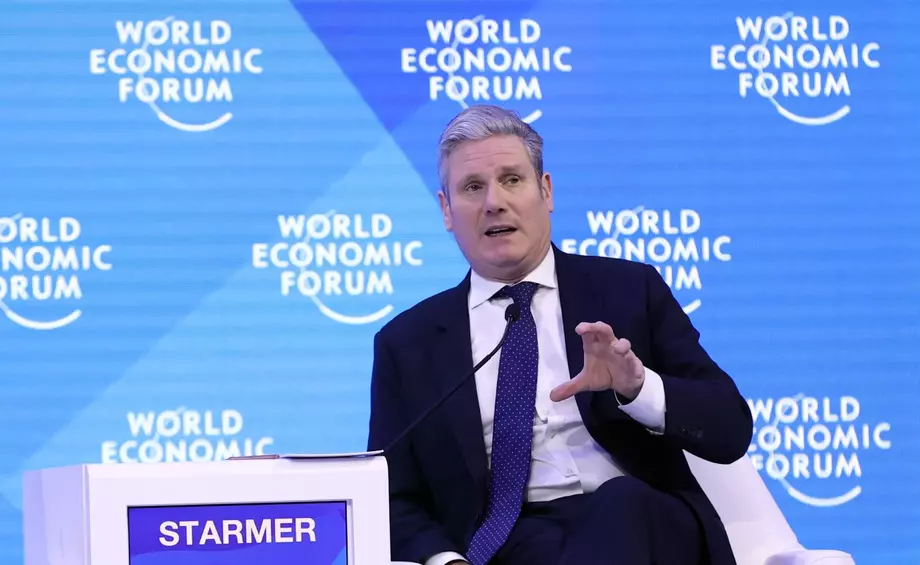
Keir Starmer sucking up to the rich and powerful at World Economic Forum, Davos.

Beyond each Labour U-turn is a well of suffering and poverty that has no justifiable reason to exist, says trade union case worker Kasmira Kincaid

Our politicians invariably speak of “fiscal responsibility”; of “balancing the budget” and “living within our means”. The Keir Starmer of today – as opposed to the Keir Starmer who was elected to lead the Labour Party in 2020 – is no different. But these words just serve to obscure the obscenity of what is actually being said: that we can’t afford to feed the poor, to house the homeless, and to allow people to live in dignity and comfort.

But the thing is we can. We know we can. We know it when we see government funds used to drop bombs on foreign countries. We know it when we see sweeping tax cuts to the wealthy, and tax evaders let off the hook. And we know it when we walk past empty tower blocks, full of investment properties, while homeless people die on the streets.

It’s a supreme form of gaslighting to suggest otherwise, asking us to deny the evidence of our senses and experiences. Making sure everyone gets what they need is a logistical challenge, for sure. But there is enough to make sure everyone gets what they need.

As a new Labour government comes to feel inevitable, many of us are taking stock of what such a government would mean. Over the last four years, Keir Starmer has U-turned on practically every anti-austerity policy in his 2020 leadership bid: from abolishing universal credit and what he once called “the Tories’ cruel sanctions regime”; to scrapping work capability assessments and the two-child limit on benefits; to re-nationalising key public services.

Today I live a life where few of these policies would directly affect me. Yet I haven’t forgotten what it felt like to be in the firing line for government decisions. The material conditions of people’s lives should be the beginning and end of politics. As we voice our opposition to continued austerity we’d do well to remember that. To remember that beyond each of these U-turns is a well of human suffering that has no justifiable reason to exist.

Kasmira Kincaid is a trade union case worker and former benefits claimant.

https://www.bigissue.com/opinion/keir-starmer-austerity-u-turn-labour-poverty-suffering/

Image of cash and pre-payment meter key
Continue ReadingKeir Starmer will continue austerity. That means keeping vulnerable people in ‘brutalising poverty’

UK environment laws under threat in ‘deregulatory free-for-all’

Spread the love

https://www.theguardian.com/environment/2022/sep/23/uk-environment-laws-under-threat-in-deregulatory-free-for-all

Environmentalists accused Liz Truss’s government of reneging on a commitment made after Brexit to halt the decline of nature by 2030. They say the revoking of 570 environmental laws that were rolled over from EU law after Brexit amounts to a deregulatory free-for-all leaving the environment unprotected.

The bill laid before parliament outlines how 570 environmental laws, and hundreds more covering every government department, including transport, health and social care, working hours and other areas, are being lined up to be removed from UK law or rewritten. These include the habitat regulations that have been vital in the protection of places for wildlife in the last 30 years and laws covering the release of nitrates and phosphates into rivers.

The laws were retained after Brexit when the then Conservative environment secretary, Michael Gove, promised the UK’s environmental laws would not be watered down.

RSPB ‘not ruling out’ direct action to defend nature from government policy

The head of the RSPB says the bird charity is ruling nothing out as it organises a mobilisation of millions of people against what it calls the government’s “attack on nature”.

Beccy Speight dismissed accusations by Conservative MPs that the group was lying to its members and pursuing a marketing drive, as it leads a coalition campaigning against the government over key “growth” policies which it argues will damage wildlife and nature.

The chief executive said a meeting with the secretary of state for environment, food and rural affairs, Ranil Jayawardena, had not provided any reassurance that the government’s growth policies would protect nature.

The director general of the National Trust, Hilary McGrady, accused the government of “demonising” conservationists, saying her members were “outraged and worried”.

Continue ReadingUK environment laws under threat in ‘deregulatory free-for-all’

Jeremy Corbyn videos :: 2

Spread the love

This blog and my previous blog is about me being a political dissident and a political activist. I am supporting Jeremy Corbyn in the Labour leadership campaign.

I consider that the vast majority of the UK electorate has been denied the opportunity to vote for anybody remotely representing their interests for far too long. Isn’t democracy an absolute farce if your choice is Conservative, Conservative or Conservative? (Conservative, Conservative-Liberal-Democrat or Conservative-Labour).

I will be featuring some videos about Jeremy Corbyn’s campaign. These vids are just within the last day or so.

Comments are monitored. They will be published if relevant regardless of any other consideration. OK, they may be cen***ed if obscene but they are welcome and encouraged.

ed: There are a lot more available. YouTube has a filter Sort by Upload date


Continue ReadingJeremy Corbyn videos :: 2