Corporate Media Push Conspiracy Theories to Discredit Student Protesters

Spread the love

Original article by NAOMI LACHANCE republished from FAIR under a Creative Commons Attribution-NonCommercial-NoDerivs 3.0 Unported License.

Across corporate media, journalists and pundits introduced conspiracy theories to discredit the pro-Palestine student protest movement, particularly that they are funded by foreign countries or “outside agitators.”

Joe Scarborough and Hillary Clinton on MSNBC‘s Morning Joe (5/9/24) to talk about “misinformation,” agreeing that student protesters are “extremists…funded by Qatar.”

MSNBC‘s Joe Scarborough (5/9/24) went on a rant about the college students who have been staging the protests, suggesting to guest Hillary Clinton that they were influenced by China or Qatar:

I’m going to talk about radicalism on college campuses. The sort of radicalism that has mainstream students getting propaganda, whether it’s from their professors or whether it’s from Communist Chinese government through TikTok, calling the president of the United States “Genocide Joe.” Calling you and President Clinton war criminals.

Eventually, he called the students “extremists—I’m sorry—funded by Qatar.”

Clinton responded: “You raised things that need to be vented about.”

Scarborough’s claim that Qatar funds the students likely comes from a Jerusalem Post article (4/30/24), which called the protests “despicable.” The story reported, “Qatar has invested $5.6 billion in 81 American universities since 2007, including the most prestigious ones: Harvard, Yale, Cornell and Stanford.” Of course, funding  universities is not the same as funding student protests; the university administrations that actually received the Qatari funding have often been quite hostile to the protesters.

‘Mr. Putin’s message’

Nancy Pelosi, interviewed by Dana Bash on CNN (1/28/24), accused protesters of being “connected to Russia” because “to call for a ceasefire is Mr. Putin’s message.”

House Speaker Emeritus Nancy Pelosi (D–Calif.) suggested on CNN’s State of the Union (1/28/24) that Russia has played a role in the protests:

And what we have to do is try to stop the suffering and gossip….. But for them to call for a ceasefire is Mr. Putin’s message…. I think some of these protesters are spontaneous and organic and sincere. Some I think are connected to Russia.

CNN’s Dana Bash asked, “you think some of these protests are Russian plants?” Pelosi responded: “I don’t think they’re plants; I think some financing should be investigated.”

Like MSNBCFox News (5/2/24) has also pushed the narrative suggesting that China is behind the protests: “China may be playing a significant role in the anti-Israel protests by using TikTok to foment division on college campuses,” Alicia Warren wrote.

Gordon Chang, a senior fellow at the far-right, anti-Muslim Gatestone Institute, told Fox that “China is using the curation algorithm of TikTok to instigate protests.”

The presence of pro-Palestinian advocacy on TikTok has been cited by lawmakers as a justification for censoring the social media platform (FAIR.org5/8/24). But the messages on TikTok, which is popular among younger people, may simply reflect public opinion among that demographic. According to the Pew Research Center, “Younger adults are much less supportive of the US providing military aid to Israel than are older people.”

In a story headlined, “Campus Protests Give Russia, China and Iran Fuel to Exploit US Divide,” the New York Times (5/2/24) described “overt and covert efforts by the countries to  amplify the protests.” The story included some speculation about foreign influence: “There is little evidence—at least so far—that the countries have provided material or organizational support to the protests,” Steven Lee Myers and Tiffany Hsu wrote. If there was any evidence, they did not present it.

The journalists blamed the protests for having “allowed” these “foreign influence campaigns…to shift their propaganda to focus on the Biden administration’s strong support for Israel.”

‘Professional outside agitators’

ADL’s Jonathan Greenblatt on CNN (4/29/24): “There’s no rule that says the school needs to tolerate students or, again, outside activists dressing like they’re in Al Qaeda.”

Beyond foreign influence, another conspiracy theory pushed by corporate media about student protesters is that they are influenced by “outside agitators.” While people who are not students have joined the protests, the term has long been used to delegitimize movements and portray them as led by nefarious actors.

New York City Mayor Eric Adams was an early source of this claim, announcing at a press conference (4/30/24) that Columbia students have “been co-opted by professional outside agitators.” He made a similar statement in mid-April as well (4/21/24).

On MSNBC (5/1/24), NYPD deputy police commissioner Kaz Daughtry defended the claim, holding up a bicycle lock with a substantial metal chain that police had found at Columbia. “This is not what students bring to school,” he said. In fact, Columbia sells the bike lock at a discount to students (FAIR.org5/9/24).

CNN‘s Anderson Cooper (4/29/24) asked the Anti Defamation League’s Jonathan Greenblatt about the outside agitators, “How many of them are actually students?” “A lot of them are not students,” Greenblatt replied, adding unironically: “You can’t even tell who’s an outside agitator and who’s an actual student.”

CNN senior political commentator David Axelrod tweeted (4/30/24): “It will be interesting to learn how many of those arrested in Hamilton Hall at Columbia are actually students.”

“I really believe they are brainwashed,” Donald Trump (Fox News4/30/24) said of student protesters.

Former president Donald Trump made a similar claim on Fox (4/30/24). “I really think you have a lot of paid agitators, professional agitators in here too, and I see it all over. And you know, when you see signs and they’re all identical, that means they’re being paid by a source,” he told Fox host Sean Hannity. He continued: “These are all signs that are identical. They’re made by the same printer.”

It’s worth noting that a political movement is not like an intercollegiate athletic competition, where it’s cheating for non-students to play on a college team; it’s not illegitimate for members of the broader community to join an on-campus protest, any more than it’s unethical for students to take part in demonstrations in their neighborhoods.

“If you’re a protester who’s planned it, you want all outsiders to join you,” Justin Hansford of the Thurgood Marshall Civil Rights Center told PolitiFact (5/6/24). “That’s why this is such a silly concept.”

That didn’t stop the New York Post (5/7/24) from publishing an op-ed by former New York Lt. Gov. Betsy McCaughey  headlined “Pursue Anti-Israel ‘Outside Agitators’ Disrupting Colleges—and End the Nonsense for Good.” McCaughey wrote, “Ray Kelly, former NYPD commissioner, nailed it Sunday when he said the nationwide turmoil ‘looks like a conspiracy.’” It looks like a conspiracy theory, anyway.

Tents situation

NYPD deputy police commissioner Kaz Daughtry (Fox 5 New York, 4/23/24): “Look at the tents. They all were the same color. They all were the same type of tents.”

One key piece of evidence offered for the “outside agitators” claim was the uniformity of many of the encampments’ tents. When Fox 5 New York (4/23/24) invited two NYPD representatives to discuss the protests, NYPD’s Daughtry said: “Look at the tents. They all were the same color. They all were the same type of tents.” He continued: “To me, I think somebody’s funding this. Also, there are professional agitators in there that are just looking for something to be agitated about, which are the protests.”

“Somebody’s behind this, and we’re going to find out who it is,” Daughtry said.

That students might be observing the world and their role in it, and acting accordingly, was not considered.

Newsweek (4/23/24) quoted Daughtry’s claim with no rebuttal or attempt to evaluate its veracity, under the headline, “Police Investigating People ‘Behind’ Pro-Palestinian Protests.” Fox News anchor Bret Baier (4/23/24) also cited the tents as a smoking gun: “We do see, it is pretty organized. The tents all look the same. And it’s expanding.”

The problem with this conspiracy theory is that the look-alike tents at most encampments were not expensive at all. As HellGateNYC (4/24/24) pointed out, the two-person tents seen at Columbia cost $28 on Amazon (where they’re the first listing that comes up when you search “cheap camping tent”), and the ones at NYU were even cheaper, at $15. While many Columbia students receive financial aid, the basic  cost of tuition, fees, room and board at the school is $85,000 a year. What’s another $15?

‘Soros paying student radicals’

Fox News (4/26/24): “Progressive anti-Israel agitators across the country…are associated with groups tied to far-left groups with radical associations backed by dark money and liberal mega-donor George Soros.”

And finally, some news outlets alleged that the student protesters are funded by financier George Soros. For example, Fox (4/26/24) reported that a group that funds National Students for Justice in Palestine (NSJP) received a donation from an unnamed nonprofit that is funded by Soros. Fox was apparently referring to the Tides Foundation, a philanthropy that Soros has given money to; Tides gave $132,000 to WESPAC, a Westchester, N.Y., peace group that serves as a financial sponsor to NSJP in Palestine (PolitiFact5/2/24Washington Post4/26/24). In standard conspiratorial reasoning, this three-times-removed connection means that, as Fox put it, protests attended by SJP members are “backed by dark money and liberal mega-donor George Soros.”

The New York Post (4/26/24) published a similar piece, headlined “George Soros Is Paying Student Radicals Who Are Fueling Nationwide Explosion of Israel-Hating Protests.”

On NewsNation (5/1/24), House Speaker Mike Johnson (R-La.) also suggested Soros may be connected, saying that the FBI should investigate:

I think the FBI needs to be all over this. I think they need to look at the root causes and find out if some of this was funded by—I don’t know—George Soros or overseas entities. There’s sort of a common theme and a common strategy that seems to be pursued on many of these campuses.

“It looked pretty orchestrated to me,” NewsNation host Blake Burman agreed.

Soros is a billionaire philanthropist who survived the Holocaust. He has come to represent an antisemitic trope among right wingers of a puppet master controlling events behind the scenes (see FAIR.org3/7/22). To put it simply, these supposedly antisemitic protesters are now on the receiving end of antisemitism.


Featured image: New York Post graphic (4/26/24) alleging that Jewish billionaire George Soros is bankrolling “Israel hate camps.”

Original article by NAOMI LACHANCE republished from FAIR under a Creative Commons Attribution-NonCommercial-NoDerivs 3.0 Unported License.
Continue ReadingCorporate Media Push Conspiracy Theories to Discredit Student Protesters

DeSmog Launches Investigation Into Food and Farming Misinformation Ahead of EU Elections

Spread the love

Original article by Clare Carlile republished from DeSmog.

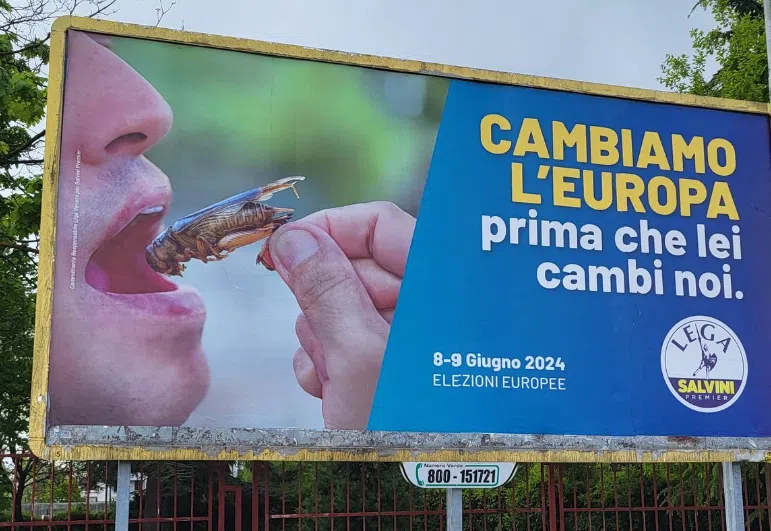
Credit: Alberto Perinot/X

The far right is set to piggyback on agricultural discontent to capture votes in June.

A large blue billboard stands outside a park in the town of Conegliano in northern Italy. On the left, a man pops a vast cricket into his mouth. On the right, are the words, “Let’s Change Europe before it changes us” – and the dates of the upcoming elections.  

The poster – an advert for the country’s radical right party Lega per Salvini Premier – refers to a conspiracy theory that has swept across Italy in the last 18 months. Elites in Brussels are planning to replace meat with bugs and are using environmental regulations to do so, or so the theory goes.

As millions of voters across the EU prepare to head to the polls from 6-9 June, conspiracy theories and misinformation on food and farming could pull voters towards the far right and parties opposing climate-friendly laws.

In the face of this onslaught of misinformation, DeSmog is launching a new series that investigates misleading claims and their impact on climate policy in the farming sector. 

Over the next two months DeSmog will monitor the spread of misinformation across the continent, working in seven different languages. We will look to identify false claims and uncover who is spreading these narratives online.

Agriculture accounts for 11 percent of carbon emissions in the EU, and has contributed to plummeting bird and bee numbers. But tackling the sector’s harms has become one of the most divisive issues on the continent, with tractors blocking highways across Europe during demonstrations this year. 

The protests – attended by thousands of farmers in several countries – reflected a wide range of concerns, from unfair food prices to calls for protection from increasingly extreme weather. Yet this complexity was barely represented in the media where demonstrations were cast as opposition to environmental measures. 

Far-right groups also weaponised the protests. In January, Jordan Bardella, lead EU candidate for France’s National Rally (formerly National Front), accused the country’s President Emmanuel Macron of pursuing “the death of agriculture” while Santiago Abascal, leader of Spain’s far-right party Vox, wrote to Macron demanding an end to “aggressions” against Spanish producers, who he described as “victims” of EU policy.

In the eyes of its critics, green reforms agreed in the last EU term would destroy farming. Plans to cut chemical use and make farmers protect natural habitats would lead to monumental job losses, they claim. The same arguments are used by agricultural corporations that stand to lose out if green reforms are enacted.

The most extreme opponents, including radical right think tanks and hardline farming groups, see green reforms as part of a plan by Brussels bureaucrats to control the industry and “grab land”. 

These claims, however, contradict the facts: last year, more than 6,000 scientists said that such nature-friendly measures were “the cornerstone of food security and human health”. 

The policies that are currently being attacked aim to tackle climate breakdown – the biggest threat to producers across the EU, who are already feeling the effects of global heating. A “staggering portion” of the continent has been exposed to high drought risk in recent years, according to the European Drought Observatory, leading to widespread crop losses.

Right-wing and far-right groups stand to make massive gains from stoking these tensions. A recent study by the EU’s Committee of the Regions showed that discontented rural areas could be a major source of votes.  

This series will shine a light on those candidates that are weaponising false claims for electoral gain.

Original article by Clare Carlile republished from DeSmog.

Continue ReadingDeSmog Launches Investigation Into Food and Farming Misinformation Ahead of EU Elections

Quick, blame the deep state! The tactics at play when Tories spout conspiracy theories

Spread the love
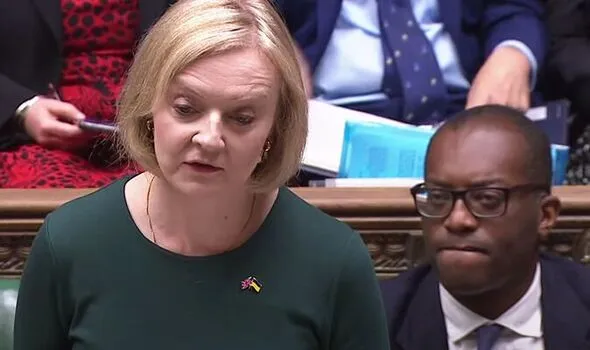
Image of Liz Truss and Kwasi Kwarteng


Adam Koper, Cardiff University

Conservative MPs seem increasingly willing to use the rhetoric of conspiracy. Recently, Liz Truss claimed that her brief tenure as prime minister had been ended by the deep state – shadowy forces within the British establishment and the media.

A few days later, Lee Anderson, the Conservative party’s former deputy chairman, asserted that London’s mayor, Sadiq Khan, is being controlled by Islamists. He was adding his own twist on a similar conspiracy theory put forward by former home secretary Suella Braverman, who claimed in a Telegraph article that Islamists are in charge of the whole country.

Why do politicians make conspiracy claims like these? It seems strange for MPs whose party has been in government for almost 14 years to imply that they aren’t really in control and that power is wielded by hidden actors.

Maybe Truss and Anderson mean what they say, and say what they mean. But even if they do believe that Britain is governed by a deep state or Islamist plotters, knowing a bit about rhetoric can help us to see that there is more going on when politicians use the language of conspiracy.

Context matters

A good politician will adapt what they say to fit the moment and their audience. For example, Truss’s deep state comments were made at CPAC, a conference for American conservatives. She was speaking in part to promote her new book, Ten Years to Save the West, and so had little reason to do anything other than give her audience what it likes. Conspiracy theories have become prominent in American conservatism (think QAnon and the claims that the 2020 presidential election was stolen), so echoing the rhetoric is an obvious way for a CPAC speaker to ingratiate themselves with an audience.

Anderson, though, was speaking in the UK, where conspiracist language is more unusual. His comments were seen by many as deliberately divisive and Islamophobic, and quickly landed him a suspension from his party. That said, government ministers were evasive when asked why his comments were wrong and whether they were Islamophobic.

Part of the brand

Courting controversy carries risks, as Anderson’s suspension shows. But it can also thrust a politician into the limelight, giving them a chance to speak to a broader audience and potentially gain new supporters. Much of the time, politicians make their own character – or ethos, as it is known in classical rhetoric – part of their pitch.

In her comments alleging a deep state conspiracy, Truss took on a populist tone. She portrayed herself as an anti-establishment figure fighting for the British people against the elites. She didn’t mention her party’s long period in government in charge of the civil service that allegedly made her tenure so impossible. Nor did she refer to the economic problems brought about during her fleeting administration.

Speaking to an audience which is likely to be less familiar with her political career, Truss was able to present herself as the protagonist in a David and Goliath narrative – albeit one in which David is defeated.

Similarly, Anderson used the controversy around his comments to present himself as a man of the people. Rather than giving any evidence to back up his claims about Islamists controlling Khan, Anderson instead justified his views by citing the positive reaction he had received from his constituents. When told in an interview with Channel 4 News that people were puzzled by his refusal to back down, Anderson replied: “If you go and speak to people in Ashfield [Anderson’s constituency] and ask them if they’re puzzled about it, no they’re not.”

In the aftermath of the controversy, Anderson told GB News: “When I went into pubs in Ashfield at the weekend, Friday, Saturday, Sunday, I got a round of applause when I went in. And these are normal working-class people.”

Such comments can be seen as part of a broader trend. Politicians have learned to cite the opinions of ordinary people in order to justify spurious claims. Rather than explaining anything about how he came to view Islamists being in charge of London, Anderson’s response to questions has been to use them as an opportunity to present himself as an outsider to the political establishment – a man in tune with what voters really think.

Pitting ‘us’ against ‘them’

This focus on presenting a certain persona and using it to justify baseless comments tells us something important – that identity is a key ingredient in conspiracist rhetoric.

It enables a politician to construct a conflict between an in-group and an out-group – a struggle between “us” and “them” – and asks the audience to pick a side. Rather than focusing on policies or ways of improving life for the British population, this rhetoric wants the audience to identify with the speaker’s character and join them in opposing a threatening enemy.

In this way, conspiracist rhetoric is much like the Conservatives’ attacks on “woke ideology” – it deflects attention away from their record in government, and rallies their supporters against an enemy at a time when the party is down on its luck.

Counteracting this is no easy task. Rhetoric is an art, not an exact science. One strategy could be to focus more on what politicians are trying to achieve when they use conspiracist rhetoric. While it is important to determine whether or not they really believe in a deep state or Islamist conspiracy, we also need to challenge the personas that politicians craft for themselves, as well the us-against-them divisions they construct.The Conversation

Adam Koper, WISERD Civil Society Post-Doctoral Fellow, Cardiff University

This article is republished from The Conversation under a Creative Commons license. Read the original article.

Continue ReadingQuick, blame the deep state! The tactics at play when Tories spout conspiracy theories

David Cameron Islamic Extremism speech July 2015

Spread the love

I’ll be making some remarks on David Cameron’s recent speech on so-called Islamic Extremism. Later on in his speech Cameron says that he wants to do away with this blog under his ‘Extremism Bill’. edit: He doesn’t actually say this blog but

“First, any strategy to defeat extremism must confront, head on, the extreme ideology that underpins it. We must take its component parts to pieces – the cultish worldview, the conspiracy theories

we should together challenge the ludicrous conspiracy theories of the extremists. The world is not conspiring against Islam; the security services aren’t behind terrorist attacks

Second, as we counter this ideology, a key part of our strategy must be to tackle both parts of the creed – the non-violent and violent.

This means confronting groups and organisations that may not advocate violence – but which do promote other parts of the extremist narrative.

We must demand that people also condemn the wild conspiracy theories, the anti-Semitism, and the sectarianism too. Being tough on this is entirely keeping with our values.

We need to put out of action the key extremist influencers who are careful to operate just inside the law, but who clearly detest British society and everything we stand for [Tory values]. These people aren’t just extremists. There are despicable far right groups too. And what links them all is their aim to groom young people and brainwash their minds.

So as part of our Extremism Bill, we are going to introduce new narrowly targeted powers to enable us to deal with these facilitators and cult leaders, and stop them peddling their hatred.

As I said, this is not about clamping down on free speech. It’s just about applying our shared values uniformly.

This blog peddles conspiracy theories and claims that security services are behind terrorist attacks.

Sorry Cameron, you’ll be imprisoning me.

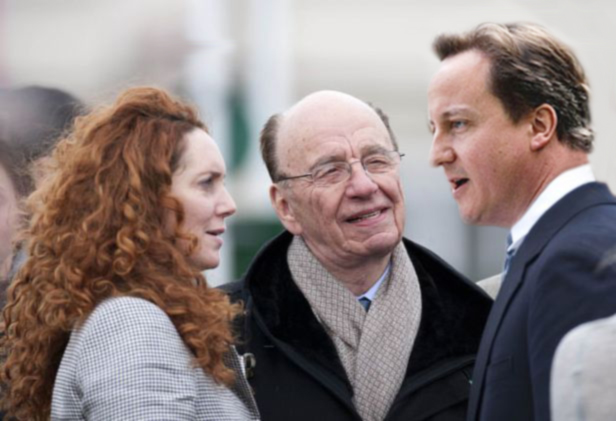
image of David Cameron, Rupert Murdoch and Rebekah Brooks
David Cameron, Rupert Murdoch and Rebekah Brooks

http://www.independent.co.uk/news/uk/politics/david-cameron-extremism-speech-read-the-transcript-in-full-10401948.html

It’s great to be here at this outstanding school, Ninestiles School. Your inspiring teachers and your commitment to British values means you are not just achieving outstanding academic success, but you are building a shared community where children of many faiths and backgrounds learn not just with each other, but from each other too.

Politicians giving speeches at schools is out of order. While they’re guaranteed an audience it’s insulting and disrespectful to the school-students involved. There is an authoritarian regime in schools where students are ordered about and they follow those orders. Their human rights are not recognised. The students didn’t realise they could turn around and say “Fuck off! I’m not listening to that asshole” because of course they can’t. It’s lucky no politician tried that while I was at school.

Blair used to do it a lot – probably because he’d never get an audience towards the end of his reign. He’d go to a school and avoid any eye contact with the students – that’s one of the things that put me onto him and his evil ways. Why was he avoiding eye contact?

Blair went to one school and was booed by the students. He was so deranged and divorced from reality that his aides persuaded him that they were doing some youth-speak “Boom” showing respect for him. Twat.

And that goes right to the heart of what I want to talk about today.

I said on the steps of Downing Street that this would be a ‘one nation’ government, bringing our country together.

That’s total bullshit then. It’s four or five nations for a start. What about the Evel measures Cameron was pursuing? That’s certainly very divisive.

Today, I want to talk about a vital element of that. How together we defeat extremism and at the same time build a stronger, more cohesive society.

My starting point is this.

Over generations, we have built something extraordinary in Britain – a successful multi-racial, multi-faith democracy. It’s open, diverse, welcoming – these characteristics are as British as queuing and talking about the weather.

It’s not welcoming, is it?

It is here in Britain where different people, from different backgrounds, who follow different religions and different customs don’t just rub alongside each other but are relatives and friends; husbands, wives, cousins, neighbours and colleagues.

It is here in Britain where in one or two generations people can come with nothing and rise as high as their talent allows.

It is here in Britain where success is achieved not in spite of our diversity, but because of our diversity.

I’m letting that pass because it’s trivial.

So as we talk about the threat of extremism and the challenge of integration, we should not do our country down – we are, without a shadow of doubt, a beacon to the world.

Oh come on.

And as we debate these issues, neither should we demonise people of particular backgrounds. Every one of the communities that has come to call our country home has made Britain a better place. And because the focus of my remarks today is on tackling Islamist extremism – not Islam the religion – let me say this.

Hmm, Muslims are the one religion that is seriously discriminated against. I happened across a couple of Muslim school students who were about fourteen the other day. I was cycling through a park and they had to move out of the way for me to pass through the gate to leave the park. We exchanged a few words. They were ashamed. I regret not making an issue of telling them that they had nothing to be ashamed of. This is what it’s all about – it’s young Muslims who will be [ed: relentlessly] bullied by school authorities – they’re not ever going to have a break, are they? That seems to me very much like a way to create extremism rather than defeat it.

26/7/15 I’m going to jump ahead because it’s crap.

I was thinking about whether these “our values” actually exist and who is Cameron to define these “our values”. I was intending to argue that there is no consensus since we are so diverse as Cameron has already said and that I share very few values with Cameron. Values are different from beliefs and I should think that values probably follow from beliefs. It follows that since peoples’ beliefs are different then they have different values. I think that’s about right. What about you?

Take for example a religion that promotes the idea that all other religions are inferior – that all others not following that particular religion are animals or beasts in human form, sub-human. Now if you had accepted such beliefs, wouldn’t values follow? and wouldn’t behaviour follow from those values?

So, my proposition is that there are no such “our values”.

26/7/15 19.30 BST

What are these “our values”?

But you don’t have to support violence to subscribe to certain intolerant ideas which create a climate in which extremists can flourish.

Ideas which are hostile to basic liberal values such as democracy, freedom and sexual equality.

Surely Cameron must mean pretend-democracy, pretend-freedom and not even pretend sexual equality. Cameron, former PM Tony Blair and former Resident Dubya Bush are Neo-Conservatives. Neo-Conservatives follow the anti-democratic and illiberal philosophy of Leo Strauss that it is necessary to deceive to rule. It would seem that Cameron is proposing that “our values” includes support for an obvious sham-democracy that is maintained through dissembling and deception.

Ideas which actively promote discrimination, sectarianism and segregation.

Like Cameron’s proposed Extremism Bill.

Ideas – like those of the despicable far right – which privilege one identity to the detriment of the rights and freedoms of others.

Like the religion I mentioned earlier and this speech and the proposed Extremism Bill and Neo-Conservatives.

TBC

Danger Mice

Cameron fights for his brutish values – more Islamophobia and war

Continue ReadingDavid Cameron Islamic Extremism speech July 2015