Coral Bleaching ‘Off the Charts’ in Atlantic as NOAA Warns Ocean Going ‘Crazy Haywire’

Spread the love

Original article by JULIA CONLEY republished from Common Dreams under Creative Commons (CC BY-NC-ND 3.0).
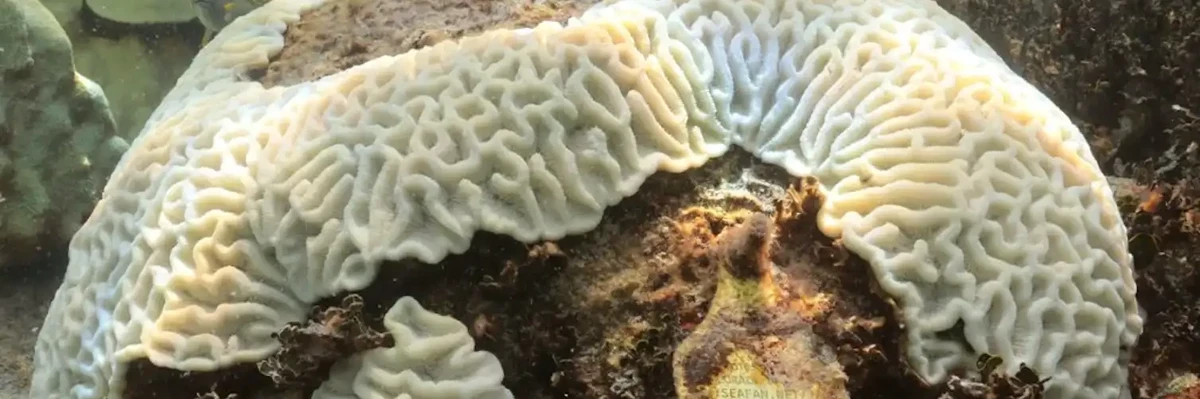
A bleached mound of coral at the Cheeca Rocks monitoring site in the Florida Keys National Marine Sanctuary that had been previously tagged shows the coral skeleton. (Photo: NOAA AOML)

“We had to add additional bleaching alert levels to appropriately categorize just how hot it was,” said a coral reefs expert at the agency.

The phrase “off the charts” is no exaggeration in the National Oceanic and Atmospheric Administration’s latest warning about a global coral bleaching event that scientists have linked to rising ocean temperatures and heat stress.

Derek Manzello, coordinator of NOAA’s Coral Reef Watch Program, told reporters Thursday that about 60.5% of the world’s coral reefs are now experiencing heat stress severe enough to cause bleaching, which can make the reefs more vulnerable to disease and harm the biodiversity they support.

Manzello said at the press briefing that after observing the first months of the coral bleaching event, which began in early 2023, NOAA changed its existing bleaching alert system because conditions were so abnormally warm in the Atlantic Ocean, Gulf of Mexico, and Caribbean Sea.

The agency’s new bleaching alert system categorizes heat stress for coral reefs on a scale of 1-5, with Alert Level 5 representing ocean heat that could kill “approximately 80% or more of corals on a particular reef,” Manzello said.

“We had to add additional bleaching alert levels to appropriately categorize just how hot it was,” he said, with Level 5 “analogous to a Category 5 hurricane or cyclone.”

“I hate that I have to keep using that word ‘unprecedented.’… But, again, we are seeing unprecedented patterns again this year.”

The world’s oceans, Manzello, said, are going “crazy haywire.”

In the Caribbean this year, heat stress off the coasts of Panama, Costa Rica, Nicaragua, and Colombia are now at levels that in previous years weren’t seen until the summer months.

“I hate that I have to keep using that word ‘unprecedented,'” Manzello told The New York Times. “But, again, we are seeing unprecedented patterns again this year.”

The bleaching that took place last year resulted in coral mortality of at least 50% and as high as 93% in reefs off the coast of Huatulco, Mexico, according to a team of Mexican scientists.

In the Atlantic, fossil fuel-driven planetary heating has been exacerbated by El Niño—the natural phenomenon that causes warmer-than-normal ocean surface temperatures—and has caused the “most unprecedented and extreme” bleaching-level heat stress observed in the past year.

Manzello said 99.7% of reef areas in the Atlantic have experienced heat stress that could cause bleaching.

“The Atlantic Ocean has been off the charts,” he said.

Scientists have recorded four global bleaching events since 1998 and have linked all of them to warmer ocean temperatures. Since 1950, the world has lost half of its coral reefs, according to a 2021 study.

Along with serving marine life, a quarter of which rely on coral reefs at some point in their life cycles, reefs also protect coasts from storms, whose growing severity in recent years scientists have also linked to planetary heating.

The current bleaching event has affected reefs off the coasts of at least 62 countries and territories.

Scientists earlier this year confirmed that 2023 was the hottest year in human history and the warmest year on record for the world’s oceans, which absorb more than 90% of excess heat from greenhouse gas emissions.

“I am very worried about the state of the world’s coral reefs,” Manzello said. “We are seeing [ocean temperatures] play out right now that are very extreme in nature.”

Original article by JULIA CONLEY republished from Common Dreams under Creative Commons (CC BY-NC-ND 3.0).

Continue ReadingCoral Bleaching ‘Off the Charts’ in Atlantic as NOAA Warns Ocean Going ‘Crazy Haywire’

NOAA Warns World’s Coral on Verge of ‘Worst Bleaching Event in History of the Planet’

Spread the love

Original article by BRETT WILKINS republished from Common Dreams under Creative Commons (CC BY-NC-ND 3.0).

A view of major bleaching on the coral reefs of the Society Islands on May 9, 2019 in Moorea, French Polynesia. (Photo: Alexis Rosenfeld/Getty Images).

“It’s looking like the entirety of the Southern Hemisphere is probably going to bleach this year,” one scientist said.

Driven by sustained climate-fueled oceanic heating, the planet is on the brink of another mass coral bleaching event that marine biologists warn could kill large swaths of tropical reefs including significant areas of Australia’s Great Barrier Reef.

Scientists are sounding the alarm following months of record ocean temperatures exacerbated by the planetary emergency and the El Niño climate pattern in the Pacific Ocean.

“It’s looking like the entirety of the Southern Hemisphere is probably going to bleach this year,” Derek Manzello of the National Oceanic and Atmospheric Administration’s (NOAA) Coral Reef Watch told Reuters. “We are literally sitting on the cusp of the worst bleaching event in the history of the planet.”

As NOAA explains:

When water is too warm, corals will expel the algae (zooxanthellae) living in their tissues causing the coral to turn completely white. This is called coral bleaching. When a coral bleaches, it is not dead. Corals can survive a bleaching event, but they are under more stress and are subject to mortality.

In 2005, the U.S. lost half of its coral reefs in the Caribbean in one year due to a massive bleaching event. The warm waters centered around the northern Antilles near the Virgin Islands and Puerto Rico expanded southward. Comparison of satellite data from the previous 20 years confirmed that thermal stress from the 2005 event was greater than the previous 20 years combined.

Following the planet’s hottest summer on record last year, the Caribbean suffered its worst recorded bleaching event. The last worldwide bleaching occurred in 2014-17, when scientists say approximately 15% of all reefs experienced major coral deaths. Nearly a third of the Great Barrier Reef’s coral perished during the bleaching.

In the Southern Hemisphere, where summer is ending and ocean temperatures are at or near their annual peaks, there is “basically bleaching all over the place,” according to Manzello.

Matthew England, a professor at the University of New South Wales in Australia who studies ocean currents, recently told TheNew York Times that “the sea ice around the Antarctic is just not growing” and “the temperature’s just going off the charts.”

“It’s like an omen of the future,” he added.

It’s a similar story in the North Atlantic, which “has been record-breakingly warm for almost a year now,” University of Miami hurricane expert Brian McNoldy told the Times. “It’s just astonishing. Like, it doesn’t seem real.”

A 2018 report from the United Nations Intergovernmental Panel on Climate Change estimates that global heating of 1.5°C is likely to result in the loss of 70-90% the planet’s coral reefs over the coming decades.

Current emissions-based forecasts have Earth on track for at least 1.5°C of warming, which researchers say is likely to trigger five climate tipping points: melting of the Greenland and Antarctic ice sheets, mass die-off of warm-water coral reefs, thawing of Arctic permafrost, and collapse of the North Atlantic Subpolar Gyre circulation.

The European Environment Agency’s long-term forecasts for 2071-2100 predict worldwide oceanic heating of 0.5°C-3.8°C, depending on future greenhouse gas emission scenarios.

Scientists say the best way to avert worst-case outcomes for both coral reefs and the climate is to swiftly transition from fossil fuels to renewable energy. Reducing land-based pollution and overfishing are also critical to reef preservation.

Original article by BRETT WILKINS republished from Common Dreams under Creative Commons (CC BY-NC-ND 3.0).

Continue ReadingNOAA Warns World’s Coral on Verge of ‘Worst Bleaching Event in History of the Planet’