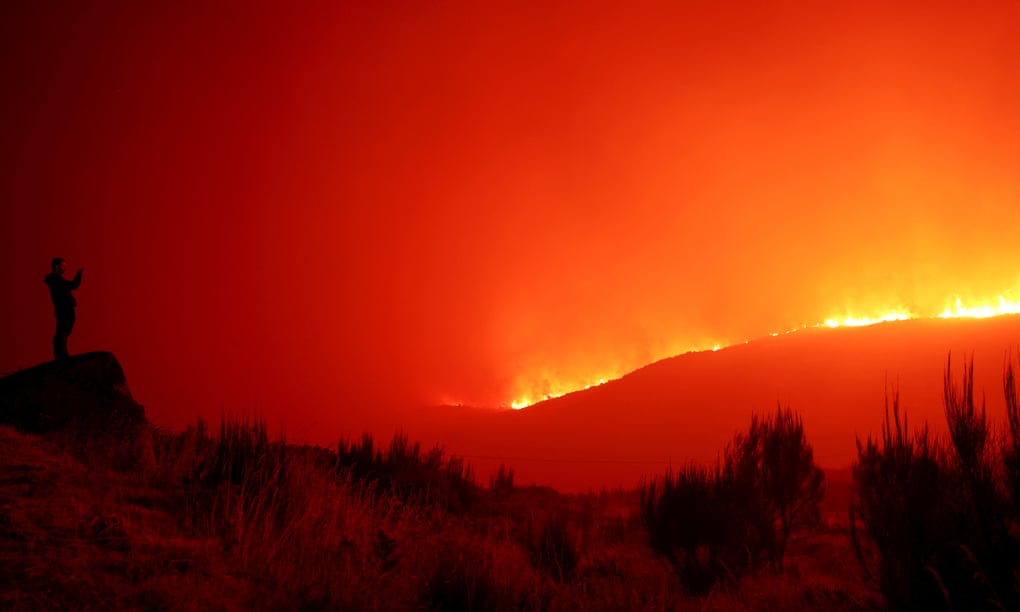
A wildfire near Povoa de Montemuro, Portugal, 18 September 2024. Photograph: Susana Vera/Reuters
Labour seems gripped by a form of denialism. The danger is real and incremental change won’t avert it
…
If our political leaders acted out of humanity, the plight of others would be enough to motivate them into action. In the absence of empathy, perhaps we need to be more direct: the climate crisis is coming for you, because it is coming for us all.
Without urgent action, “once-in-a-generation” events – the flooding of New York subways, the typhoon-like winds sucking people out of their apartments in China, the forest fires – will become the new routine of daily life. Politicians abandoned the goal to stop climate breakdown many years ago. We have a much more basic demand: to stop climate breakdown entering a new phase of existential disaster.
That means avoiding certain “tipping points” that would put humanity on an irreversible path to catastrophe. The collapse of the Atlantic meridional overturning circulation, for example, would disrupt the rains that billions of people depend on for food in India, South America and west Africa. Permafrost thaw would generate an irreversible release of carbon dioxide. And the loss of the Greenland ice sheet would result in disastrous runaway melting.
Few politicians deny that human-made global heating is real. Instead, our government peddles a different – more insidious – kind of denialism. One that moves away from a disbelief in the climate crisis, and toward a belief that incremental change can fix it.
…
This government is not just failing to stand up to fossil fuel giants. It is failing to confront the economic system that empowers them. The richest 1% are responsible for more carbon emissions than the poorest 66%, yet our government still refuses to bring in wealth taxes to reduce inequality. Unless the government has the courage to rewrite the rules of our ecocidal economy, its climate targets will soon become yet another broken promise.
A planet cannot be cooled by warm words; we need fundamental change, now. A Green New Deal would invest in publicly owned renewable energy and water. It would create millions of green jobs. It would promote sustainable farming based on the principles of agroecology. And it would kickstart an economy based on human need, not corporate greed.
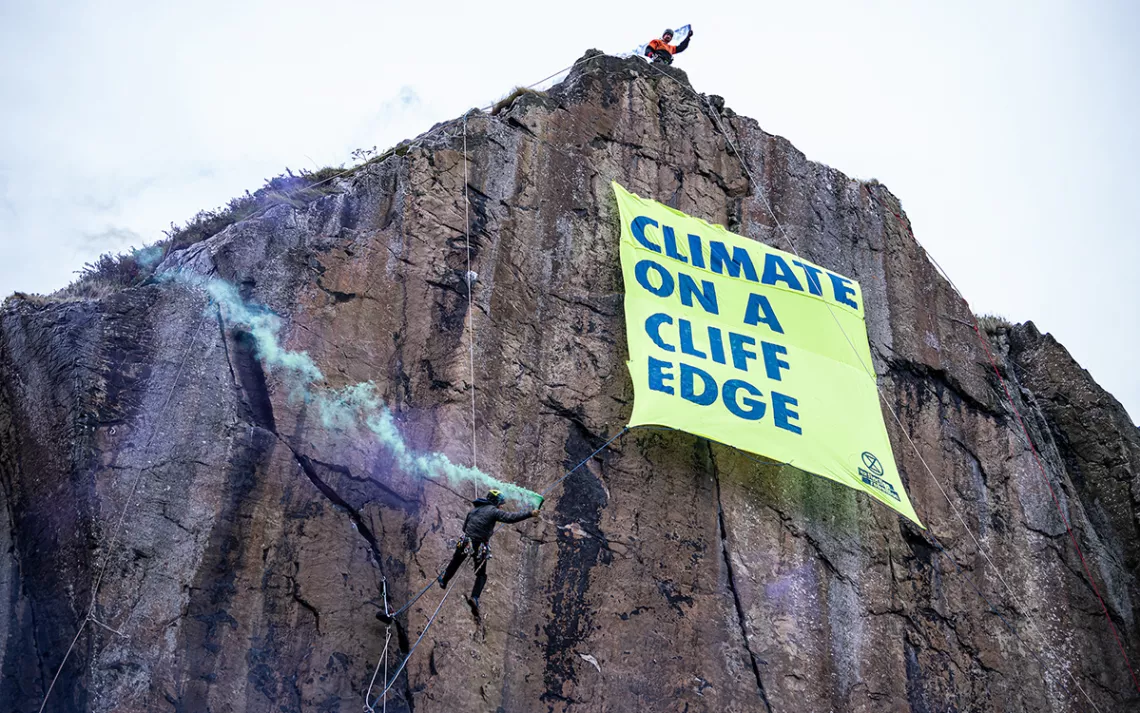
Experienced climbers scale a rock face near the historic Dumbarton castle in Glasgow, releasing a banner that reads “Climate on a Cliff Edge.” One activist, dressed as a globe, symbolically looms near the edge, while another plays the bagpipes on the shores below. | Photo courtesy of Extinction Rebellion and Mark Richards
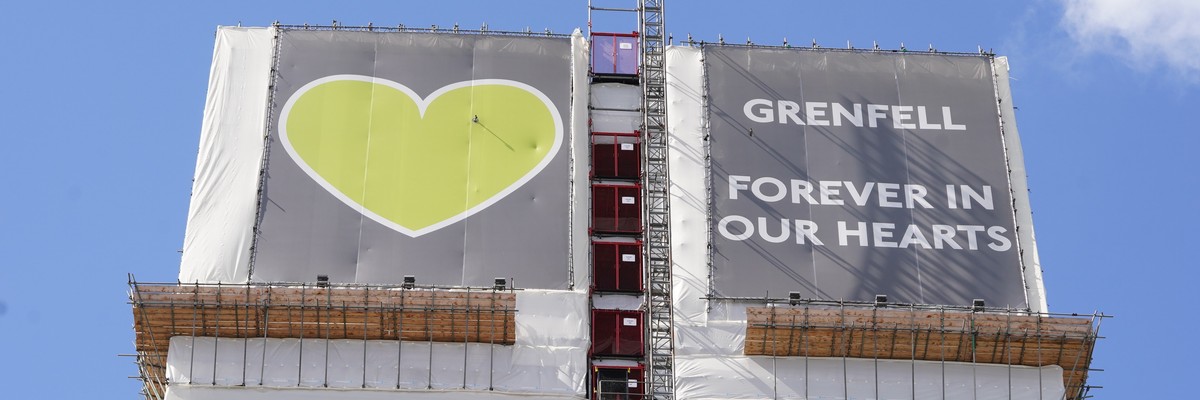
Grenfell Tower is shown in west London on September 3, 2024.. (Photo: Lucy North/PA Images via Getty Images)
“The Grenfell Report gives us official confirmation: 72 people needlessly died because of corporate deceit, deregulation, privatization, ignorance, and contempt for working-class communities,” wrote Jeremy Corbyn.
Seven years after the U.K.’s worst residential fire since World War II, the second half of a report on the causes of the Grenfell Tower disaster partly attributed the deadly blaze to corporate greed.
The Phase 2 report, released Wednesday, blamed both private malfeasance and government deregulation for the fire on June 14, 2017, which claimed the lives of 72 people, including 18 children, when the cheap, flammable cladding surrounding the building ignited.
“The simple truth is that the deaths that occurred were all avoidable and that those who lived in the tower were badly failed over a number of years and in a number of different ways by those who were responsible for ensuring the safety of the building and its occupants,” inquiry chair Sir Martin Moore-Bick said in a statement.
“The system isn’t broken, it was built this way.”
The inquiry, which was launched the day after the fire by then-Prime Minister Theresa May, reviewed more than 300,000 documents and 1,500 witness statements. The first half, released October 30, 2019, focused on how the fire ignited and spread. The second, which took longer than expected, examined the “underlying causes.”
Those include the “systematic dishonesty” of the companies that sold the flammable cladding and insulation used to refurbish the tower in 2015, namely Arconic Architectural Products, Celotex, and Kingspan.
“They engaged in deliberate and sustained strategies to manipulate the testing processes, misrepresent test data, and mislead the market,” the report authors wrote.
For example, Arconic had known since 2005 that its Reynobond 55 PE, used on Grenfell as rainscreen panels, “reacted to fire in a very dangerous way” when sold in cassette form and since 2011 that the cassette form performed worse under fire than its riveted form.
“Nonetheless, it was determined to exploit what it saw as weak regulatory regimes in certain countries (including the U.K.) to sell Reynobond 55 PE in cassette form, including for use on residential buildings,” the report authors noted.
The report authors also blamed quality control bodies such as the British Board of Agrément, Local Authority Building Control, and the U.K. Accreditation Body for failing to do their due diligence. The Building Research Establishment, a former government agency that had been privatized in 1997, was actually “complicit” with Celotex in misleading consumers about the insulation RS5000 by devising a strategy to rig tests to ensure the material passed.
At the same time, the companies took advantage of a period of deregulation in the U.K. during the 2010s, specifically in the Department for Communities and Local Government. The report authors concluded:
The government’s deregulatory agenda, enthusiastically supported by some junior ministers and the secretary of state, dominated the department’s thinking to such an extent that even matters affecting the safety of life were ignored, delayed, or disregarded.
During that period the government determinedly resisted calls from across the fire sector to regulate fire risk assessors and to amend the Fire Safety Order to make it clear that it applied to the exterior walls of buildings containing more than one set of domestic premises.
In addition, the report authors found fault with the Tenant Management Organization for not taking tenant concerns, including about fire safety, seriously enough; the Royal Borough of Kensington and Chelsea, where the tower is located; Studio E, the architect behind the refurbishment; contractor Rydon Maintenance Ltd and some of its subcontractors; and the London Fire Brigade, which was not prepared to respond to a high-rise fire.
“The inquiry report reveals that whenever there’s a clash between corporate interest and public safety, governments have done everything they can to avoid their responsibilities to keep people safe,” Grenfell United, a group of fire survivors and bereaved family members, said in a statement. “The system isn’t broken, it was built this way.”
The group added that the reports’ conclusions spoke to a “lack of competence, understanding, and a fundamental failure to perform the most basic duties of care.”
They continued: “When voids were created as the government outsourced their duties, Kingspan, Celotex, and Arconic filled the gaps with substandard and combustible materials. They were allowed to manipulate the testing regimes, fraudulently and knowingly marketing their products as safe.”
They added that their lawyers had told the inquiry that the three companies were “little better than crooks and killers,” a statement the report reveals to be “entirely true.”
“We were failed in most cases by incompetence and in many causes by calculated dishonesty and greed,” they wrote.
The Grenfell fire, when it first ignited seven years ago, called attention to rising inequality in London, as it was a public housing building in one of the city’s wealthiest boroughs.
In 2019, Member of Parliament Jeremy Corbyn said that “Grenfell Tower would not have happened to wealthy Londoners. It happened to poor and mainly migrant Londoners.”
Upon the report’s publication, he wrote on social media: “The Grenfell Report gives us official confirmation: 72 people needlessly died because of corporate deceit, deregulation, privatization, ignorance, and contempt for working-class communities. We will never, ever forget.”
The Grenfell Report gives us official confirmation: 72 people needlessly died because of corporate deceit, deregulation, privatisation, ignorance, and contempt for working-class communities.
The Peace & Justice Project, meanwhile, wrote that the report showed: “The legislative actions of the Conservative-Liberal Democrat coalition government on 2010-15 are largely to blame for the fire and resulting death toll. Their disgraceful and habitual deregulation has been found to have led to safety matters being ‘ignored, delayed, or disregarded’ by building materials manufacturers and council officials.”
To avoid another similar fire, the report authors made several recommendations, including:
Making one government department responsible for fire safety issues;
Creating a construction regulator;
Mandating fire safety strategies for high-risk buildings;
Developing a special license for contractors who work on higher-risk buildings; and
Establishing a system for accrediting fire-risk assessors.
Grenfell United called the recommendations “basic safety principles that should already exist.”
In addition to following the report’s advice, the survivors and family members also called for the government to ban Arconic, Kingspan, Celotex, and Rydon from working with both central and local governments.
They also urged the Metropolitan Police and the Crown Prosecution Service, who are now reviewing the report to decide on charges, to hold those responsible accountable. Any cases are not expected to go to trial until 2027.
“To prevent a future Grenfell, the government needs to create something that doesn’t exist,” the group wrote, “A government with the power and ability to separate itself from the construction industry and corporate lobbying, putting people before profit.”
The Peace & Justice Project also called for accountability, saying: “Today’s report paints a clear picture of how the Grenfell Tower disaster was allowed to happen. We are hopeful that this stage of the inquiry brings those responsible to justice in the form of prosecutions and criminal proceedings, as well as an immediate end to the callous privatization that has been allowed to shatter communities like Grenfell.”
It noted that there remain 4,630 residential buildings in the U.K. with unsafe cladding as of July 2024.
“With only 29% of the necessary remedial work undertaken under the Conservative governments of May, Johnson, Truss, and Sunak, we call on the new Prime Minister Keir Starmer to accelerate the removal of dangerous cladding from residential buildings to ensure the safety of all residents and the avoidance of another preventable tragedy like the Grenfell Tower fire,” the group wrote.
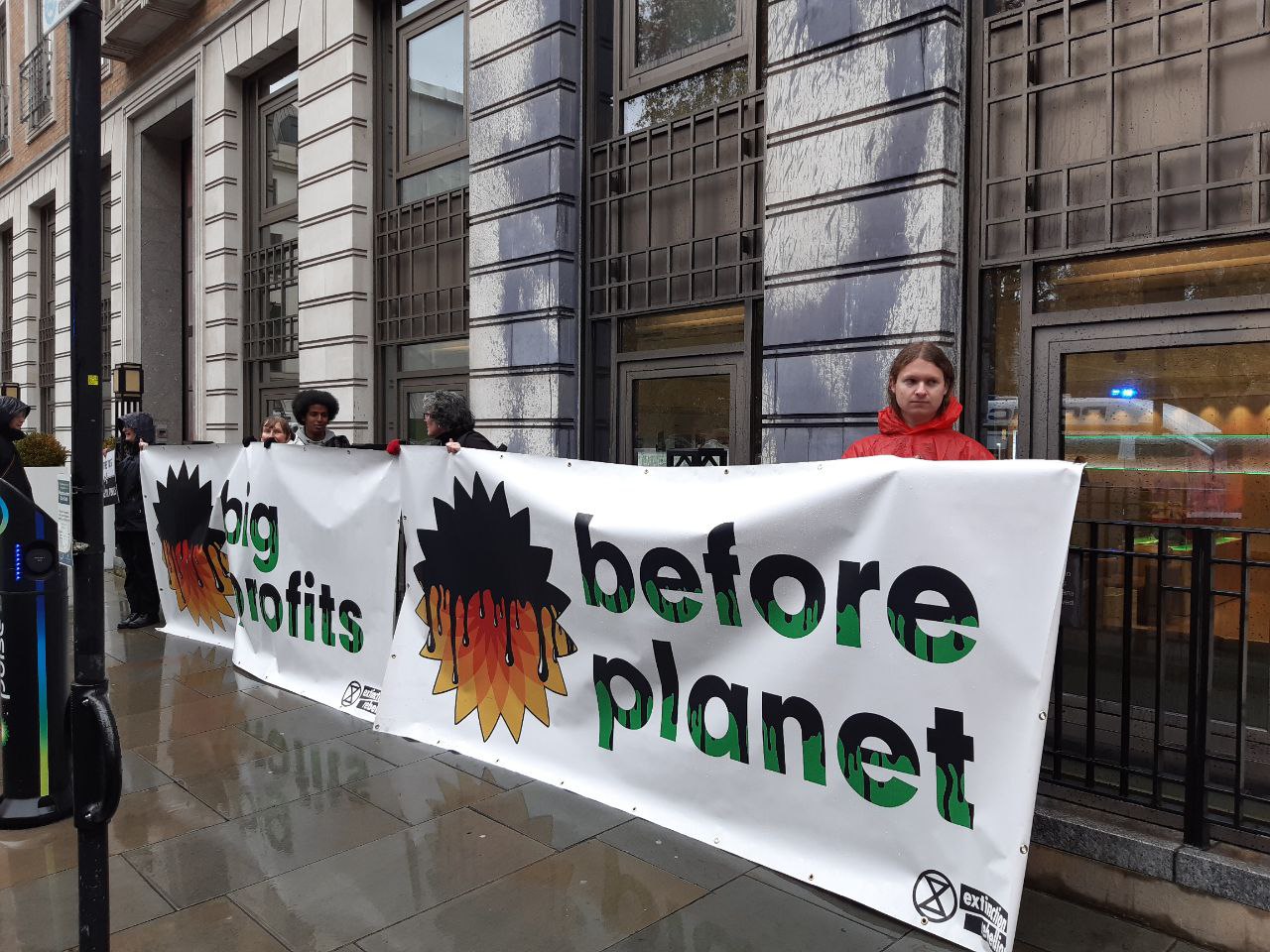
Extinction Rebellion protests at BP London. Banner reads big profits before planet
“The world can no longer afford fossil fuel companies putting short-term profits above people and planet.”
The London-based oil giant BP announced Tuesday that it hauled in $2.8 billion in profit during the second quarter of the year as the world faced the consequences of the fossil fuel industry’s business model in the form of record-shattering heat, devastating wildfires, and other weather extremes.
The company’s second-quarter profit surpassed analysts’ expectations and brought its total profit for the first half of 2024 to $5.5 billion. BP on Tuesday also announced a 10% dividend increase, an expansion of its stock buyback program, and a green light for a new drilling platform in the Gulf of Mexico, even as international scientists say any new fossil fuel production is incompatible with critical warming targets set out by the Paris climate accord.
BP said that once completed, the new floating platform would have the capacity to produce 80,000 barrels of crude oil daily.
Chiara Liguori, Oxfam Great Britain’s senior climate justice policy adviser, said in a statement that “the world can no longer afford fossil fuel companies putting short-term profits above people and planet.”
“It is inexcusable that BP, one of the world’s most polluting and profitable fossil fuel companies, continues to rake in billions of pounds while low-income countries are in urgent need of funds to tackle the devastating impacts of the climate crisis despite doing the least to cause it,” said Liguori. “The costs of inaction are already here with deadly heat waves, wildfires, flooding, and drought, but it is people living in poverty who are left paying the highest price.”
BP’s profit report came weeks after the company, now under the leadership of CEO Murray Auchincloss, announced it would pause new offshore wind projects and put fresh “emphasis on oil and gas amid investor discontent over its energy transition strategy,” as Reuters reported last month. The move came over a year after the company rolled back its plan to curtail oil and gas production.
Extreme weather driven by the burning of fossil fuels, meanwhile, continued to wreak havoc across the globe.
“By the end of the week—which saw the four hottest days ever observed by scientists—dozens had been killed in the raging floodwaters and massive mudslides triggered by Typhoon Gaemi,” Kaplan continued. “Half of Jasper was reduced to ash. And about 3.6 billion people around the planet had endured temperatures that would have been exceedingly rare in a world without burning fossil fuels and other human activities, according to an analysis by scientists at the group Climate Central.”
Izzie McIntosh, a climate campaigner at the United Kingdom-based advocacy group Global Justice Now, said Tuesday that BP’s “mammoth profits” come “at the expense of our climate, communities, and the Global South facing the most brutal impacts of a climate crisis they did not cause.”
“Labour has made some promising signals about a move toward green energy—it now needs to throw its weight behind tackling the rampant profiteering of oil and gas companies,” McIntosh said of the newly elected U.K. government. “It can do this by introducing a windfall tax and other measures to fund the U.K.’s contribution to a globally just fossil fuel phaseout that works for workers and communities in the U.K. and around the world.”
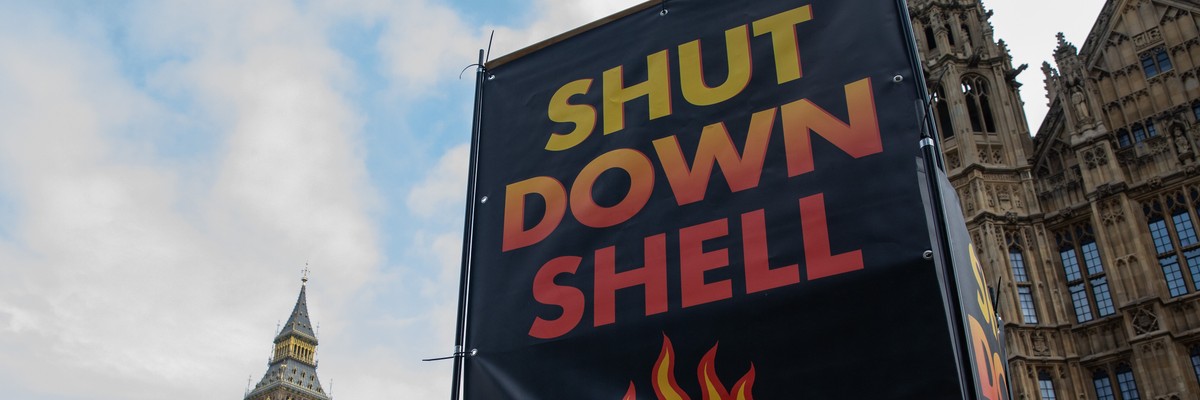
A large display from the environmental group Fossil Free London is seen during a climate protest in London on April 24, 2023. (Photo: Mark Kerrison/In Pictures via Getty Images)
“The only ‘danger’ Shell would see in cutting production is to their eye-watering profits,” said one campaigner.
Two days after scientists recorded the hottest day on record and warned that the milestone is the latest clear sign that all fossil fuel production must be urgently phased out, the CEO of multinational oil and gas giant Shell claimed that transitioning to renewable energy sources is what would endanger the world and expressed what campaigners called “cynical” concerns for the well-being of the Global South.
Wael Sawan, who took over the U.K.-based company last year, told the BBC Thursday that the world’s energy system “continues to desperately need oil and gas,” contrary to evidence put forward by the International Energy Agency, the Intergovernmental Panel on Climate Change, United Nations Secretary-General António Guterres, and other experts.
“I think what would be dangerous and irresponsible is actually cutting out the oil and gas production so that the cost of living—as we saw just last year—starts to shoot up again,” said Sawan.
Cost-of-living increases have raised alarm in communities around the world following the coronavirus pandemic and Russia’s invasion of Ukraine—but numerous analyses have pointed to corporate greed and price-gouging, not the decreasing supply of oil and gas, as primary drivers of financial hardship for working people.
Shell reported record-breaking profits of nearly $40 billion last year, doubling its total for 2021.
“The only ‘danger’ Shell would see in cutting production is to their eye-watering profits,” Alice Harrison of the international human rights group Global Witness told The Guardian Thursday. “Whether blinded by the pound signs or simply willfully ignorant, Shell’s CEO is wrong. Ending our dependence on fossil fuels and transitioning to green energy will serve both the planet and provide energy security for all. Shell [has] once again made their loyalties clear—profit over people and planet.”
Guterres is among the critics who have warned that companies that continue to invest in fossil fuels will not continue to see enormous profits forever, and as Common Dreams reported last week, research from the University of Waterloo in Canada found that public pensions in the United States have lost tens of billions of dollars due to their refusal to pull out of the oil, gas, and coal sectors.
“Investing in new fossil fuels infrastructure is moral and economic madness,” Guterres said earlier this year. “Such investments will soon be stranded assets—a blot on the landscape and a blight on investment portfolios.”
In his comments to the BBC, Sawan suggested his concern is not with his own company’s future, but that of the Global South—where people are suffering disproportionately from the effects of the climate crisis and planetary heating, despite causing a tiny fraction of the fossil fuel pollution that originates in wealthier countries.
He said the distribution of benefits from the use of renewable energy must be “globally responsible” so the Global North doesn’t hoard energy sources such as solar and wind power.
“Let’s be clear, companies like Shell are fueling both the climate crisis and the soaring cost of energy,” Jamie Peters of Friends of the EarthtoldThe Guardian. “They are profiting from the misery of ordinary people while destroying the planet, and they’re making a cynical case to continue locking us into the volatile fossil fuel markets that are the root cause of the energy crisis.”
As environmental journalist Harry Cockburn noted on social media, for all Sawan’s claims of concern for people in the Global South, he made clear that Shell’s profits are his top priority as the interview concluded.
Quite amazing interview with Shell boss Wael Sawan here, in which he argues global fossil fuel production must be maintained, or children will be working by candle light, before adding: "Ultimately, I am in the service of shareholder value". https://t.co/JPnI5EgHLM
“Cutting production is only dangerous in the kind of upside-down world where profit rules over everything,” said the grassroots coalition Stop Cambo, which pressured Shell to pull out of the Cambo oil field off the coast of Scotland in 2021. “Even as the planet burns and people are forced to choose between heating and eating.”