This work by Middle East Monitor is licensed under a Creative Commons Attribution-NonCommercial-ShareAlike 4.0 International License.
Pope Leo XIV attends general audience in St. Peter’s Square at the Vatican, on May 21, 2025. [isabella Bonotto – Anadolu Agency ]
Pope Leo XIV on Thursday renewed his call for “an immediate ceasefire” in the Gaza Strip and expressed his “profound hope” for “dialogue, reconciliation and lasting peace in the region,” following an Israeli attack on a Catholic church sheltering civilians, Anadolu reports.
The appeal came in a telegram signed by Vatican Secretary of State Cardinal Pietro Parolin after the Church of the Holy Family in Gaza was hit during an Israeli military raid.
The pope said he was “deeply saddened” by the assault on the parish, which has provided refuge to more than 500 people since the beginning of the war.
Among those injured was the parish priest, Father Gabriel Romanelli, who sustained a light leg wound and was treated at Al-Ahli hospital in Gaza City.
The pontiff addressed Father Romanelli directly in the telegram, assuring him of his “spiritual closeness” and offering prayers to the entire parish community.
“Entrusting the souls of the deceased to the loving mercy of Almighty God,” the pope said he is praying “for the consolation of those who mourn and for the healing of the wounded.”
In the course of its deadly offensive on the Gaza Strip, the Israeli army has bombed several worship places, including the Gaza Baptist Church and the Greek Orthodox Church of Saint Porphyrius, the oldest in the Gaza Strip and the third oldest in the world.
The Holy Family Church is the only Catholic church in the Gaza Strip, which has been sheltering many displaced Christian and Muslim Palestinians since October 2023.
The Israeli army, rejecting international calls for a ceasefire, has pursued a brutal offensive against Gaza since October 2023, killing nearly 58,600 Palestinians, most of them women and children.
Last November, the International Criminal Court issued arrest warrants for Israeli Prime Minister Benjamin Netanyahu and his former Defense Minister Yoav Gallant for war crimes and crimes against humanity in Gaza.
Israel also faces a genocide case at the International Court of Justice for its war on the enclave.
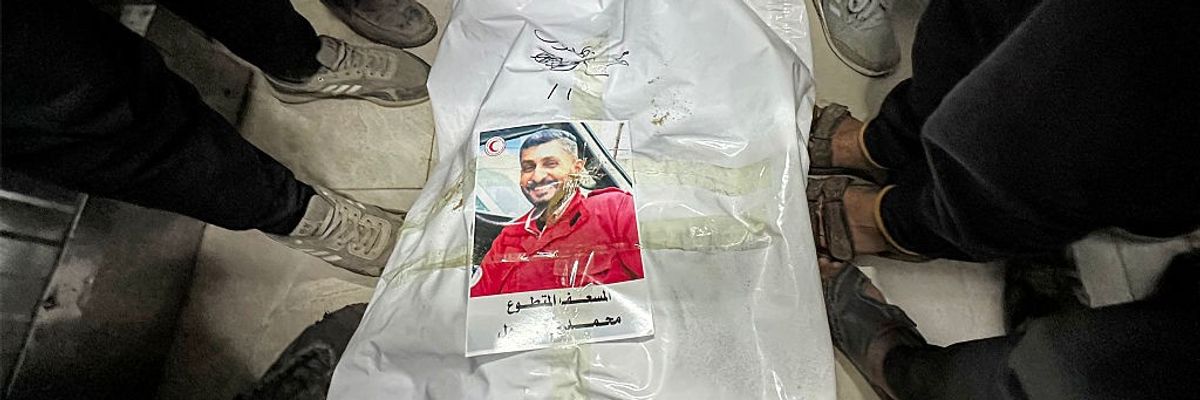
People gather around the body of Palestinian paramedic Mohamed Bahloul, who was killed with other first responders a week before in Israeli military fire on ambulances, as it lies at Nasser Medical Complex in Khan Yunis in the southern Gaza Strip on March 30, 2025. (Photo by AFP via Getty Images)
“Everyone involved in this crime against humanity, and everyone who covered it up, would face prosecution in a world that had any shred of dignity left.”
A video presented to officials at the United Nations on Friday and first made public Saturday by the New York Times provides more evidence that the recent massacre of Palestinian medics in Gaza did not happen the way Israeli government claimed—the latest in a long line of deception when it comes to violence against civilians that have led to repeated accusations of war crimes.
The video, according to the Palestine Red Crescent Society (PRCS), was found on the phone of a paramedic found in a mass grave with a bullet in his head after being killed, along with seven other medics, by Israeli forces on March 23. The eight medics, buried in the shallow grave with the bodies riddled with bullets, were: Mustafa Khafaja, Ezz El-Din Shaat, Saleh Muammar, Refaat Radwan, Muhammad Bahloul, Ashraf Abu Libda, Muhammad Al-Hila, and Raed Al-Sharif. The video reportedly belonged to Radwan. A ninth medic, identified as Asaad Al-Nasasra, who was at the scene of the massacre, which took place near the southern city of Rafah, is still missing.
The PRCS said it presented the video—which refutes the explanation of the killings offered by Israeli officials—to members of the UN Security Council on Friday.
So I guess everything the IDF said a few days ago about those paramedics in Gaza was not true at all.
NYTimes just released this video found on the cell phone of one paramedic.
“They were killed in their uniforms. Driving their clearly marked vehicles. Wearing their gloves. On their way to save lives,” Jonathan Whittall, head of the UN’s humanitarian affairs office in Palestine, said last week after the bodies were discovered. Some of the victims, according to Gaza officials, were found with handcuffs still on them and appeared to have been shot in the head, execution-style.
The Israeli military initially said its soldiers “did not randomly attack” any ambulances, but rather claimed they fired on “terrorists” who approached them in “suspicious vehicles.” Lt Col Nadav Shoshani, an IDF spokesperson, said the vehicles which the soldiers open fired were driving with their lights off and did not have clearance to be in the area. The video evidence directly contradicts the IDF’s version of events.
🚨This video was discovered on the cellphone of a paramedic who was found along with 14 other Palestinian rescue and medical workers in a mass grave in Gaza.
The Red Cross and Red Crescent Societies presented it to the UN Security Council this week. https://t.co/FozXtJ3Nsb
The Times obtained the video from a senior diplomat at the United Nations who asked not to be identified to be able to share sensitive information.
The Times verified the location and timing of the video, which was taken in the southern city of Rafah early on March 23. Filmed from what appears to be the front interior of a moving vehicle, it shows a convoy of ambulances and a fire truck, clearly marked, with headlights and flashing lights turned on, driving south on a road to the north of Rafah in the early morning. The first rays of sun can be seen, and birds are chirping.
In an interview with Drop Site News published Friday, the only known paramedic to survive the attack, Munther Abed, explained that he and his colleagues “were directly and deliberately shot at” by the IDF. “The car is clearly marked with ‘Palestinian Red Crescent Society 101.’ The car’s number was clear and the crews’ uniform was clear, so why were we directly shot at? That is the question.”
The release of the video sparked fresh outrage and demands for accountability on Saturday.
“The IDF denied access to the site for days; they sent in diggers to cover up the massacre; and intentionally lied about it,” said podcast producer Hamza M. Syed in reaction to the new revelations. “The entire leadership of the Israeli army is implicated in this unconscionable war crime. And they must be prosecuted.”
“Everyone involved in this crime against humanity, and everyone who covered it up, would face prosecution in a world that had any shred of dignity left,” said journalist Ryan Grim of DropSite News.
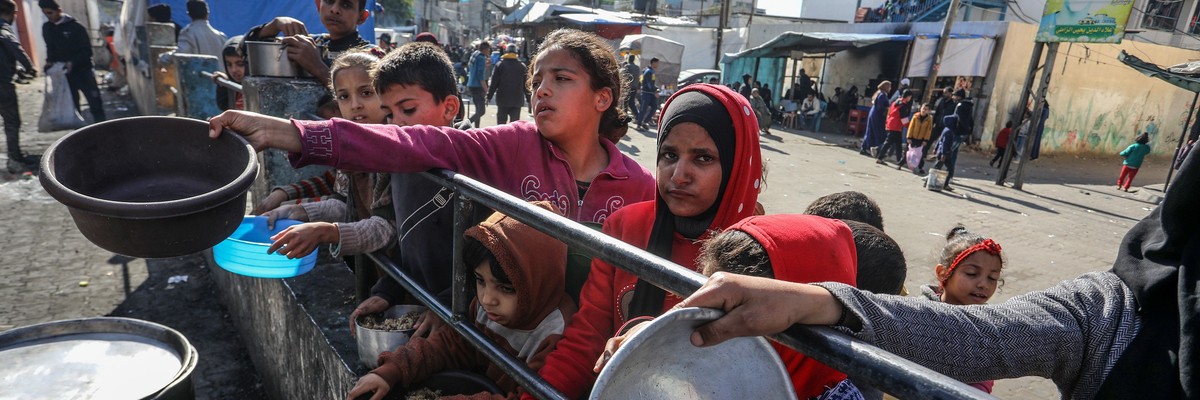
Palestinian children wait in line to receive food in Rafah, Gaza on February 09, 2024. (Photo: Abed Rahim Khatib/Anadolu via Getty Images)
One Palestinian human rights group called Israel’s evacuation orders “a pretext to push Gaza’s population closer to the border with Egypt in preparation for their mass deportation.”
Israeli Prime Minister Benjamin Netanyahu on Friday ordered the Israel Defense Forces to craft a plan to “evacuate” the population of Rafah, a small city near Gaza’s border with Egypt that’s packed with at least 1.4 million people—most of whom fled there to escape Israeli bombs and troops.
Human rights advocates immediately sounded alarm, stressing that the forcible transfer of civilians is a crime against humanity and that there’s nowhere safe for Gazans to flee as Israeli forces bomb the area and snipers fire on civilians in Khan Younis, a city to Rafah’s north.
“Make no mistake—the entirety of Gaza is a ‘combat zone,’” Frankie Leach, head of media at ActionAid U.K., wrote Friday.
Kenneth Roth, former executive director of Human Rights Watch, was among those asking where the 1.4 million people currently in Rafah are supposed to move.
“Does he plan a mass deportation to Egypt (a blatant war crime)?” Roth wrote on social media.
The Al Mezan Center for Human Rights, a Palestinian organization, called Israel’s evacuation orders “a pretext to push Gaza’s population closer to the border with Egypt in preparation for their mass deportation.”
“Time is running out: The international community must act now to halt the ground invasion of Rafah,” the group added.
Humanitarian aid organizations and United Nations officials have been bracing for an Israeli invasion of Rafah for weeks, warning that any large-scale attack on the densely populated city would be a grave violation of international law.
“A full-scale military operation in Rafah would have devastating consequences for civilians in Gaza who have endured more than four months of trauma, extreme hunger, lack of water, disease, and extremely limited medical resources due to the conflict and siege of the enclave,” CARE International said Friday. “Such an escalation would also bring existing humanitarian operations to a standstill, impacting all of Gaza. The limited aid that is currently able to trickle into the enclave does so from Rafah, and most humanitarian organizations currently operate from there.”
U.N. Secretary-General António Guterres said late Thursday that an Israeli ground assault on Rafah “would exponentially increase what is already a humanitarian nightmare with untold regional consequences.”
“The only thing that will stop this situation spinning even further out of control is an immediate and permanent cease-fire.”
Netanyahu’s office claimed in a statement Friday that “it is impossible to achieve the war objective of eliminating Hamas and leaving four Hamas battalions in Rafah.”
“On the other hand, it is clear that a massive operation in Rafah requires the evacuation of the civilian population from the combat zones,” the statement continued. “That is why the prime minister directed the IDF and the defense establishment to bring to the cabinet a dual plan for both the evacuation of the population and the disbanding of the battalions.”
Yousef Munayyer, a Palestinian American political analyst, wrote in response that “the Israeli PM is ordering ethnic cleansing of the Palestinian refugees amassed in Rafah.”
During the first week of its latest assault on the Gaza Strip, Israel instructed the entire population of northern Gaza—roughly 1.1 million people—to evacuate to the south, then proceeded to bomb evacuation routes and supposed “safe zones.”
Now Israel’s military is preparing to move on the enclave’s last-remaining refuge for displaced people. In recent days, Israeli forces have ramped up airstrikes on the Rafah, destroying houses and killing civilians—including children.
Israel ordered Palestinians to flee to Southern Gaza. They did, and were bombed in Khan Younis. Israel then ordered Palestinians to flee further south. They did, and now they may be about to be bombed in Rafah
Overcrowding in Rafah, a city that’s about a quarter the size of Baltimore, has become so severe that many people are sleeping on the streets and outside of hospitals in makeshift tents. Hundreds of people have been forced to share a single toilet, and many are starving.
“Now, they may be forced to flee once more as Israeli forces prepare to invade the area. A military assault on the city would lead to thousands of new civilian deaths and injuries,” Medical Aid for Palestinians (MAP) said in a statement Friday. “Urgent action must be taken now if this new crisis in Rafah is to be averted. World leaders need to use all tools at their disposal to demand an immediate and permanent cease-fire, and protection for civilians in Gaza. We reiterate our continuous warnings about the very real prospect of mass displacement of Palestinians into Egypt.”
Rohan Talbot, director of advocacy and campaigns at MAP, wrote in response to Netanyahu’s order that “we’ve warned of this since week one.”
“This is what impunity gets you,” Talbot added.
The U.S., Israel’s top ally and arms supplier, has said it would oppose an Israeli military incursion into Rafah unless adequate steps were taken to protect civilians.
But aid groups warned that it’s impossible to protect civilians without an immediate end to Israel’s bombing and ground assault.
“Where on earth is Gaza’s exhausted and starving population supposed to go?” asked Riham Jafari, advocacy and communications coordinator at ActionAid Palestine, in a statement on Friday. “People are now so desperate that they’re eating grass in a last attempt to stave off hunger. Meanwhile, infections and diseases are running rampant amid such overcrowded conditions.”
“The only thing that will stop this situation spinning even further out of control,” Jafari added, “is an immediate and permanent ceasefire—it’s the only way to stop more lives being lost and to allow enough lifesaving aid to enter the territory.”
![Pope Leo XIV attends general audience in St. Peter's Square at the Vatican, on May 21, 2025. [isabella Bonotto - Anadolu Agency ]](https://i0.wp.com/www.middleeastmonitor.com/wp-content/uploads/2025/05/AA-20250521-38028952-38028944-POPE_LEO_XIV_ATTENDS_HIS_FIRST_GENERAL_AUDIENCE.jpg?fit=920%2C613&ssl=1)