This work by Middle East Monitor is licensed under a Creative Commons Attribution-NonCommercial-ShareAlike 4.0 International License.
Police officers stand guard as Pro-Palestine demonstrators take part in a protest on the second anniversary of October 7th to condemn the ongoing Israeli attacks on Gaza since then and to demand the stop of the war on October 07, 2025 in Muenster, Germany. [Hesham Elsherif – Anadolu Agency].
UN human rights experts on Thursday called on Germany to end what they described as the “criminalising, punishing, and suppressing” of legitimate Palestinian solidarity activism, warning that the country’s actions undermine fundamental democratic freedoms, Anadolu reports.
“We are alarmed by the persistent pattern of police violence and apparent suppression of Palestine solidarity activism by Germany,” the experts said in a statement.
They urged Berlin to uphold its human rights obligations and “to respect and facilitate the right to peaceful assembly for everyone without discrimination.” The experts stressed that “non-violent protests are protected and must not be punished,” and that dissenting political views “must not be subject to undue restrictions based on content.”
According to the experts, Germany has intensified restrictions on pro-Palestinian protests since October 2023 – when Israel’s relentless offensive on Gaza began – even though most demonstrations have been peaceful. Protesters have voiced demands such as halting arms exports to Israel, ensuring humanitarian access to Gaza, and recognizing the state of Palestine.
They said demonstrators in Berlin had been met with police violence, arrests, and bans, including cases where people were detained simply for chanting “From the river to the sea, Palestine will be free.”
The experts said German courts have issued contradictory rulings on whether the slogan constitutes protected speech or condones violence.
“Germany must support, not suppress, actions aiming to stop atrocity crimes and genocide,” the experts said. “No circumstances can justify unnecessary and excessive police violence or unjust criminalisation for exercising fundamental freedoms.”
Critics say Germany’s foreign policy stance has been mirrored by a domestic campaign to silence pro-Palestinian voices. Over the past two years, authorities have banned hundreds of rallies, canceled cultural events and academic panels, and denied visas to prominent international speakers critical of Israel.
German Chancellor Friedrich Merz, a staunch ally of Israel, has repeatedly emphasized Germany’s historical responsibility for Israel’s security, rooted in its Nazi past and the Holocaust.
Keir Starmer objects to criticism of the IDF. He asks how could anyone object to them starving people to death, forced marches like the Nazis did, bombing Gaza’s hospitals and universities, mass-murdering journalists, healthworkers and starving people queuing for food, killing and raping prisoners and murdering children. He calls for people to stop obstructing his genocide for Israel.Genocide denier and Current UK Prime Minister Keir Starmer is quoted that he supports Zionism without qualification. He also confirms that UK air force support has been essential in Israel’s mass-murdering genocide. Includes URLs https://www.declassifieduk.org/keir-starmers-100-spy-flights-over-gaza-in-support-of-israel/ and https://youtu.be/O74hZCKKdpAOrcas discuss Genocide-supporting and complicit Zionists. Donald Trump, Keith Starmer, David Lammy, Rachel Reeves, Angela Rayner and Wes Streeting are acknowledged as evil genocide-complicit and supporting cnuts.
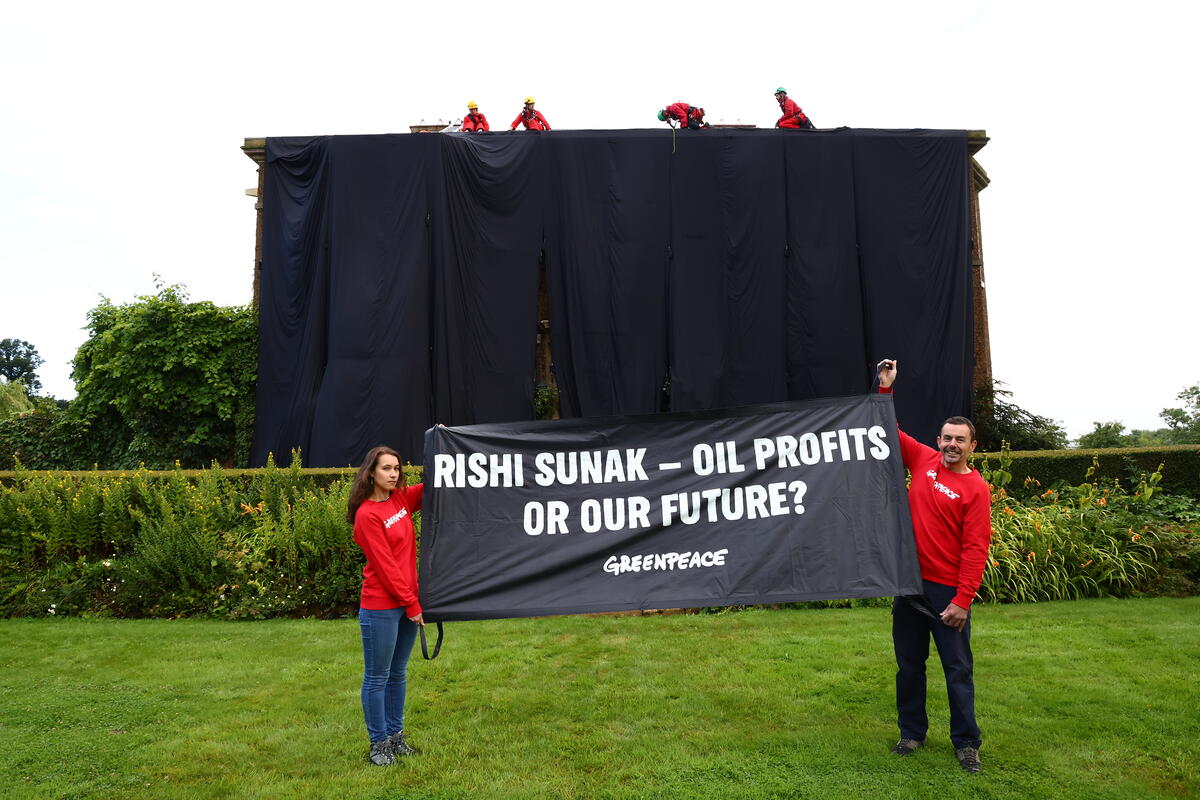
Climate and environmental protest is being criminalised and repressed around the world. The criminalisation of such protest has received a lot of attention in certain countries, including the UK and Australia. But there have not been any attempts to capture the global trend – until now.
We recently published a report, with three University of Bristol colleagues, which shows this repression is indeed a global trend – and that it is becoming more difficult around the world to stand up for climate justice.
This criminalisation and repression spans the global north and south, and includes more and less democratic countries. It does, however, take different forms.
Our report distinguishes between climate and environmental protest. The latter are campaigns against specific environmentally destructive projects – most commonly oil and gas extraction and pipelines, deforestation, dam building and mining. They take place all around the world.
Climate protests are aimed at mitigating climate change by decreasing carbon emissions, and tend to make bigger policy or political demands (“cut global emissions now” rather than “don’t build this power plant”). They often take place in urban areas and are more common in the global north.
The intensifying criminalisation and repression is taking four main forms.
1. Anti-protest laws are introduced
Anti-protest laws may give the police more powers to stop protest, introduce new criminal offences, increase sentence lengths for existing offences, or give policy impunity when harming protesters. In the 14 countries we looked at, we found 22 such pieces of legislation introduced since 2019.
2. Protest is criminalised through prosecution and courts
This can mean using laws against climate and environmental activists that were designed to be used against terrorism or organised crime. In Germany, members of Letzte Generation (Last Generation), a direct action group in the mould of Just Stop Oil, were charged in May 2024 with “forming a criminal organisation”. This section of the law is typically used against mafia organisations and had never been applied to a non-violent group.
Criminalising protest can also mean lowering the threshold for prosecution, preventing climate activists from mentioning climate change in court, and changing other court processes to make guilty verdicts more likely. Another example is injunctions that can be taken out by corporations against activists who protest against them.
3. Harsher policing
This stretches from stopping and searching to surveillance, arrests, violence, infiltration and threatening activists. The policing of activists is carried out not just by state actors like police and armed forces, but also private actors including private security, organised crime and corporations.
In Germany, regional police have been accused of collaborating with an energy giant (and its private fire brigade) to evict coal mine protesters, while private security was used extensively in policing anti-mining activists in Peru.
4. Killings and disappearances
Lastly, in the most extreme cases, environmental activists are murdered. This is an extension of the trend for harsher policing, as it typically follows threats by the same range of actors. We used data from the NGO Global Witness to show this is increasingly common in countries including Brazil, Philippines, Peru and India. In Brazil, most murders are carried out by organised crime groups while in Peru, it is the police force.
Protests are increasing
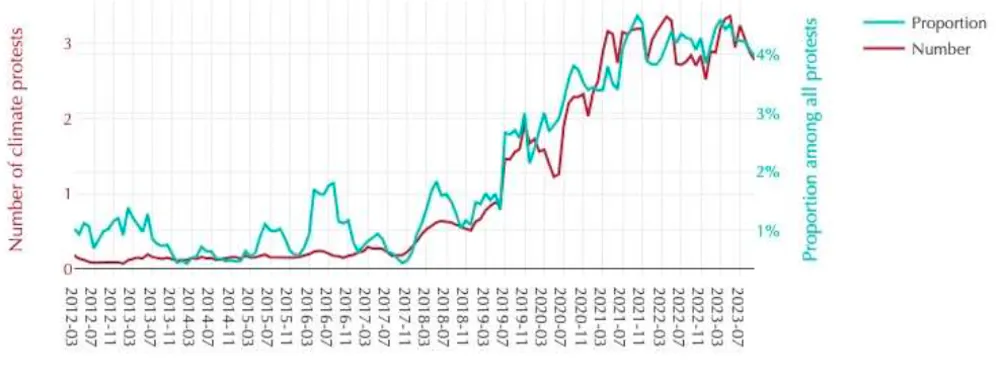
To look more closely at the global picture of climate and environmental protest – and the repression of it – we used the Armed Conflicts Location Event database. This showed us that climate protests increased dramatically in 2018-2019 and have not declined since. They make up on average about 4% of all protest in the 81 countries that had more than 1,000 protests recorded in the 2012-2023 period:
Climate protests increased sharply in the late 2010s in the 14 countries studied. (Data is smoothed over five months; number of protests is per country per month.) Berglund et al; Data: ACLED, CC BY-SA
This second graph shows that environmental protest has increased more gradually:
Environmental protests in the same 14 countries. Data: ACLED, CC BY-SA
We used this data to see what kind of repression activists face. By looking for keywords in the reporting of protest events, we found that on average 3% of climate and environmental protests face police violence, and 6.3% involve arrests. But behind these averages are large differences in the nature of protest and its policing.
A combination of the presence of protest groups like Extinction Rebellion, who often actively seek arrests, and police forces that are more likely to make arrests, mean countries such as Australia and the UK have very high levels of arrest. Some 20% of Australian climate and environmental protests involve arrests, against 17% in the UK – with the highest in the world being Canada on 27%.
Meanwhile, police violence is high in countries such as Peru (6.5%) and Uganda (4.4%). France stands out as a European country with relatively high levels of police violence (3.2%) and low levels of arrests (also 3.2%).
In summary, while criminalisation and repression does not look the same across the world, there are remarkable similarities. It is increasing in a lot of countries, it involves both state and corporate actors, and it takes many forms.
This repression is taking place in a context where states are not taking adequate action on climate change. By criminalising activists, states depoliticise them. This conceals the fact these activists are ultimately right about the state of the climate and environment – and the lack of positive government action in these areas.
People wait in the woodland by the Greek border fence in northwest Turkey, in March 2020 | Gokhan Balci/Anadolu Agency/Getty Images. All rights reserved
I supported people who’d been violently pushed back from Greece to Turkey – and was accused of being a criminal spy
In October 2020, my colleague and I were sitting in a cafe in central Istanbul, unsure of what would come next. We were exhausted: physically and mentally tired from supporting the people being violently pushed back from Greece and Bulgaria to Turkey, documenting the violations, and fielding requests from journalists.
That morning, the apartment we had planned to move into had fallen through. Three weeks earlier, Turkey had cancelled the residence permits of two colleagues and given them just 24 hours to leave the country.
We were running out of funds, burnt out, and ill. Now, we had nowhere to live.
“What’s next?” I wondered.
My phone pinged. It was a message from Giorgos Christides, then the Greece correspondent for the German newspaper Der Spiegel. I called him back.
“You are one of them! One of the four!” he told me. He had sent a picture of the front page of a Greek newspaper. On it was a screenshot of our website and a letter from the police on Lesvos island that named our organisation, Josoor.
I can’t read Greek, but I understood what was happening. The article was following up on a press release issued by Greek police a week earlier, detailing a “secret operation uncovering a spy network” of four NGOs on Lesvos island. We had just been named as one of them.
I sat frozen as Giorgos translated the text. Espionage. Violation of state secrets. Forming a criminal organisation. Facilitation of illegal entry. Up to 35 years in prison.
How did we end up here?
Multiple crises at the border
The story starts seven months earlier, in March 2020. It had been a sleepless night: we’d been out in freezing temperatures, and our eyes were still stinging from the tear gas. The evening before, two colleagues and I had entered the closed military zone at the border to Greece near Edirne, northwest Turkey.
Our goal was to assess the feasibility of a civil society relief response to the crisis then unfolding at the border. We were three of around 180 volunteers who had met on a Facebook group for aid efforts in Greece, and we refused to just stand by and watch.
The situation was dire. Up to 20,000 people seeking protection were stranded in makeshift tents on the Turkish side. It was cold, and people had to queue for hours to receive a minimal amount of food from the Turkish disaster relief agency. There was no medical care available, and the area was regularly exposed to tear gas from both sides.
Many of those we encountered had been violently pushed back to Turkey by Greek officers, and even enlisted civilians. Two people had been shot dead.
We knew that the Turkish authorities had been obstructing organised relief before we entered the zone. But our scouting trip made it clear to us that they were also creating deliberately poor conditions. So this loose network of volunteers started distributing aid – food, clothes, sleeping bags, hygiene and first aid supplies – under the radar while also keeping the international media informed of what was going on. It was the beginning of Josoor’s work in Turkey.
Men, women and children were – and still are – arriving on Turkish land beaten, humiliated and robbed of all their possessions
The crisis we were responding to had been brewing for years. Turkey had long been threatening to ‘send’ the 3.6 million Syrian refugees in Turkey to Europe, in response to escalating tensions between the country and the European Union.
In the 2016 EU-Turkey agreement, the EU promised Turkey a €6 billion support package and visa-free travel for Turkish citizens. In exchange, Turkey promised to prevent asylum seekers from leaving its territory and to re-admit those who reached the Greek islands.
The deal was described by Amnesty International as an “abject failure”, corrosive for the EU’s human rights record, and “based purely on political convenience”. It turned people seeking protection into pawns for politics – and leverage in the hands of the Turkish government.
The agreement also led to a sharp increase in the frequency and violence of so-called pushbacks back to Turkey from Greece. This informal and illegal practice of collective expulsions had been documented at the land border for decades, but they had never been so systematic nor so violent.
Following the deal, they were also extended to the sea border. The Greek Coastguard (HCG) began disabling peoples’ dinghies and creating waves to push them back to Turkish waters. By 2020, their officers were puncturing inflatable dinghies, setting people adrift in overcrowded life rafts, and even firing live rounds at unarmed people.
People dodge tear gas near the Greek border fence in northwest Turkey | Photo taken by Josoor members
But despite the obvious “political convenience” of the deal for Europe, it didn’t keep to the bargain. By 2019, the EU had only paid Turkey half the promised amount and no progress had been made regarding travel restrictions. It did, however, continue to put pressure on Turkey over its role in the Syrian civil war. Then came the last straw: 33 Turkish soldiers were killed in an airstrike in Idlib, northwest Syria, and Turkey said it could no longer cope with holding up its end of the deal with the EU.
Just weeks after we arrived at the border area, Covid-19 struck. After forcing thousands of people to the border and trapping them there, Turkish authorities suddenly ordered people to clear the area.
People scattered. Some returned to Istanbul or went somewhere else. Those who refused to leave were forced onto buses and kept in quarantine camps before being dropped off in various locations, and stranded without supplies during Turkey’s first nationwide lockdown.
One group sent us a video from the Aegean coast, saying they’d been told by their bus driver to “try to make it to Greece”. Turkish officers apparently told another group the same thing after they were stranded in a different spot.
As we did with all the information we received, we published this on social media in our daily update. The next day, we woke to Greek media headlines alleging that “Turkey sends Covid-infected migrants to Greece as a biological weapon of hybrid warfare”. This ‘news’ had also reached right-wing outlets, only they’d added: “according to Turkish spy organisation Josoor”.
Efforts to correct the narrative were futile – the damage was done. After just a month of operating in Turkey, Josoor was now on the radar.
In hindsight, this media frenzy should have worried and prepared us for what was to come. But we were fully occupied with the situation on the ground, trying to fill the massive gap in monitoring and support for border violence survivors.
We were no longer just a bunch of volunteers trying to sort out an emergency response. Organisational structures were established and our operations were growing. We started providing accommodation, clothing, food, and medical care. And we started taking testimonies to evidence the systematic fundamental rights violations committed by European forces.
Greek, Bulgarian, and EU border and coast guard agency (Frontex) officers continued their campaign of pushbacks following the events of March 2020. There were endless reports of inhumane and degrading treatment, arbitrary detention in appalling conditions, theft, forced undressing, sexualised violence, and torture. Men, women and children were – and still are – arriving on Turkish land beaten, humiliated and robbed of all their possessions.
We joined the Border Violence Monitoring Network (BVMN) and took our evidence and advocacy to the UN, EU, and member state levels. Josoor became a key source of information for international media, collaborating with outlets from 40 countries. But unbeknownst to us, this rapid success had already triggered a first of three secret criminal investigations.
The first warning signs
“We have a right to live,” said Farzad (a pseudonym) in a video livestreamed in June 2020. Alongside the unaccompanied 17-year-old were ten other children, four babies, and 18 adults from Afghanistan, the Democratic Republic of Congo and Syria.
They had been drifting in a flimsy dinghy in the Aegean Sea for three days.
Independent search and rescue operations were effectively banned in the area. Greece’s Hellenic coast guard (HCG) was the authority in charge. But, according to Farzad, it was the coast guard itself that was responsible for their distress. He explained in his video how HCG officers had removed the dinghy’s engine, then used their boat to create waves to push the dinghy back into Turkish waters.
The video was picked up in an unexpected place. Runa Godø Sæther, a music teacher and single mother of three, was managing a Facebook page at the time, sharing posts of people on the move to a European audience from her small town in Norway.
Runa and I didn’t know each other, but we had talked online about collaborating on advocacy. She came across Farzad’s livestream and connected the boy to me, since she had no experience handling ongoing distress cases like this one.
Remarkably, Farzad’s boat eventually reached Lesvos. His desperate calls for help had reached a Turkish liaison officer aboard a German NATO ship, who pressured the crew to intervene and tow it to Lesvos.
A WhatsApp message from a person who had arrived on a dinghy to Lesvos island before being forced back into the sea by police and the Greek coast guard| Natalie Gruber
I introduced him to some journalists when he arrived, and within a short time he had spoken to multiple media outlets about his ordeal. Two days after arriving, a UNHCR official warned him to stop speaking to the press – the police were beginning to take notice.
Farzad instantly cut all ties with journalists – but it was too late. When the others from his boat were transferred to Moria reception centre, Farzad was taken into police custody. He was held there for seven months. Initially, we had no idea why Farzad had been detained. Greek police only told his lawyer he was deemed “a threat to public security”, but never filed charges.
When the Greek press splashed the news of the police letter across their front page, the one that Giorgos had translated for me over the phone, it finally became clear.
The ‘criminal network’
“The Lesvos 35”, as we came to be known, included 32 members from four civil society organisations, one independent volunteer (Runa, the Norwegian music teacher), and two asylum seekers, including Farzad.
Of the four accused organisations, only one – Mare Liberum – actually operated on Lesvos. Registered in Germany, they shared an address with Sea Watch in Berlin, who had ceased operations in Greece four years prior but was still included in the case. Our organisation, Josoor, operated in Turkey.
The other accused organisation was FFM, a research society hosting the donation account for the real target: AlarmPhone. This network of volunteers from all around the Mediterranean runs an emergency hotline for people in distress at sea.
The investigation never aimed to uncover an ‘organised human trafficking network’. It sought to defame, discredit, deter, distract, and disable
The six-month investigation run by the Greek intelligence service, anti-terror unit and HCG resembled a poorly scripted spy movie. Over the course of the investigation, they recruited two asylum seekers, who they sent back to Turkey as “agents” to return to Greece. Then armed special forces conducted a dawn raid on Mare Liberum’s ship, confiscating all electronic devices and detaining the crew for several hours – before releasing them without interrogation.
Our lawyers also strongly suspected that our phones were tapped, making everyone who was now reaching out to us for support a potential target for authorities. And everything we said or wrote in private messages and calls could possibly come back to haunt us. This put immense psychological pressure on us and forced us to censor our communication.
Despite felony charges being announced, none of the 33 organisation members were ever arrested or called to testify. Some even continued to work on the island. Greece has a well-earned reputation of overusing pre-trial detention. Had the authorities believed their own claims – that an allegedly dangerous criminal network was spying on Greek authorities – they should, and I believe would, have arrested us.
Instead, they only leaked information to servile media, while high-ranking government officials, including Prime Minister Kyriakos Mitsotakis, made numerous statements fuelling the defamation campaign.
I cannot quite put into words what this meant. On the one hand, we, the accused, knew full well that we had done nothing criminal at all, so it was hard to take the allegations seriously. But on the other hand, we were slandered and defamed, and our work was discredited. And even though it was absurd, we still faced the possibility of 35 years in prison, which is longer than I have lived.
For three years, seven months and 12 days, we faced the threat of prosecution. The constant anxiety of waiting to be summoned for trial ate away at me. Throughout this time, Greece was so geographically close to me, and a place very dear to my heart – but I couldn’t set foot in the country for fear of arrest.
That threat was finally lifted on 30 April 2024, when our lawyers received the only official communication about the case from the Greek state: a 16-page decision dropping all charges against us.
Like other cases targeting civil society organisations across Europe, this investigation never aimed to uncover an “organised human trafficking network” or to stop “spy games”. It sought to defame, discredit, deter, distract, and disable.
Defame us as a reliable source of information. Discredit our reports exposing human rights violations. Deter others from doing the same. Distract us from our work by forcing us to prepare a legal defence and campaign. Disable our operations through the financial and psychological strain of ongoing investigations.
We got close to quitting back then. But we also realised that being targeted so quickly and so viciously meant that our work so far had been successful. And every day we saw how those we had committed to support were dealt a much worse hand.
So despite the threats we continued for another two years. And each year brought another criminal investigation from Greece. The second case, which started in 2021, simply dissolved for us, but ended with severe consequences for other defendants.
Then, in May 2022 and with pressure mounting inside Turkey, the Greek media once again published claims of criminal investigations into an NGO network. This time, we were sure we were one of the accused. We tried to hang on, and for months we discussed our options.
But in August 2022, we made the difficult decision to dissolve Josoor. Not long after, another of the organisations caught up in the first case, Mare Liberum, also ceased their operations due to the pressure caused by the investigations.
Deterrence at all costs
The mental load of waiting for the day I’m summoned to defend myself against accusations of espionage is hard to describe. It was overwhelming knowing I was being constantly surveilled – sometimes in person in Turkey, and apparently digitally from Greece – while working to support people who had suffered unimaginable rights abuses at the EU border. I was propelled into burnout and PTSD.
For me, the proceedings are far from over. After we submitted a freedom of information request to Europol, the EU law enforcement agency, my co-defendants were told there was no personal information being held about them. But in May 2021, Europol denied my request on the grounds that it could cause “potential jeopardy to member state investigations”. Contacts of mine in the EU data protection authority told me it’s highly likely that Greece, and possibly Frontex, had reported me to the policing agency.
My subsequent complaint to the European Data Protection Supervisor, filed two years ago, remains unresolved, despite the conclusion of their investigation into my case earlier this year.
I was so burnt out that I was ready to accept the situation. But Statewatch and EDRi, who are engaged in crucial work on this issue, reached out to tell me they are eager to advance my case to the European courts, to seek redress for my criminalisation and wrongful entry into Europol’s databases.
Although it will be a long time before my name is cleared, the relief I felt once the charges against us had been dropped showed me just how much pressure I had been under.
Throughout these years, the EU and its member states have shown how far they will go in order to silence those who expose their crimes. And yet, we are only collateral damage. The real targets of all these criminalisation campaigns are those challenging the border regime simply by stepping across the arbitrary lines we have drawn.
Voluntarily or forced, people have moved from one place to another throughout human history. But particularly in this past decade, Europe’s only response to this simple, human phenomenon has been deterrence and externalisation.
Pushbacks are one hallmark of these brutal, costly and racially motivated policies. The criminalisation of migration is another hallmark, resulting in the widespread imprisonment of people seeking protection. By extension, authorities are also engaging in secondary criminalisation: targeting those stepping in where states fail, providing basic yet desperately needed support at Europe’s borders.
Within the Border Violence Monitoring Network, eight of the 14 organisations faced criminal proceedings across four European countries in 2022. Journalists, lawyers, doctors and other aid workers are increasingly being targeted as well.
The criminal proceedings had a huge toll on me. But as a white EU citizen, the price I paid was small – uncomparable to all those unjustly spending years or even decades in prison just for seeking protection. In the end, society as a whole pays a high price. The widespread erosion of the rule of law across Europe threatens nothing less than democracy itself – and the fundamental rights it has ensured for everyone.
Explore the rest of the series
This series looks at how the UK, EU and bordering countries are increasingly treating migration as a criminal offence, and targeting migrants and solidarity actors in the name of ‘anti-smuggling’ and ‘border control’.
dizzy: Experiencing some problems posting with WordPress today, having to use a different browser to normal and it may look a little different. So what eh?
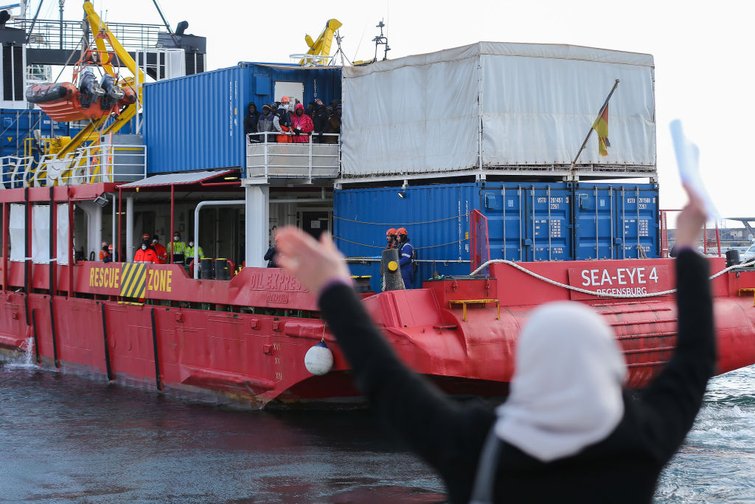
A woman greets the people on board the Sea-Eye 4 rescue ship as it arrives in Naples, Italy in June 2023 | Marco Cantile/LightRocket/Getty Images. All rights reserved
We were fined and our boat blocked after we rescued 114 people. It’s a political campaign to make movement illegal
Hope arrived on the radio, late in the afternoon with August sunshine blasting the deck.
After tortuous negotiations with authorities from four countries, Italy had finally granted us a port of safety. We were allowed to disembark the people we had rescued, in accordance with international law.
We had 114 passengers on board our ship, the Sea Eye 4, where I was volunteering as part of the crew. Overall, we had rescued three boats in distress. Some of the rescued had drifted without food, fuel, or water for days. One man had been unconscious for over 24 hours and would have been unlikely to survive much longer without aid.
But the rescue operation was not where the troubles ended. On reaching port in Salerno, we found our ship detained for 20 days and its operator, the NGO Sea Eye, fined €3,000.
We were one of three ships detained during that week in August 2023. This represented a total loss of 60 operating days during high summer, in a year where at least 2,000 people had already died while trying to cross the Mediterranean.
We were detained under the 2023 Piantedosi Decree, an Italian law which mandates immediate return to port after just one rescue. The law forces crews to make impossible choices. Should you ignore incoming distress calls and risk lives in the present, or risk detention and the ability to save lives in the future?
The decree is not an isolated piece of legislation – in Italy or the EU. It is just one of dozens of policies and laws that have been created to limit the movement of people across borders, and to limit other people’s capacity to help them. For over a decade, European states have withdrawn, denied, or evaded their responsibility to carry out rescues or provide safe ports.
Criminalisation: a refined tactic
It didn’t start off this way. In 2013, horrific twin shipwrecks near Lampedusa led to a serious response from the Italian government – a year-long rescue operation called Mare Nostrum, which saved thousands of lives.
But as the claims grew that Europe was experiencing a ‘migration crisis’, and with wider European support significantly lacking, the mood in Italy changed. Mare Nostrum was cancelled, and in 2017 a ‘code of conduct’ was introduced that restricted the actions of civil rescue ships.
This “Minniti Code” was brought in by centrists seeking to blunt a right-wing surge by proving they were sufficiently tough on irregular migration. It had little effect. Instead, the code handed tools to the far-right (such as the mainstreaming of an anti-migrant narrative and demonisation of rescue operations) that they would build on in later years to make additional gains.
At the end of last decade, rescue crews were being surveilled, wiretapped, and threatened with jail in a vicious offensive led by the Italian right. The sweeping crackdowns were an undeniable effort to criminalise humanitarian action and the movement of people across borders.
This campaign was eventually seen by policymakers as counterproductive. It had caused a huge public backlash, and taking NGOs and individuals to court with little evidence proved costly and time consuming. Undeterred, however, the Italian state switched to bureaucratic harassment.
Using a combination of fines, blockades, the assignment of distant ports of safety and weaponised inspections, they continued to significantly limit the ability of rescue crews to save lives at sea. They just kept a lower profile this time, lessening the potential for public outcry.
Block the rescuers, enable the militias
While Italy harassed rescue workers, it was also busy – together with the EU – handing over responsibility for rescue to violent criminals. The so-called Libyan Coast Guard (LCG) has received boats, equipment, funding, and support to establish a wider search and rescue area. It is routinely given the coordinates of boats in distress by Frontex, the EU border agency.
The LCG attacks, abuses, and violates the rights of people in distress at sea. It also returns them to detention camps in Libya where extortion, torture and exploitation are rife.
When the Libyan coast guard first spotted the rescue boat, they threatened to shoot at the rescuers
On their first mission back at sea after Sea Eye 4’s detainment, the crew arrived at a scene where the LCG was dangerously manoeuvring around a boat in distress, causing people to fall into the water. And when the LCG first spotted the rescue boat, they threatened to shoot at the rescuers.
Sea Eye 4 ultimately did respond to the people in distress, but was unable to prevent four people drowning. When they returned, Italy once again detained the ship and fined its crew for failing to “cooperate” with Libyan forces.
Over a year later, I returned to the central Mediterranean aboard the Humanity 1, a rescue ship run by the organisation SOS Humanity. The day before we sailed, Tunisia’s president Kais Saied was re-elected. He has joined Libya as a staunch ally in Europe’s fight against people migrating. Tunisia, Libya and Morocco have carried out countless “desert dumps”, in which thousands of mostly Black migrants are transported to and abandoned en masse in the Sahara.
Tunisia’s coast guard, which also has a grim record of rights abuses, is becoming more active too. Our most recent mission took place near the recently expanded Tunisian zone of rescue responsibility in the Mediterranean. The expansion of the zone has left rescue crews in that area at even further risk of detainment if they don’t return rescued people to Tunisia.
Whilst we were at sea, Giorgia Meloni launched a new attempt to forcibly transfer people disembarked in Italy to camps in Albania to await deportation. This proved a costly failure when the first twelve detainees immediately returned to Italy after a court judgment. But it provides just one more indication of a very worrying direction of travel for Italy and the EU.
All these efforts to hinder civilian rescue are, of course, partially about limiting the number of people arriving by sea to Europe. But that’s not the whole picture.
All together, the civil fleet only carries out a small proportion of overall rescues in the Med. Its ships brought in just 8% of those arriving in Italy in 2023. The Italian coast guard is still rescuing the rest of those delivered to the country’s shores – even though their area of operations has now shrunk to an area relatively close to the shoreline.
So why go to such great effort to stymie and discredit civil sea rescue? Something else is going on here.
Making movement illegal
Europe speaks loudly about its commitment to human rights and humanitarian values. For years, rescue organisations have pointed to the shallowness of these commitments in the face of thousands dying off European shores.
Europe and its member states have responded by delegitimising rescue workers’ motives and their voices, impugning them as not genuine humanitarians. They accuse the civil fleet of unprofessionalism, of being too political, and of cooperating with ‘smugglers’. When they’re feeling generous, they say rescuers are well-intentioned but their presence at sea encourages people to risk dangerous crossings.
None of this has ever been proven. Every single smuggling case brought against rescue crews has collapsed. And comprehensive studies have debunked the link between the presence of rescue assets and people’s decisions to cross the Mediterranean.
As the EU rewrites its anti-smuggling policy, there is a real risk that the criminalisation of people migrating, and people who assist them, will deepen
But it does not matter anymore. Humanitarian actors in the Mediterranean have already become associated with criminality, and that idea is now embedded in European political discourse. Justified by the claim of ‘countering smuggling’, the EU is seeking to undermine every aspect of irregular movement by criminalising more and more parts of it outright and framing the rest as criminal in essence.
It’s not just rescue workers. From 2015 to 2018 alone, Italy arrested 1,300 people they accused of driving small boats. An Iranian women’s rights activist fleeing persecution and four Libyan refugee footballers who survived a shipwreck were among those caught up in this campaign. Greece has engaged in similar tactics, with thousands of trials taking place and ‘boat drivers’ handed sentences of over 100 years in prison.
Many of the trials are deeply legally unsound, and some have lasted as little as 30 minutes. But their effect on the framing of humanitarian action has a much longer shelf life. Europe and Italy are seeking to tar everyone associated with irregular migration as criminals in the court of public opinion – those on the move and those extending a hand.
‘Counter-smuggling’ doesn’t work
The EU is currently rewriting its anti-smuggling policy, and there is a real risk that the criminalisation of people migrating, and people who act in solidarity with them, will deepen. As with the war on drugs and prohibition-type policies in general, the strategy won’t stop people from doing either of these things. But it will likely get more people killed.
Neither smuggling groups nor rescue actors create the demand for their services. Poverty, violence, and the absence of safe routes do. As borders are enforced more harshly, people attempting to move are forced to rely on more dangerous routes, and sometimes more dangerous actors. More people end up in distress, and more people need to be rescued.
It’s a loop, but not one created by smuggling profits. It exists because governments refuse to see reason.
Another way to understand this is to see ‘countering smuggling’ not so much as a policy approach, but as a political convergence. It’s where the demands of the right for evermore violent border control and the demands of liberals for lip-service to humanitarian principles meet.
This convergence reframes border enforcement as ‘protecting’ migrants from the brutality of gangs. It conjures up a simple enemy, obscuring the agency of people migrating and the reality of their journeys. And it treats movement as a crime, one which necessitates a multinational police and military response.
In turn, this helps the lucrative border and surveillance industry to hijack policy, selling ever more expensive ‘solutions’ to monitoring and controlling movement. Those resources should be going into helping people, not harming them. The first imperative should not be to “smash gangs” but to save lives.
We need the restoration of coordinated search and rescue by the competent authorities. We need safe routes. And we need funding and support both for people arriving and the wider communities they settle in.
At the moment, such vision and compassion seem a long way from the reality of European politics. But the emergency at Europe’s shores is not going anywhere. Not until we reach an approach founded on hope and courage rather than fear and division.
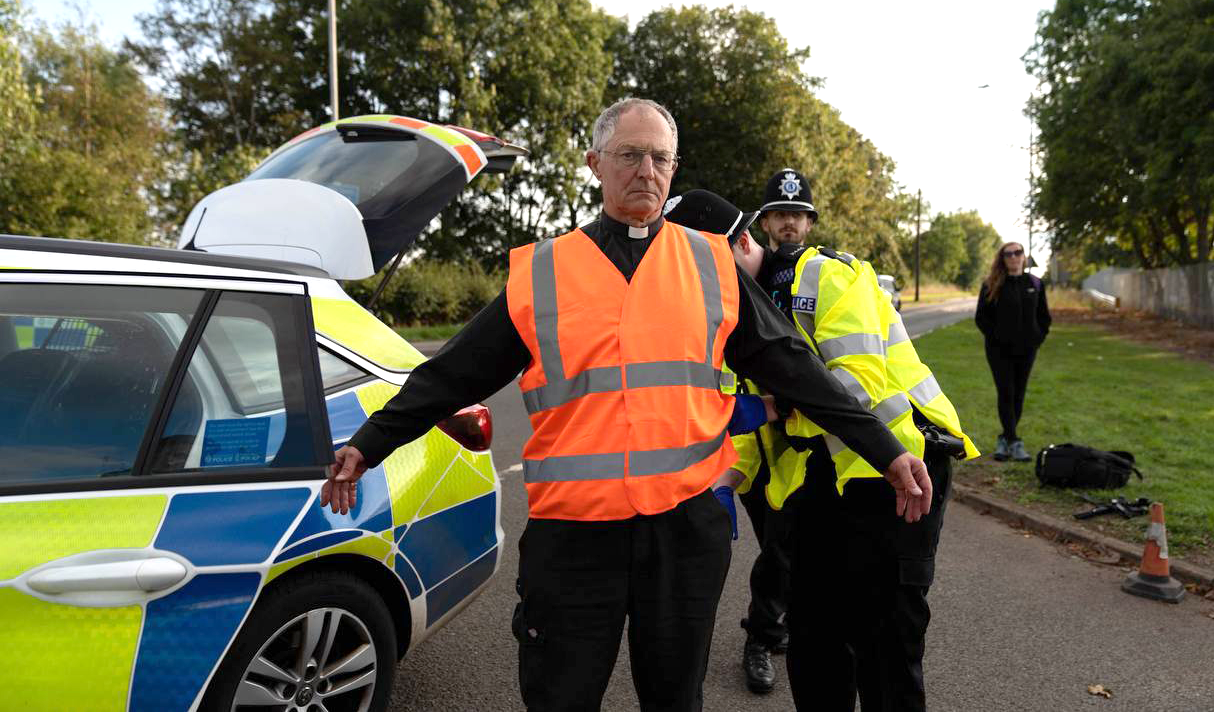
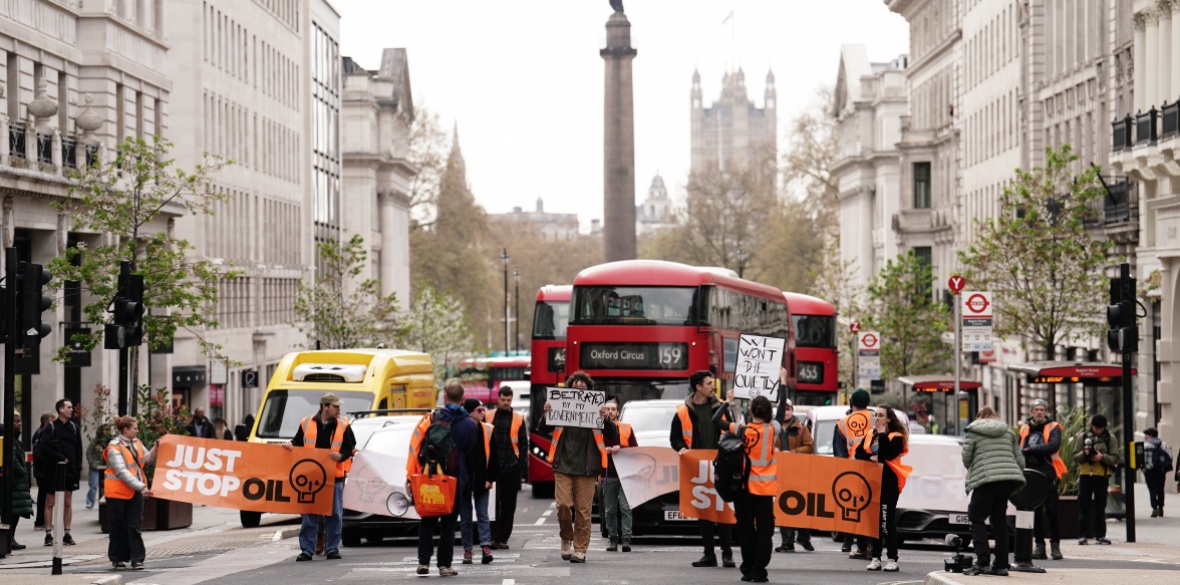
Just Stop Oil protesters as they take part in a slow march protest through London as part of the group’s campaign to convince the government to end all new oil and gas projects in the UK, April 24, 2023
THE government’s draconian anti-protest laws have been used to give a shocking six-month prison sentence to a climate activist for taking part in a peaceful slow march.
Just Stop Oil supporter Stephen Gingell, 57, was sentenced at Manchester magistrates’ court on Thursday.
The father-of-three was arrested on November 13 after taking part in a slow march in north London for about half an hour.
Mr Gingell pleaded guilty to breaching section seven of the Public Order Act, which bans any act “which interferes with the use or operation of any key national infrastructure in England and Wales.”
Passed in May, the widely condemned legislation allows police to ban peaceful protests merely on the grounds that they might become disruptive.
“It seems this government has now made walking down the road, walking on the public highway, an illegal act that is worthy of imprisonment,” a Just Stop Oil spokesperson said.