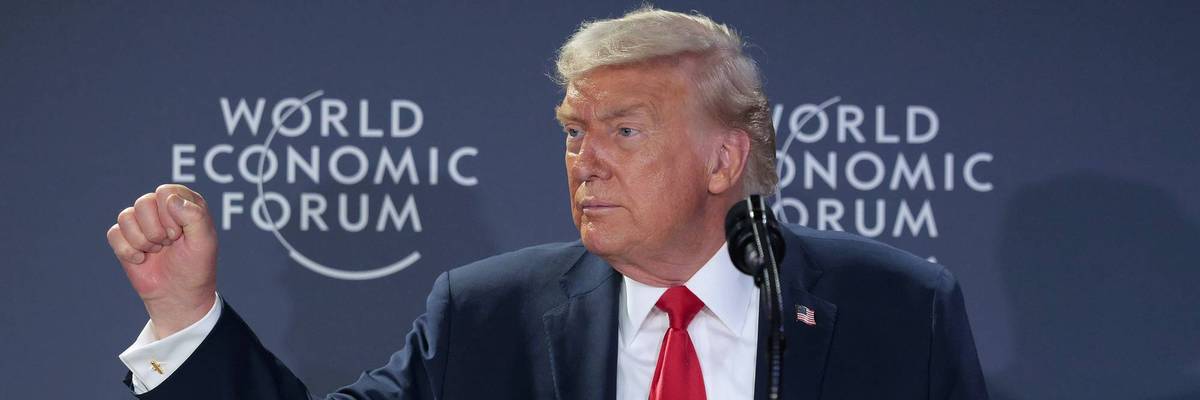
US President Donald Trump holds up a signed ‘Board of Peace’ charter during the Annual Meeting of the World Economic Forum in Davos, Switzerland, January 22, 2026
DONALD TRUMP’S new “Board of Peace,” launched today, appropriately enough at the billionaires’ confab in Davos, is a danger to international law, security and peace itself.
It is entirely right to dub it in reality a board for war, as the anti-war movement did.
The clear purpose of the board is to sideline the United Nations and replace the world body with a committee entirely subordinated not just to the United States but to President Trump personally.
Its initial make-up is dominated by despots and extreme rightwingers, like Hungary’s Viktor Orban or Argentina’s Javier Milei. Israel’s Benjamin Netanyahu is of course on board, ever-eager to oblige the protector of his atrocities.
Trump himself is to serve as its chair, handing himself sweeping powers, including the right to veto any decision of which he disapproves.
It will doubtless function as a sort of far-right “international” to advance Trump’s imperialist and authoritarian agenda around the world.
The board’s creation was authorised by the UN — mistakenly in our view — specifically in relation to assisting to stabilise the notional ceasefire in Gaza. Its new remit, however, allows it to intervene much more widely.
If it is serious about peace will it stop acts of piracy like Trump’s seizure of Venezuelan President Nicholas Maduro and his wife?
Will it block moves by Trump to bomb Iran in violation of international law? Will it oppose his aggressive moves to annex Greenland?
Will it challenge his threats to Cuba and Colombia? Or his demand that he be handed control of the Panama Canal, and that Canada become the 51st state of the US?
We know the answer. Its only function will be to legitimise the campaign of aggression and plunder embarked on by the Trump administration, and to provide diplomatic cover for intervention in the affairs of nations across the world.
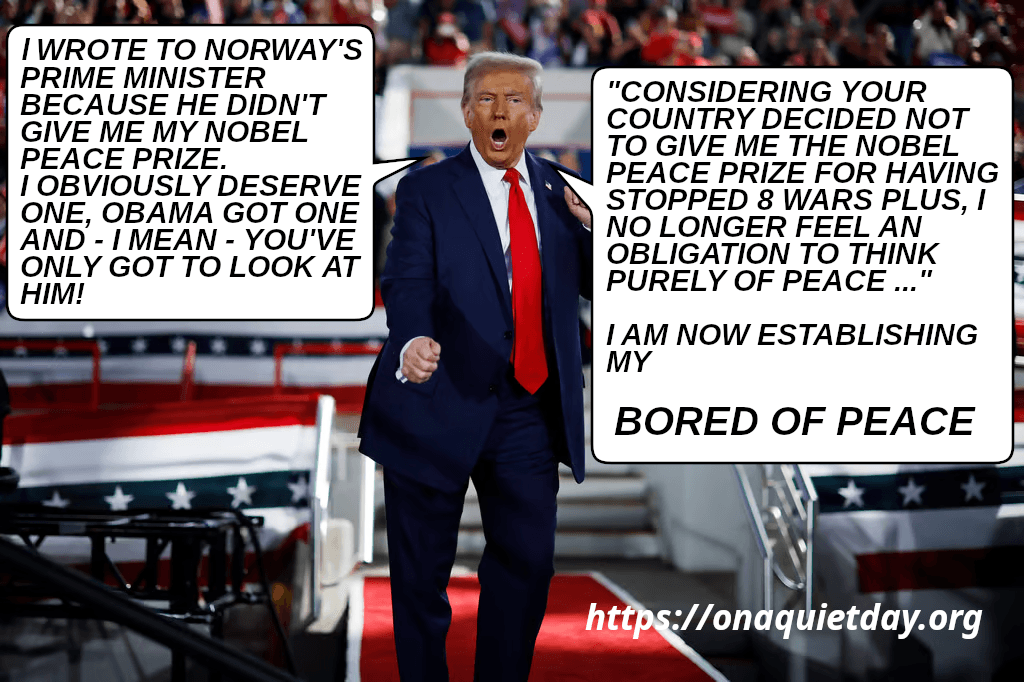
Donald Trump explains why he established his Bored of PeaceElon Musk urges you to be a Fascist like him, says that you can ignore facts and reality then.Orcas discuss how Trump was re-elected and him being an obviously insane, xenophobic Fascist.
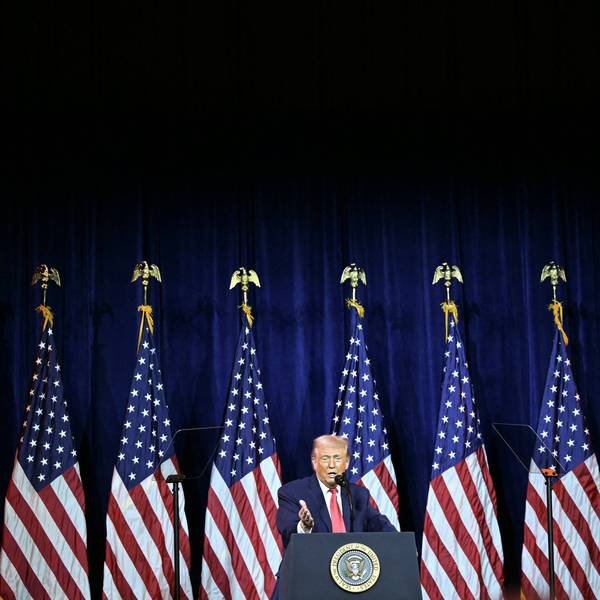
US President Donald Trump speaks during a reception for business leaders at the World Economic Forum annual meeting on January 21, 2026, in Davos, Switzerland. (Photo by Chip Somodevilla/Getty Images)
Trump previously said he wished he could cancel elections, but feared being called a “dictator” by his detractors. Now he’s calling himself one in front of the whole world.
After weeks of authoritarian threats to crush protests with the military, cancel elections, conquer foreign countries, and send masked agents door-to-door to round up anyone who can’t prove their citizenship, Trump on Wednesday told an already uneasy room full of world leaders that “sometimes you need a dictator.”
The offhanded comment came in the middle of a rambling speech at the reception dinner for the annual meeting of the World Economic Forum in Davos, Switzerland, on Wednesday, in which Trump congratulated himself on a different rambling speech he’d given earlier that day at the summit.
“We had a good speech, we got great reviews. I can’t believe it, we got good reviews on that speech,” Trump said of the widely mocked address in which he continued to demand the US take over Greenland (which he repeatedly referred to as “Iceland”) and made new tariff threats against Canada and Europe if they resist the annexation.
“Usually they say ‘he’s a horrible dictator-type person,’ I’m a dictator,” Trump continued. “But sometimes you need a dictator! But they didn’t say that in this case… It’s all based on common sense, it’s not conservative or liberal, or anything else.”
At least twice over the past month, Trump has suggested that the 2026 midterm elections should be canceled, since his party is likely to lose.
The first time he brought up the idea, on the five-year anniversary of the January 6, 2021, Capitol insurrection, he seemed to back off the idea for fear of being called a dictator by his detractors: “I won’t say cancel the election; they should cancel the election, because the fake news would say: ‘He wants the elections canceled. He’s a dictator.’ They always call me a dictator.”
But if being called a dictator was the only thing holding him back from attempting to suspend democracy, he no longer appears to care.
As political commentator Charlotte Clymer wrote on social media, “Trump is now openly referring to himself as a dictator” in front of the whole world.
Elon Musk urges you to be a Fascist like him, says that you can ignore facts and reality then.Donald Fuhrump says that Amerikkka doesn’t bother with crimes or charges anymore, not being 100% Amerikkkan and opposing his real estate intentions is enough.Orcas discuss how Trump was re-elected and him being an obviously insane, xenophobic Fascist.
World leaders have gathered for the World Economic Forum annual meeting in Davos, Switzerland. One of their main goals is to align their responses to geopolitical shocks such as floods and wildfires that hamper trade, investment and more.
The meeting also supposedly aims to find ways to stimulate economic growth to improve living standards, foster a just and inclusive energy transition, achieve security and cooperation amidst conflicts, and accelerate the economic response to an “intelligent age” of AI.
But, a new report from Oxfam International, published on the first day of the meeting in Davos, highlights how global inequality is more rampant than ever. The report, written by a team of policy campaigners and inequality research advisers outlines how billionaire wealth rose sharply in 2024 worldwide, with the pace of the increase three times faster than in 2023.
The World Economic Forum lists extreme weather as one of the top global risks. But, as world leaders convene in Davos, the high-profile anti-climate stances of some of them stand in stark opposition to any meaningful progress for climate action.
The Oxfam report highlights the exploitation involved in creating and sustaining wealth and outlines how, as inequalities deepen, vulnerable communities are disproportionately affected. The most vulnerable – overwhelmingly women, people of colour, Indigenous groups and low-wage workers – are caught in a cycle of insufficient wages, limited services and minimal political influence.
The report also highlights how wealth inequality is often intertwined with historical processes of extraction — both within countries (for example, through weak labour protections that lowers wages) and between countries (through trade, finance, and resource exploitation).
The climate connection
Other research has also shown how inequality is deeply interwoven with climate breakdown. Each crisis exacerbates the other. Historically, the richest nations – and within them, the wealthiest people – have contributed the most to greenhouse gas emissions.
Meanwhile, lower-income countries that bear little responsibility for global heating suffer the most. These countries, already burdened by debt and systemic inequality, have fewer resources to protect communities from extreme weather, crop failures and infrastructure damage. This makes day-to-day survival a struggle for billions.
When climate change exacerbates existing inequalities, marginalised communities are denied basic human rights. For instance, droughts reduce crop yields and deplete water sources, so more people — often women and children — have to ration supplies or go without. This directly infringes on their rights to food, safe drinking water and sanitation.
In these ways, without climate action, the warming planet threatens to widen inequalities by affecting the poorest people most severely. A 2020 World Bank report estimated that an additional 68 to 135 million people could be pushed into poverty by 2030 because of climate change. French researchers identified that climate change also slows down the economic catch-up of poorer countries.
The reality on the ground is bleak. Floods in Pakistan displaced thousands and affected more than 33 million people in 2023. That’s ten times more than the total population of Los Angeles where, when the recent wildfires struck, 170,000 people had to be evacuated.
Around the world, climate movements continue. Law suits that demand climate action are transforming governance. High-level negotiations like the UN’s annual climate summit carry on seeking progress, although the processes could be improved to accelerate change.
What can Davos do? World leaders need to look at how wealth and power can be redistributed (reparations for climate damages is one way to do this) and low-income, climate-vulnerable nations can be better represented in global decision-making.
Without this kind of change, there’s a risk climate action will perpetuate the same structural imbalances that first enabled environmental exploitation. Only by tackling both climate injustice and economic inequality together can the world prevent further climate disasters and ensure a more equitable future.
The video shows that Rachel Reeves intended to means test winter fuel payments in 2014. Her claims that she was forced to take this action because of the economic position inherited from the Tories is – therefore – very suspect. Labour weren’t forced to do it as she repeatedly claims – she and they intended to do it 10 years ago.
Keir Starmer says pensioners can freeze to death and poor children can starve and be condemned to failure and misery all their lives.
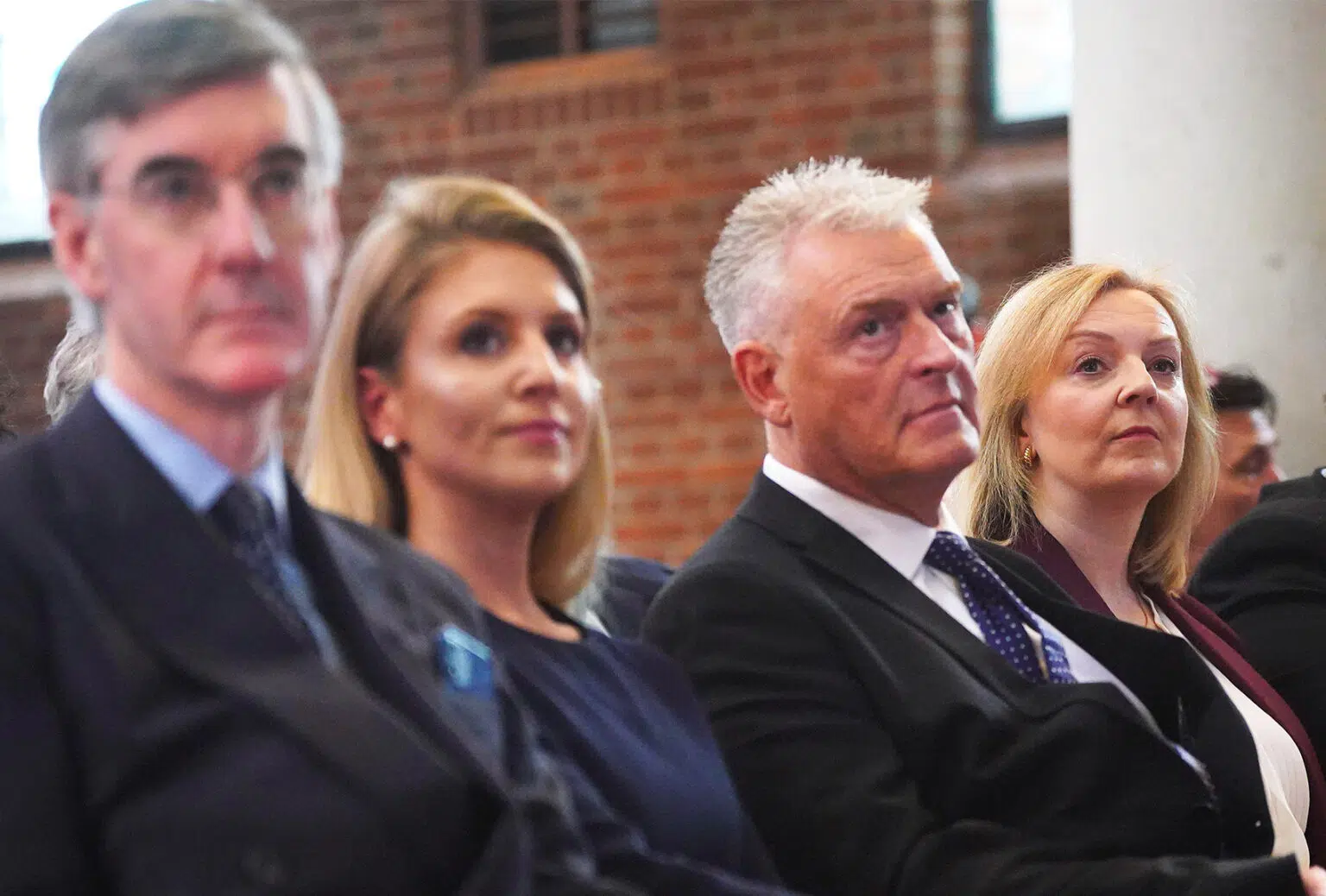
Jacob Rees-Mogg, Lee Anderson and Liz Truss at the launch of ‘Popular Conservatism’. Credit: PA Images / Alamy
The launch of Popular Conservatism saw attacks on “net zero zealots” and the Climate Change Committee.
Liz Truss’s new ‘Popular Conservatism’ faction of the Conservative Party launched today with attacks on net zero targets and environmental bodies, using the playbook established by libertarian lobby groups.
The self-styled PopCons included politicians critical of climate policies and science, including Lord Frost, who is a director of the climate science denial Global Warming Policy Foundation, as well as Conservative MP Lee Anderson and Reform party president Nigel Farage.
PopCon director Mark Littlewood is the outgoing managing director of the Institute of Economic Affairs (IEA), an influential free market think tank that has talked up its access to government.
The IEA received funding from oil company BP every year from 1967 to 2018, according to an Unearthed investigation confirmed by the IEA. Both IEA and BP have declined to say if this funding continues, when asked by DeSmog.
A branded leaflet handed out at the event, under the heading “what we stand for”, stated: “End net zero zealotry and promote energy pragmatism to provide both security of supply and low prices”.
The leaflet also named the Climate Change Committee (CCC), the government’s independent advisory body on hitting its climate targets, as one of the institutions which “stand in the way of meaningful reform”.
Littlewood’s speech criticised the UK’s net zero target, complaining about “the Climate Change Committee, pronouncing on our progress to the eye-wateringly [sic] expensive and almost certainly unachievable aim of being carbon net zero”.
Lee Anderson, former deputy chair of the Conservative Party, repeatedly attacked net zero in his speech, which he claimed “never comes up on the doorstep” aside from when it is brought up by “the odd weirdo”.
Anderson said: “if we became net zero tomorrow, this country… it wouldn’t make a blind bit of difference to the earth’s atmosphere”, pointing to the higher emissions produced by other countries.
Anderson argued that net zero would cost voters money, calling for an “opt-in, opt-out” approach to what he called “green levies” on energy bills, adding: “Not one politician can put their hand on their hearts and tell you how much it’s [net zero] going to cost.”
The CCC has estimated the cost of net zero at less than one percent of GDP, while the Office for Budget Responsibility has said that “the costs of failing to get climate change under control would be much larger than those of bringing emissions down to net zero”.
Liz Truss used her speech to say: “If we look at the net zero zealots that Lee has just been talking about, the need for cheaper energy is being drowned out by some very active campaigners.” She claimed voters “don’t like the net zero policies which are making energy more expensive”.
The International Monetary Fund found in September 2022 that the energy crisis was hitting UK households harder than any country in western Europe, due to the UK’s reliance on gas for heating homes.
Tufton Street Links
Politicians fronting the PopCon group have a history of working with anti-green think tanks and supporting more fossil fuel extraction.
Truss (who went to the University of Oxford with Littlewood) has extensive ties to the IEA, which is part of the Tufton Street network – a cluster of libertarian pressure groups and think tanks that oppose state-led climate action.
In 2022, Truss’s campaign for Tory leader was run by Ruth Porter, a former communications director at the IEA. Once in 10 Downing Street, Truss hired Porter as her senior special advisor, and has since appointed her to the House of Lords. A number of former Tufton Street figures were appointed to government advisory roles during Truss’s short-lived tenure in Downing Street.
The IEA publicly supported Truss’s ‘mini-budget’, which caused economic chaos by promising large tax cuts without explaining how they would be funded. While in office, Truss lifted the UK’s ban on fracking for shale gas, a policy advocated by the IEA. (The policy was ditched by her successor Rishi Sunak.)
The IEA has consistently opposed UK government climate policies, preferring “market solutions”. In October 2022, IEA executive Andy Mayer said the government should “get rid of” its net zero target, which he called a “very hard left, socialist, central-planning model”.
During her 2022 leadership campaign, Truss received £5,000 from Lord Vinson, one of the few known funders of the Tufton Street-based Global Warming Policy Foundation (GWPF), the UK’s main climate science denial group.
Rees-Mogg also has a long record of opposing climate policies. Earlier this month he said: “the current headlong rush to net zero risks impoverishing the nation to no global benefit on emissions”.
The UK government’s legally-binding target to cut carbon dioxide emissions to net zero by 2050 is part of international efforts to keep global warming below 1.5C.
As Business and Energy Secretary in 2022, Rees-Mogg supported overturning the UK’s ban on fracking, and said “we have to stop demonising oil and gas” in a meeting with the UAE’s state investment company.
He also receives around £29,000 per month to host a show on right-wing broadcaster GB News. A DeSmog investigation last year found one in three GB News hosts spread climate science denial on air in 2022, while more than half attacked net zero policies. The channel‘s co-owner, Paul Marshall, has £1.8 billion invested in fossil fuels via his investment fund Marshall Wace.
Science Denial
Several figures with ties to climate science denial turned out for the PopCon launch. They included Lord Frost, a trustee of the GWPF who last year said global warming could be “beneficial”, along with Dame Andrea Jenkyns, who sits on the board of the GWPF’s campaign arm, Net Zero Watch.
The IEA and GWPF have both received funding from Neil Record, a Conservative donor who was IEA chairman until July 2023 and remains chair of Net Zero Watch. Record has donated thousands to Tory MP Steve Baker, an IEA ally and former GWPF trustee who has claimed much climate science is “contestable” and “propagandised”.
The PopCon launch was also attended by GB News host Nigel Farage, honorary president of right-wing party Reform UK, which campaigns to “scrap net zero”. Last year the party received £135,000 from donors who spread climate denial or had fossil fuel interests. Reform leader Richard Tice has claimed that “CO2 isn’t poison; it’s plant food”.
Farage posed for a photo at the PopCon event with Lois Perry, director of climate denial group CAR26, who is running for leader of UKIP and last month said she does not believe in human-caused climate change.
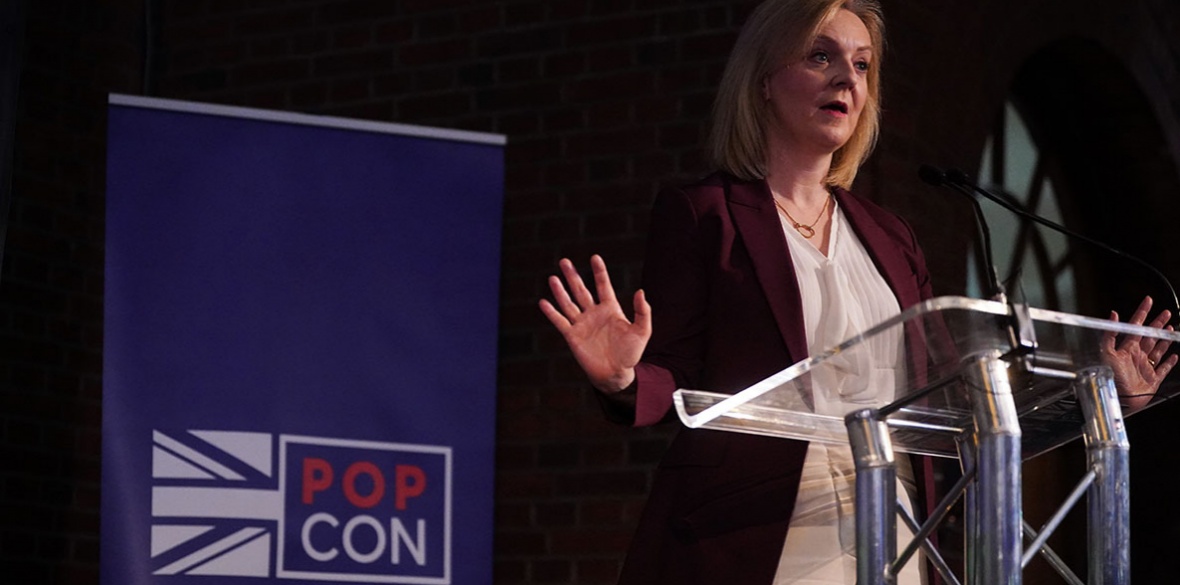
Addressing the audience Truss made a series of bizarre attacks on the Left, taking aim at “wokeism” and said the Tories had failed to “take on the left-wing extremists”.
“Wokeism seems to be on the curriculum,” said Truss. “There is confusion about basic biological facts, like what is a woman.
“Look at the net zero zealots, if you listen to the Today programme, I don’t recommend it, you’ll hear demands for more public spending.”
Truss went on to warn that the left were “on the march and actively organising”.
“These people have repurposed themselves, they don’t believe they are socialist or communists anymore. They say they’re environmentalists, they say they’re in favour of helping people across all communities, they are in favour of supporting LGBT people or groups of ethnic minorities.
“So they no longer admit that they are collectivists but that is what their ideology is about.”
She went on to claim that anti-capitalists were being “pandered to” by the Government and that Conservative values were being eroded and said it was “only through Conservative values that we can give the British people what they want”, however fell short on saying what this was exactly.
Former prime minister Liz Truss during the launch of the Popular Conservatism movement at the Emmanuel Centre in central London, in a bid to rally right-wing Tory MPs ahead of a general election this year, February 6, 2024
…
Running through a list of enemies almost longer than her catastrophic time in Downing Street, Ms Truss nevertheless claimed that Britain was “full of secret Conservatives — people who agree with us but don’t want to admit it,” while the Tory party had been appeasing “left-wing extremists.”
Painting a picture of a world on the edge of socialism, the former prime minister, best known for crashing the economy in a matter of days, asserted that “the left have been on the march.”
“They have been on the march in our institutions, they have been on the march in our corporate world, they are on the march globally,” she claimed.
Taking on this menace and “changing the system itself” will require “resilience and bravery,” Ms Truss added.
Unfortunately, rather than resilience and bravery, she had to hand only Lee Anderson and Jacob Rees-Mogg, former frontbenchers taking a break from their present gigs on GB News.

 US President Donald Trump holds up a signed ‘Board of Peace’ charter during the Annual Meeting of the World Economic Forum in Davos, Switzerland, January 22, 2026