Trump’s military escalation against Venezuela repeats the Iraq War blueprint

Spread the love

Original article by Manolo De Los Santos republished from peoples dispatch under a Creative Commons Attribution-ShareAlike 4.0 (CC BY-SA) license.
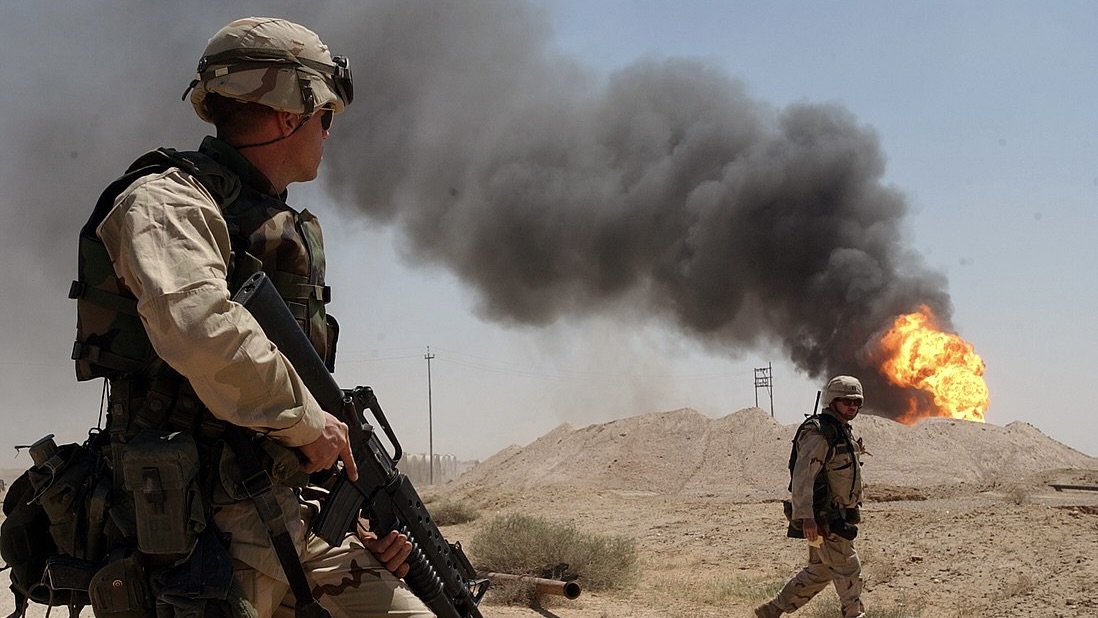
A US Army soldier watching a burning oil well at Rumaila oil field in Iraq in April 2003. Photo: US Navy

With the suspension of dialogue between the US and Venezuela, the sighting of US B-52 bombers in Venezuelan airspace, and the further lethal US strikes in the Caribbean, the US seems to be accelerating its drive towards war with Venezuela

Lee en español aquí

The mood in the Caribbean grows increasingly tense, as the United States intensifies its military threats. Beneath the deceptive shroud of the “war on drugs,” the United States is actively executing a blueprint for military intervention in Venezuela, employing lethal force and projecting power in a manner that legal institutions and regional leaders have condemned as a profound threat to international order. This aggression is not a law enforcement operation; it is the negation of law, a neocolonial revival of the Monroe Doctrine, designed to shatter the sovereignty of Venezuela, seize control of the world’s largest oil reserves, and install a compliant regime.

A license to kill: the precedent of state murder

A chilling adoption of extrajudicial violence has marked the current escalation. The Trump administration has ordered unilateral military strikes against private vessels near the Venezuelan coast, allegedly to stop drug trafficking. To launch these alarming attacks, the US military has deployed a massive naval force of warships, drones, and special operations forces.

These strikes have resulted in the summary execution of at least 27 people as of recent reports. The most recent lethal strike in the Caribbean resulted in the “elimination” of 6 more people. This is not law enforcement; it is extrajudicial murder and a campaign that now stands as part of a war plan against Venezuela. The administration has characterized the victims, without credible proof, as drug traffickers and “terrorists,” a claim that, even if true, provides no legal authority for the US president to execute whomever it decides.

Read more: Trump chooses war over diplomacy in the Caribbean

Legal and human rights organizations have been unequivocal in their condemnation of this profound and dangerous policy, which replaces established law enforcement procedures with premeditated lethal force. The New York City Bar Association (NYCBA), a key voice on international legal ethics, has strongly denounced these actions. The NYCBA stated explicitly that “Because the recent attacks on Venezuelan vessels and their crews were unauthorized by US law and in violation of binding international law, they were illegal summary executions – murders.” They further argued that these actions violate the fundamental international principle that “No one shall be arbitrarily deprived of his life” under the International Covenant on Civil and Political Rights.

The US government possesses ample legal authority for the Coast Guard to interdict and search vessels suspected of carrying narcotics, followed by prosecution in US courts according to due process requirements. However, in the case of the Venezuelan vessels, the Coast Guard’s Congressionally authorized police function was bypassed; instead, the crews were simply targeted and executed by overwhelming military force. Regional leaders, including Colombian President Gustavo Petro, have condemned the extrajudicial killings, highlighting the profound anxiety across Latin America over a return to unilateral US military action under the cover of anti-narcotics policy.

Read more: Trump’s smokescreen on Venezuela: Exposing the “narco-state” accusation

Escalation: B-52s and the threat of war

Beyond the lethal strikes, the US government has engaged in significant military posturing that amounts to a direct challenge to Venezuelan sovereignty. The sighting of US B-52 bombers in Venezuelan airspace, flying in close range, is a significant escalation. This warmongering has nothing to do with the “war on drugs” and everything to do with regime change to plunder Venezuela’s oil. This reckless push for war is a criminal act of international aggression.

The Trump Administration’s unilateral drone strikes in the Caribbean, combined with the White House’s termination of all negotiations with Venezuela, appear as a precursor for a full-scale regime change operation. This is a critical moment. We must sound the alarm: there is a risk of a new, catastrophic conflict in the region.

The US government’s own officials continue to escalate the crisis with bellicose rhetoric and actions. Secretary of State Marco Rubio, a key architect of the regime-change policy, has consistently refused to rule out a military option, asserting that the Maduro regime has become a “threat to the region and even to the United States.”

Venezuela’s response has been one of principled defense of its sovereignty. Ambassador to the UN, Samuel Moncada has repeatedly sounded the alarm on the global stage, arguing that the US military deployment in the Caribbean is a massive propaganda operation that seeks “excuses to fabricate a conflict” to seize the country’s oil wealth. Moncada affirmed that, “The United States believes that the Caribbean belongs to it because it has been using the expansionist Monroe Doctrine for over 100 years, which is nothing more than a remnant of colonialism.”

President Nicolás Maduro has called on Washington to resume dialogue, stating, “Our diplomacy isn’t the diplomacy of cannons, of threats, because the world cannot be the world of 100 years ago,” while simultaneously mobilizing national defense exercises to ensure the country is prepared for any direct assault. The NYCBA warned that attacks against Venezuelan vessels and reported threats against the Venezuelan government violate the nation’s obligations under the United Nations Charter, with the risk of escalating to open hostilities.

Parallels with the Iraq War: oil, ideology, and deception

The current situation is chillingly reminiscent of the lead-up to the 2003 invasion of Iraq. In that case, the Bush administration justified unilateral action on the basis of “weapons of mass destruction,” but this was a pretext. The true objectives were not limited to oil, but also included achieving profound ideological and political goals – overthrowing a government to reshape Middle Eastern politics and assert dominance.

Read more: In the name of the “War on Drugs”, the US continues to target Venezuelan boats

Washington must learn the lessons of this history. The Bush administration promised a quick victory in Iraq. Instead, the invasions and occupation claimed countless Iraqi lives, resulted in tens of thousands of American soldiers killed or wounded, and destabilized the region. The notion that the US can carry out military invasions into the heart of Latin America without a massive blowback is outlandish.

In the case of Venezuela, the “war on drugs” and the labeling of the government as a “threat” serve as the new rhetorical pretexts. The US interest is multifaceted: it involves securing the world’s largest proven oil reserves and achieving the ideological and political goal of overthrowing a socialist government to assert dominance and reshape Latin American politics. The US seeks to dismantle the Bolivarian Revolution and eliminate a major center of anti-imperialist politics in the hemisphere.

The current escalation is not about law enforcement or counter-narcotics; it is about regime change and plunder. While members of Congress from both Democratic and Republican parties, as well as key voices of public opinion, are increasingly speaking up about the illegality of these strikes and the absence of credible information from the administration, this situation requires much more urgency, once the escalation ladder is climbed, there may be no going back. The international community must recognize this aggressive campaign for what it is: a criminal act of international aggression. The world must stand against this threat of a new, catastrophic conflict.

Manolo De Los Santos is Executive Director of The People’s Forum and a researcher at Tricontinental: Institute for Social Research. His writing appears regularly in Monthly Review, Peoples Dispatch, CounterPunch, La Jornada, and other progressive media. He coedited, most recently, Viviremos: Venezuela vs. Hybrid War (LeftWord, 2020), Comrade of the Revolution: Selected Speeches of Fidel Castro (LeftWord, 2021), and Our Own Path to Socialism: Selected Speeches of Hugo Chávez (LeftWord, 2023).

Original article by Manolo De Los Santos republished from peoples dispatch under a Creative Commons Attribution-ShareAlike 4.0 (CC BY-SA) license.

Donald Fuhrump says that Amerikkka doesn't bother with crimes or charges anymore, not being 100% Amerikkkan and opposing his real estate intentions is enough.
Donald Fuhrump says that Amerikkka doesn’t bother with crimes or charges anymore, not being 100% Amerikkkan and opposing his real estate intentions is enough.
Elon Musk urges you to be a Fascist like him, says that you can ignore facts and reality then.
Orcas discuss how Trump was re-elected and him being an obviously insane, xenophobic Fascist.

Continue ReadingTrump’s military escalation against Venezuela repeats the Iraq War blueprint

Big Oil Rallies to Obstruct Accountability

Spread the love

Original article by Emily Sanders republished from DeSmog.

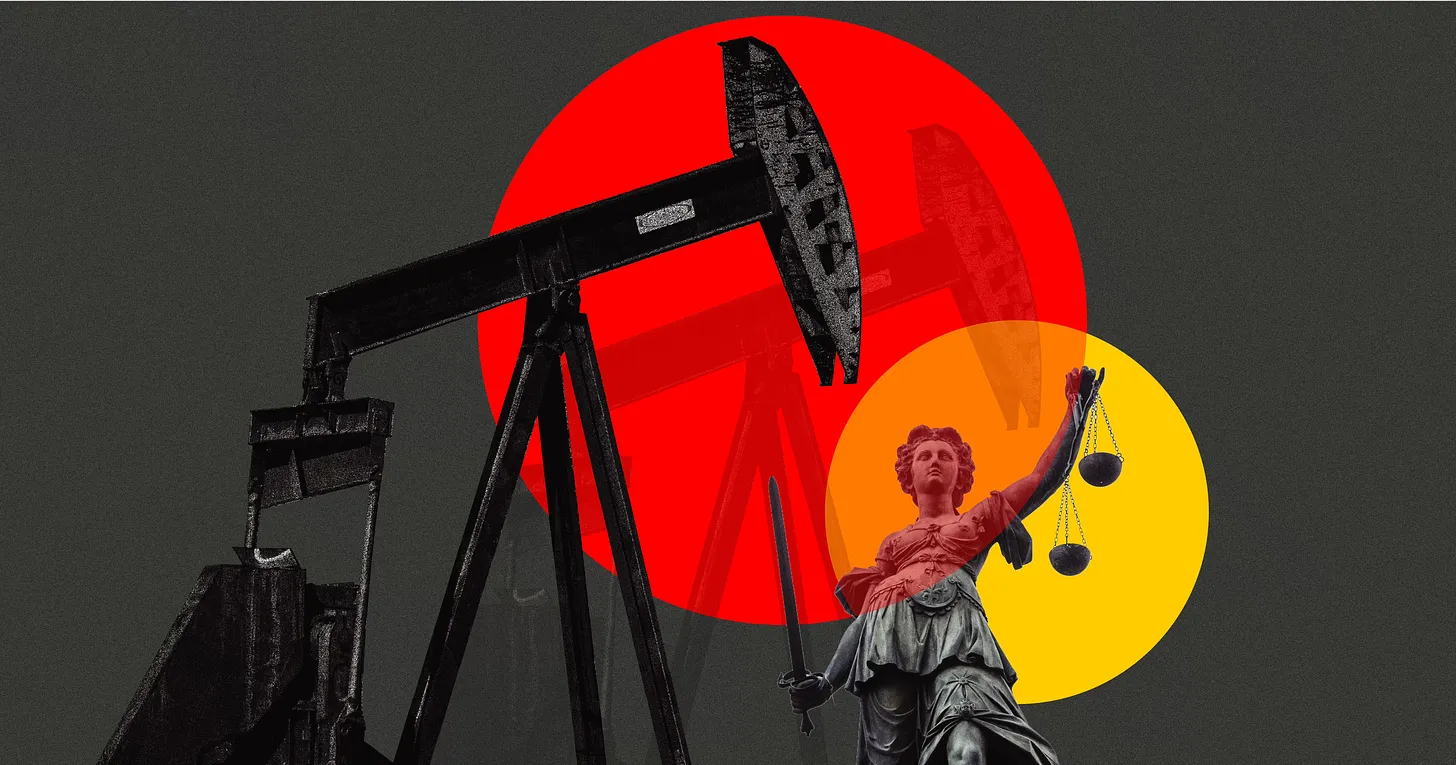
Far-right industry allies with ties to Chevron have mounted an “unprecedented” pressure campaign calling on the Supreme Court to stop a potentially historic climate deception lawsuit against oil majors from going to trial. Graphic design by Tess Abbot

Fossil fuel interests are deploying unprecedented strategies to hide evidence of companies’ deception and block liability lawsuits before they reach trial.

This article by ExxonKnews is published here as part of the global journalism collaboration Covering Climate Now.

In the face of mounting scrutiny from local, state, and federal officials, fossil fuel companies and their allies are deploying a range of tactics to obstruct ongoing lawsuits and investigations concerning evidence that the industry has misled the public about the harms it knew its products would cause to the climate, environment, and human health.

Far-right industry allies with ties to Chevron have mounted an “unprecedented” pressure campaign calling on the Supreme Court to stop a potentially historic climate deception lawsuit against oil majors from going to trial. Republican attorneys general are separately urging the Supreme Court to throw out similar climate fraud lawsuits from five states. Plastics industry trade associations are suing the California state attorney general’s office to block an investigation into whether oil companies lied about plastic recycling. And fossil fuel giants and their trade groups have responded to congressional subpoenas with highly redacted records and “baseless” First Amendment legal defenses. 

“I think we’re seeing an escalation by the industry to do anything it can to avoid being held accountable for the consequences of climate change,” said Lisa Graves, executive director of investigative watchdog group True North Research and an expert on dark money special interest groups. “It continues to try to thwart efforts to try to mitigate climate change and it continues to try to stop efforts to get any compensation for the harms it has caused, not just through the burning of fossil fuels but also by the delay and deceit that it has promoted through front groups.”

State and local climate lawsuits, which accuse oil and gas majors of lying about the dangers of fossil fuels and seek to hold them accountable for the resulting damages, are advancing in state courts despite the industry’s efforts. Most recently, a Colorado judge denied nearly all motions by ExxonMobil and Suncor Energy to dismiss the City and County of Boulder’s case against them. 

It’s the fifth time to date that a court has rejected Big Oil’s efforts to dismiss climate accountability lawsuits — bringing the companies closer to facing trial and potentially billions of dollars in liability. If any of the cases go to trial, said Michael Gerrard, director of the Sabin Center for Climate Change Law at Columbia University, “it will shine a very harsh light on the fossil fuel companies and it could lead to crushing monetary judgments.”

“Clearly the defendants here are using everything they can think of to derail these cases,” Gerrard said. That attitude has been most evident in Big Oil’s response to a lawsuit from Honolulu, which could be among the first communities to put the companies on trial. 

In February, oil company defendants — including Exxon, Chevron, BP, and Shell — petitioned the U.S. Supreme Court to review a Hawai‘i state Supreme Court ruling that allowed Honolulu’s case to move toward trial. The case, the companies argued in their petition, is preempted by federal law and should be dismissed. 

But after traditional legal arguments have failed to shield the industry to date, allies seem to be turning to more extreme and novel measures.

Leonard Leo to the Rescue?

In the weeks and months before the Supreme Court was scheduled to hear Big Oil’s petition in Honolulu’s lawsuit, a flood of social media ads and op-eds called for the Supreme Court justices to take up — and throw out — the case.

“To end this nuisance charade, the Supreme Court needs to take up the Honolulu case and declare once and for all that public nuisance is for local issues, not global climate change,” reads the narrator of one such video ad posted to X. 

The name behind that ad, the Alliance for Consumers, is part of an organization called the Concord Fund, formerly known as the Judicial Crisis Network. Those groups, Graves and others have pointed out, are projects of billionaire Leonard Leo, head of the far-right legal advocacy group the Federalist Society and known as the architect of the current Supreme Court. CRC Advisors — one of the Leo-backed companies in the effort — appears to have had Chevron, a defendant in Honolulu’s case, as a client.

The fossil fuel industry also helped fund the Federalist Society, and partners at major law firms representing oil and gas companies — including Theodore Olson of Gibson Dunn, the law firm representing Chevron against Honolulu and other communities’ climate liability cases — sit on its board

Former Hawai‘i Supreme Court Justice Michael Wilson, who served on the state’s highest court for a decade, called the pressure campaign targeting the Supreme Court a “powerful intervention” by “the strongest special interest group in the history of human civilization.” 

“This is the most important case in the United States from the point of view that it will allow a jury of citizens to see the fraud and to decide what to do about it,” said Wilson. “This is a high-risk strategy that shows that the fossil fuel industry is desperate.”

Oil companies, which quietly funded front groups like the American Legislative Exchange Council (ALEC) to sow climate denial and oppose climate action on their behalf, are now rallying their allies and benefactors to strike at lawsuits that seek to hold them accountable, explained Graves. In April, 20 Republican attorneys general filed a brief with the U.S. Supreme Court in support of the oil companies’ petition.

The attorneys general are all members of the Republican Attorneys General Association, or RAGA, which helps Republican attorneys general with their election or reelection campaigns. Its top donor in 2024 was Leo’s Concord Fund.

“The Leo-tied groups are a soup-to-nuts intervention machine, from the Republican attorneys general to the judges he helped put on the court,” said Graves.

In June, the Supreme Court delivered a one-line order asking the U.S. Justice Department to weigh in on the case — an “extraordinary” response at this stage, according to Wilson, considering that the case has not yet gone to trial. If the Solicitor General neglects to weigh in before the election, that response could be in the hands of a Trump administration. Trump has promised that if re-elected, he will “stop the wave of frivolous litigation from environmental extremists.”  

A ‘Highly Unusual’ Request

In May, 19 members of RAGA made a “highly unusual” request to the Supreme Court: to intervene in and undermine climate accountability lawsuits filed by five states — California, Connecticut, Minnesota, New Jersey, and Rhode Island — claiming that their cases would impose “ruinous liability” on fossil fuel companies and threaten “our basic way of life.” 

The Supreme Court has original jurisdiction over disputes between states — meaning it can hear a case without it first being heard by another court —  but such challenges are more commonly brought over issues like water rights, said Gerrard of Columbia’s Sabin Center. “I’ve never previously heard of an instance where there’s an effort to invoke the original jurisdiction of the [U.S.] Supreme Court to swat down litigation,” he said.

RAGA obtains some of its largest donations from the fossil fuel industry — including Koch Industries, Exxon, and the American Petroleum Institute, all of whom are defendants in climate liability cases — according to an analysis by the Center for Media and Democracy. 

“These AGs have now placed their allegiance directly with the special interest group that is threatening the survival of future generations,” said Wilson.

The filing argues that “oil and natural gas have supported improvements in environmental quality and have reduced weather-related deaths,” and claims that “America’s air is cleaner than a century ago thanks in part to the increased use of oil and natural gas.”

It isn’t the first time Republican attorneys general have rushed to shield oil companies from accountability for their climate deception — and overtly used climate denialist talking points first leveraged by Big Oil in their defense. In 2016, Exxon sued the attorneys general of New York and Massachusetts in an attempt to block investigations into the company’s private research and public communications about climate change, claiming the probe was an attack on their free speech and other constitutional rights. 

Republican attorneys general from 12 states filed a 2018 brief in support of the oil giant, arguing that “Climate change is the subject of legitimate international debate.” 

“[T]he most undeniable fact about climate change is that, like so many other areas of science and public policy, the debate remains unsettled, the research is far from complete, and the path forward is unclear,” they wrote.

A(nother) First Amendment Fight

Another industry strategy to block accountability is playing out in response to California Attorney General Rob Bonta’s investigation into whether Exxon and other petrochemical companies deceived the public about the efficacy of plastic recycling as a solution to plastic waste. In May, the American Chemistry Council and Plastics Industry Association — two major trade groups representing oil and chemical giants including Exxon, Chevron, Amoco, Dow, and DuPont — filed a lawsuit against the attorney general in federal court, claiming the investigation violates their free speech rights.

Bonta, who had said he would decide whether to sue Exxon by the summer, responded with petitions asking the Sacramento County Superior Court to order the groups to comply with his office’s subpoenas.

“For years, the plastics industry has engaged in an aggressive campaign to deceive the public, perpetuating a myth that recycling can solve the plastics waste and pollution crisis,” Bonta said in a statement. “The continuous delay tactics are failing to comply with our subpoena. Enough is enough: What are they trying to hide?”

Members of Congress have similarly accused the Big Oil companies of trying to obstruct investigations. 

When Senate Budget Chairman Sheldon Whitehouse (D-RI) and House Oversight Ranking Member Jamie Raskin (D-MD) referred their years-long investigation into the industry’s climate deception to the Justice Department, the lawmakers wrote that “some companies claimed that the First Amendment or undefined ‘privilege’ protected them from the House Oversight Committee’s subpoena.” The main subjects of that investigation have been Exxon, Shell, Chevron, BP, API, and the U.S. Chamber of Commerce.

“The companies further obstructed the investigation by significantly redacting or entirely withholding more than 4,000 documents without any valid basis,” the lawmakers wrote, adding that their refusal to comply “provides a basis to infer that there is even more damning evidence of deceptive practices by the companies and their trade associations waiting to be uncovered.”

Fossil fuel companies and the law firms representing them have used a First Amendment defense to try to dismiss the climate accountability lawsuits, claiming company statements on climate change are protected political speech. One of the most prominent voices for that argument have been attorneys at Gibson Dunn, the firm that represents Chevron, and whose partner Theodore Olson sits on the Federalist Society board. 

If these “overt” and “brazen” efforts to escape accountability can be overcome, the industry will no doubt face a reckoning, said Wilson, the former Hawai‘i Supreme Court justice. Communities like Honolulu “are being ravaged by climate” and “will apply the rule of law fairly,” he said. 

“Hawai‘i is not a place that can be manipulated by the fossil fuel industry. That is a very big threat to the most powerful special interest group that’s now maintaining its power based on complicity.”

Original article by Emily Sanders republished from DeSmog.

Continue ReadingBig Oil Rallies to Obstruct Accountability

New report accuses fossil fuel companies of greenwashing, but profits are up

Spread the love

https://www.energymonitor.ai/features/new-report-accuses-fossil-fuel-companies-of-greenwashing-but-profits-are-up/

A new report by the Senate Committee on the Budget details how fossil fuel companies have avoided tackling the climate crisis.

Last week, US Democrats released a report three years in the making detailing the ways that large fossil fuel producers including ShellBP and Exxon have sought to avoid responsibility for the climate crisis.

The 65 page-long report, jointly authored by the Democrats House Committee On Oversight And Accountability and the Senate Committee on the Budget, contains files subpoenaed from big oil companies that “demonstrate for the first time that fossil fuel companies internally do not dispute that they have understood since at least the 1960s that burning fossil fuels causes climate change and then worked for decades to undermine public understanding of this fact and to deny the underlying science”.

Previous documentation has shown that companies including Exxon knew about human-made climate change since at least 1981, and files released earlier this year suggest it may have been known since the 1950s. The importance of this report lies in proving that fossil fuel companies not only knew, but privately believed the science despite public rejection.

The files also show the tactics used by major fossil companies to discredit climate activism, the report says, among them “pivot[ing] from outright climate denial to a new strategy of deception. Instead of misrepresenting the science and the consequences of climate change, they pivoted to misrepresenting their business plans, their investments in low carbon technologies, the alleged safety of natural gas, and their support for various climate policies and emission reduction targets”.

Article continues at https://www.energymonitor.ai/features/new-report-accuses-fossil-fuel-companies-of-greenwashing-but-profits-are-up/

Continue ReadingNew report accuses fossil fuel companies of greenwashing, but profits are up

BP Was Warned Gas-Driven Climate Change Could Cause ‘Unprecedented Famine’

Spread the love

Original article by Geoff Dembicki republished from DeSmog.

Yet the oil and gas major led a campaign to present gas as a climate solution, new ‘confidential’ documents released by a U.S. Congressional investigation reveal.

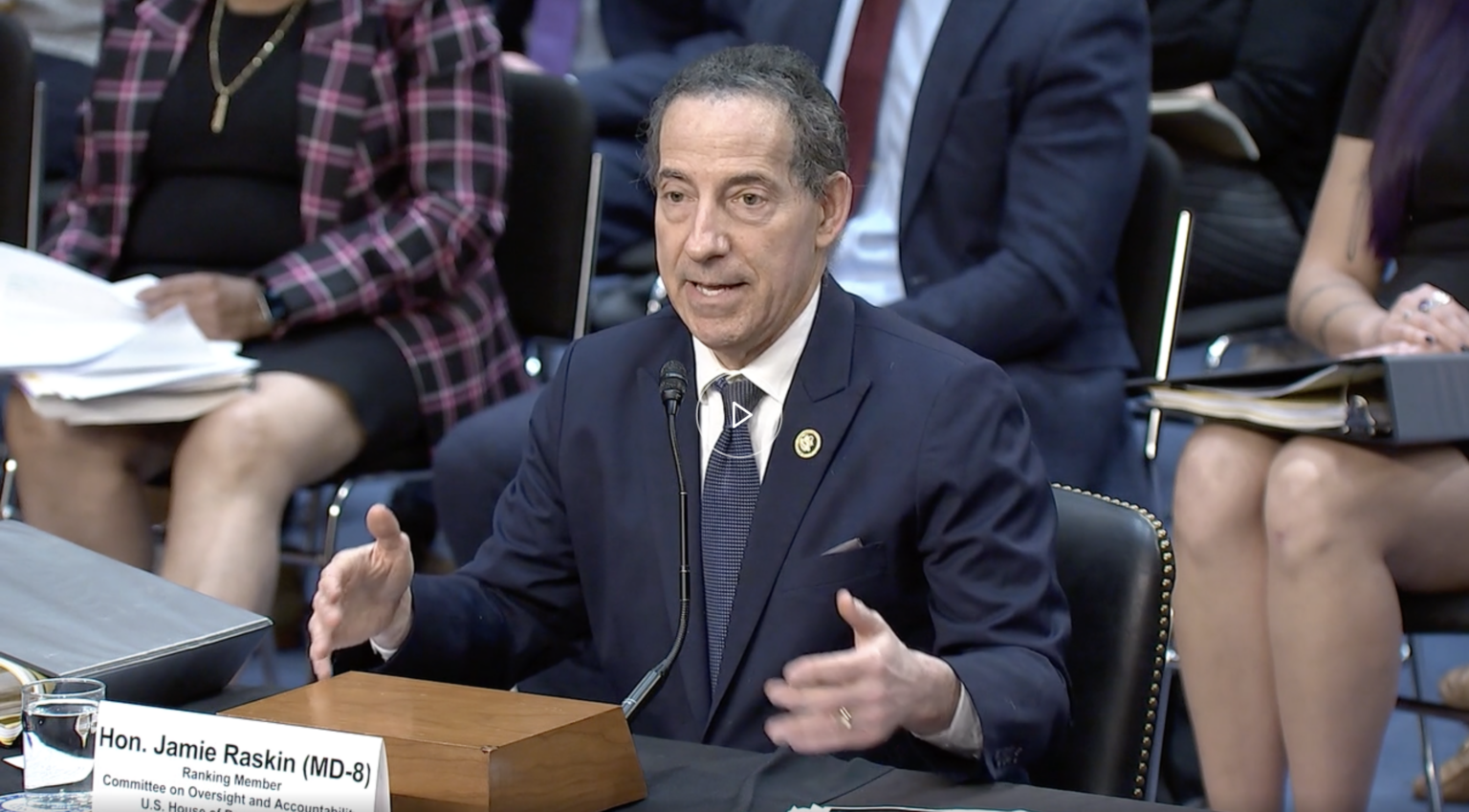
Democrat Jamie Raskin appeared before a Senate hearing examining Big Oil’s efforts to avoid climate accountability. Credit: US Senate

BP was warned by Princeton University researchers in 2016 that climate change accelerated in part by new global supplies of shale gas could lead to catastrophic events such as “mass extinctions and unprecedented famine.” 

Yet despite acknowledging internally the concern that “gas doesn’t support climate goals,” the UK-headquartered oil and gas major embarked on a marketing campaign to “advance and protect the role of gas—and BP—in the energy transition.” 

That’s been accompanied by large new investments in gas, including a recent agreement to take nearly two million tonnes per year of liquefied natural gas shipments from a $5.1 billion export facility called Woodfibre LNG proposed for the west coast of British Columbia. 

Revelations concerning BP’s private knowledge about the dangers of gas expansion were contained in a trove of documents—some labelled “confidential”—released by Democrats in early May as part of a joint House and Senate investigation into the oil and gas industry’s climate obstruction. 

“The fossil fuel industry evolved from denying climate science to spreading disinformation and perpetuating doublespeak about the safety of natural gas and its commitment to reducing greenhouse gas emissions,” the Joint Staff Report argues.  

BP didn’t respond to questions from DeSmog related to the report. 

Documents contained in the report, which were obtained via federal subpoenas, suggest that the highest levels of BP leadership have been privately made aware of potential climate disruption caused by natural gas. Comments on a draft outline for a 2017 speech by BP’s then-CEO Robert Dudley articulate that fear explicitly.

“You don’t say anything about concerns about so-called lock-in, the idea that, once built, gas locks in future emissions above a level consistent with 2 degrees, at least without CCUS,” the comments read, referring to expensive and frequently underperforming carbon capture utilization and storage technologies. 

A confidential 2018 presentation from BP notes that while gas may release less emissions when burned than coal, those climate gains can be erased by leakages of the “potent” greenhouse gas methane. “Methane (CH₄) accounts for 20% of GHGs [greenhouse gas emissions],” a slide from the presentation notes. “Oil and gas accounts for nearly a quarter of this 20%.”

The presentation acknowledges the concern, widely reported in the media by that point, that “gas doesn’t support climate goals when you take methane emissions into account.” BP appears to have seen such worries as an “opportunity” for the company, however. 

The company intended to launch a communications campaign that could “position BP as [a] strong gas player” in part by “demonstrating leadership on methane challenge,” the slide reads.

Yet the oil and gas producer had been warned that a failure to limit global temperature rise to below 2 degrees could be catastrophic for humankind and the planet. During a 2016 town hall event for BP in Houston, Princeton researchers noted “innovation in the energy sector has been dramatically affected by the arrival of shale gas and oil and low energy prices.” 

One result, they noted, is that “fossil fuels are so abundant that, for even a weak climate target, attractive fossil fuel will be left in the ground.” But if the world fails to limit warming below 2 degrees, “the climate monsters begin to come into the room,” they noted. 

As warming approaches 3 degrees, their presentation explained, “we expect a rogue’s gallery, from the loss of all of our coastal cities because of >10 m of sea level rise, to cessation of the ocean’s circulation.”

Yet the company continues to publicly portray the fossil fuel as a climate solution. “As the world seeks secure, affordable and lower carbon energy, global demand for LNG is expected to continue to grow,” a BP executive said last year upon the company signing its latest off-take agreement with Woodfibre LNG in Canada. 

This is part of a years-long global campaign to spread “disinformation” about the role of gas “as a bridge fuel to a fossil-free future,” the Congressional report argues. “It is long past time to hold Big Oil accountable for its deception campaign and to take action to undo the harms it has perpetrated.”

Original article by Geoff Dembicki republished from DeSmog.

Continue ReadingBP Was Warned Gas-Driven Climate Change Could Cause ‘Unprecedented Famine’

Big Oil Clouded the Science on Extreme Weather. Now It Faces a Reckoning.

Spread the love

Original article by Emily Sanders, ExxonKnews republished from DeSmog.

As more communities sue oil majors following climate disasters, a collection of evidence reveals the industry’s efforts to deny the link between extreme weather and climate change.

Illustration by Tess Abbot

This story was originally published by ExxonKnews.

When Bucks County, Pennsylvania, filed a lawsuit last week against major oil and gas companies for climate damages, Commissioner Chair Diane Ellis-Marseglia pointed to “unprecedented weather events here in Bucks County that have repeatedly put residents and first responders in harm’s way, damaged public and private property and placed undue strain on our infrastructure.” The county argues oil companies’ “campaigns to deceive and mislead the public about the damaging nature of their fossil fuel products” delayed climate action for decades, robbing communities of precious time to mitigate the climate-driven disasters they now face.

One of those disasters occurred last year, when a rainstorm in Bucks County caused deadly flash flooding that swallowed vehicles and killed 7 people, including two children. Scientists said the deluge and its aftermath — not the county’s first “100-year flood” in recent years — are a harbinger of the intense and dangerous rainstorms that a warming climate is making more likely.

As the science connecting climate change to more frequent and severe weather events becomes clearer, there is mounting evidence that members of the fossil fuel industry coordinated to downplay that link — evidence that could be valuable to lawsuits seeking accountability. 

Bucks County is just one in a growing list of communities taking legal action against fossil fuel companies in the wake of deadly extreme weather events. Multnomah County, Oregon sued oil, gas, and coal majors after a 2021 heat dome that killed nearly 70 people. On the 10 year anniversary of Superstorm Sandy, New Jersey’s attorney general took Exxon, Chevron, and other oil giants to court, citing the billions of dollars in damage and deaths the hurricane caused in the state. In the first-ever racketeering lawsuit against Big Oil companies, Puerto Rico municipalities are seeking to recover costs incurred by Hurricane Maria. 

Fossil fuel majors, these cases argue, should help communities pay for the costs of adapting to and recovering from climate disasters given the industry’s early research into — and subsequent denial of — their products’ harm. “We’re already seeing the human and financial tolls of climate change beginning to mount,” said Commissioner Ellis Marseglia. “If the oil companies’ own data is to be believed, the trend will continue.”

It’s a trend that the fossil fuel industry worked to obscure for decades. collection of evidence just published to ClimateFiles.com reveals the extent to which oil companies and their trade associations sought to deny and downplay the relationship between climate change and extreme weather. 

Nicky Sundt, a climate expert and former communications director for the U.S. Global Change Research Program during the George W. Bush administration, said she tried to publicly communicate the science behind that link, but was “stymied over and over again” by industry interests inside and outside the White House — an experience she has discussed with The Guardian and PBS Frontline.

“By interfering with the communications of climate science to the public, [the fossil fuel industry] knew that the public was less likely to become agitated and do something about it,” Sundt said. “The consequence was to slow efforts to reduce our emissions, and to leave us more unprepared for the impacts of climate change. The longer you wait, the more expensive it is to deal with all of these issues, and they’ve eaten up incredibly important time we needed.”

“A new norm”

In 1997, fossil fuel interests successfully convinced prominent United States officials to oppose U.S. ratification of the Kyoto Protocol — an international climate agreement that would have limited greenhouse gas emissions decades ago. 

A year later, the American Petroleum Institute (API) — the largest oil and gas trade association in the U.S. — bluntly outlined a plan to keep drumming up opposition to the Kyoto Protocol as negotiations continued. According to a newly uncovered February 1998 internal strategy proposal reviewed by ExxonKnews, API would “develop and implement a campaign-style ‘rapid response’ team… to respond to op-eds that make exaggerated claims about climate science… and to media events staged by government officials and/or environmental organizations seeking to tie extreme weather events to possible human impacts on global climate.” 

Long before that campaign began, internal industry memos and promotional materials show, major oil companies knew about the role that climate change would play in intensifying hurricanes, floods, droughts, heatwaves, precipitation patterns, and other extreme weather events.

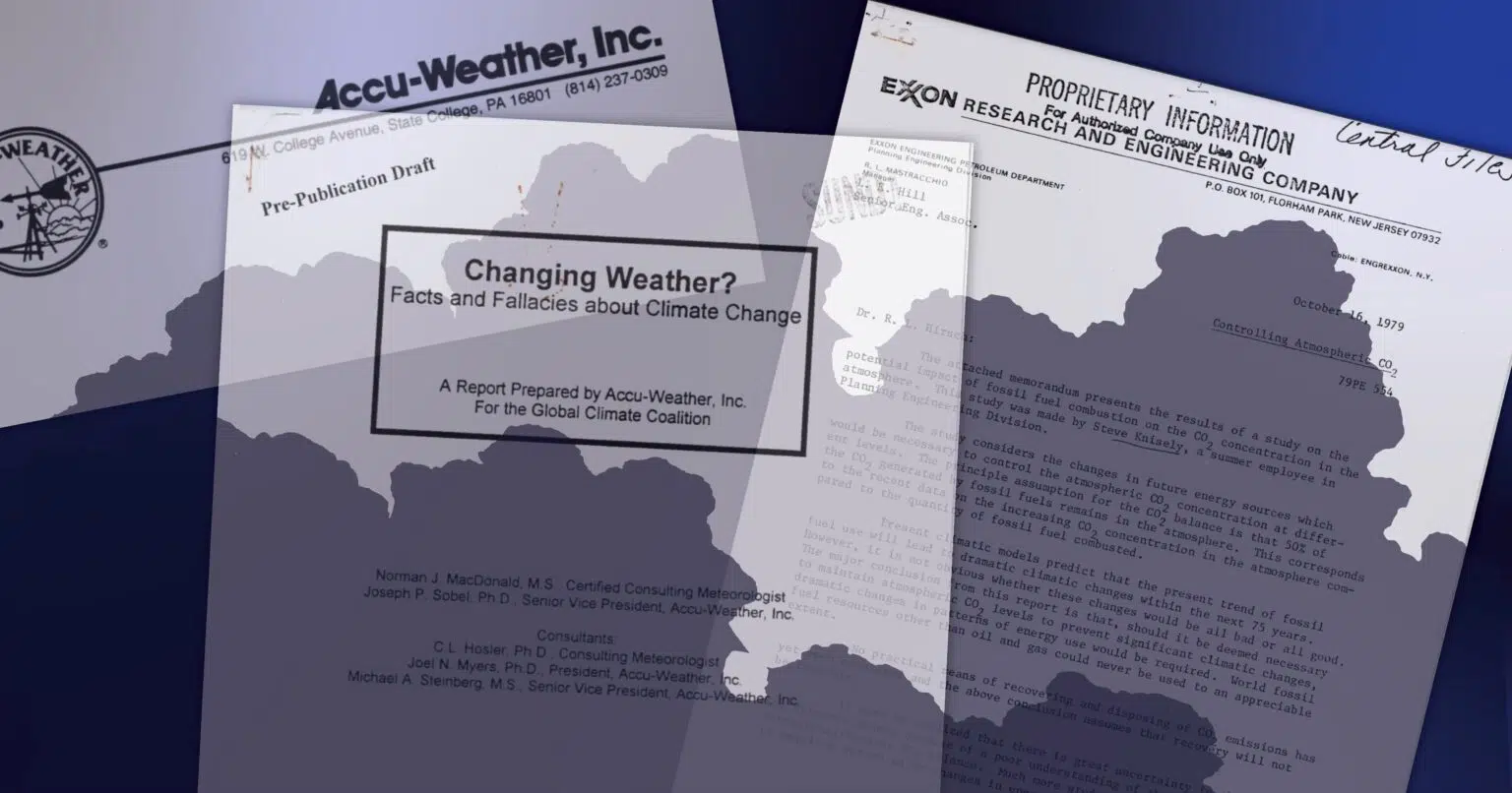
One 1979 memo distributed to Exxon management, about a report conducted by Steve Knisley of Exxon’s Research and Engineering Department, accurately predicted the growth of atmospheric carbon dioxide concentrations by 2010 and referenced the “ecological consequences of increased CO2 levels.” Those consequences were listed in detail, including global temperature increases, water shortages in the U.S. southwest, increased rainfall, and “violent storms.”

In a 1991 film production by Shell, called “Climate of Concern,” a narrator warns that “if the weather machine were to be wound up to such new levels of energy, no country would remain unaffected,” and that “what is now considered abnormal weather could become a new norm.”

Another film produced that year by BP, called “This Earth – What Makes Weather?”, alludes to the ways climate change would increase the frequency and damage caused by extreme weather events like storms, flooding, and drought. “From warmer seas, more water would evaporate — making storms and the havoc they cause more frequent,” the narrator predicts. “Catastrophic floods could become commonplace and low-lying countries like Bangladesh would be defenseless against them.”

But around the same time, the industry began to worry about how public understanding of those phenomena could affect their core business. A 1989 presentation by Duane LeVine, a senior executive at Exxon, expressed concern that an extreme heat and drought event the year before had “drawn much attention to the potential problems and we’re starting to hear the inevitable call for action. Exactly what happens now is not clear… but this critical event has energized the greenhouse effort and raised public concern over PEG [potential enhanced greenhouse].”

Under the cover of trade associations and front groups, through PR campaigns and funded academic research, the industry developed a strategy to undermine the link between climate change and weather-related disasters — and discredit those who sought to communicate that science to the public.

A Campaign to Turn the Tide

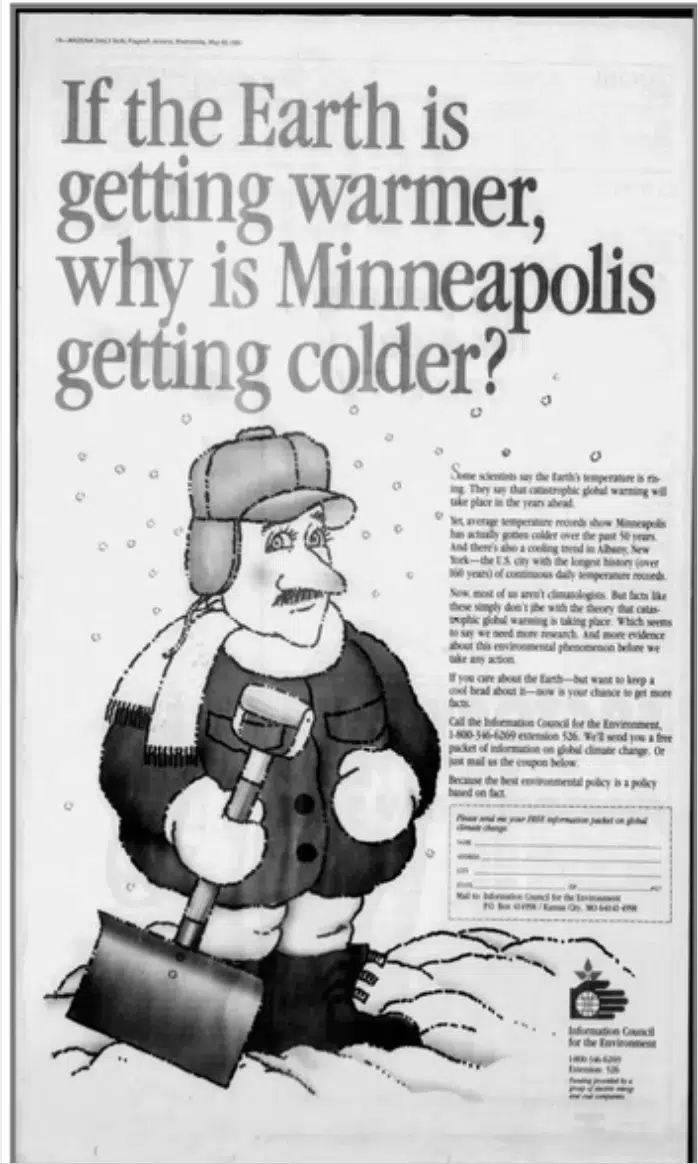
One ad from a PR campaign by the “Information Council on the Environment,” funded by fossil fuel and electric utility interests. Minnesota is now suing ExxonMobil, Koch Industries, and the American Petroleum Institute for climate fraud.

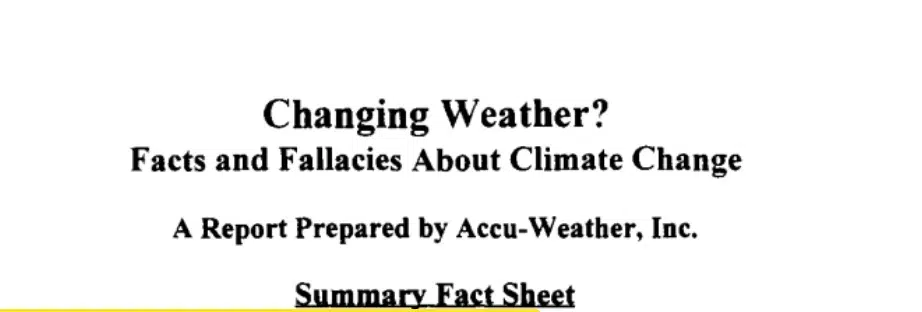
One key player was the Global Climate Coalition (GCC) — an international industry lobbying group that was instrumental in early efforts to deny climate change and generate opposition to policy action to reduce emissions. In 1994, the GCC hired weather forecasting service AccuWeather Inc. to produce a report minimizing the impact of global warming on extreme weather, which the GCC would cite in a pamphlet distributed at the United Nations climate convention the following year. 

“No convincing, observational evidence exists that hurricanes, tornadoes and other extreme temperature and precipitation events are on the rise because of the recent slight increase in the Earth’s surface temperature,” the report states. 

A report that AccuWeather produced minimizing the impact of global warming on extreme weather in 1994.

In response to ExxonKnews’ requests for comment on the report, a spokesperson for AccuWeather said that “AccuWeather and the other leading consulting meteorologists involved had been engaged to produce an analysis based upon the available data at that time. There was much debate and uncertainty in the scientific community over the causes and effects of global warming during that time period, and a new generation of computer modeling studies was just beginning to emerge that would create an important shift in scientific judgment.” 

“As an organization rooted in science, AccuWeather’s view on global warming and extreme weather has evolved over the past three decades, as has the view of many other scientific organizations,” they said, noting that data now shows a “marked increase in billion-dollar disasters due to extreme weather events.” Today, the spokesperson added, AccuWeather has signed the “Global Climate Science-Media Action Pledge”, and is committed to communicating the impacts of climate change on extreme weather to the public.

The GCC also hired academics to further their cause. Internal meeting notes from July 1997 show that the GCC commissioned a research paper from Robert E. Davis, a University of Virginia climatologist, explicitly denying the climate and extreme weather connection. 

Excerpt from Global Climate Coalition meeting notes in 1997.

“A belief commonly held is that global warming will produce more extreme weather,” the published paper read. “While this thinking serves as convenient fuel for sensationalist headlines linking what only a decade ago would have been viewed as the normal vagaries of weather to some approaching climatic apocalypse, it is not based on sound science.”

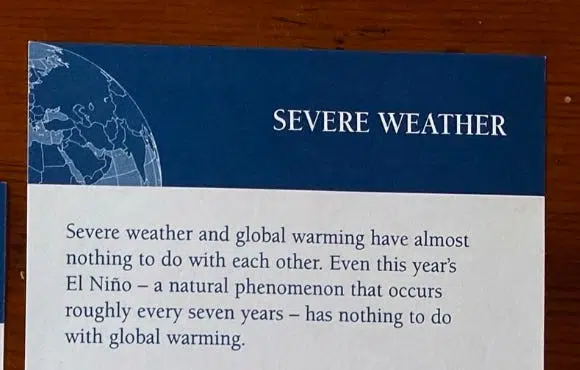
From a folder handed out by the GCC at the UN climate negotiations in 1999.

In 1999, in the wake of Hurricane Floyd, Frank Maisano, then a spokesman for the GCC, faxed a memo to “Communicators Interested in Global Climate Issues.” “As millions of people flee Hurricane Floyd, many climate activists have again suggested — despite the facts — that hurricanes and global warming are connected,” the memo stated.

In response to questions about the memo and the GCC’s positions, Maisano told ExxonKnews that “Any fair review of the debate over any link between climate and severe weather has always been the subject of significant discussion between the experts themselves, especially with regard to hurricanes.”

“Importantly,” Maisano said, “GCC’s main focus at the time was on the economic impacts, sovereignty and effectiveness of any policy proposed to address climate change.”

Maisano now runs a strategic communications practice for Bracewell LLP, whose separate law practice provides services for oil and gas companies including Eni (currently being sued for climate deception in Italy) and Phillips 66 (which is a defendant in many U.S. climate lawsuits, including those filed by Bucks County and the state of New Jersey). Since 2005, the group has also advocated for renewables, Maisano said.

The industry’s campaign stretched on for years. In 2006, shortly after Hurricane Katrina, the DCI Group — a lobbying and campaign contractor with ties to Exxon — produced and sent VHS tapes of videos designed to look like a national news broadcast to Gulf of Mexico area news stations. The tape featured Dr. William Gray, a (now deceased) hurricane scientist at Colorado State University and climate change denier, stating that in the past 20 years, scientists had seen “no significant change in the frequency and intensity of major hurricanes around the globe…. This is the way nature sometimes works.” (Scientists have since concluded that climate-driven warming contributed to the increased rainfall and severity of storm surge during Hurricane Katrina, which killed nearly 2,000 people.) 

According to Sundt, after Hurricane Katrina hit, the communications arm of the U.S. Global Change Research department proposed hosting a session on the implications for preparing for climate change on the Gulf Coast. “We had a well developed proposal, and it was just killed [by the White House] without explanation,” she said.

“A more resilient world”

Today, the steady growth of attribution science — or research investigating the role of climate change in altering or intensifying extreme weather events — has put a dent in Big Oil’s designs. The field of study has developed to even be able to tie the emissions of specific corporate actors to climate-worsened disasters — opening up more possibilities for those companies to be held liable for climate damages in court.

One such study, from researchers from the Union of Concerned Scientists and the University of California, Merced, found that nearly 40% of all forests burned in the Western U.S. and Canada since 1986 can be tied to emissions from just 88 of the world’s largest fossil fuel and cement manufacturers. That research was cited in Multnomah County’s lawsuit against oil and gas majors for climate damages last year.

Delta Merner, lead scientist for the Union of Concerned Scientists’ climate litigation hub and a co-author of the study, pointed out that many of the same companies that fought regulation of climate-warming emissions adapted their own fossil fuel infrastructure to account for rising seas, warming temperatures, and worsening storms decades ago. 

“As you look through the oil industry’s own reactions to their knowledge about climate change, they were able to build better infrastructure to be resilient,” Merner said. “We would have a more resilient world, we would not be facing the realities of climate change that we’re seeing today if it wasn’t for the lies the industry propped up for so long.”

At least one oil major anticipated legal action decades ago. In a planning scenario from 1998, Shell made an eerie prediction: “In 2010, a series of violent storms causes extensive damage to the eastern coast of the U.S. … Following the storms, a coalition of environmental NGOs brings a class-action suit against the US government and fossil-fuel companies on the grounds of neglecting what scientists (including their own) have been saying for years: that something must be done.”

Shell was ahead of its time. Between the increased frequency, severity, and costs of extreme weather events, the advancing science connecting them to polluters, and mounting legal theories, Merner said she expects more communities to file suit. Even as she sees the industry’s deception evolving in content and sophistication — like companies trying to shift the blame for emissions onto consumers to avoid responsibility — Merner believes attribution research is evolving faster.

“It’s a testament to the power of science that climate litigation has been able to withstand an additional onslaught of disinformation from the fossil fuel industry and is now a key part in the fight for climate justice,” she said. 


Note: Additional individuals mentioned here were asked to provide comment. The piece will be updated if they respond.

CLARIFICATION 4/3/24: This story has been updated to clarify the difference between Bracewell LLP’s strategic communication practice and its law practice.

Original article by Emily Sanders, ExxonKnews republished from DeSmog.

Continue ReadingBig Oil Clouded the Science on Extreme Weather. Now It Faces a Reckoning.