HSBC helped oil and gas industry raise $47bn despite net-zero pledge

Spread the love

Original article by Josephine Moulds republished from The Bureau of Investigative Journalism under a Creative Commons Attribution-NonCommercial-NoDerivs 3.0 Unported License.

The bank’s work for businesses expanding production of fossil fuels is a stark contrast to its climate change promises
Every year business and world leaders jet into Davos to discuss climate change and other global issues at the World Economic Forum. And every year they are met with vigorous accusations of hypocrisy. Those accusations may well be levelled at the executives from HSBC – one of the world’s top funders of fossil fuel expansion – as they mingled with their peers in the pretty Swiss ski town this week, discussing how to develop a long-term strategy for climate, nature and energy.

HSBC says delivering a net-zero global economy is “a pillar of our strategy as a business”. In December 2022, the bank made the shock announcement that it would stop financing new oil and gas fields. Environmental campaigners celebrated, with the responsible investment charity ShareAction saying the decision set “a new minimum ambition for all banks committed to net zero”.

But on the same day, HSBC bankers started selling shares in the refining business of Saudi Aramco, one of the most aggressive expanders of oil and gas. An investor in HSBC told the Bureau of Investigative Journalism that the bank’s policy has been cleverly worded to allow it to fund some of the world’s biggest polluters while boasting about its green credentials.

An analysis of Refinitiv data by TBIJ has found that in the year since HSBC’s new policy was announced, the bank has helped raise more than $47bn (£37bn) for companies that are expanding the production of oil and gas, despite dire warnings from scientists that this will push the world beyond its survivable limits.

Fatih Birol, executive director of the International Energy Agency, told ITV News: “In the world, if we make large scale oil, gas and coal development, we cannot reach our 1.5 degrees target, full stop.” He said if a bank is serious about aligning its business with net zero, it cannot continue to fund companies developing new oil and gas fields.

Andrew Harper, chief responsibility officer at Epworth, an investment manager that holds HSBC shares, said: “[HSBC’s] policy, which is supposed to act as a safety net for the climate, is by design letting the bank circumvent its pledges by allowing them to adhere to the letter rather than the spirit of what they’re claiming.

“As investors, we’re not going to be fooled by the marketing, by the pledges, by these policies. We want to see real change and for them to seriously end new fossil fuel financing, no loopholes. Anything short of that is the bank trying to dupe its key stakeholders.”

HSBC said its policy allows the bank to continue providing finance “at a corporate level” and its approach “is based on the latest science for achieving net zero and follows the UN-backed approach for climate target setting and net zero alignment for banks”.

New projects, no problem

In its feted policy, HSBC notes that global demand for oil and gas to 2050 is “more than met by existing [oil and gas] fields”. It says the bank will therefore no longer provide finance for “new oil and gas fields and related infrastructure whose primary use is in conjunction with new fields”.

However, that has not stopped HSBC from funding companies that are exploiting new oil and gas fields, and providing the necessary infrastructure to do so.

In the first half of last year, HSBC, with other banks, helped the UAE’s state oil and gas company, Adnoc, raise $3.2bn from selling shares in its gas and logistics businesses. Adnoc will receive a further cash boost of $3bn in hefty dividends from Adnoc Gas.

Separately, HSBC helped arrange a $3.2bn loan for Borouge 4, a petrochemicals plant that will be a key customer for Adnoc’s gas, and was described by its project director as “an enabler of Adnoc’s growth strategy”.

Scientists agree that we cannot develop any new oil and gas fields if we are to limit global heating to 1.5C. Adnoc plans to increase oil production by 25% between 2023 and 2027, however, which would dramatically overshoot these limits.

Last year, Adnoc rubber stamped the exploitation of a vast new gas field off the UAE coast, which threatens a vital habitat for sea cows. Burning the gas Adnoc plans to extract from this field would produce 30m tonnes of carbon dioxide per year – more than Denmark’s annual emissions.

HSBC has similarly close ties with Saudi Arabia’s national oil company. The share sale for Saudi Aramco’s refining business, Luberef – which HSBC bankers were working on as it unveiled its new oil and gas policy – raised $1.3bn. After the share sale, Saudi Aramco remains a 70% shareholder of Luberef and has management control of the business.

A couple of months later HSBC bankers helped raise $3bn in bonds for Greensaif, a company set up for the sole purpose of taking a stake in Saudi Aramco’s gas pipelines business, alongside Saudi Aramco, which retained the controlling stake.

And in another wildly successful share offering, HSBC helped raise $1.2bn for Ades Holding, which provides oil drilling rigs primarily to Saudi Aramco, among other oil and gas expanders in the region. Adnoc and Saudi Aramco declined to comment.

Adnoc is investing heavily in offshore expansion in the United Arab Emirates Giuseppe Cacace/AFP via Getty Images

HSBC rejected the suggestion that its policies allow for financing that is at odds with a net zero transition. “Net zero-aligned scenarios require continued, though declining, financing of fossil fuel supplies to meet energy demand, security, and affordability during the transition.”

The bank said its policy makes clear that it will continue to provide finance for companies with transition plans that align with its climate commitments. “HSBC’s approach is to engage with our major oil and gas clients on their targets and transition plans, and to align our oil and gas financing portfolio to a 2030 net zero aligned financed emissions target.”

Transition plans

Saudi Aramco, the world’s biggest polluter, does not appear to be preparing for a transition away from fossil fuels. The company expects to grow oil production by 8% by 2027, and increase gas production by up to 60% by 2030. Last year UN experts sent a letter of concern to Aramco – and its banks, including HSBC – saying its ongoing expansion of fossil fuel production threatens human rights by worsening climate change.

HSBC has chased business in the oil-rich Middle East and was last year named the region’s best bank for financing by Euromoney. Julian Wentzel, HSBC’s head of global banking in the region, told the magazine: “We have been at the nucleus of every major deal in the region, providing the full suite of banking services to our valued partners.”

Ed Matthew, campaigns director of think tank E3G, told TBIJ: “There’s a complete conflict between [HSBC’s] ambition to be at the heart of Middle Eastern oil and gas development and their commitment to start to pull out of fossil fuel financing globally.

“They can’t have their cake and eat it. Either they’re serious about delivering on the Paris Agreement or they’re not. At the moment, they’re putting short-term profits ahead of a habitable planet.”

Aggressive fossil fuel expansion

HSBC also funded oil and gas businesses far beyond the Middle East. In December, the bank helped arrange a $5bn loan for TransCanada Pipelines, which is among the top companies in the world expanding infrastructure for oil and gas, according to the Rainforest Action Network. (TC Energy, which owns TransCanada Pipelines, said: “Sustainability is foundational in everything we do.”) A few weeks later, the bank helped secure a $4.7bn loan for Occidental Petroleum, which is buying a Texas oil driller to expand its operations in the biggest shale field in the US.

In Europe, HSBC was among the banks that arranged a $3.3bn loan for Eni, the Italian oil and gas expander. Eni announced last year that it plans to increase its oil and gas extraction by 3-4% a year until 2027.

Experts have praised HSBC’s oil and gas policy for prohibiting funding for infrastructure linked to new oil and gas fields, in addition to the projects themselves. But the bank has continued to raise money for companies involved in the frantic building of export terminals for natural gas on the US southern coast.

The expansion of gas drilling and export in the region has been described as a “carbon bomb” – if all the planned projects are built, the associated annual emissions would outstrip those of Russia. Last year, HSBC, together with a slew of other banks, helped arrange loans worth $14.3bn for two of the companies building gas export hubs in the region.

HSBC was also among a group of banks to arrange loans worth $6bn for Baker Hughes, which provides oilfield services and equipment to oil and gas companies around the world. It helped raise a further $790m in share sales for oil drilling services companies Saipem and Nabors during the year.

At Davos there has been plenty of debate about how to limit global heating to 1.5C but campaigners fear it will remain just that. “Davos has always been a lot of talk and not much action,” said E3G’s Matthew. He would like to see stricter regulation of fossil fuel funding. “We can’t just leave it in the hands of banks, we need stronger action by governments and central banks to help prevent these investments. They need to introduce penalties for banks which are continuing to finance fossil fuel expansion.”

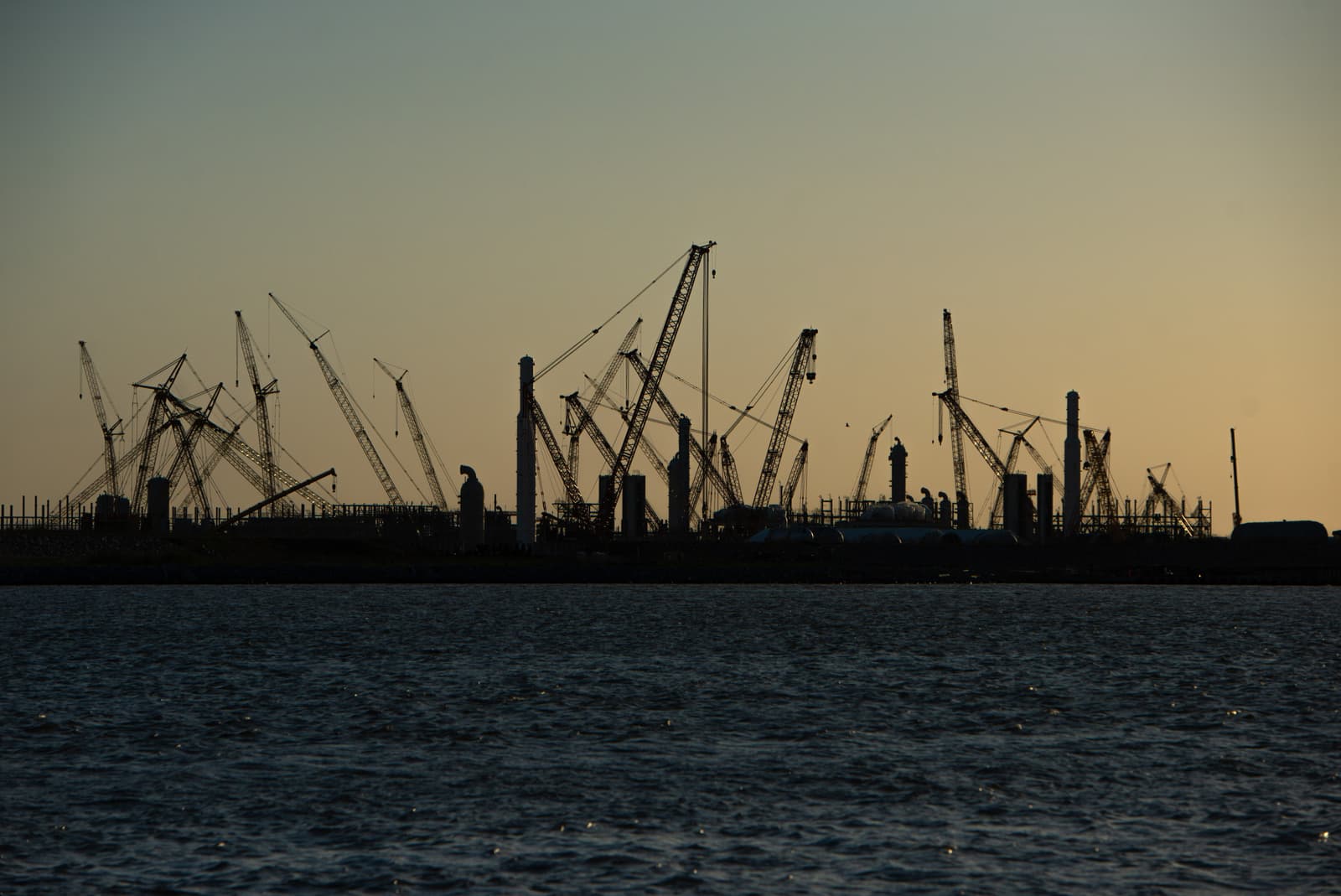
Header image: A liquified natural gas terminal on the Texas Louisiana border in the United States. Credit: The Washington Post via Getty Images.

Reporters: Josephine Moulds
Environment editor: Robert Soutar
Impact producer: Grace Murray
Deputy editor: Chrissie Giles
Editor: Franz Wild
Production editor: Frankie Goodway
Fact checker: Alice Milliken

This reporting is funded by the Sunrise Project. None of our funders have any influence over our editorial decisions or output.

Original article by Josephine Moulds republished from The Bureau of Investigative Journalism under a Creative Commons Attribution-NonCommercial-NoDerivs 3.0 Unported License.

Continue ReadingHSBC helped oil and gas industry raise $47bn despite net-zero pledge

New Shell Files Could Aid Climate Cases, Attorneys Say 

Spread the love

Original article by Matthew Green and Merel de Buck republished from DeSmog.

Credit: Sabrina Bedford.

Latest documents unearthed by Dutch climate activist seen as “valuable sources” for litigators.

Newly-discovered Shell documents dating back decades could help strengthen lawsuits aiming to hold the oil major to account for climate damages, climate attorneys say.

Among the files, reported for the first time today by DeSmog and Follow The Money, and published on Climate Files, there is a 1970 industry journal article where Shell appears to accept responsibility for harms caused by its products. A trove of Shell publications from the 1980s and 1990s foresee the “major adverse changes” the “greenhouse effect” is liable to cause to the climate. 

And a 1998 report spells out Shell’s reasons for leaving the Global Climate Coalition, a now defunct lobby group that worked to undermine climate science. The document shows that Shell had acknowledged the need to adopt  “prudent precautionary measures” to avoid the worst impacts of the climate crisis — even as it continued to push for more production of oil and gas.   

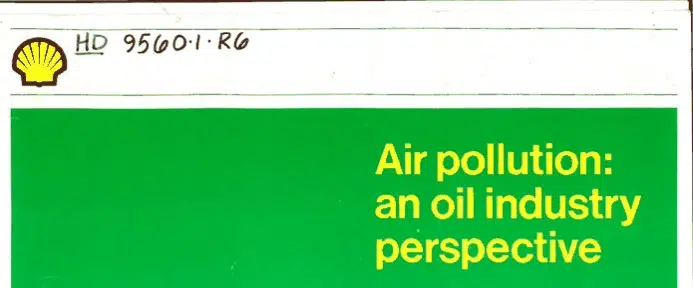
“It is feared that a further rise in carbon dioxide levels in the atmosphere could lead to a higher average surface temperature on Earth, which could have far-reaching environmental, social and economic consequences,” wrote the authors of a 1987 internal Shell publication entitled “Air Pollution: an Oil Industry Perspective.”

Cover of the 1987 internal Shell publication “Air Pollution: an Oil Industry Perspective.”

“Global warming could challenge the very fabric of the world’s ecological and economic systems,” Shell executive Ged Davis wrote in a contribution to a report by the Organisation for Economic Co-operation and Development (OECD) published two years later.

Vatan Hüzeir, a climate activist and doctoral candidate in sociology at Rotterdam’s Erasmus University, unearthed the documents over five years of research, gathering thousands of pages of Shell-related material from archives, former employees, and other sources.

The latest materials add to an initial tranche published in April last year which showed that even as Shell’s awareness of the potentially devastating consequences of climate change grew during the 1970s and 1980s, the company downplayed or omitted key risks in public communications; emphasised scientific uncertainties; and pushed for more fossil fuels.

Shell and other oil and gas companies have been named as defendants in dozens of U.S. climate lawsuits brought by the attorneys general of states such as New Jersey, Vermont, and California, as well as Washington, D.C. and other municipalities across the country. Some of these cases have been brought under consumer fraud or protection laws that penalise companies for misrepresenting their products to the public.

The Washington D.C.-based Center for Climate Integrity, which has filed briefs in support of many of the climate cases against Shell, said that the latest documents provide further evidence that the company has known for at least half a century that its products posed a threat to the climate, as well as the grave consequences of delaying action.

“These internal admissions are valuable sources for litigators around the world seeking to hold Shell accountable for its climate deception under a variety of legal theories,” Corey Riday-White, senior staff attorney at the Center for Climate Integrity, told DeSmog. “While Shell privately acknowledged the dangers of using its products as intended, the corporation publicly sowed doubt about the science and fought efforts to regulate its pollution.”

Hüzeir hopes the latest documents will support two additional and complementary legal strategies: showing that Shell has long accepted some liability for harms caused by its products — including, by implication, climate change — and demonstrating that even as Shell supported lobby groups that sought to block meaningful action to curb fossil fuel use, senior executives acknowledged the need for a “precautionary” approach to the growing climate crisis.    

In response to a request for comment, Shell referred DeSmog to a previous statement it has made regarding the lawsuits. 

“It is for government to determine the right trade-offs for society and put in place smart policy to enable fundamental change in the way society consumes energy,” a Shell spokesperson said.  

More than a dozen of the newly released documents, as well as the previous tranche published in April, can be viewed on Climate Files, under the title Dirty Pearls: Exposing Shell’s hidden legacy of climate change accountability, 1970-1990

Shell Knew

In July 2023, 20 Democratic members of Congress cited DeSmog’s initial coverage of the documents in a letter to U.S. Attorney General Merrick Garland, in which they requested a Department of Justice investigation into the evidence that Shell, ExxonMobil and other oil majors concealed their early knowledge of climate risks.

This spring, a Dutch court is due to hear Shell’s appeal of a 2021 order to slash the company’s carbon dioxide (CO2) emissions 45 percent by 2030, issued in response to a suit filed by environmental group Milieudefensie. Six other organisations also participated in the suit, including FossielvrijNL, a campaign group chaired by Hüzeir, as well as 17,000 Dutch citizens.  

“Shell must do its part to contribute to combating dangerous climate change,” Hague district court judge Larissa Alwin said, reading out the ruling.

Hüzeir believes the latest tranche of documents will strengthen cases brought by climate litigators in Europe and North America, in part by providing clues to the possible existence of additional Shell documents that could be obtained through discovery — a pre-trial procedure in the U.S. legal system that parties involved in a lawsuit use to obtain evidence from each other.

“You have to ‘crack the shell,’” Hüzeir told DeSmog. “With the existing documents in hand, and perhaps many more yet to be discovered, prosecutors, litigators and campaign groups can ground their demands for Shell to be held accountable in even more detailed fact and documentation.”

‘Annoying Consequences’

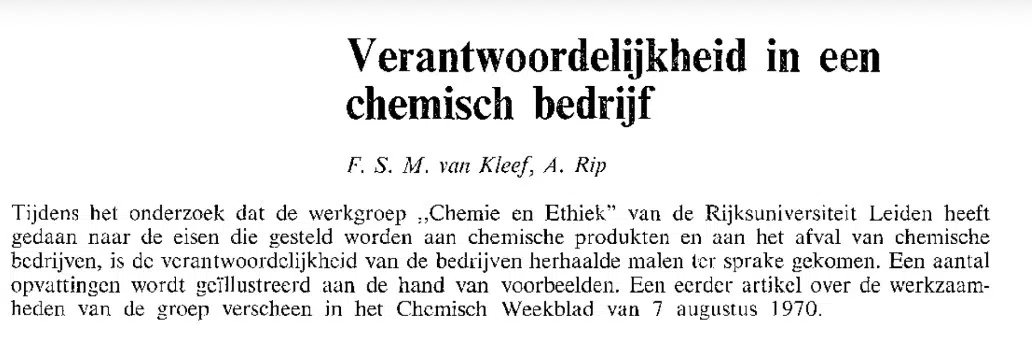
Among the new documents is an October, 1970 article in Dutch trade publication Chemisch Weekblad (Chemical Weekly), in which two authors from the University of Leiden reported on their research into “chemistry and ethics” — including the results of interviews with petrochemical executives. Representatives from Shell had appeared to acknowledge that the company bore some responsibility for the problems that its products would cause.

“If a product is used, as indicated by Shell, and annoying consequences nevertheless arise, Shell feels partly responsible,” they told the researchers.

Excerpt from an October, 1970 article in Dutch trade publication Chemisch Weekblad (Chemical Weekly).

Hüzeir said the document, and others like it, could support litigators to argue that Shell’s apparent early admission of some liability for the side-effects caused by its products should, by extension, also include climate impacts from burning its oil and gas, now known as “Scope 3” emissions. 

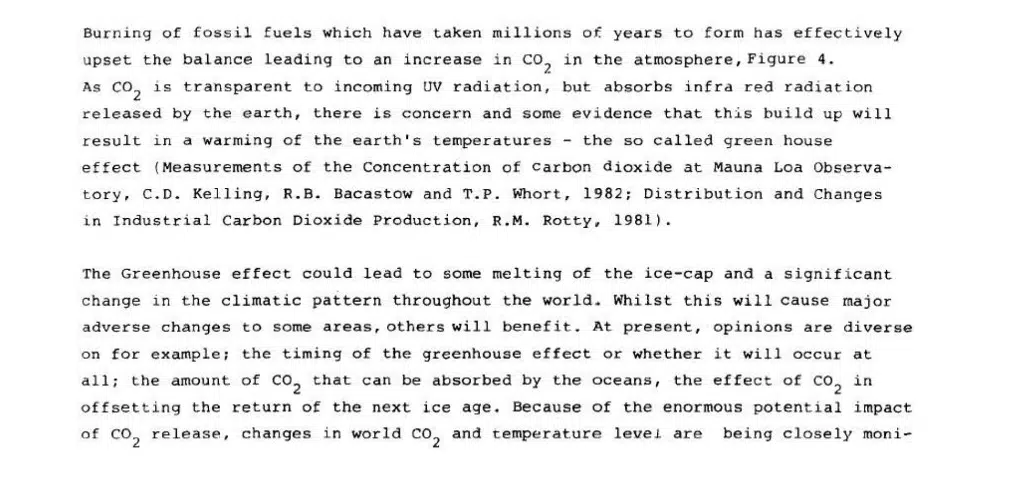
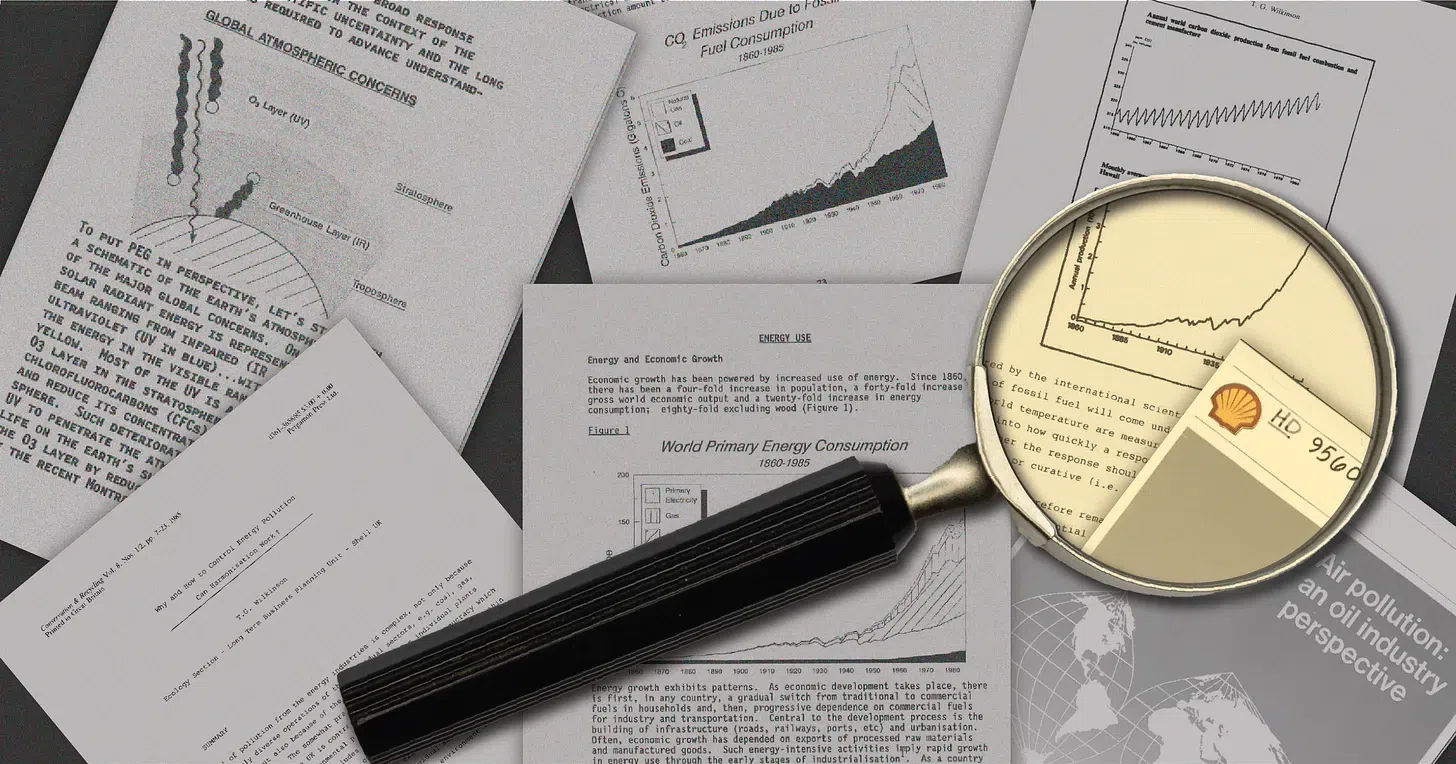
Later documents cast new light on Shell’s growing understanding of the risks posed by climate change. In a March 1985 article in the journal Conservation & RecyclingT.G. Wilkinson, who worked at the time in the Ecology Section of Shell UK’s Long Term Business Planning Unit, explored the risks posed by “energy-generated pollution.” 

“Burning of fossil fuels which have taken millions of years to form has effectively upset the balance leading to an increase in CO2 in the atmosphere,” Wilkinson wrote. “The Greenhouse effect could lead to some melting of the ice-cap and a significant change in the climatic pattern throughout the world. Whilst this will cause major adverse changes to some areas, others will benefit.”

Excerpt from a March 1985 article in the journal Conservation & Recycling by T.G. Wilkinson, who worked at the time in Shell UK’s Long Term Business Planning Unit.

Wilkinson went on to explore whether a precautionary approach should be adopted to prevent the “potential enormous effects on the world’s climate.”

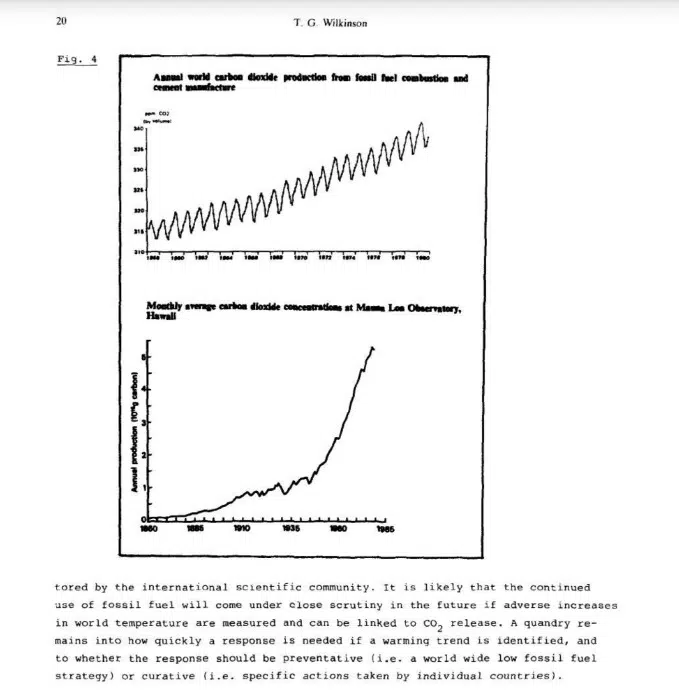
“It is likely that the continued use of fossil fuel will come under close scrutiny in the future if adverse increases in world temperature are measured and can be linked to CO2 release. A quandary remains into how quickly a response is needed if a warming trend is identified, and to whether the response should be preventative (i.e. a worldwide low fossil fuel strategy) or curative (i.e. specific actions taken by individual countries).

“The dilemma therefore remains as to whether to encourage the continued use of fossil fuels with the potential enormous effects on the world’s climate.”

Wilkinson returned to this dilemma in his conclusion, again noting the dangers posed by “emissions and discharges” caused by fossil fuels and nuclear power. 

“As well as the benefits of these energy developments however, there are also consequences to the environment arising from the emissions and discharges which are part of the process operations or are implicit in the subsequent use of the fuel,” Wilkinson wrote. “There is concern that energy-generated pollution could well affect the quality of life that has at least in part been made possible by energy developments.”

Graphs showing growing carbon dioxide emissions from fossil fuels, and rising CO2 concentrations in the atmosphere, in Shell staffer T.G. Wilkinson’s March 1985 article in Conservation & Recycling.

Winners and Losers

Further evidence of Shell’s growing understanding of the risks posed by burning its products appears in the 1987 internal Shell publication “Air Pollution: an Oil Industry Perspective.” 

“It is feared that a further rise in carbon dioxide levels in the atmosphere could lead to a higher average surface temperature on Earth, which could have far-reaching environmental, social and economic consequences,” the document said. “A lot of scientific research is being done to determine which climatic changes can occur and which measures should be taken.”

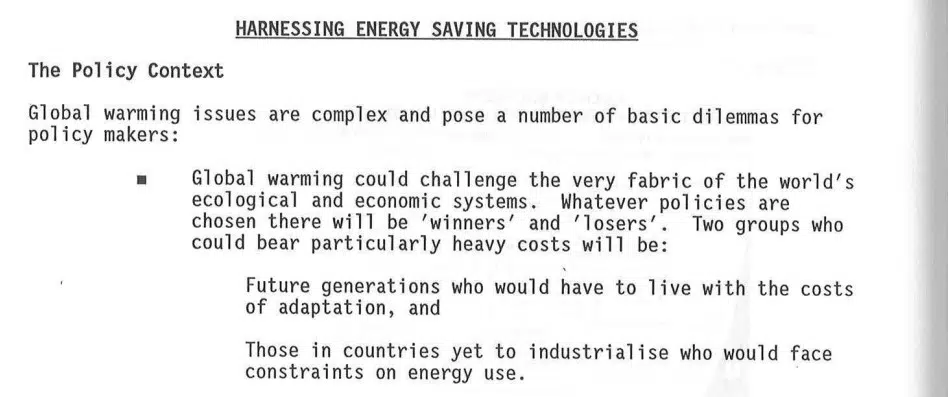
Shell’s understanding of the gravity of the dangers was also apparent in the 1989 OECD report, entitled “Energy Technologies for Reducing Emissions of Greenhouse Gases.” Davis, the Shell executive, who warned that “global warming could challenge the very fabric of the world’s ecological and economic systems,” also foresaw the possible cost to future generations of failing to curb emissions.

“Whatever policies are chosen there will be ‘winners’ and ‘losers,’” he wrote. “Two groups who could bear particularly heavy costs will be: Future generations who would have to live with the costs of adaptation, and…Those in countries yet to industrialise who would face constraints on energy use…How should we allocate resources between prevention and adaptation?”

An excerpt from Shell executive Ged Davis’ contribution to a 1989 report by the OECD.

Shell planners spelled out the risks even more starkly in an October 1989 confidential scenario exercise, previously reported by DeSmog. The authors warned that climate-fuelled migration could spark conflicts by swamping borders in the U.S., Soviet Union, Europe, and Australia, and that “civilisation could prove a fragile thing.”

‘Too Late’

In the 1990s, as the oil industry increasingly backed lobby groups and think tanks working to undermine climate science, the stark assessments of the risks of burning fossil fuels made by Shell staff in the previous decade gave way to a greater emphasis on scientific uncertainty.  

In an October 1990 internal Dutch-language publication entitled “Climate Change,” Shell acknowledged that many leading scientists were convinced of the existence of the “greenhouse effect” — the term then used for climate change. 

But the publication also echoed a message  seen in other Shell documents that Hüzeir has turned up: emphasizing uncertainty about the magnitude and timing of climate impacts, “if they do come.” 

“There is a considerable period of time (perhaps decades) between the increase in greenhouse gases and their ultimate effect on the climate,” the report stated. “As a result, by the time the enhanced greenhouse effect has been conclusively proven, it may be too late to do anything about it.” 

Nevertheless, the report went on to acknowledge the importance of reducing greenhouse gas emissions, and referenced the possibility of using carbon taxes to promote a shift away from fossil fuels. “It is widely recognized that emissions of the main greenhouse gases must be limited if there is to be any chance of reducing the further strengthening of the greenhouse effect,” the document said.

The report also noted technologies that could reduce emissions, ranging from switching to fuels that produce less CO2 per unit of energy, to boosting nuclear and renewables such as solar and wind energy. Hüzeir hopes this explicit acknowledgement of the existence of alternatives could strengthen the hand of litigators who want to prove that Shell chose to continue boosting production of fossil fuels, even while knowing that cleaner options were available.

The cover of the October 1990 internal Dutch-language publication entitled “Climate Change.”

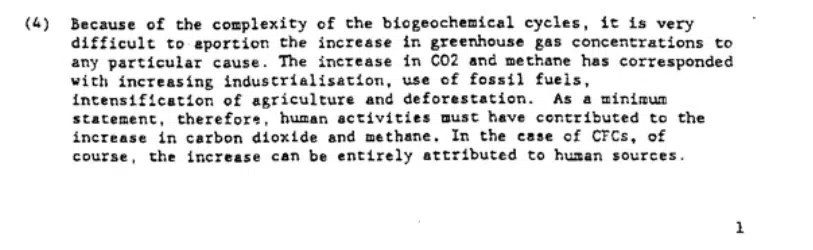
Shell’s emphasis on scientific uncertainty was evident again two years later, in September 1992, when the company’s Group Planning department published a “Business Environment Occasional Paper” on the “Potential Augmented Greenhouse Effect, & Depletion of the Ozone Layer.”

In contrast to Shell authors who had squarely recognised the primary role of fossil fuels in driving climate change in documents and graphs published during the 1980s, the authors emphasised that it was difficult to assess the extent to which fossil fuels were responsible. 

“Because of the complexity of the biogeochemical cycles, it is very difficult to aportion [sic] the increase in greenhouse gas concentrations to any particular cause,” the paper said. “The increase in CO2 and methane has corresponded with increasing industrialisation, use of fossil fuels, intensification of agriculture and deforestation. As a minimum statement, therefore, human activities must have contributed to the increase in carbon dioxide and methane.”

An excerpt from Shell’s September 1992 “Business Environment Occasional Paper” on the “Potential Augmented Greenhouse Effect, & Depletion of the Ozone Layer.”

Meanwhile, in other documents, Shell recognised the need to adopt a “precautionary” approach to climate change. In a 1993 report by the World Energy Council, a think tank backed by government and industry, where Shell’s managing director at the time, John Jennings, served on the board, the word “precautionary” appears more than 20 times. 

“Given the as yet unknown consequences of continued and increasing greenhouse gas emissions and impacts, the ability to ascertain the ‘economically optimal’ level of emissions and their mitigation, as required by a cost-benefit approach, is impossible,” the report said. “As a matter of simple prudence, therefore, action based on the precautionary principle is advocated.” 

An excerpt from a 1993 report by the World Energy Council, where Shell held a seat on the board.

Hüzeir argues that such explicit acknowledgements of the need for precautionary measures will further bolster lawsuits alleging that Shell had developed a thorough understanding of the dangers posed by fossil fuels, even as it issued other publications that emphasised scientific uncertainties, and backed lobby groups working to undermine climate action.  

‘Profits and Principles’

Shell was a founding member of the Global Climate Coalition (GCC), the outspoken oil industry lobby group, which was formed in 1989 to actively promote uncertainty and doubt about climate science in order to delay climate action.

Hüzeir believes Shell’s explanation of why it left the GCC in 1998 in an English-language sustainability report called “Profits and Principles – Does There Have to Be a Choice?” could provide a further hook for litigators.  

DeSmog has previously documented that the GCC had attempted to limit the strength of statements regarding the human causes of climate change made by the Intergovernmental Panel on Climate Change, the UN’s scientific advisory body, in the run-up to the 1997 climate conference where nations agreed to the Kyoto Protocol.

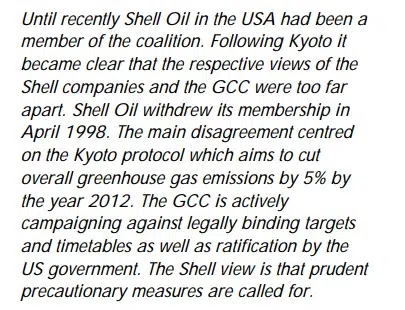
The “Profits and Principles” document said that the “main disagreement” between Shell and the GCC centred on the group’s opposition to the Kyoto agreement, which aimed to cut global greenhouse gas emissions by five percent by 2012.

“The GCC is actively campaigning against legally binding targets and timetables as well as ratification by the US government,” the report said. “The Shell view is that prudent precautionary measures are called for.”

An excerpt from Shell’s 1998 English-language sustainability report called “Profits and Principles – Does There Have to be a Choice?

Hüzeir said that Shell’s admission that it saw the need for these “precautionary measures” affirms that the company had long understood the risks posed by the climate crisis — knowledge apparent in many earlier files. 

This document also raised the question of why Shell had continued to fund the GCC, as late as 1998 — the year it left the organisation — despite that understanding, Hüzeir said.  

Shell’s acknowledgement that its position in GCC had become untenable could also help litigators demonstrate that oil and gas companies that remained in the group until it disbanded in 2002 had been acting in bad faith, Hüzeir added.

“We’ve heard many times from the fossil fuel industry that it was unsure whether or not to take early action on the climate crisis, because there were uncertainties in the science,” Hüzeir said. “But Shell’s deepening embrace of the precautionary principle, as revealed in this document, shows that Shell was well aware of the crisis ahead. What else did they know?”

Original article by Matthew Green and Merel de Buck republished from DeSmog.

Continue ReadingNew Shell Files Could Aid Climate Cases, Attorneys Say 

Congressman: DOJ Investigation of Big Oil Is Now “Even More Urgent” Following Shell Revelations

Spread the love

Original article by Emily Sanders, ExxonKnews republished from DeSmog.

Credit: Tess Abbot/ExxonKnews

With more proof of Shell’s climate deception, Rep. Ted Lieu is once again urging the Department of Justice to look into whether fossil fuel companies broke the law.

After new evidence emerged last week showing that oil major Shell internally acknowledged the dangers of their fossil fuel products decades ago, a member of Congress is renewing his previous call for the U.S. Department of Justice to investigate whether Shell and other Big Oil companies’ “alleged campaigns of climate deception” may have violated federal law.

The company documents, first unearthed by Dutch researcher Vatan Hüzeir and reported last week by DeSmog and Follow the Money, reveal Shell executives and employees predicting “major adverse changes” to the climate from fossil fuel emissions — and admitting Shell’s role in causing the problem. “Global warming could challenge the very fabric of the world’s ecological and economic systems,” warned Shell executive Ged Davis in one newly uncovered document from 1989. 

“This new set of documents further demonstrates that Shell privately knew about the dangers its products would cause to the environment yet continued to deceive the public in pursuit of company profits. This is wrong and potentially illegal,” said U.S. Rep. Ted Lieu (D-CA), who along with Sen. Richard Blumenthal (D-CT) led 20 members of Congress in a letter last year urging the Department of Justice to look deeper into evidence that Shell, ExxonMobil, and other fossil fuel majors “lied — and continue to lie — to the public about their central role in exacerbating the climate crisis.” 

“These new documents provide additional evidence and make our calls for an investigation even more urgent,” Lieu told ExxonKnews in response to the latest Shell revelations. 

The lawmakers’ July 25 letter cited an initial batch of internal Shell documents released by Hüzeir last March. The evidence, they wrote, should inspire the DOJ to “investigate Exxon, Shell, and other members of the fossil fuel industry to determine whether they violated RICO, consumer protection, truth in advertising, public health, or other laws.” 

A separate letter from U.S. Sens. Bernie Sanders (D-VT), Elizabeth Warren (D-MA), Ed Markey (D-MA), and Ed Markey (D-OR) urged the DOJ to go even further and “bring suits against the fossil fuel industry for its longstanding and carefully coordinated campaign to mislead consumers and discredit climate science in pursuit of massive profits.”

The latest documents add to an abundance of proof that Shell was well aware of the harm its products would cause — and acknowledged its culpability for the damage.

“If a product is used, as indicated by Shell, and annoying consequences nevertheless arise, Shell feels partly responsible,” representatives from Shell told researchers from the Dutch University of Leiden in 1970.

Those “annoying consequences” — which turned out to be more catastrophic and deadly than just annoying — were plainly elucidated by the company in the years to follow. In a 1985 journal article, Shell employee T.G. Wilkinson observed that the burning of fossil fuels has “upset the balance” of carbon dioxide in the atmosphere, and “will cause major adverse changes to some areas.” 

“The dilemma therefore remains as to whether to encourage the continued use of fossil fuels with the potential enormous effects on the world’s climate,” Wilkinson wrote.

Two years later, an internal Shell report titled “Air Pollution: an Oil Industry Perspective” noted that a rise in CO2 in the atmosphere “could lead to a higher average surface temperature on Earth, which could have far-reaching environmental, social and economic consequences.”

In 1989, Shell executive Davis warned that “Two groups who could bear particularly heavy costs will be: Future generations who would have to live with the costs of adaptation, and…Those in countries yet to industrialise who would face constraints on energy use.”

Davis is now executive chair of world energy scenarios at the World Energy Council.

Armed with the information it needed to steer the world toward cleaner sources of energy, Shell embarked on a campaign to undermine climate action instead. 

The same year Davis made his prediction in the OECD report, Shell helped found the Global Climate Coalition (GCC), an oil industry lobbying group that worked to spread disinformation about climate science. 

A year later, in an internal publication, Shell admitted the need to reduce greenhouse gas emissions and embrace alternative sources of energy — but stated that “by the time the enhanced greenhouse effect has been conclusively proven, it may be too late to do anything about it.”

Shell went on to promote the idea that climate science was uncertain and downplayed the role of fossil fuels in the years to come. “It is very difficult to aportion [sic] the increase in greenhouse gas concentrations to any particular cause,” read one paper published by the company in 1992. 

When Shell left the GCC, citing its opposition to the Kyoto climate agreement, it explained in a 1998 report that “The Shell view is that prudent precautionary measures are called for.”

Hüzeir, the researcher who unearthed these reports, told DeSmog that documents like this could help litigators make the case against Shell in a growing wave of lawsuits seeking to hold the company accountable for knowingly fueling climate chaos. “Shell’s deepening embrace of the precautionary principle, as revealed in this document, shows that Shell was well aware of the crisis ahead,” he said. “What else did they know?”

The documents add to a heap of evidence that could spur the country’s most powerful public interest law firm to investigate Big Oil.

“If the allegations against ExxonMobil, Shell, and other major fossil fuel companies are true, their coordinated efforts to deceive Americans constitute the most consequential deception campaign in history, with potentially existential consequences for our planet,” Lieu and other members of Congress wrote in their July letter to the DOJ. “We respectfully request that the DOJ investigate whether these actions violated federal law.”

Since that letter was sent last year, more state and local governments have taken the companies to court for that deception. California — the most populous state in the nation and one of the world’s largest economies — sued Shell and other fossil fuel majors for climate damages and consumer fraud. Two Indigenous tribal governments in Washington State, forced to spend millions relocating their communities due to rising seas, filed their own lawsuit against oil giants. Honolulu’s climate accountability lawsuit cleared motions to dismiss the case by fossil fuel defendants, putting it on a path to be the first case of its kind to go to trial. 

The stakes of these legal efforts are only getting higher, as climate disasters continue to batter many of the same communities awaiting their day in court. The DOJ threw its support behind the plaintiffs in a U.S. Supreme Court brief the agency filed last March, but it hasn’t yet taken independent action against the fossil fuel industry.

“It’s time to hold polluters accountable for their lies, which could have existential consequences for our planet,” Lieu said.

Original article by Emily Sanders, ExxonKnews republished from DeSmog.

North Sea Bill’s Carbon Emissions Test is a ‘Smokescreen’ And ‘Makes No Sense’ — Experts

US/See How Louisiana’s Growing Fossil Fuel Industry Threatens Climate and Justice Promises

Dark Money, CCS Bonanza, Corporate Comms Offensives: What to Watch in 2024

Continue ReadingCongressman: DOJ Investigation of Big Oil Is Now “Even More Urgent” Following Shell Revelations

What Big Oil knew about climate change, in its own words

Spread the love


The oil industry was aware of the risks of climate change decades ago.
Barry Lewis/InPictures via Getty Images

Benjamin Franta, Stanford University

Leer en español.

Four years ago, I traveled around America, visiting historical archives. I was looking for documents that might reveal the hidden history of climate change – and in particular, when the major coal, oil and gas companies became aware of the problem, and what they knew about it.

I pored over boxes of papers, thousands of pages. I began to recognize typewriter fonts from the 1960s and ‘70s and marveled at the legibility of past penmanship, and got used to squinting when it wasn’t so clear.

What those papers revealed is now changing our understanding of how climate change became a crisis. The industry’s own words, as my research found, show companies knew about the risk long before most of the rest of the world.

Surprising discoveries

At an old gunpowder factory in Delaware – now a museum and archive – I found a transcript of a petroleum conference from 1959 called the “Energy and Man” symposium, held at Columbia University in New York. As I flipped through, I saw a speech from a famous scientist, Edward Teller (who helped invent the hydrogen bomb), warning the industry executives and others assembled of global warming.

“Whenever you burn conventional fuel,” Teller explained, “you create carbon dioxide. … Its presence in the atmosphere causes a greenhouse effect.” If the world kept using fossil fuels, the ice caps would begin to melt, raising sea levels. Eventually, “all the coastal cities would be covered,” he warned.

1959 was before the moon landing, before the Beatles’ first single, before Martin Luther King’s “I Have a Dream” speech, before the first modern aluminum can was ever made. It was decades before I was born. What else was out there?

In Wyoming, I found another speech at the university archives in Laramie – this one from 1965, and from an oil executive himself. That year, at the annual meeting of the American Petroleum Institute, the main organization for the U.S. oil industry, the group’s president, Frank Ikard, mentioning a report called “Restoring the Quality of Our Environment” that had been published just a few days before by President Lyndon Johnson’s team of scientific advisers.

“The substance of the report,” Ikard told the industry audience, “is that there is still time to save the world’s peoples from the catastrophic consequences of pollution, but time is running out.” He continued that “One of the most important predictions of the report is that carbon dioxide is being added to the earth’s atmosphere by the burning of coal, oil, and natural gas at such a rate that by the year 2000 the heat balance will be so modified as possibly to cause marked changes in climate.”

Ikard noted that the report had found that a “nonpolluting means of powering automobiles, buses, and trucks is likely to become a national necessity.”

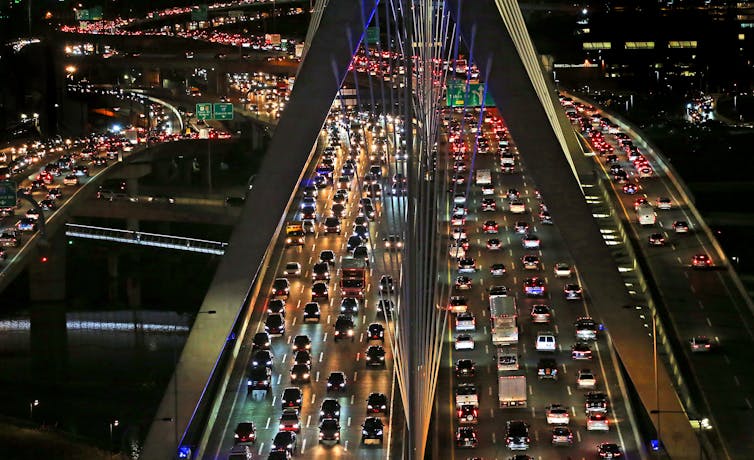
Traffic lights up the evening on a Boston bridge

Transportation is now the leading source of carbon dioxide emissions in the U.S., followed by electricity.
David L. Ryan/The Boston Globe via Getty Images

As I reviewed my findings back in California, I realized that before San Francisco’s Summer of Love, before Woodstock, the peak of the ’60s counterculture and all that stuff that seemed ancient history to me, the heads of the oil industry had been privately informed by their own leaders that their products would eventually alter the climate of the entire planet, with dangerous consequences.

Secret research revealed the risks ahead

While I traveled the country, other researchers were hard at work too. And the documents they found were in some ways even more shocking.

By the late 1970s, the American Petroleum Institute had formed a secret committee called the “CO2 and Climate Task Force,” which included representatives of many of the major oil companies, to privately monitor and discuss the latest developments in climate science.

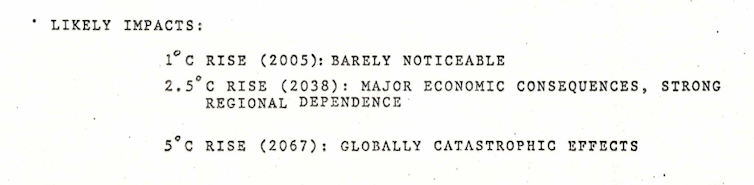
In 1980, the task force invited a scientist from Stanford University, John Laurmann, to brief them on the state of climate science. Today, we have a copy of Laurmann’s presentation, which warned that if fossil fuels continued to be used, global warming would be “barely noticeable” by 2005, but by the 2060s would have “globally catastrophic effects.” That same year, the American Petroleum Institute called on governments to triple coal production worldwide, insisting there would be no negative consequences despite what it knew internally.

A slide from John Laurmann’s presentation to the American Petroleum Institute’s climate change task force in 1980, warning of globally catastrophic effects from continued fossil fuel use.

Exxon had a secretive research program too. In 1981, one of its managers, Roger Cohen, sent an internal memo observing that the company’s long-term business plans could “produce effects which will indeed be catastrophic (at least for a substantial fraction of the earth’s population).”

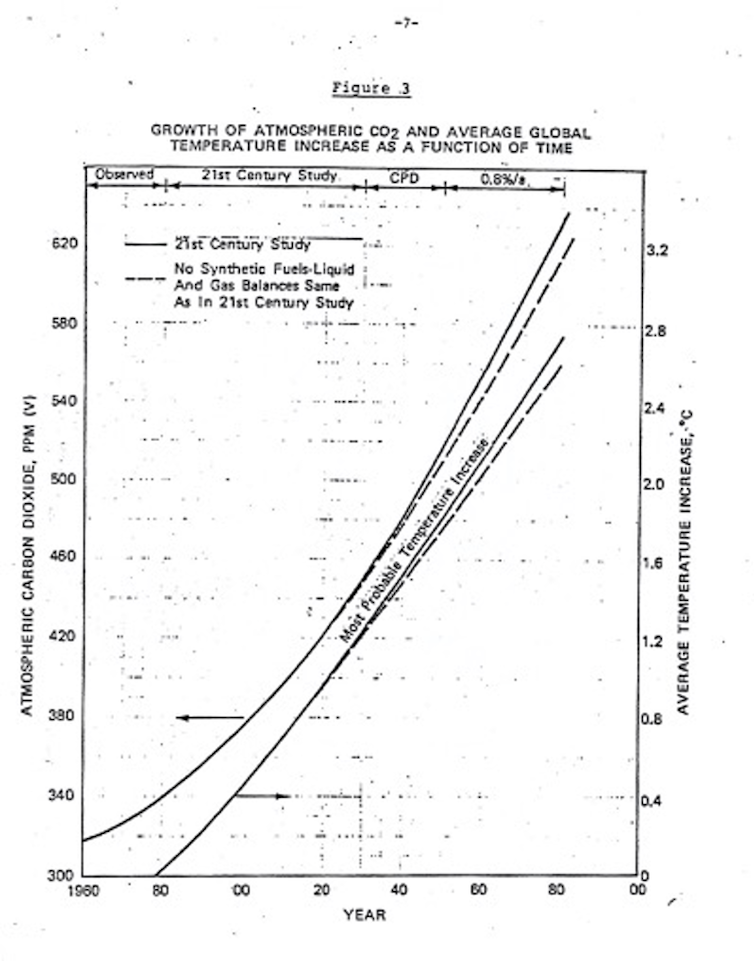
The next year, Exxon completed a comprehensive, 40-page internal report on climate change, which predicted almost exactly the amount of global warming we’ve seen, as well as sea level rise, drought and more. According to the front page of the report, it was “given wide circulation to Exxon management” but was “not to be distributed externally.”

And Exxon did keep it secret: We know of the report’s existence only because investigative journalists at Inside Climate News uncovered it in 2015.

A figure from Exxon’s internal climate change report from 1982, predicting how much carbon dioxide would build up from fossil fuels and how much global warming that would cause through the 21st century unless action was taken. Exxon’s projection has been remarkably accurate.

Other oil companies knew the effects their products were having on the planet too. In 1986, the Dutch oil company Shell finished an internal report nearly 100 pages long, predicting that global warming from fossil fuels would cause changes that would be “the greatest in recorded history,” including “destructive floods,” abandonment of entire countries and even forced migration around the world. That report was stamped “CONFIDENTIAL” and only brought to light in 2018 by Jelmer Mommers, a Dutch journalist.

In October 2021, I and two French colleagues published another study showing through company documents and interviews how the Paris-based oil major Total was also aware of global warming’s catastrophic potential as early as the 1970s. Despite this awareness, we found that Total then worked with Exxon to spread doubt about climate change.

Big Oil’s PR pivot

These companies had a choice.

Back in 1979, Exxon had privately studied options for avoiding global warming. It found that with immediate action, if the industry moved away from fossil fuels and instead focused on renewable energy, fossil fuel pollution could start to decline in the 1990s and a major climate crisis could be avoided.

But the industry didn’t pursue that path. Instead, colleagues and I recently found that in the late 1980s, Exxon and other oil companies coordinated a global effort to dispute climate science, block fossil fuel controls and keep their products flowing.

We know about it through internal documents and the words of industry insiders, who are now beginning to share what they saw with the public. We also know that in 1989, the fossil fuel industry created something called the Global Climate Coalition – but it wasn’t an environmental group like the name suggests; instead, it worked to sow doubt about climate change and lobbied lawmakers to block clean energy legislation and climate treaties throughout the 1990s.

For example, in 1997, the Global Climate Coalition’s chairman, William O’Keefe, who was also an executive vice president for the American Petroleum Institute, wrote in the Washington Post that “Climate scientists don’t say that burning oil, gas and coal is steadily warming the earth,” contradicting what the industry had known for decades. The fossil fuel industry also funded think tanks and biased studies that helped slow progress to a crawl.

Today, most oil companies shy away from denying climate science outright, but they continue to fight fossil fuel controls and promote themselves as clean energy leaders even though they still put the vast majority of their investments into fossil fuels.

A Congressional subcommittee on Oct. 28, 2021, questioned executives from Exxon, BP, Chevron, Shell and the American Petroleum Institute about industry efforts to downplay the role of fossil fuels in climate change. Exxon CEO Darren Woods told lawmakers that his company’s public statements “are and have always been truthful” and that the company “does not spread disinformation regarding climate change.”

As I write this, climate legislation is again being blocked in Congress by a lawmaker with close ties to the fossil fuel industry.

People around the world, meanwhile, are experiencing the effects of global warming: weird weather, shifting seasons, extreme heat waves and even wildfires like they’ve never seen before.

Will the world experience the global catastrophe that the oil companies predicted years before I was born? That depends on what we do now, with our slice of history.

This article was updated Oct. 28, 2021, with details from a Congressional hearing.

Benjamin Franta, Ph.D. Candidate in History, Stanford University

This article is republished from The Conversation under a Creative Commons license. Read the original article.

Related video

Continue ReadingWhat Big Oil knew about climate change, in its own words

David Cameron Islamic Extremism speech July 2015

Spread the love

I’ll be making some remarks on David Cameron’s recent speech on so-called Islamic Extremism. Later on in his speech Cameron says that he wants to do away with this blog under his ‘Extremism Bill’. edit: He doesn’t actually say this blog but

“First, any strategy to defeat extremism must confront, head on, the extreme ideology that underpins it. We must take its component parts to pieces – the cultish worldview, the conspiracy theories

we should together challenge the ludicrous conspiracy theories of the extremists. The world is not conspiring against Islam; the security services aren’t behind terrorist attacks

Second, as we counter this ideology, a key part of our strategy must be to tackle both parts of the creed – the non-violent and violent.

This means confronting groups and organisations that may not advocate violence – but which do promote other parts of the extremist narrative.

We must demand that people also condemn the wild conspiracy theories, the anti-Semitism, and the sectarianism too. Being tough on this is entirely keeping with our values.

We need to put out of action the key extremist influencers who are careful to operate just inside the law, but who clearly detest British society and everything we stand for [Tory values]. These people aren’t just extremists. There are despicable far right groups too. And what links them all is their aim to groom young people and brainwash their minds.

So as part of our Extremism Bill, we are going to introduce new narrowly targeted powers to enable us to deal with these facilitators and cult leaders, and stop them peddling their hatred.

As I said, this is not about clamping down on free speech. It’s just about applying our shared values uniformly.

This blog peddles conspiracy theories and claims that security services are behind terrorist attacks.

Sorry Cameron, you’ll be imprisoning me.

image of David Cameron, Rupert Murdoch and Rebekah Brooks
David Cameron, Rupert Murdoch and Rebekah Brooks

http://www.independent.co.uk/news/uk/politics/david-cameron-extremism-speech-read-the-transcript-in-full-10401948.html

It’s great to be here at this outstanding school, Ninestiles School. Your inspiring teachers and your commitment to British values means you are not just achieving outstanding academic success, but you are building a shared community where children of many faiths and backgrounds learn not just with each other, but from each other too.

Politicians giving speeches at schools is out of order. While they’re guaranteed an audience it’s insulting and disrespectful to the school-students involved. There is an authoritarian regime in schools where students are ordered about and they follow those orders. Their human rights are not recognised. The students didn’t realise they could turn around and say “Fuck off! I’m not listening to that asshole” because of course they can’t. It’s lucky no politician tried that while I was at school.

Blair used to do it a lot – probably because he’d never get an audience towards the end of his reign. He’d go to a school and avoid any eye contact with the students – that’s one of the things that put me onto him and his evil ways. Why was he avoiding eye contact?

Blair went to one school and was booed by the students. He was so deranged and divorced from reality that his aides persuaded him that they were doing some youth-speak “Boom” showing respect for him. Twat.

And that goes right to the heart of what I want to talk about today.

I said on the steps of Downing Street that this would be a ‘one nation’ government, bringing our country together.

That’s total bullshit then. It’s four or five nations for a start. What about the Evel measures Cameron was pursuing? That’s certainly very divisive.

Today, I want to talk about a vital element of that. How together we defeat extremism and at the same time build a stronger, more cohesive society.

My starting point is this.

Over generations, we have built something extraordinary in Britain – a successful multi-racial, multi-faith democracy. It’s open, diverse, welcoming – these characteristics are as British as queuing and talking about the weather.

It’s not welcoming, is it?

It is here in Britain where different people, from different backgrounds, who follow different religions and different customs don’t just rub alongside each other but are relatives and friends; husbands, wives, cousins, neighbours and colleagues.

It is here in Britain where in one or two generations people can come with nothing and rise as high as their talent allows.

It is here in Britain where success is achieved not in spite of our diversity, but because of our diversity.

I’m letting that pass because it’s trivial.

So as we talk about the threat of extremism and the challenge of integration, we should not do our country down – we are, without a shadow of doubt, a beacon to the world.

Oh come on.

And as we debate these issues, neither should we demonise people of particular backgrounds. Every one of the communities that has come to call our country home has made Britain a better place. And because the focus of my remarks today is on tackling Islamist extremism – not Islam the religion – let me say this.

Hmm, Muslims are the one religion that is seriously discriminated against. I happened across a couple of Muslim school students who were about fourteen the other day. I was cycling through a park and they had to move out of the way for me to pass through the gate to leave the park. We exchanged a few words. They were ashamed. I regret not making an issue of telling them that they had nothing to be ashamed of. This is what it’s all about – it’s young Muslims who will be [ed: relentlessly] bullied by school authorities – they’re not ever going to have a break, are they? That seems to me very much like a way to create extremism rather than defeat it.

26/7/15 I’m going to jump ahead because it’s crap.

I was thinking about whether these “our values” actually exist and who is Cameron to define these “our values”. I was intending to argue that there is no consensus since we are so diverse as Cameron has already said and that I share very few values with Cameron. Values are different from beliefs and I should think that values probably follow from beliefs. It follows that since peoples’ beliefs are different then they have different values. I think that’s about right. What about you?

Take for example a religion that promotes the idea that all other religions are inferior – that all others not following that particular religion are animals or beasts in human form, sub-human. Now if you had accepted such beliefs, wouldn’t values follow? and wouldn’t behaviour follow from those values?

So, my proposition is that there are no such “our values”.

26/7/15 19.30 BST

What are these “our values”?

But you don’t have to support violence to subscribe to certain intolerant ideas which create a climate in which extremists can flourish.

Ideas which are hostile to basic liberal values such as democracy, freedom and sexual equality.

Surely Cameron must mean pretend-democracy, pretend-freedom and not even pretend sexual equality. Cameron, former PM Tony Blair and former Resident Dubya Bush are Neo-Conservatives. Neo-Conservatives follow the anti-democratic and illiberal philosophy of Leo Strauss that it is necessary to deceive to rule. It would seem that Cameron is proposing that “our values” includes support for an obvious sham-democracy that is maintained through dissembling and deception.

Ideas which actively promote discrimination, sectarianism and segregation.

Like Cameron’s proposed Extremism Bill.

Ideas – like those of the despicable far right – which privilege one identity to the detriment of the rights and freedoms of others.

Like the religion I mentioned earlier and this speech and the proposed Extremism Bill and Neo-Conservatives.

TBC

Danger Mice

Cameron fights for his brutish values – more Islamophobia and war

Continue ReadingDavid Cameron Islamic Extremism speech July 2015