Trump at CPAC 2025: Attack Climate Policy and Double Down on Denial

Spread the love

Original article by Zach D. Roberts republished from DeSmog.
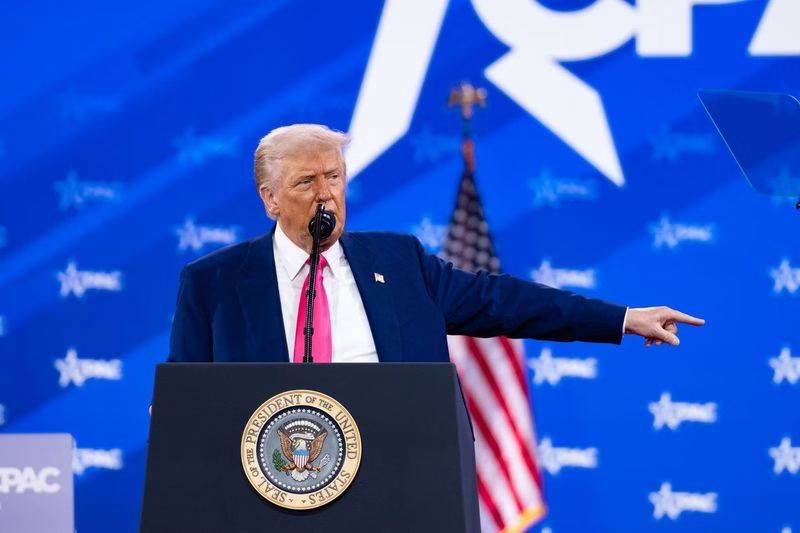
Trump boasted about withdrawing from the “one-sided” Paris Agreement, saying, “It was a disaster.” Credit: Zach D. Roberts

Conservative conference featured global right-wing speakers from Liz Truss to JD Vance calling for an end to climate protections.

Just a month into President Donald Trump’s chaotic administration, American and international conservatives swooped into the 2025 Conservative Political Action Conference (CPAC) outside Washington, D.C., in mid-February, and took a knee to the president, non-elected billionaire Elon Musk, and their fossil fuel deregulation agenda. 

After numerous speeches heralding the MAGA movement by major figures on the right, including Vice President JD Vance, DOGE chief Elon Musk, ex-Trump aide Steve Bannon, and Speaker of the House Republican Mike Johnson, on the last day of the four-day event, Trump himself spoke to the faithful. Basking in chants of “USA, USA,” Trump boasted about withdrawing from the “one-sided” Paris Agreement, saying, “It was a disaster, it was a disaster.” 

“I terminated the Green New Scam,” he went on, referring to the Green New Deal, which was never enacted or proposed as an actual bill. “One of the greatest hoaxes ever played on this country is the Green New Scam. We spent trillions of dollars on this nonsense … It really set back our country.”

In a rambling speech bereft of solid policy or facts, Trump also said he “canceled Joe Biden’s insane electric vehicle mandate, where everybody has to have an electric,” again referring to non-existent legislation. Biden did not mandate people to switch to electric cars; he had progressively stricter pollution standards. 

Trump’s final reference to the environment in his speech was that “people can buy any type of car they want, except for hydrogen. The only thing you can’t do is buy a hydrogen-powered car. You know why? They said it really works great, but when it doesn’t work, you never find a body. It’s a bet that’s a bad sign.” As of this publication date, no one has been disintegrated by a hydrogen car explosion. He then ended with his signature dance as the Village People’s “YMCA” blared over the loudspeakers.
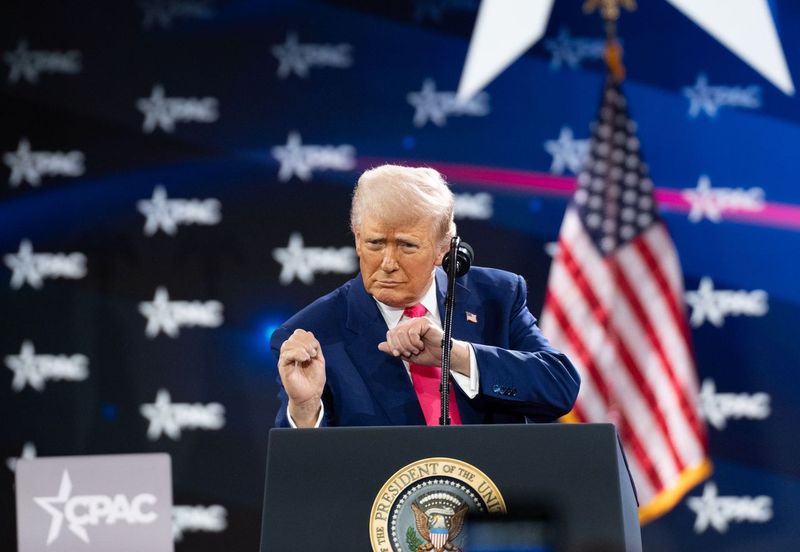
Trump dances to the song, “YMCA” at CPAC 2025. Credit: Zach D. Roberts

Trump’s references to fake climate policy was emblematic of this year’s CPAC discussions on the environment. In past years, the conference’s environmental speakers were more “scientific,” with conservative climate denialists showing graphs and data to prove their theories that climate change seemingly does not exist. But with no breakout sessions this year, the gathering was all anti-climate talk and pro-MAGA with zero attempts at science. 

Take former UK Prime Minister Liz Truss’s talk on Thursday, Feb. 20, the second day of CPAC. Truss, who had previously served as the UK’s environment secretary, expressed her anger that her move to end the ban on fracking in Great Britain was brought back in 2022 by her predecessor, Prime Minister Rishi Sunak. 

Truss was famously only in office for 45 days. “Sadly, I wasn’t in office long enough to actually make [the fracking ban] happen,” she told the conference crowd.

“We have net-zero policies that have decimated our oil and gas industry,” she said. “The net result is we have the highest energy prices in the developed world. And in Britain, we’ve just seen the last steel plant close down last year. We cannot produce our own steel anymore.”

Former UK Prime Minister Liz Truss echoed Trump’s disdain for big government. Credit: Zach D. Roberts

The former Prime Minister, who spent much of her adult life in government, then repeated Trump’s disdain for the “deep state,” saying, “We want to dismantle the British deep state, which is older and more entrenched than the American one.” 

“We need a great restoration bill to repeal all of the terrible laws, from the Equality Act to the Climate Change Act, the Human Rights Act to the Constitutional Reform Act,” she said. “We need to eradicate judicial activism in Britain and restore parliamentary sovereignty.”

CPAC has expanded its international influence and speakers over the last few years with annual South Korea and Hungary meetings. Leader of the Reform UK party Nigel Farage, who also attended, has spoken at the conference for many years, and is considered a bit of a celebrity here.

Wright Vows to Axe Regulations

On the first day of the conference, U.S. Energy Secretary Chris Wright’s speech pushed Trump’s “drill baby drill and build baby build” philosophy. The former fracking CEO of Liberty Energy promised that his and Trump’s other cabinet departments would be “working feverishly” to remove regulations to pave the way for higher energy production. He also emphasized removing restrictions the Biden Administration put on fossil fuel appliances like gas stoves. 

Last year, gas stoves were the new “plastic straws” in the world of right-wing media as conservative news outlets claimed the Democratic administration was looking to ban them fully, which it was not.
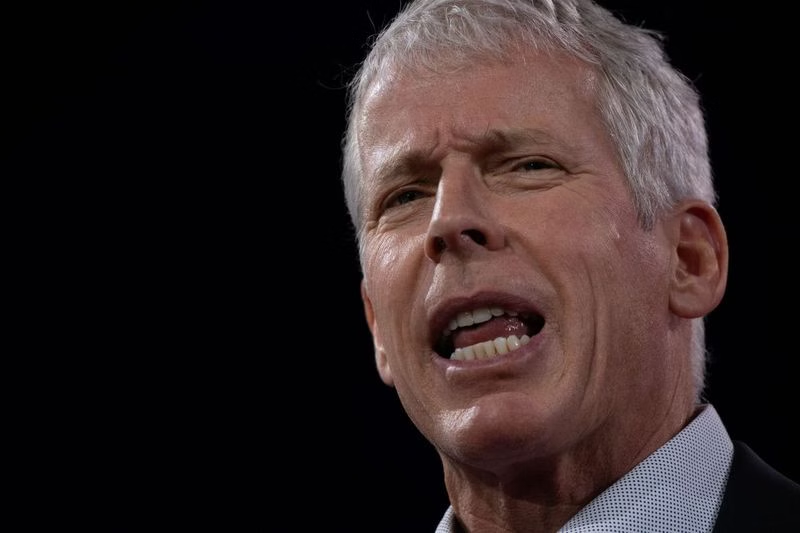
U.S. Energy Secretary Chris Wright talked about the amount of energy needed for AI data centers. Credit: Zach D. Roberts

Economic competition with China has been a running theme through many of the speeches at CPAC for years. But now, with the massively successful launch of DeepSeek, finding energy for artificial intelligence operations is a priority. Wright’s speech emphasized the energy use that AI technology will demand and claimed that it will lead to “enormous benefits” in drug discovery and national security. “We want China to lead the way in AI? I would feel naked if their AI was better than ours,” he said.

AI and tech companies donated huge amounts to the Trump campaign, to the tune of tens of millions of dollars. That investment has paid off as the closure of the Consumer Financial Protection Bureau and Trump’s changes at the FTC and FCC to reign in their powers will benefit the tech world immensely. Trump has even rescinded Biden’s executive order warning people about AI.  

Dunleavy’s Political Ambitions

One of Trump’s first executive orders demanded the nation “unleash Alaska’s extraordinary resource potential.” Environmental rights organization, EarthJustice replied, “While the Trump administration’s plans were made clear in the orders, it’s important to note that the vast bulk of the actions cannot be made unilaterally by the President without cooperation from government agencies, Congress, or other authorities.”

Running throughout CPAC on the big screens in the main ballroom amounted to campaign ads for Alaska Gov. Mike Dunleavy, who wants to leave his job in the 49th state. Called the “worst-kept-secret,” Dunleavy had been auditioning for a gig in the Trump administration, but now that that doesn’t seem to be happening, he’s likely looking at running for Senator against one of his fellow Republicans, Dan Sullivan, who is up for reelection in 2026, or Lisa Murkowski, who is up in 2028. The ad, which features Trump prominently, has the President speaking about how he will work with Dunleavy to provide “energy to Alaska and allies around the world.” 

A campaign ad screened at CPAC for Republican Gov. Mike Dunleavy’s Senate campaign. Credit: Zach D. Roberts

From the CPAC stage, Gov. Dunleavy told the audience that Trump “sees us [Alaska] as a solution to many of America’s problems.” A $44 billion liquified natural gas pipeline project that both Trump and Dunleavy are pushing is oddly not planned to send energy to the lower 48, but to Asian customers. Japan has been trying to curry favor with Trump for access since that could help the nation diversify supplies away from riskier sources like Russia.

Secretary of the Interior Doug Burgum 

President Trump has commanded the new Secretary of the Interior, Doug Burgum, to find new ways to exploit public lands. The goal, Burgum explained in his CPAC speech, is to “sell to our friends and allies.” He claims that doing so will “end our trade deficits” and “the wars abroad.” Ultimately, Burgum claims this work will set up President Trump to “win the Nobel Prize.”

Burgam, a billionaire former two-term governor of North Dakota and a software developer, has extensive ties to the oil and gas industry, including hundreds of thousands in investments. After a brief run for President in 2024, Burgam endorsed Trump.  
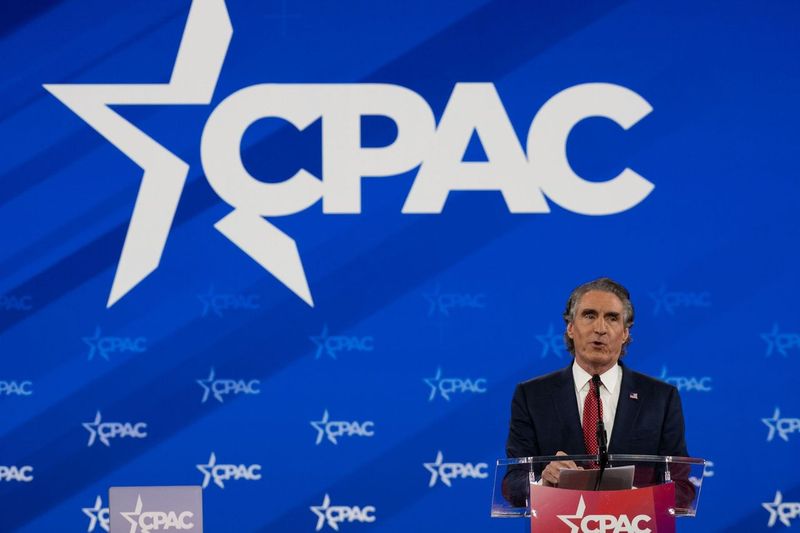
Interior Secretary Doug Burgum aims to exploit public lands to “sell to our friends and allies.” Credit: Zach D. Roberts

Burgam will also chair the newly founded National Energy Dominance Council with Energy Secretary Chris Wright as vice chair. The council “will advise President Trump on strategies to achieve energy dominance by improving the processes for permitting, production, generation, distribution, regulation, and transportation across all forms of American energy.” It will also cut “red tape” through axing regulations. 

CFACT Was the Lone Climate Group in Hall

Down in the exhibit hall, the tables that many years ago mainly saw small government groups were filled with culture warriors – groups opposed to abortion, trans rights, and other historically underrepresented communities. This year, the lone group in the hall focusing on climate was CFACT, Committee for a Constructive Tomorrow, a “conservative libertarian think tank.” 

Nate Meyers, CFACT’s national field coordinator was clear on the group’s approach to  the “science” of climate change –“It’s not settled at all,” he said. Meyers verbally added, “™”[trade mark]] as he said the words “climate change” when speaking to DeSmog. 

https://www.youtube.com/embed/QKjLqdrm3N0?feature=oembedCFACT’s Nate Myers speaks with DeSmog. Credit: Zach D. Roberts

Collegians for a Constructive Tomorrow is CFACT’s college campus organization, which, according to Myers, has 32 campus groups. Like Charlie Kirk’s Turning Point USA, CFACT aims to capture the minds of young people, according to Myers., “College campuses are so totally captured by the left. Statistically, you’re more likely to be instructed by a Marxist than you are a Republican,” he said.

“That demonstrates a huge need for alternative viewpoints on college campuses,” he added. “And it’s kind of a cliche thing to say, but the children and young people are our future.”

When asked who funds CFACT, Myers mentioned small donations and occasional larger direct donations, emphasizing the grassroots nature of the organization. When DeSmogasked if they received backing from Koch Inc., like many similar climate-denying groups, Myers demurred, saying he wasn’t a fan of Koch.) In the past, CFACT has received large sums from Koch’s Donors Trust, along with all the other usual suspects of right-wing climate denying donors.  

Original article by Zach D. Roberts republished from DeSmog.

DONALD TRUMP breaks into YMCA DANCE at CPAC

Neo-Fascist Climate Science Denier Donald Trump says Burn, Baby, Burn.
Continue ReadingTrump at CPAC 2025: Attack Climate Policy and Double Down on Denial

Trump 2.0: the rise of an ‘anti-elite’ elite in US politics

Spread the love
Elon Musk urges you to be a Fascist like him, says that you can ignore facts and reality then.

William Genieys, Sciences Po and Mohammad-Saïd Darviche, Université de Montpellier

US president Donald Trump is surrounded by a new cohort of politicians and officials. While one of his campaign promises was to overthrow the “corrupt elites” he accuses of flooding the American political arena, his second term in office has elevated elites chosen, above all, for their political loyalty to him.

The media’s focus on Trump’s comments on making Canada the 51st US state and annexing Greenland and billionaire Elon Musk’s support for some far-right parties in Europe has obscured the ambitious programme to transform the federal government that the new political elite intends to implement.

In the wake of Trump’s inauguration on January 20, the Republican elites most loyal to the MAGA (“Make America Great Again”) leader, who staunchly oppose Democratic elites and their policies, are operating amid their party’s control over the executive and legislative branches (at least until the midterm elections in 2026), a conservative-dominated Supreme Court that includes three Trump-appointed justices, and a federal judiciary that shifted right during his first term.

However, the political project of the Trumpist camp consists less of challenging elitism in general than attacking a specific elite: one particular to liberal democracies.

Castigating democratic elitism

Typical anti-elite political propaganda, along the lines of “I speak for you, the people, against the elites who betray and deceive you,” claims that a populist leader would be able to exercise power for and on behalf of the people without the mediation of an elite disconnected from their needs.

Political theorist John Higley sees behind this form of anti-elite discourse an association between so-called “forceful leaders” and “leonine elites” (who take advantage of the former and their political success): a phenomenon that threatens the future of Western democracies.

Since the Second World War, there has been a consensus in US politics on the idea of democratic elitism. According to this principle, elitist mediation is inevitable in mass democracies and must be based on two criteria: respect for the results of elections (which must be free and competitive); and the relative autonomy of political institutions.

The challenge to this consensus has been growing since the 1990s with the increased polarization of American politics. It gained new momentum during and after the 2016 presidential campaign, which was marked by anti-elite rhetoric from both Republicans and Democrats (such as senators Bernie Sanders and Elizabeth Warren). At the heart of some of their diatribes was an aversion to “the Establishment” on the east and west coasts of the United States, where many prestigious financial, political and academic institutions are based, and the conspiracy notion of the “deep state”.

The re-election of Trump, who has never admitted defeat in the 2020 presidential vote, growing political hostility and the direct involvement of tech tycoons in political communication –especially on the Republican side– further reinforce the denial of democratic elitism.

Trump’s populism from above: a revolt of the elites

The idea that democracy could be betrayed by “the revolt of the elites”, put forward by the US historian Christopher Lasch (1932-1994), is not new. For the anthropologist Arjun Appadurai, it is a particular feature of contemporary populism, which comes “from above.” Indeed, if the 20th century was the era of the “revolt of the masses”, the 21st century, according to Appadurai, “is characterized by the ‘revolt of the elites’.” This would explain the rise of populist autocracies (such as those currently led by Viktor Orban in Hungary, Recep Tayyip Erdogan in Turkey and Narendra Modi in India, and formerly led by Jair Bolsonaro in Brazil), but also the election successes of populist leaders in consolidated democracies (including those of Trump in the US, Giorgia Meloni in Italy, and Geert Wilders in the Netherlands, for example).

As Appadurai explains, the success of Trumpian populism, which represents a revolt by ordinary Americans against the elites, casts a veil over the fact that, following Trump’s victory in November, “it is a new elite that has ousted from power the despised Democratic elite that had occupied the White House for nearly four years.”

The aim of this “alter elite” is to replace the “regular” Democrat elites, but also the moderate Republicans, by deeply discrediting their values (such as liberalism and so-called “wokeism”) and their supposedly corrupt political practices. As a result, this populism “from above” carried out by the President’s supporters constitutes an alternative elite configuration, the effects of which on American democratic life could be more significant than those observed during Trump’s first term.

Beyond the idea of a ‘Muskoligarchy’

The idea that we are witnessing the formation of a “Muskoligarchy” –in other words, an economic elite (including tech barons such as Jeff Bezos, Mark Zuckerberg and Marc Andreessen) rallying around the figurehead of Elon Musk, whom Trump asked to lead what the president has called a “Department of Government Efficiency” (DOGE) –is seductive. It perfectly combines the vision of an alliance between a “conspiratorial, coherent, conscious” ruling class and an oligarchy made up of the “ultra-rich”. For the Financial Times columnist Martin Wolf, it is even a sign of the development of “pluto-populism”. (It is also worth noting that former president Joe Biden, in his farewell speech, referred to “an oligarchy… of extreme wealth” and “the potential rise of a tech-industrial complex.”)

However, some observers are cautious about the advent of a “Muskoligarchy.” They point to the sociological eclecticism of the new Trumpian elite, whose facade of unity is held together above all by a political loyalty, for the time being unfailing, to the MAGA leader. The fact remains, however, that the various factions of this new “anti-elite” elite are converging around a common agenda: to rid the federal government of the supposed stranglehold of Democratic “insiders.”

An ‘anti-elite’ elite against the ‘deep state’

In his presidential inauguration speech in 1981, Ronald Reagan said: “Government is not the solution to our problem; government is the problem.” The anti-elitism of the Trump elite is inspired by this diagnosis, and defends a simple political programme: rid democracy of the “deep state.”

Although the idea that the US is “beleaguered” by an “unelected and unaccountable elite” and “insiders” who subvert the general interest has been shown to be unfounded, it is nonetheless predominant in the new Trump Administration.

This conspiracy theory has been taken to the extreme by Kash Patel, the candidate being considered to head the FBI. In his book, Government Gangsters, a veritable manifesto against the federal administration, the former lawyer writes about the need to resort to “purges” in order to bring elite Democrats to justice. He lists around 60 people, including Biden, ex-secretary of state Hillary Clinton and ex-vice president Kamala Harris.

Government Gangsters, Kash Patel’s controversial book. Google Books

The appointment of Russell Vought as head of the Office of Management and Budget at the White House, a person who is known for having sought to obstruct the transition to the Biden Administration in 2021, also highlights the hard turn that the Trump administration is likely to take.

Reshaping the state around political loyalty

To “deconstruct the administrative state”, the “anti-elite” elites are relying on Project 2025, a 900-plus page programme report that the conservative think-tank The Heritage Foundation, which published it, says was produced by “more than 400 scholars and policy experts.” According to former Project 2025 director Paul Dans, “never before has the entire movement… banded together to construct a comprehensive plan” for this purpose. On this basis, the “anti-elite” elite want to impose loyalty to Project 2025 on federal civil servants.

But this idea is not new. At the end of his first term, Trump issued an executive order facilitating the dismissal of statutory federal civil servants occupying “policy-related positions” and considered to be “disloyal”. The decree was rescinded by president Biden, but Trump on his first day back in office signed an executive order that seeks to void Biden’s rescindment. As President, Trump is also able to allocate senior positions within the federal administration to his supporters.

The “anti-elite” elite not only want to reduce the size of the state, as was the case under Reagan’s “neoliberalism”, but to deconstruct and rebuild it in their own image. Their real aim is a more lasting victory: the transformation of democratic elitism into populist elitism.

William Genieys, Directeur de recherche CNRS au CEE, Sciences Po and Mohammad-Saïd Darviche, Maître de conférences, Université de Montpellier

This article is republished from The Conversation under a Creative Commons license. Read the original article.

Continue ReadingTrump 2.0: the rise of an ‘anti-elite’ elite in US politics

Liz Truss refuses to apologise for her role In mortgage rate rises In excruciating Interview

Spread the love

https://leftfootforward.org/2024/04/liz-truss-refuses-to-apologise-for-her-role-in-mortgage-rate-rises-in-excruciating-interview/ Many articles from LeftFootForward today.

“Do you have an apology for the people whose mortgages went up so much when you were in office?”

Former Prime Minister Liz Truss has refused to apologise for her disastrous economic policies which led to an increase in mortgage costs, before she was booted out of office.

Truss has been promoting her new book ‘Ten Years to Save the West’ during a round of media appearances, in which she has shown little humility, blaming everyone else for her economic policies which resulted in financial turmoil, a collapse in the pound and the Bank of England having to step in to save pension funds.

Appearing on Sky News, Economics Editor Ed Conway asked: “Do you have an apology for the people whose mortgages went up so much when you were in office?”

Truss replied: “Well, I question the premise of what you’re asking me, Ed. Because the fact is, mortgage rates have gone up across the world.

“The issues that I faced in office were issues of not being able to deliver the agenda I’d set out, because of a deep resistance within the British economic establishment.”

Borrowing from the Trump playbook, Truss has blamed the ‘deep state’ for her failures in office.

She added: “I think it’s wrong to suggest that I’m responsible for British people paying higher mortgages. That is something that has happened in every country in the free world.”

https://leftfootforward.org/2024/04/liz-truss-refuses-to-apologise-for-her-role-in-mortgage-rate-rises-in-excruciating-interview/ Many articles from LeftFootForward today.

Continue ReadingLiz Truss refuses to apologise for her role In mortgage rate rises In excruciating Interview

Liz Truss Book Calls for Climate Laws to be Abolished and Boasts of Effort to Cancel UK COP Summit

Spread the love

Original article by Adam Barnett republished from DeSmog.

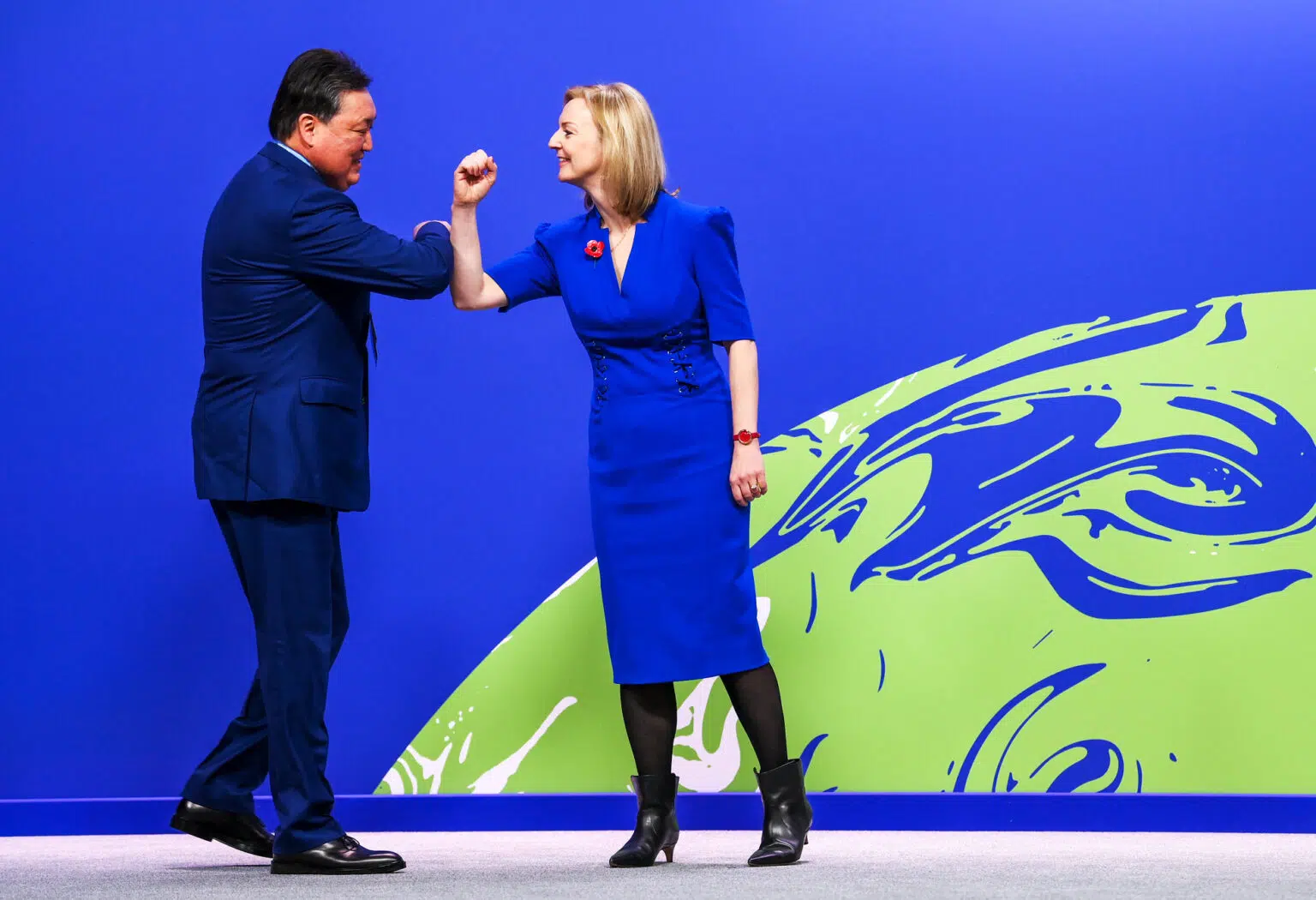
Liz Truss and former Prime Minister of Kazakhstan Asqar Mamin at the COP26 summit in Glasgow. Credit: Karwai Tang/UK Government (CC BY-NC-ND 2.0)

The former prime minister attacks flagship climate deals and makes false claims about electric vehicles, Russia’s influence on energy policies, and net zero.

The new book by former Prime Minister Liz Truss urges the UK, U.S. and EU to drop their landmark climate change laws, spreads falsehoods about green policies, and fondly recalls an attempt to cancel a major climate conference.

Truss, who is the Conservative MP for South West Norfolk, resigned as prime minister in October 2022 after just 49 days in office.

Since leaving 10 Downing Street, Truss has attempted to expose the “deep state” forces that allegedly brought down her premiership, while advocating for “free market” ideas within the Conservative Party, helping to launch the Popular Conservatives group.

In her book, Ten Years to Save the West, which she is promoting widely this week, Truss writes that “the zealous drive to net zero”, the UK’s legally binding 2050 climate target, amounts to “unilateral economic disarmament” and is “a drag on economic growth”. She also claims that, while serving in the Treasury, she attempted to cancel the 2021 COP26 climate summit in Glasgow.

Truss writes: “We should abolish the Climate Change Act and instead adopt a new Climate Freedom Act that enables rather than dictates technology”. She adds that “the U.S. should reverse the Inflation Reduction Act, and the EU should abandon its equivalent measures”.

The Climate Change Act legalised the UK’s commitment to reducing carbon dioxide emissions by at least 80 percent by 2050 from 1990 levels. The Inflation Reduction Act is a $369 billion package of grants and subsidies by the U.S. government to spur green technology investment. 

Scientists at the Intergovernmental Panel on Climate Change (IPCC) have said that without “immediate and deep emissions reductions across all sectors” limiting global heating to 1.5C is beyond reach.

Restricting global temperatures to this threshold – the target agreed by the UK as part of the 2015 Paris Agreement – would prevent the worst and most irreversible effects of climate change, including floods, droughts, heatwaves, and wildfires.

In the book, Truss also attacks climate advocates, writing that “the environmental movement is fundamentally driven by the radical left”, adding: “This ‘watermelon’ tendency is green on the outside, red on the inside – a modern rebranding of socialism. It features the same instincts of collectivism and authoritarianism.”

Truss writes that “we should cancel” the United Nations annual COP climate summit, and falsely claims that electric vehicles are worse for the environment than those powered by fossil fuels.

“In recent years, more radical forms of climate misinformation and disinformation have become mainstreamed”, said Jennie King, director of climate research and policy at the Institute of Strategic Dialogue think tank. “Such content continues to grow in virality and engagement online, but its impacts are vastly increased when platformed in the media or by politicians.”

King said “the normalisation of wild and outlandish claims”, with climate action “being framed through a conspiratorial, tribalist and anti-scientific lens”, can lead to “real-world harm”. 

“When such ideas are conveyed from the very corridors of power, it sets a dangerous precedent”, she added. 

The IPCC warned in 2022 that efforts to tackle climate change were being delayed by “rhetoric and misinformation that undermines climate science and disregards risk and urgency”.

Truss Claims ‘Couldn’t be Further from the Truth’

Truss’s book is published by Biteback Publishing, a company owned by former Conservative deputy chair and major party donor Michael Ashcroft. 

The former prime minister dedicates a chapter to green policies, titled ‘A Hostile Environment’, apparently a play on the term used by the Conservative government about its anti-immigration policies

Truss writes that current environmental policies should be scrapped in favour of a “free market” approach. On energy, she calls for more fossil fuel extraction, advocating a mix of “oil and gas as well as nuclear and renewables”, adding: “The use of North Sea oil and gas is crucial, so there needs to be investment in that too. There also should be fracking in the UK.”

Fracking for shale gas is a controversial practice that risks causing air, water, and noise pollution.

She fails to mention that oil and gas firms receive major subsidies and tax breaks from the government, which would logically be removed in a “free market” energy system. The UK government has given £20 billion more in support to fossil fuel producers than renewables companies since 2015.

Truss’s book also attacks the multilateral UN COP process, which has seen agreements on transitioning away from fossil fuels, and financial support for poorer countries suffering the worst effects of climate change. 

Truss writes that “we should cancel the COP gravy train”. She claims that, in 2018, when she was chief secretary to the Treasury, she made “11th-hour attempts to ditch COP26”, the UN climate summit hosted by the UK in 2021, arguing that it was not a spending priority. 

At COP26, nearly 200 countries agreed to ramp up efforts to cut emissions, also calling on wealthy countries to double their funding to poorer nations that have contributed the least to climate change. More than 40 countries also pledged to quit coal, the dirtiest fossil fuel and the world’s largest source of carbon dioxide emissions.

The book also spreads false claims about climate policies. Truss writes that “in the UK and Europe, Russia has funded anti-fracking campaigns”, a claim which is not supported by any evidence.

Truss claims that policies like “the switch from petrol to diesel in cars or the use of electric vehicles, have either harmed the environment in other ways or empowered our polluting adversaries elsewhere in the world”. 

Colin Walker, head of transport at the Energy and Climate Intelligence Unit think tank, told DeSmog: “The notion that the switch to electric vehicles will have little discernible environmental impact, and make us dependent on imported gas and coal, couldn’t be further from the truth.

“The total lifetime CO2 emissions of an electric vehicle, from being built to being driven, are three times lower than a petrol vehicle – a figure that will only get higher as our grid becomes cleaner. And while older technologies like petrol cars and gas boilers rely on fossil fuels imported from abroad, EVs and heat pumps can be powered by electricity generated by British wind and solar farms.”

Truss also writes of “ludicrous claims that pursuing a net zero agenda … will boost the economy and drive growth”. 

Walker added: “The UK’s net zero economy is now worth £74 billion, and grew by nine percent in 2023.  The wider economy grew just 0.1 percent. Talking down the economic opportunities net zero has to offer the UK is at odds with a growth agenda when the U.S., EU and China are all competing for clean industries.” 

Truss’s Climate Denial Ties

Truss has a long history of opposing climate policies. In the 2022 Conservative Party leadership contest, she attacked solar farms on agricultural land and, during her brief time in 10 Downing Street, she overturned the UK’s ban on fracking. (A policy reversed by her successor, Rishi Sunak.)

As DeSmog reported at the time, Truss’s leadership campaign received £30,000 from a pro-fracking lobby group, £10,000 from a climate denial activist, and £100,000 from the wife of a former BP oil executive. Truss received a further £5,000 from Lord Vinson, a Tory peer who has provided funding to the UK’s leading climate science denial group, the Global Warming Policy Foundation

Since leaving office, Truss has received £250,000 in speaking fees, including £7,600 last April from the Heritage Foundation, a right-wing U.S. think tank that has long promoted climate science denial. Heritage President Kevin Roberts provides a long and glowing blurb for Truss’s book. 

Earlier this year, Truss helped to launch the Popular Conservatives (PopCon), a new initiative run by Truss-ally Mark Littlewood, the former director general of the Institute of Economic Affairs, a think tank which received funding from oil major BP for at least 50 years. 

At the PopCon launch, Truss attacked “net zero zealotry”, claiming voters “don’t like the net zero policies which are making energy more expensive”

.Additional reporting by Sam Bright

Original article by Adam Barnett republished from DeSmog.

Continue ReadingLiz Truss Book Calls for Climate Laws to be Abolished and Boasts of Effort to Cancel UK COP Summit

Quick, blame the deep state! The tactics at play when Tories spout conspiracy theories

Spread the love
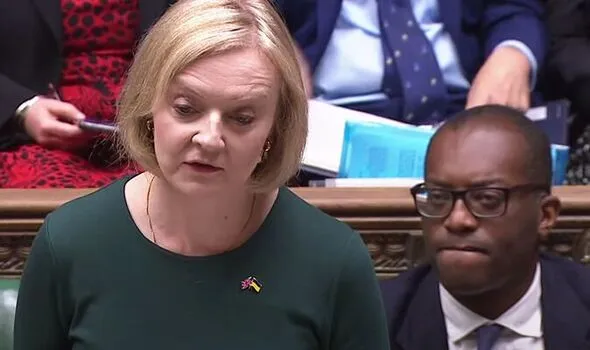
Image of Liz Truss and Kwasi Kwarteng


Adam Koper, Cardiff University

Conservative MPs seem increasingly willing to use the rhetoric of conspiracy. Recently, Liz Truss claimed that her brief tenure as prime minister had been ended by the deep state – shadowy forces within the British establishment and the media.

A few days later, Lee Anderson, the Conservative party’s former deputy chairman, asserted that London’s mayor, Sadiq Khan, is being controlled by Islamists. He was adding his own twist on a similar conspiracy theory put forward by former home secretary Suella Braverman, who claimed in a Telegraph article that Islamists are in charge of the whole country.

Why do politicians make conspiracy claims like these? It seems strange for MPs whose party has been in government for almost 14 years to imply that they aren’t really in control and that power is wielded by hidden actors.

Maybe Truss and Anderson mean what they say, and say what they mean. But even if they do believe that Britain is governed by a deep state or Islamist plotters, knowing a bit about rhetoric can help us to see that there is more going on when politicians use the language of conspiracy.

Context matters

A good politician will adapt what they say to fit the moment and their audience. For example, Truss’s deep state comments were made at CPAC, a conference for American conservatives. She was speaking in part to promote her new book, Ten Years to Save the West, and so had little reason to do anything other than give her audience what it likes. Conspiracy theories have become prominent in American conservatism (think QAnon and the claims that the 2020 presidential election was stolen), so echoing the rhetoric is an obvious way for a CPAC speaker to ingratiate themselves with an audience.

Anderson, though, was speaking in the UK, where conspiracist language is more unusual. His comments were seen by many as deliberately divisive and Islamophobic, and quickly landed him a suspension from his party. That said, government ministers were evasive when asked why his comments were wrong and whether they were Islamophobic.

Part of the brand

Courting controversy carries risks, as Anderson’s suspension shows. But it can also thrust a politician into the limelight, giving them a chance to speak to a broader audience and potentially gain new supporters. Much of the time, politicians make their own character – or ethos, as it is known in classical rhetoric – part of their pitch.

In her comments alleging a deep state conspiracy, Truss took on a populist tone. She portrayed herself as an anti-establishment figure fighting for the British people against the elites. She didn’t mention her party’s long period in government in charge of the civil service that allegedly made her tenure so impossible. Nor did she refer to the economic problems brought about during her fleeting administration.

Speaking to an audience which is likely to be less familiar with her political career, Truss was able to present herself as the protagonist in a David and Goliath narrative – albeit one in which David is defeated.

Similarly, Anderson used the controversy around his comments to present himself as a man of the people. Rather than giving any evidence to back up his claims about Islamists controlling Khan, Anderson instead justified his views by citing the positive reaction he had received from his constituents. When told in an interview with Channel 4 News that people were puzzled by his refusal to back down, Anderson replied: “If you go and speak to people in Ashfield [Anderson’s constituency] and ask them if they’re puzzled about it, no they’re not.”

In the aftermath of the controversy, Anderson told GB News: “When I went into pubs in Ashfield at the weekend, Friday, Saturday, Sunday, I got a round of applause when I went in. And these are normal working-class people.”

Such comments can be seen as part of a broader trend. Politicians have learned to cite the opinions of ordinary people in order to justify spurious claims. Rather than explaining anything about how he came to view Islamists being in charge of London, Anderson’s response to questions has been to use them as an opportunity to present himself as an outsider to the political establishment – a man in tune with what voters really think.

Pitting ‘us’ against ‘them’

This focus on presenting a certain persona and using it to justify baseless comments tells us something important – that identity is a key ingredient in conspiracist rhetoric.

It enables a politician to construct a conflict between an in-group and an out-group – a struggle between “us” and “them” – and asks the audience to pick a side. Rather than focusing on policies or ways of improving life for the British population, this rhetoric wants the audience to identify with the speaker’s character and join them in opposing a threatening enemy.

In this way, conspiracist rhetoric is much like the Conservatives’ attacks on “woke ideology” – it deflects attention away from their record in government, and rallies their supporters against an enemy at a time when the party is down on its luck.

Counteracting this is no easy task. Rhetoric is an art, not an exact science. One strategy could be to focus more on what politicians are trying to achieve when they use conspiracist rhetoric. While it is important to determine whether or not they really believe in a deep state or Islamist conspiracy, we also need to challenge the personas that politicians craft for themselves, as well the us-against-them divisions they construct.The Conversation

Adam Koper, WISERD Civil Society Post-Doctoral Fellow, Cardiff University

This article is republished from The Conversation under a Creative Commons license. Read the original article.

Continue ReadingQuick, blame the deep state! The tactics at play when Tories spout conspiracy theories