Article by Jamal Kanj republished from Common Dreams under Creative Commons (CC BY-NC-ND 3.0).
Trump continues to issue maximalist demands for conditions he helped create. The American president’s lack of strategic and emotional maturity only promises more war.
The closure of the Strait of Hormuz following the temporary ceasefire is the culmination of an American policy defined by strategic incoherence. At the center stands Donald Trump, whose shifting positions, confused war objectives, and conflicting actions have not only failed to ease regional tensions but have actively deepened them.
Nowhere is this clearer than in Trump’s threats to blow up the whole country, including its bridges and power plants. At the same time, he touted a military “big day,” presenting potential war crimes as diplomatic tool, aggression as diplomacy, and destruction as leverage.
RECOMMENDED…
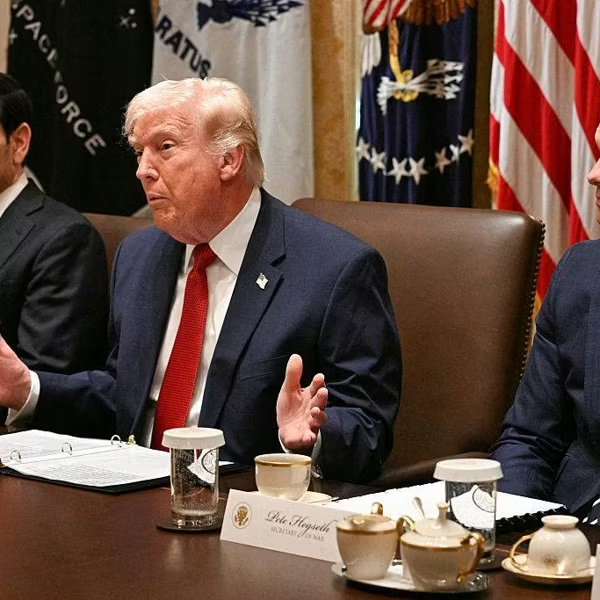
As Trump Prepares Iran Ground Assault, Expert Warns He’s ‘Run Out of Options’ for Victory
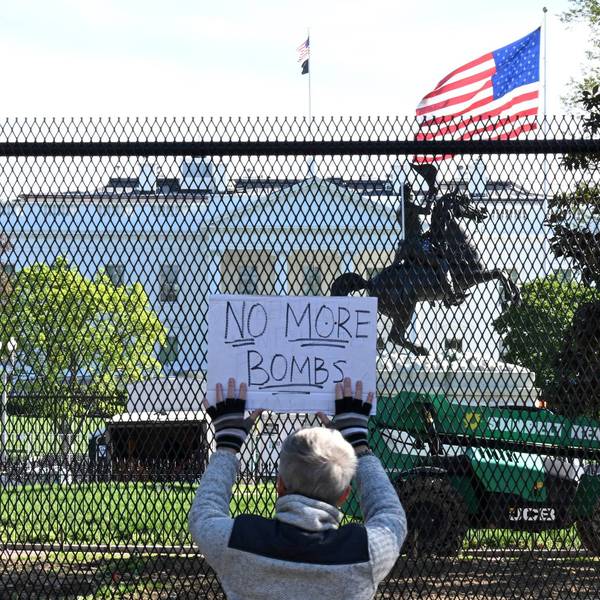
‘This Depraved Idiot Is Out of Control’: With Middle East in Flames, Trump Eyes ‘Next Conquest’
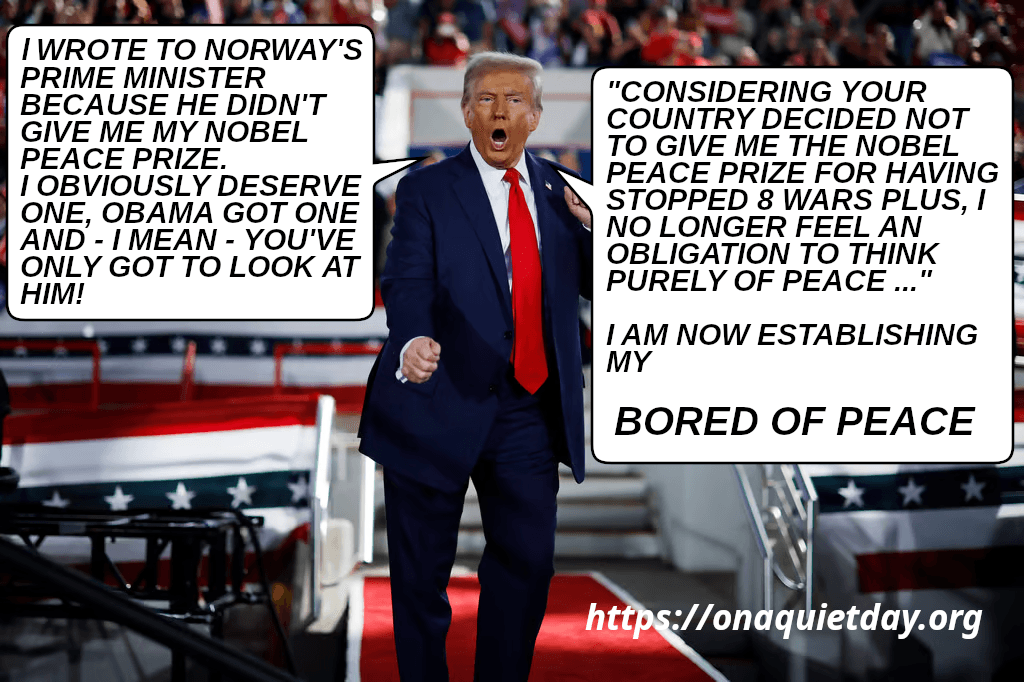
Trump inflated, almost delusional, promises ahead of potential talks come across less as statesmanship and more as a calculated sales pitch to the American public. His vows “to end up with a great deal,” coupled with an almost obsessive focus on Barack Obama by insisting his agreement will be “far better” than the one negotiated over a decade ago. An approach that reflects a tendency toward messaging driven less by policy depth and more by projection, comparison, and to frame outcomes in terms of self-aggrandizement and personal glory. Instead of articulating clear strategic objectives, his policy relies on distinguishing himself and image cultivation to project authority and superiority, leaving the underlying substance vague and open to question.
By manufacturing optimism and exaggerating progress while promising an imminent “great deal,” Trump appears to be negotiating with himself—or detached from reality—seeking to construct a narrative of success regardless of the facts on the ground. The performative optimism stands in sharp contrast to his simultaneous threats and pompous rhetoric, suggesting not confidence but a measure of desperation.
This yo-yoing of positions does more than create confusion; it erodes the credibility. Diplomacy depends on a baseline of predictability and mental stability.
Trump’s rationale for extending the ceasefire because of “internal divisions” within Iran is unconvincing. If internal debate within Iran is seen as warranting a pause, what should be said of a policy where direction shifts from one moment to the next? Differing political views are the essence of a normally functioning political system, whereas impulsive, erratic, personalized decision-making is not.
All of this unfolds as Trump continues issuing maximalist demands for conditions he helped create. For instance, he demands the surrender of enriched uranium that would not exist had he not abandoned the Joint Comprehensive Plan of Action (JCPOA). Likewise, the Strait of Hormuz was closed as a consequence of his and Netanyahu’s war, not as its cause.
The consequences of these Israel-driven U.S. policies are felt by ordinary Americans at the gas pump and in grocery stores. The Strait of Hormuz has become a battleground, destabilizing global energy supply chains and economies worldwide. Yet despite these cascading effects, the core strategy remains unchanged. Trump continues to operate within an echo chamber of Israel-first sycophants that assume military might alone can deliver results, even as the policy falters and the war spills across the region, threatening roughly one-fifth of the world’s energy infrastructure.
This is not merely a political flaw or a matter of mismanagement. It is rather a strategic vulnerability shaped by Israel-first loyalists pulling U.S. strategy in directions that ultimately undermine U.S. national interests. In the absence of clearly defined national objectives, as in the first Israel’s war in Iraq, each step risks drawing the U.S. deeper into the polluted water of the Gulf, while simultaneously advancing an environment of chaos that serves only Israel’s calculated aims.
In this framework, was Israeli Prime Minister Benjamin Netanyahu’s recent statement that the war with Iran is “not over” an embedded message to Trump ahead of the proposed peace talks in Pakistan?
Negotiation between countries, especially in the context of war is not selling real estate deals, where haggling and the threat of retracting an offer are routine tactics. The craft of negotiation in this case operates on an entirely different level. Culture, national dignity, historical memory, and political positioning shape both the process and the outcome. Leaders are not merely bargaining over financial assets or credit ratings, they are navigating domestic demands, legitimacy, and the perception of strength or weakness on the global stage.
In this regard, threats or the constant withdrawal and reintroduction of proposals are not leverage, they are weakness. Unlike commercial transactions where the “Art of the Deal” is largely concluded at the moment of signing, international agreements mark the beginning of an ongoing, often long-term relationship. What may pass as hard-nosed bargaining in business can, in international diplomacy, be interpreted as bad faith, an approach that tends to invite resentment and resistance instead of compromise. This is why since last Tuesday, Trump was left waiting for Iran to come to the negotiation table.
Effective diplomacy requires serious leadership, consistency, and an understanding of the symbolic as much as the substantive. Agreements endure not because one side is pressured into submission, but because all parties can present the outcome as preserving their dignity and advancing mutual interests.
The lack of strategic maturity is indicative in a proclamation in the morning signaling openness to de-escalation; by midday, the message splinters, issuing threats and ultimatums while simultaneously hinting at imminent breakthrough deals; by the middle of the night, amid his insomnia, it escalates to threats of total destruction. This constant shifting of positions is not a minor stylistic quirk. It is possible that, at least some of this, is associated with his nocturnal communications with Netanyahu, who is apparently wagging him left and right.
This yo-yoing of positions does more than create confusion; it erodes the credibility. Diplomacy depends on a baseline of predictability and mental stability. When signals shift faster than the wind, uncertainty breeds mistrust, and negotiations drift from closed rooms into fiery statements played out for public consumption, creating an opening for Israel to drive the war and breed destruction and more chaos.
Article by Jamal Kanj republished from Common Dreams under Creative Commons (CC BY-NC-ND 3.0).