Morning Star Editorial: Zarah Sultana: if Palestine Action are banned as ‘terrorists’ who will be next?

Spread the love

dizzy: I hope that Morning Star will excuse me quoting this article in it’s entirety.

https://morningstaronline.co.uk/article/zarah-sultana-if-palestine-action-are-banned-terrorists-who-will-be-next

 Zarah Sultana speaking after a march organised by the Palestine Solidarity Campaign, from Russell Square to Whitehall in central London, June 21, 2025
This week, MPs shamefully approved the proscription of Palestine Action. Several challenged the move in the Commons. Zarah Sultana, Independent MP for Coventry South, gave an outstanding speech in condemnation. Because of the exceptional gravity of the issue, we reproduce her speech, lightly edited, here.

TWENTY-ONE years ago, a human rights barrister … defended an activist who broke into RAF Fairford trying to disable a bomber to prevent war crimes in Iraq. That became a landmark case in lawful, non-violent direct action against an illegal war. That barrister is now our Prime Minister, Keir Starmer KC. He argued that it was not terrorism, but conscience.

Fast-forward to June 20 2025: two Palestine Action activists entered RAF Brize Norton and sprayed red paint — red paint, not fire — on aircraft linked to surveillance flights over Gaza. Instead of prosecuting them for criminal damage, the Home Secretary is using the Terrorism Act 2000 to proscribe Palestine Action as a terrorist group.

This is an unprecedented and dangerous overreach of the state. Never before in Britain has it been a crime to simply support a group.

Palestine Action’s real crime is shutting down Elbit Systems sites that arm the Israeli military; its true offence is being audacious enough to expose the blood-soaked ties between this government and the genocidal Israeli apartheid state and its war machine.

Let us be clear: to equate a spray can of paint with a suicide bomb is not just absurd; it is grotesque. It is a deliberate distortion of the law to chill dissent, criminalise solidarity and suppress the truth.

Amnesty International, Liberty, over 266 senior lawyers and UN special rapporteurs have all opposed these draconian measures. Under this order, anyone expressing moral support for a proscribed group could face 14 years in prison. That includes wearing a badge, wearing a T-shirt, sharing a post or calling for de-proscription.

And journalists have no exemption either: there is no legal protection for reporting favourably, even factually, about Palestine Action.

Let us not forget what is happening in Gaza, where the real crimes are being ignored: hospitals bombed, children starved, and tens of thousands of people killed. Palestinian children now suffer more amputations per capita than children anywhere else on Earth.

Israel is on trial for genocide at the International Court of Justice, and the Israeli Prime Minister faces an International Criminal Court arrest warrant, yet the government’s response is to criminalise solidarity and to continue exporting lethal F-35 jets that are decimating Gaza.

We also have to understand the history of this country and what built our democracy: the tradition of civil disobedience that includes the suffragettes, without whom I would not have the vote, let alone the privilege of being here as an MP.

Even those who oppose Palestine Action’s tactics must recognise the vast gulf between criminal damage and terrorism. If this order passes, what and who is next — climate protesters, striking workers, feminists in the street?

Already we have seen a wider crackdown on our civil liberties — musicians censored, journalists arrested, and demonstrators, including MPs sitting here, harassed — and now this government want to use anti-terror laws to make peaceful protest itself a crime. If our democratic institutions functioned as they should, none of this would be necessary.

If this proscription passes, we have to understand that no campaign will be safe tomorrow. We have to recognise that this will go down as a dark day in our country’s history … People will ask, “Which side were you on?” and I stand with the millions of people who oppose genocide, because I am one of them. I oppose the blood-soaked hands of this government trying to silence us. So I say this loudly and proudly: we are all Palestine…

Deputy Speaker intervened here with “Order!”

https://morningstaronline.co.uk/article/zarah-sultana-if-palestine-action-are-banned-terrorists-who-will-be-next

UK Labour Party government ministers Keir Starmer, Angela Rayner and Rachel Reeves explain that they are partners complicit in Israel's Gaza genocide. The UK has provided Israel with arms, military and air force support. They explain that they don't do gas chambers but do do forced marches, starvation, destroy hospitals, mass-murders of journalists and healthcare workers.
UK Labour Party government ministers Keir Starmer, Angela Rayner and Rachel Reeves explain that they are partners complicit in Israel’s Gaza genocide. The UK has provided Israel with arms, military and air force support. They explain that they don’t do gas chambers but do do forced marches, starvation, destroy hospitals, mass-murders of journalists and healthcare workers.
Keir Starmer objects to criticism of the IDF. He asks how could anyone obect to them starving people to death, forced marches like the Nazis did, bombing Gaza's hospitals and universities,mass-murdering journalists, healthworkers and starving people queuing for food, killing and raping prisoners and murdering children. He calls for people to stop obstructing his genocide for Israel.
Keir Starmer objects to criticism of the IDF. He asks how could anyone obect to them starving people to death, forced marches like the Nazis did, bombing Gaza’s hospitals and universities,mass-murdering journalists, healthworkers and starving people queuing for food, killing and raping prisoners and murdering children. He calls for people to stop obstructing his genocide for Israel.
Keir "I support Zionism without Qualification" Starmer supporting genocide.
Keir “I support Zionism without Qualification” Starmer supporting genocide.
Continue ReadingMorning Star Editorial: Zarah Sultana: if Palestine Action are banned as ‘terrorists’ who will be next?

16 killed by police in Kenya on anniversary of historic anti-Finance bill protests

Spread the love

Original article by Nicholas Mwangi republished from peoples dispatch under a Creative Commons Attribution-ShareAlike 4.0 (CC BY-SA) license.

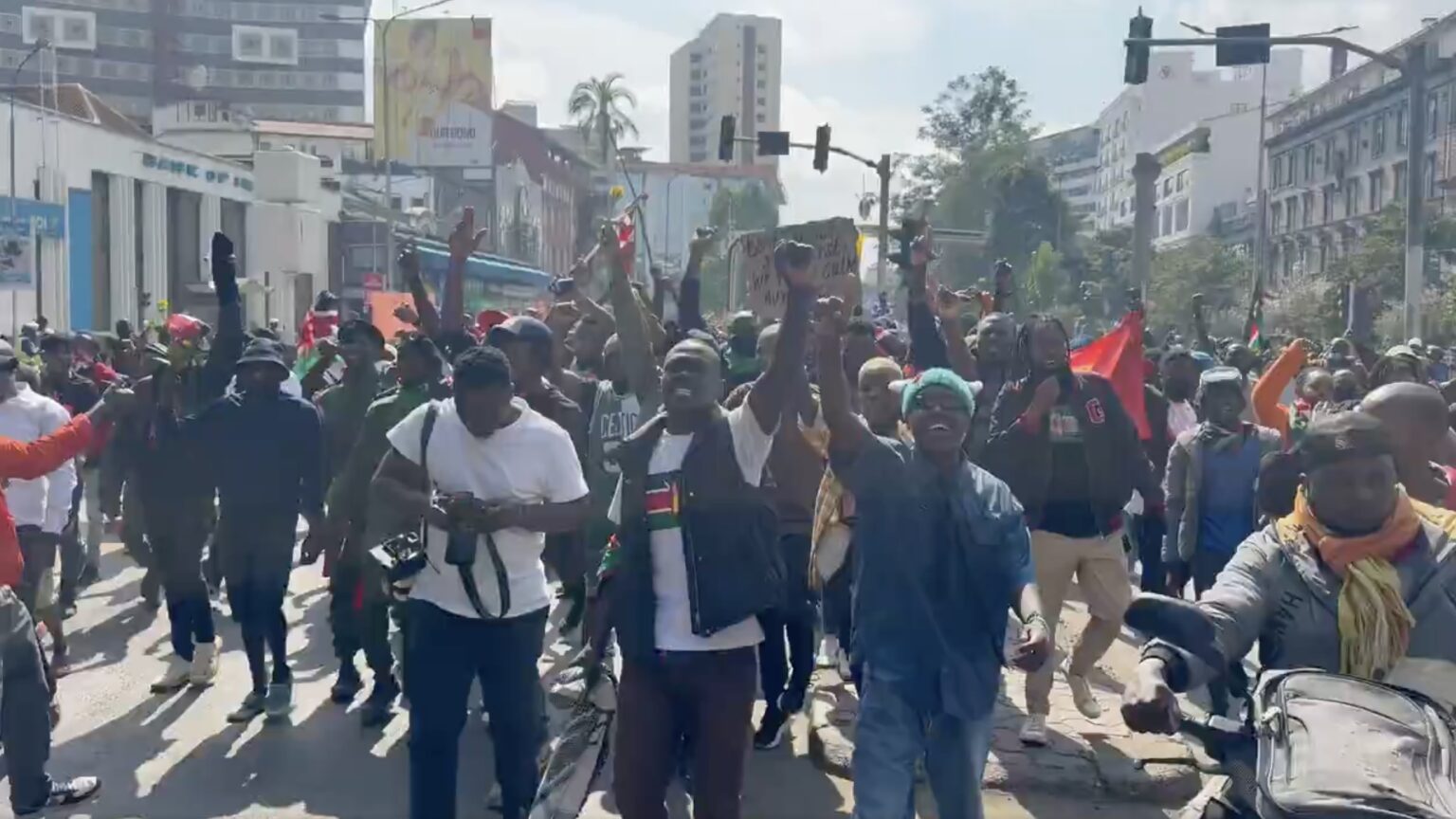
Revolutionary Youth League of Kenya on the streets of Nairobi on June 25. Photo: Screenshot

What was meant to be a solemn commemoration of the first anniversary of the historic anti-Finance Bill protests in Kenya turned chaotic on Tuesday as police clashed with demonstrators across several cities. Police used tear gas and water cannons against largely peaceful protesters, who had gathered to honor those killed during last year’s unrest and to demand justice over recent cases of police brutality and enforced disappearances.

At least 16 people were confirmed dead, with hundreds injured, after law enforcement agencies used excessive force to suppress the gatherings.

“The protests now symbolize indictments of the system itself – a system defined by authoritarianism, police violence, austerity, foreign domination, and the privatization of every public good. The state responded as expected – not with dialogue, but with bullets,” Rodgers, a grassroots organizer with the Nairobi chapter of the Social Justice Movement, told Peoples Dispatch.

The 2024 Finance Bill protests

Last year’s demonstrations, which began in response to the controversial Finance Bill 2024, led to a brutal crackdown that left over 60 young people dead, hundreds injured, and many arrested. The bill, championed by the government of President William Ruto, was widely criticized for introducing punitive taxes on essential goods and services amidst a cost-of-living crisis.

This year’s protests were organized to honor those who lost their lives during the 2024 demonstrations. However, they also served as a platform to raise alarm over recent developments, including the killing of a popular blogger in police custody and a worrying surge in abductions of activists and dissenters.

Read more: Amid economic hardship and repression, Kenyans reject the Finance Bill 2024

Media blackout raises alarm

In what many have called a blatant attempt to stifle freedom of the press, the Communications Authority of Kenya (CA) ordered a suspension of live TV coverage of the protests. Several local stations, including Citizen TV, NTV, KTN were either switched off or restricted, preventing real-time reporting of the police response and protest.

Many people also condemned the presence of infiltrators and hired goons among the protestors. These individuals were allegedly used to discredit the demonstrations by engaging in looting and property destruction tactics used as part of a wider strategy to delegitimize grassroots mobilization and participation in protests.

Despite the violent disruptions, the anniversary protests saw thousands of Kenyans across the country take to the streets. Demonstrators carried placards bearing the names of those killed in 2024 and chanted slogans demanding accountability, justice, and police reform.

Voices from the protests

In dialogue with Peoples Dispatch, Rodgers, a grassroots organizer with the Nairobi chapter of the Social Justice Movement, reflected on the deeper meaning behind the protests:

“The June 25 protest went beyond just being a memorial. It was a continuity of a political statement from the people that they will not fear to remain defiant in the face of systemic oppression. Exactly one year since mass uprisings shook the country in opposition to the punitive Finance Bill 2024 and broader economic injustice, the people came back to the streets with even more clarity and unity.”

We just arrived where comrade Alex Maasai was murdered by Ruto thugs and the Kenya Police, in the morning we visited Central police where Albert Ojwang’ was murdered my Lagat and his criminal gangs #OccupyUntilVictory pic.twitter.com/87b6SI5UiR

— Booker Ngesa Omole ☭ (@BookerBiro) June 25, 2025

Rodgers emphasized that what distinguished this year’s protests was not only their scale – reaching 27 of Kenya’s 47 counties – but the emergence of a clearly articulated political program from below.

Citing reports confirming that between 8 and 16 people were killed and over 400 injured, Rodgers also condemned the regime’s attempt to suppress the truth by shutting down live broadcasts, which he said “exposed repression on free speech and its fear of truth, transparency, and the voice of the people.”

“The people are now conscious that the crisis in Kenya is political as much as it is systemic. It is a crisis of legitimacy, where the ruling class governs through force and deception, abandoning constitutional obligations like Article 43 on economic and social rights.”

He described the protest movement as part of a broader class struggle – pitting a parasitic elite backed by global capital against a rising mass of organized working poor and peasants demanding land, food, dignity, freedom, and power.

“Yesterday was important because it proved this movement is not spontaneous. It is becoming strategic, conscious, and unafraid.”

Unmet demands and growing anger

In the days leading up to the anniversary, momentum had been building both online and offline. Young people, civil society groups, university students, and artists held vigils, digital campaigns, and forums across the country. Yet many of the core grievances that sparked the protests in 2024 remain unresolved:

  • Runaway corruption
  • A bloated government
  • Growing public debt
  • Youth unemployment
  • The erosion of democratic space

As the country grapples with the fallout of this week’s events, people are calling for an independent investigation into the killings, injuries, and abductions. They are also demanding the immediate reinstatement of press freedoms and the prosecution of those responsible for unlawful police actions.

The anniversary protests have made it clear: Kenya’s youth are not willing to be silent, and the demand for social justice is far from over.

Original article by Nicholas Mwangi republished from peoples dispatch under a Creative Commons Attribution-ShareAlike 4.0 (CC BY-SA) license.

Continue Reading16 killed by police in Kenya on anniversary of historic anti-Finance bill protests